Connect with us

உலகம்

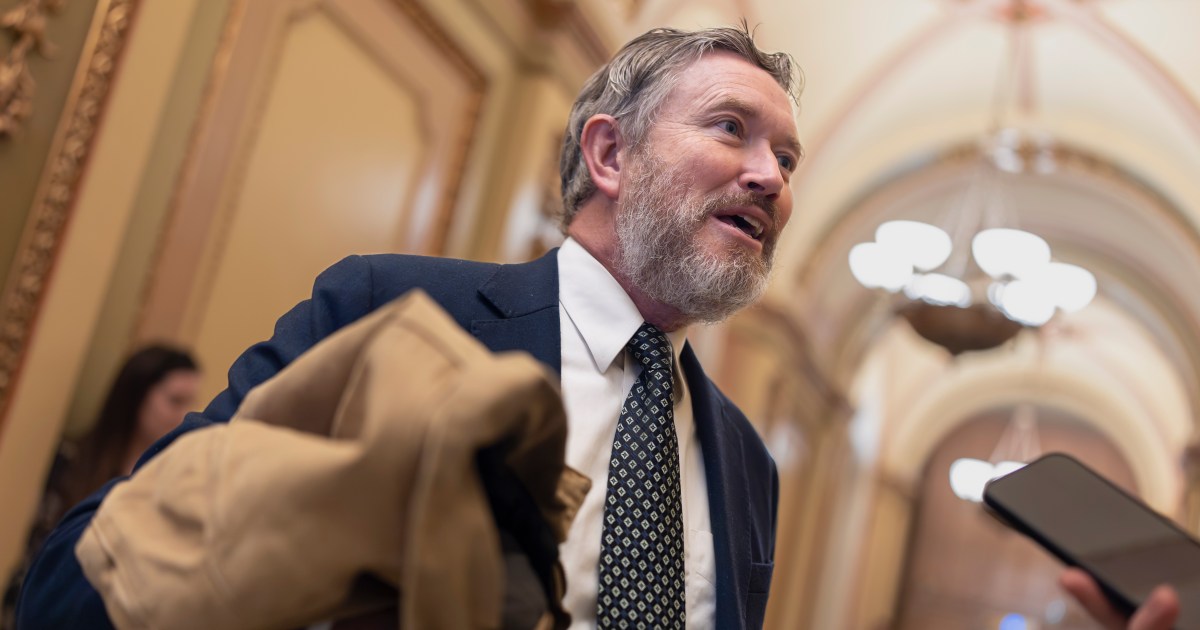
How Massie’s Kentucky primary may test Trump’s hold on the Republican Party

Published

on

Massie has emerged as one of Trump's most prominent critics in the Republican Party. Will his re-election campaign survive the president's ire?

Louisville, Kentucky – In March, President Donald Trump travelled to the southern state of Kentucky to do an unusual thing in United States politics: campaign against a fellow Republican.

“Thomas Massie is a disaster for our party,” Trump told the crowd, his fists gripping either side of his podium.

He proceeded to excoriate Massie, a seven-term congressman known for his staunch conservatism and his willingness to buck the president's priorities.

“He’s disloyal to the Republican Party. He’s disloyal to the people of Kentucky," Trump said. "And most importantly, he’s disloyal to the United States of America, and he’s got to be voted out of office as soon as possible!”

Trump's rally took place at Verst Logistics, a packaging and shipment warehouse in Hebron, right in the heart of Kentucky’s 4th Congressional District.

Massie has represented the area since 2012. But on May 19, Republican voters in the district will cast their ballots in a primary election that may decide whether the congressman retains his seat.

This is no ordinary midterm race. Experts say the results of the Kentucky primary will show how far Trump can push the Republican Party and whether voters will stick with the president or their principles.

“I think this is a direct test of the president’s endorsement,” said Robert Kahne, a data scientist and Democratic leader from Louisville, Kentucky, who hosts a Kentucky politics podcast.

Kahne argues that Massie's main opponent, Ed Gallrein, has campaigned almost exclusively as Trump's chosen candidate. Trump endorsed Gallrein in October, before he had even entered the race.

"Basically, you have the strongest and most ardent Republican critic of Donald Trump on the ballot, against someone whose only identifying factor is being pro-Trump," Kahne said.

While Massie has long dominated elections in Kentucky's 4th district, polling this year shows a tighter race than expected.

A Quantus Insights survey conducted from April 6 to 7 showed Massie leading Gallrein 46.8 percent to 37.7 percent.

Another survey conducted by Big Data Poll in early April had Massie ahead with 52.4 percent to Gallrein's 47.6 percent.

The relatively close primary could be a bellwether for Republican voting trends nationwide, according to Stephen Voss, a political science professor at the University of Kentucky.

“Massie is an early opportunity to see what Republican voters will do when their pro-Trump leanings clash with their conservative leanings," Voss said. "That is the great puzzle of this race."

This is not the first time Trump has turned against Massie, though. In 2020, another election year, Trump famously petitioned to "throw Massie out of the Republican Party".

But by 2022, Trump had reversed course, endorsing Massie over a challenger who questioned the congressman's commitment to the president.

Still, the past year has widened the rift between Trump and Massie, leading the president to make his most aggressive moves yet to unseat the congressman.

The two Republicans clashed on a range of issues in 2025. Massie, for example, opposed the president on his tax and spending measures, fearing increases to the national debt.

That meant voting against Trump's signature piece of legislation, the One Big Beautiful Bill Act, last July.

The Kentucky Republican also denounced Trump's campaign of foreign intervention. Last June, NBC News reported that it was after Massie criticised Trump's strikes on Iran that the president's allies began laying the groundwork for a primary challenge.

Massie also led the charge to compel the Department of Justice to release all the files related to the investigation into Jeffrey Epstein, the late financier and convicted child sex offender.

Shortly thereafter, Trump gave his stamp of approval to Gallrein, posting on his Truth Social site, “RUN, ED, RUN."

By that point, Gallrein, a military veteran and fifth-generation farmer, had yet to enter the race. Four days later, on October 21, he launched his bid.

Critics argue Gallrein's platform does not offer much of a distinction from Massie's. His campaign website lists his priorities as cutting taxes, reducing government spending, protecting gun rights and opposing abortion — issues Massie also supports.

“I don’t think he’s offering any kind of alternative, except for being the selection of Donald Trump," Kahne said. "I think that’s it. That’s the only thing he has to offer."

But Gallrein has drawn heavily from Trump's endorsement, using it as a badge of loyalty and authenticity.

“You deserve an authentic, true Republican conservative that stands shoulder to shoulder with our president and the Republican Party,” Gallrein declared at the Trump rally in March.

Trump, meanwhile, told the crowd he had grown so frustrated that he just wanted “somebody with a warm body to beat Massie".

It is an odd blend of principled conservatism, anti-establishment fervour, and a libertarian bent that drives Massie’s politics, according to Voss, the political scientist.

He sees Massie as a reflection of the district he represents. The 4th Congressional District is pressed along Kentucky's northern border, near the Midwestern states of Ohio and Indiana.

A serpentine piece of land, it hugs the Ohio River to the north and stretches from the Louisville exurbs in the west to the Appalachian Mountains in the east.

But unlike the nearby Midwestern suburbs that have swung back and forth in their political leanings, Massie’s district on the whole has remained reliably Republican since 2004, even if individual areas have likewise flickered between the two major political parties.

Massie's contrarian streak is also not an outlier in Kentucky. Trump has even nicknamed Massie "Rand Paul Jr", after a Kentucky Republican who is also known to be critical of the president.

“He is not some quirky, one-off gadfly, unrelated to the politics of the region he represents," Voss said of Massie.

"He very much represents and gives voice to other prominent Kentucky political figures with a similar orientation."

Voss explained that Massie emerged from a right-wing political movement known as the “Liberty Republicans", which sprouted in Kentucky in reaction to former President Barack Obama's election in 2008.

“It’s a weird, homegrown extension of the Tea Party,” Voss said.

Generally speaking, Liberty Republicans hold to traditional conservative beliefs when it comes to limiting the size and scope of the government. They are also anti-abortion but pro-business and pro-gun, like other mainstream Republicans.

But they depart from the rank-and-file on key issues. They oppose foreign intervention, detest government surveillance, and advocate for criminal justice reform such as restoring voting rights to those who were formerly incarcerated.

They are also willing to buck party leadership when something conflicts with their convictions.

“They don’t cooperate as well with top-down party leadership giving marching orders to the troops,” Voss explained.

Kahne echoed that observation, noting that Massie has a reputation for rigid ideals.

“He has a kind of quixotic nature to him,” Kahne said. “I’m not surprised that he’s the person who’s run afoul of President Trump.”

But Trump places a heavy emphasis on unwavering loyalty, and he has also moved to consolidate presidential power, even at the expense of congressional authority.

“Donald Trump has moved the Republican Party more in favour of using the power of government to influence American life," Voss said.

"Massie’s Liberty Republicanism puts him increasingly at odds with the direction Trump’s taking the Republican Party.”

That principled conservatism is what appeals to Joshua Crider, who lives in Greenup, Kentucky, on the far eastern edge of Massie’s district.

“Massie seems to me to be the same person he was six years

📰 மூல செய்தி (Source): https://www.aljazeera.com/news/longform/2026/4/28/how-massies-kentucky-primary-may-test-trumps-hold-on-the-republican-party?traffic_source=rss

உலகம்

UAE leaves OPEC in blow to oil cartel amid war on Iran

Published

on

Announcement of May 1 exit comes as Gulf producers are already struggling to ship exports through the Strait of Hormuz.

The United ‌Arab Emirates (UAE) has announced its decision to quit OPEC and OPEC+ to focus on “national interests”, dealing ⁠a heavy ⁠blow to the oil-exporting groups at a time when the US-Israel war on Iran has caused ⁠a historic energy shock and rattled the global economy.

The move, which will take effective on May 1, reflects “the UAE’s long-term strategic and economic vision and evolving energy profile”, a statement carried by state media said on Tuesday.

“During our time in the organisation, we made significant contributions and even greater sacrifices for the benefit of all,” it added. “However, the time has come to focus our efforts on what our national interest dictates.”

The loss of the UAE, a longstanding OPEC member, could create disarray and weaken the bloc, which has usually sought to show a united ⁠front despite internal disagreements over a range of issues from geopolitics to production quotas.

UAE Energy Minister Suhail Mohamed al-Mazrouei said the decision was taken after a careful look at the regional power’s energy strategies. Asked whether the UAE consulted with OPEC heavyweight Saudi Arabia, he said the UAE did not raise the issue with ‌any other country.

“This is a policy decision, it has been done after a careful look at current and future policies related to level of production,” the energy minister told Reuters news agency.

OPEC Gulf producers have already been struggling to ship exports through the Strait of Hormuz, a ‌narrow chokepoint between Iran and Oman through which a fifth of the world’s crude oil and liquefied natural gas normally passes, because of threats and attacks against vessels amid the war.

United States President Donald Trump has previously accused OPEC of “ripping off the rest of the world” by inflating oil ⁠prices.

Trump has also linked US military support for ⁠the Gulf with oil prices, saying that while the US defends OPEC members, they “exploit this by imposing high oil prices”.

The UAE had been a member of OPEC first through its emirate of Abu Dhabi in 1967, and later when it became its own country in 1971.

The oil cartel based in Vienna has seen some of its market power wane as the US increased its production of crude oil in recent years.

Additionally, the UAE and Saudi Arabia have increasingly competed over economic issues and regional politics, particularly in the Red Sea area.

The two countries had joined in together in a coalition to fight against Yemen’s Iran-backed Houthi rebels in 2015. However, that coalition broke down into recriminations in late December, when Saudi Arabia bombed what it described as a weapons shipment bound for Yemeni separatists backed by the UAE.

Energy research company Rystad Energy said the UAE’s withdrawal marks a significant shift for the oil-producer group.

“Losing a member with 4.8 million barrels per day of capacity, and the ambition to produce more, takes a real tool out of the group’s hands,” Rystad Energy’s head of geopolitical analysis Jorge Leon said in a statement.

“With demand nearing a peak, the calculation for producers with low-cost barrels is changing fast, and waiting your turn inside a quota system starts to look like leaving money on the table,” he continued.

“Saudi Arabia is now left doing more of the heavy lifting on price stability, and the market loses one of the few shock absorbers it had left.”

📰 மூல செய்தி (Source): https://www.aljazeera.com/news/2026/4/28/uae-leaves-opec-and-opec?traffic_source=rss

Continue Reading

உலகம்

Kandice in southern Lebanon

Published

on

Kandice Ardiel works with the United Nations in southern Lebanon. The Israeli military’s  attacks damaged her apartment in Tyre, forcing her to move into a UN office in Naqoura. In her video, Kandice describes  life under fire: forced evacuations, nearby explosions and having to leave the cat behind.

📰 மூல செய்தி (Source): https://www.aljazeera.com/video/on-the-ground/2026/4/28/kandice-in-southern-lebanon?traffic_source=rss

Continue Reading

உலகம்

‘War crime’: Afghan-Pakistan truce under strain after university strike

Published

on

Civilian casualties in Kunar raise tensions as Pakistan denies role, casting shadow over ceasefire and peace talks.

Islamabad, Pakistan – Afghanistan’s Taliban authorities say Pakistani mortars and missiles struck a university and residential neighbourhoods in the eastern province of Kunar on Monday, killing at least seven people and wounding more than 80.

Taliban deputy spokesperson Hamdullah Fitrat said the strikes hit the city of Asadabad, the provincial capital, as well as surrounding districts.

Afghanistan’s Ministry of Higher Education said about 30 students and professors were among the wounded, with Sayed Jamaluddin Afghani University sustaining extensive damage to its buildings and grounds.

Fitrat called the attacks “unforgivable war crimes” against civilians and academic institutions.

Pakistan’s Ministry of Information and Broadcasting rejected the account, describing reports that Pakistani forces had struck the university as a “blatant lie”.

In a statement posted on X, the ministry said no strike had been carried out on the university and that Pakistan’s targeting is “precise and intelligence based”, though it did not explicitly rule out any attack within Afghan territory.

Afghan and Pakistani officials have separately confirmed to Al Jazeera that the two sides have been exchanging fire along their porous border, even though they are formally observing a ceasefire. Kunar is a border province.

The competing claims over the attack on the university have now raised fears that the already fragile ceasefire might completely collapse. The heightened tensions follow days after peace talks held in the Chinese city of Urumqi between the two sides that Afghan Foreign Minister Amir Khan Muttaqi described as “positive”.

The Urumqi talks, hosted by China in early April, brought delegations from both sides together for the first time since the conflict’s most intense phase in February and March, when Pakistan struck Kabul multiple times and declared it was in “open war” with Afghanistan.

Afghanistan described the discussions as “useful”. Pakistan said further progress would depend on Kabul. The talks ended without a formal agreement or joint statement.

Pakistan accuses the Afghan Taliban of providing sanctuary to the Pakistan Taliban, known by the acronym TTP, which emerged in 2007 and, while distinct from the Afghan Taliban, shares deep ideological, social and linguistic ties with the group. The TTP and other groups have carried out a sustained campaign of attacks across Khyber Pakhtunkhwa and Balochistan, according to Pakistani authorities.

Afghanistan rejects accusations that it is sheltering or aiding the TTP and other anti-Pakistan groups.

Mehmood Jan Babar, a Peshawar-based political and security analyst, said the engagement in Urumqi was thin from the start.

Delegations were at the level of diplomats, with no political contact throughout. Pakistan, he said, maintained a firm position and demanded action in writing.

“Until Afghanistan puts something in writing, no verbal commitment will be trusted,” Babar told Al Jazeera. “That is what was said in Urumqi, and that is where things stand.”

Tameem Bahiss, a Kabul-based security analyst, said the outcome reflected how little ground either side had shifted.

“The negotiations in Urumqi did not achieve a clear settlement or agreement,” he told Al Jazeera. “Both sides may agree to talks under pressure from regional countries, but once the talks end, the same problems return.”

Babar noted some softening on the Afghan side.

Muttaqi had reportedly instructed senior ministers to use more restrained language on Pakistan, he said, given how much Kabul has at stake in its relationship with Islamabad.

“But Pakistan’s core position has not changed,” Babar said.

This is not the first time a diplomatic opening has quickly unravelled.

A ceasefire mediated by Qatar and Turkiye in October 2025 was followed by continued low-level clashes.

A temporary Eid ceasefire in March after fighting had resumed in February – brokered at the request of Saudi Arabia, Qatar and Turkiye – was almost immediately disputed.

The Taliban alleged Pakistan carried out dozens of mortar strikes in Kunar while the truce was still in effect.

The most contentious episode came on March 16, when a Pakistani air strike destroyed the Omar Hospital in Kabul, a 2,000-bed addiction treatment facility.

Afghan officials put the death toll at more than 400. The United Nations recorded 143.

Pakistan insisted that its target was not the hospital, but nearby military installations and an ammunition depot. The incident remains the most disputed of the conflict.

Qatar, Saudi Arabia, Turkiye and China have all attempted to broker a lasting arrangement.

Babar said Pakistan had briefed all of them on its position that cross-border attacks on Pakistani soil had decreased when Pakistan carried out its own operations.

“That is a valid argument, and it is holding weight right now,” he said.

But Bahiss said the repeated failures point to something structural.

“The main problem is that Pakistan and Afghanistan have very different views of the security situation,” he said. “If both sides cannot even agree on the nature of the problem, it becomes very difficult for mediators to agree on a solution.”

The Kabul-based analyst added that internal pressures make compromise difficult on both sides.

“Pakistan risks looking weak domestically if it accepts vague assurances and the Taliban risks looking as though it is yielding to outside pressure [if it accepts Islamabad’s assertions],” he said.

At the core of the conflict is a dispute that predates the current fighting.

Kabul denies harbouring the TTP and has accused Islamabad of using attacks in Pakistan as a pretext for interference in Afghan affairs.

Pakistan maintains that the burden lies with Kabul to take verifiable action and has sought written assurances that it says have not been provided.

Bahiss said months of military pressure have yielded little.

“The Taliban have not accepted Pakistan’s main demand in the way Islamabad wants,” he said. “They may be unwilling because of ideological or historical links, or unable because acting against the TTP could create internal divisions. Whatever the reason, the outcome is the same: Pakistan’s demands remain unmet.”

Babar said the picture inside Afghanistan is more complex than a flat refusal.

Several factions within the Taliban hold differing views, he said, with some facing public pressure.

He added that the Afghan Taliban had arrested a significant number of TTP members and their families and transferred them from the eastern provinces deeper into Afghanistan, though it remained unclear whether this constituted a policy shift or a tactical adjustment.

Afghan officials, meanwhile, argue that Pakistan’s campaign has caused civilian casualties that harden public opinion without addressing the underlying drivers of violence.

China’s role as host of the Urumqi talks carries weight. Beijing is Pakistan’s largest trading partner and has significant infrastructure investments in both countries through the economic corridor. It has a direct interest in stabilising the border.

But Babar said no agreement is possible without a written guarantee and a guarantor to enforce it.

He pointed to the Doha accord in 2020, in which the Taliban gave a written commitment that Afghan soil would not be used against any country, a commitment Pakistan says was violated.

The Doha Agreement, signed in February 2020 between the United States and the Afghan Taliban, committed the Taliban to preventing Afghan soil from being used by any group to threaten US or allied security, in exchange for a full withdrawal of US and NATO forces from Afghanistan.

“Pakistan does not want to enter into any agreement that brings it no tangible benefit,” he said. “Until a written commitment comes, nothing else moves.”

Afghanistan has its own demands: That Pakistan keep borders

📰 மூல செய்தி (Source): https://www.aljazeera.com/news/2026/4/28/war-crime-afghan-pakistan-truce-under-strain-after-university-strike?traffic_source=rss

Continue Reading

Trending

Copyright © 2024 by 7Tamil Media, All rights reserved.