Connect with us

உலகம்

Democrats up in Virginia, but US voters may pay price for redistricting war

Published

on

Experts say unprecedented flurry of tit-for-tat congressional redistricting risks surge in gerrymandering.

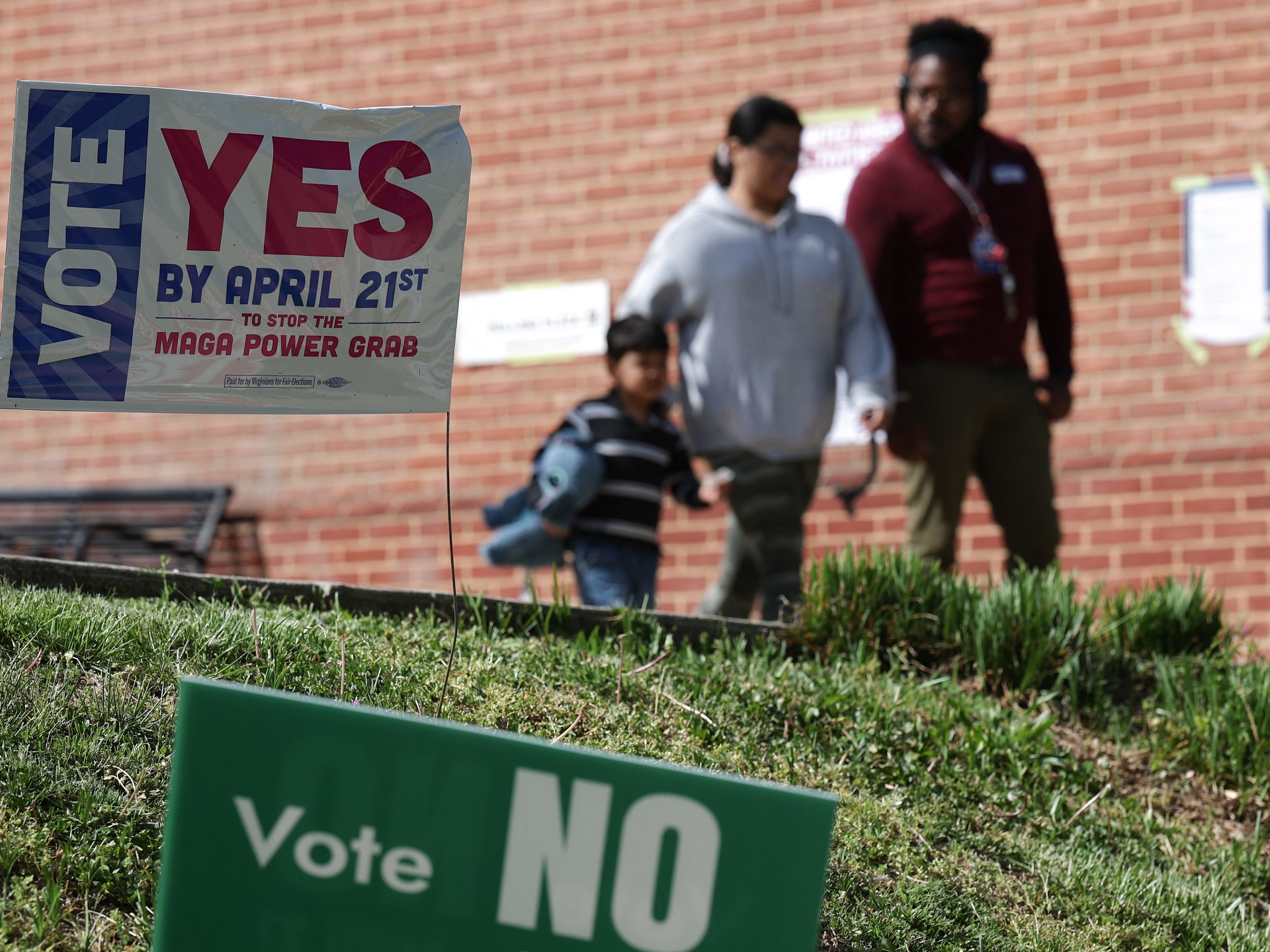
Washington, DC – The latest battle in United States congressional redistricting has been decided, with voters in Virginia approving redrawing the state’s electoral map.

The result of Tuesday’s referendum on Virginia redistricting is widely expected to benefit Democrats in their fight to retake control of the slimly Republican-controlled US House of Representatives in the midterm vote in November.

While redistricting is typically conducted every 10 years, following the US Census count of the country’s population, the election season has seen an unprecedented flurry of states moving to redraw their legislative maps early, initially spurred by pressure on US President Donald Trump to urge his fellow Republicans in Texas to do the same.

Democrats may be up at the moment, but several scenarios – including a redistricting push in Florida – could soon spoil those gains.

Experts, meanwhile, warn of the long-term implications of the election season’s norm-busting political manoeuvres, which they say could transform how and when electoral maps are drawn for years to come.

“Virginia’s unorthodox redistricting isn’t just a map redraw, it’s a mid-decade power play in a national arms race,” Rina Shah, a political adviser and strategist, told Al Jazeera.

“In a cycle defined by retaliation over reform, this sets a precedent: when one side bends the rules, the other follows, until courts or voters draw the final line.”

Trump has not been timid about his desire to redraw state congressional maps to benefit his Republican Party.

In July 2025, he confirmed the plan to reporters: “Texas would be the biggest one,” he said. “Just a very simple redrawing, we pick up five seats.”

By August, Texas’s Republican-controlled State House had passed a new map favouring Republicans, setting the party on course to secure five more seats in the US House of Representatives compared to the earlier map.

The move was soon followed by changes in Missouri, whose new maps are expected to net Republicans one additional seat, while redistricting in North Carolina and Ohio is expected to give the party two to three new Republican-dominated districts.

Democrats in several states responded in kind, pushing for redistricting in California and Utah that resulted in about six new Democrat-dominated districts. Virginia’s victory largely neutralised Republican gains, adding between two and four seats for Democrats.

“This could shift Virginia from a 6-5 split to something like 10-1 Democratic,” political adviser Shah said, referring to Virginia’s 11 congressional districts and noting this would result in “delivering up to four net seats and dramatically tightening the fight for House control in the 2026 midterms”.

This comes as Republicans are already expected to face a punishing election season, with wariness over the US-Israeli war in Iran and the stubbornly high cost of living in the US.

Democratic control of either chamber of Congress – or of both – would give the party the ability to largely curtail Trump’s agenda in the final two years of his presidency.

As of Wednesday, Sabato’s Crystal Ball, a midterm predictor published by the University of Virginia’s Center for Politics, rated 217 Congressional districts across the country as leaning towards Democrats, with 205 leaning towards Republicans and 13 rated toss-ups.

In the short term, Democrats are “winning” from the redistricting battle, according to Samuel Wang, a professor of neuroscience at Princeton University who runs the Princeton Gerrymandering Project.

“But from a non-partisan good government standpoint, it’s just a terrible event,” Wang told Al Jazeera.

He explained the “incredible” flurry of redistricting in recent months opens the possibility of a new age of heightened gerrymandering, the process by which congressional boundaries are drawn to benefit one political group.

Prior to this election cycle, there had been just three instances of mid-decade redistricting over the last five decades. Wang described the recent spurt as a “complete busting of norms”.

“It’s bad in the sense of reducing competition. Gerrymandering on both sides, basically, removes voters from the equation everywhere it happens,” he said.

Top Democrats have largely argued their hands were forced in mirroring the Republican strategy, rather than yield to the opposing party ahead of a consequential election.

“We fought back,” Hakeem Jeffries, the top Democrat in the House, told the Associated Press after Virginia’s vote. “When they go low, we hit back hard.”

But some Democrats have echoed concerns over the new precedent being set.

John Fetterman, a Democrat from Pennsylvania who has regularly sided with Republicans, told Newsmax on Wednesday, “Whether it’s a red state or whether it’s a blue state, our democracy is degraded.”

To be sure, while opportunities for further redistricting are diminishing following the vote in Virginia, the final congressional maps ahead of the midterms may not yet be set.

The Virginia vote now shifts pressure on Republicans in Florida, where Governor Ron DeSantis is set to hold a special legislative session on April 28 to discuss possible redistricting.

A new map could add up to five Republican-dominated congressional districts in the state, but could be scuttled by strict language in Florida’s constitution related to the process.

Democrat Jeffries, in a statement on Wednesday, vowed to surge resources to the state to take down Republican incumbents if the map is redrawn. “Maximum warfare, everywhere, all the time,” he pledged.

Several challenges to Virginia’s redistricting ballot measure are also currently being heard before the state’s Supreme Court, which could hinder the implementation of the new map.

Trump on Wednesday decried the Virginia vote as “rigged”, without providing any evidence to back up the claim.

Meanwhile, a case pending before the US Supreme Court could beckon in another slate of redistricting in the US South.

In Louisiana v Callais, the justices will determine whether the creation of two Black-majority congressional districts is in line with the Voting Rights Act, which seeks to assure minority representation in states with a history of racist election policies.

A ruling could open the door to redrawing maps in several states that would have previously been banned due to so-called “racial gerrymandering”, a process of drawing congressional lines based on racial makeup to dilute the electoral power of a minority group.

A handful of states have created independent commissions to oversee redistricting, in an effort to assure the process remains non-partisan.

But the vast majority rely on their state legislatures to draw the maps, which can lead to outsized influence over the party in control, barring legal challenges. That largely remains true whether redistricting is conducted every decade or, as the current election season could portend, more frequently.

But amid the current cavalcade of congressional map changes, Princeton’s Wang, who is himself running in the Democratic primary for Congress in New Jersey’s 12th district, sees a rare opportunity for federal reform.

That could take the form of Congress creating independent commissions to oversee redistricting.

“Now that mid-decade redistricting is backfiring on Republicans, it creates the possibility that both parties can see clearly that gerrymandering is a zero-sum game,” Wang said.

“It opens a path for possible bipartisan action.”

📰 மூல செய்தி (Source): https://www.aljazeera.com/news/2026/4/23/democrats-up-in-virginia-but-us-voters-may-pay-price-for-redistricting-war?traffic_source=rss

உலகம்

Top ministers quit after Peru’s president postpones F-16 fighter jet deal

Published

on

The Trump administration has warned against Peru pulling out of the deal, saying it reflects ‘bad faith’ negotiations.

Two cabinet-level ministers in Peru have resigned after interim President Jose Maria Balcazar announced he would defer a decision to buy F-16 fighter jets from the United States company Lockheed Martin.

Defence Minister Carlos Diaz and Foreign Minister Hugo de Zela cited their opposition to the move in their resignation letters on Wednesday.

“A strategic decision has been taken in the area of national security with which I have a fundamental disagreement,” Diaz wrote.

The fighter jets have long been a source of controversy in Peru, where critics have questioned whether the purchase is a sign of deference to US President Donald Trump.

Last week, the left-wing Balcazar — Peru’s ninth president in a decade — announced he would leave the decision about whether to invest $3.5bn in the purchase to the country’s next elected leader.

Balcazar himself had only been in office since February, selected by Congress to replace the latest in a string of impeached presidents.

Last week, he abruptly cancelled a signing ceremony for the F-16 deal, which would have seen an initial batch of 12 new planes added to Peru’s ageing air force. The country aims to acquire 24 jets overall.

Balcazar explained he was not pulling out of the deal, but that he felt the next presidential administration should be involved in making such a hefty financial commitment.

“For us to commit such a large sum of money to the incoming government would be a poor practice for a transitional government,” Balcazar said at the time.

“We remain firm in respecting all agreements that may have been reached at the level of the armed forces, or in this case, with the relevant ministry of the air force, to carry out the corresponding negotiations.”

His decision, however, was met with pushback, both domestically and from the US. The US ambassador to Peru, Bernie Navarro, responded on April 17 with a warning posted on social media.

“If you deal with the U.S. in bad faith and undermine U.S. interests, rest assured, I, on behalf of

[President] Trump and his administration, will use every available tool to protect and promote the prosperity and security of the United States and our region,” Navarro wrote.

Critics of the deal, however, have argued that Peru has received more competitive offers from French and Swedish aircraft makers like Dassault Aviation and Saab AB, respectively.

But Navarro on Wednesday denied that the US had been outcompeted. In a statement, he wrote that the “bid was made at a high level of competitiveness” and called the plane fleet “the most technically advanced fighter jets ever built”.

He also denounced the delay as an unreasonable stoppage on a deal he characterised as already signed.

“In planning the delivery of a product of this calibre, there is no such thing as an inconsequential delay,” he wrote.

“Every delay results in significant costs. The same package cannot be available in a couple of months, or even weeks.”

The decision to spend the $3.5bn on 24 fighter jets was made in 2024 under former President Dina Boluarte. The purchase was to be financed by $2bn in domestic borrowing in 2025 and $1.5bn in 2026.

In September, the US Department of Defense approved a potential sale of F-16s to Peru.

But Boluarte was removed from office in October, and her successor, Jose Jeri, lasted just four months in office before he too was impeached.

The instability in Peru’s presidency comes at a time when the Trump administration is seeking greater influence over Latin America, as part of what the US president has called his “Donroe Doctrine”.

Already, the Trump administration has pushed Peru to distance itself from Chinese investment. In February, for instance, it publicly protested against Chinese ownership in the Pacific port of Chancay.

“Peru could be powerless to oversee Chancay, one of its largest ports, which is under the jurisdiction of predatory Chinese owners,” the Trump administration wrote in a social media post.

“We support Peru’s sovereign right to oversee critical infrastructure in its own territory. Let this be a cautionary tale for the region and the world: cheap Chinese money costs sovereignty.”

Just this week, one of Trump’s allies, Representative Maria Elvira Salazar, warned that the Chinese-owned port was a danger to the US.

“That’s a direct threat in our hemisphere, right in the country of Peru,” she told a congressional committee. “For that reason, the new Peruvian government, which will be elected next June, must take it back.”

She added that, if the Peruvian government responded accordingly, “the United States will help them under the Trump administration”.

The country, however, is enmeshed in a messy presidential race replete with vote-counting delays and accusations of malpractice.

Election experts have said there is no evidence of voter fraud. But the slow vote count has left the race’s outcome undetermined, more than a week after the ballots were cast on April 12.

Right-wing leader and former First Lady Keiko Fujimori is all but assured of progressing to a run-off in June. But who will join her is uncertain.

Left-wing Congress member Roberto Sanchez is currently in the lead in the race for second place, with 12 percent of the votes tallied, but far-right candidate Rafael Lopez Aliaga, a former mayor, is close behind with 11.9 percent. Lopez Aliaga has been a vocal supporter of the Trump administration.

The final vote count for the first round of the election is expected to be delivered in May.

Traditionally, Peru’s new president should be sworn in on July 28, the country’s independence day.

📰 மூல செய்தி (Source): https://www.aljazeera.com/news/2026/4/22/top-ministers-quit-after-perus-president-postpones-f-16-fighter-jet-deal?traffic_source=rss

Continue Reading

உலகம்

South American migrants deported to DRC say facing pressure to return home

Published

on

Rights advocates have accused the Trump administration of using third-country deportations to intimidate asylum seekers and migrants.

Fifteen South American migrants and asylum seekers recently deported from the United States to the Democratic Republic of the Congo (DRC) say they are facing pressure to return to their countries of origin, despite concerns for their safety.

Women from Colombia, Peru and Ecuador told the Reuters news agency that, since being deported to the Central African nation last week, they have been given no credible options other than going back to their home countries.

“We feel pressured to agree to go back to our country, regardless of the risks,” a 29-year-old Colombian woman, who asked to remain anonymous out of fear of reprisals, told Reuters.

The group arrived in the DRC last week as part of a controversial third-country agreement with the administration of US President Donald Trump.

Since returning to the presidency for a second term, Trump has implemented hardline measures to restrict immigration to the US and expel immigrants already in the country, some of whom have legal status.

Among the 15 South Americans who were deported to the DRC, some say they had sought asylum — a legal immigration process — in the US after fleeing persecution in their home countries.

The 29-year-old woman, for example, wrote in her asylum application in January 2024 that she left Colombia after being kidnapped and tortured by an armed group, as well as suffering abuse at the hands of her ex-husband, who was a police officer.

A US immigration judge ruled in May 2025 that she was more likely than not to be tortured if she was sent home, according to court records reviewed by Reuters.

The AFP news agency also reported that a 30-year-old Colombian woman named Gabriela only learned that she was being sent to the DRC a day before last week’s flight. During a 27-hour trip, the hands and feet of the deportees were shackled.

“I didn’t want to go to Congo,” she told AFP. “I’m scared; I don’t know the language.”

Immigration advocates have said that third-country deportations are an effort to intimidate migrants and asylum seekers into agreeing to leave the US.

Such removals involve sending immigrants to places with which they have no familiarity. Many, including the DRC, are known for human rights concerns or are sites of active conflict.

“The goal is clear: Put people in a place so unfamiliar that they give up and agree to return home, despite the immense risk they face there,” said Alma David, a US-based lawyer representing one of the asylum seekers in the DRC.

📰 மூல செய்தி (Source): https://www.aljazeera.com/news/2026/4/22/south-american-migrants-deported-to-drc-say-facing-pressure-to-return-home?traffic_source=rss

Continue Reading

உலகம்

Iran war live: Israel kills Lebanese journalist; Tehran-US talks stalled

Published

on

Israeli attacks on Lebanon killed at least five people on Wednesday, including Lebanese journalist Amal Khalil.

📰 மூல செய்தி (Source): https://www.aljazeera.com/news/liveblog/2026/4/23/iran-war-live-israel-kills-lebanese-journalist-tehran-us-talks-stalled?traffic_source=rss

Continue Reading

Trending

Copyright © 2024 by 7Tamil Media, All rights reserved.