Connect with us

உலகம்

Can fish hook voters in India’s West Bengal elections?

Published

on

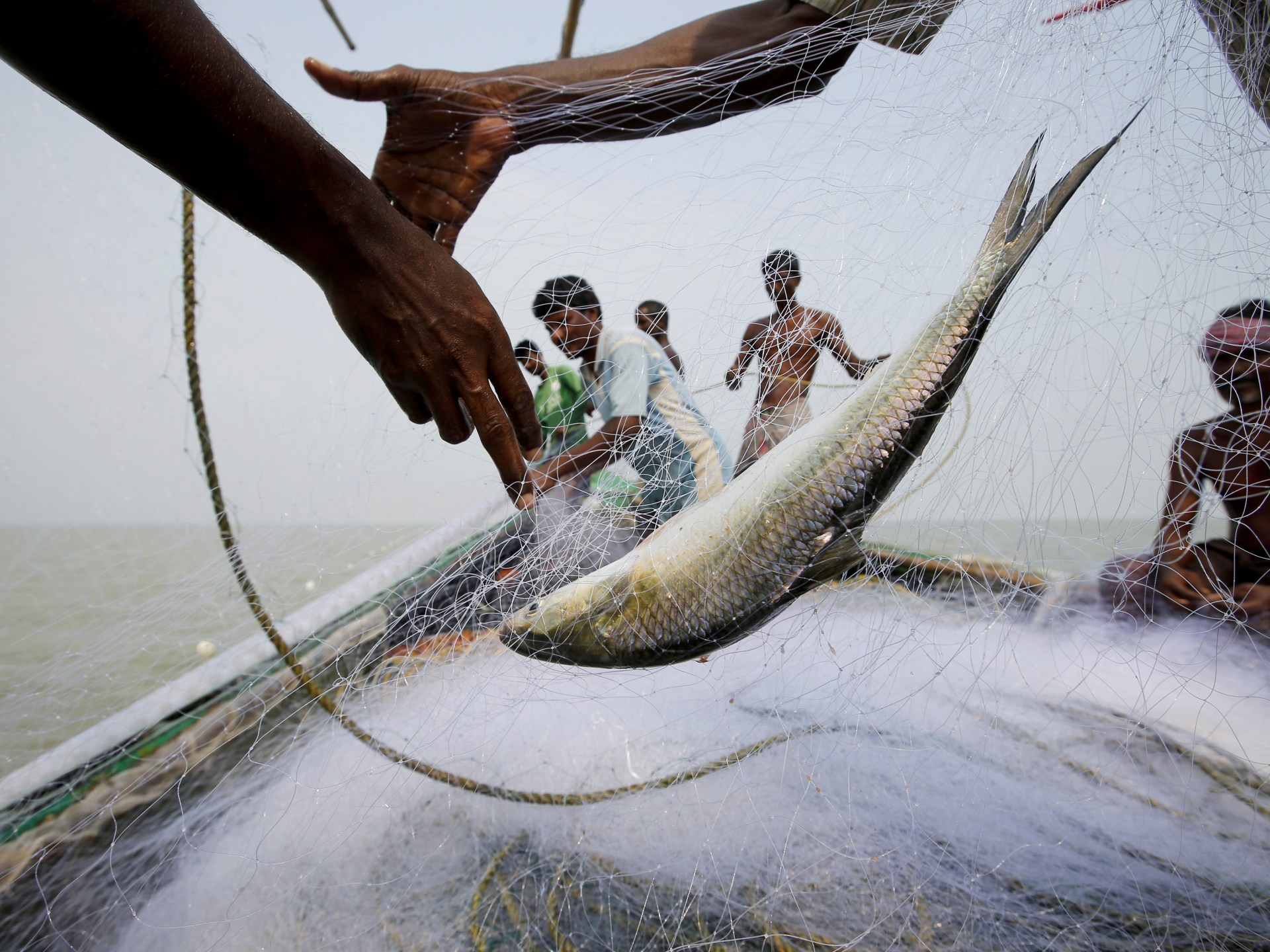
In battle for India’s West Bengal election, PM Modi’s men campaigned with fish in hand to try to connect with voters.

Waving a big Catla fish in his hands, Sharadwat Mukherjee went door to door canvassing for votes before Thursday’s election to the state legislature in the eastern Indian state of West Bengal.

Mukherjee is a candidate from Prime Minister Narendra Modi’s Bharatiya Janata Party (BJP), which rules nationally but has never come to power in the state, which has a greater population than Germany: more than 90 million people.

When he folds his hands to greet voters, the Catla just swings with a hook in its mouth. The big question: Can the fish also swing the election’s outcome?

Bengalis’ love for fish is legendary — on both sides of the border, in India and in Bangladesh. So much so that when a student-led uprising led to the ouster of then-Bangladesh Prime Minister Sheikh Hasina, some of the protesters who broke into her residence after she fled were seen raiding her refrigerator and walking away with fish.

But as West Bengal votes for its next government, fish has now leapt from kitchen slabs to the campaign trail, as leaders cosy up to voters in a variety of ways — and in some cases try to distance themselves from suspicions that their wins could hit the Bengali diet adversely.

Nearly 68 million people in West Bengal are expected to vote for their candidate of choice on April 23 and 29, to elect 294 lawmakers to the state assembly.

The results will be declared on May 4 in the crucial state vote, which the Hindu majoritarian BJP has never governed.

A revision of the electoral list, which controversially swept away a total of 9.1 million names from the register before polling, and has been criticised for disenfranchising minorities, was among the major polling issues. Some 2.7 million people have challenged their expulsions.

On the campaign trail, in rallies, and in interviews, the chief minister of Bengal, Mamata Banerjee, a firebrand, centrist regional leader — who has been sometimes touted as a contender for Modi’s job in New Delhi, if the opposition were to win — has doubled down on identity politics to corner the BJP, analysts say.

BJP-led governments in several states have imposed bans or restrictions on the sale of meat. Far-right mobs have carried out lynchings of Muslims in BJP-ruled states over accusations that they were transporting beef.

Banerjee, who is seeking a fourth consecutive term, has time and again warned that if the BJP were to come to power, they would “ban fish, meat, and even eggs” — effectively labelling them as outsiders, unaware of Bengali culture. The BJP has rejected these allegations.

Biswanath Chakraborty, a psephologist and political analyst in West Bengal who has authored several books on voting behaviour, told Al Jazeera that the whole issue surrounding fish had been “constructed by Mamata Banerjee.”

“For long, she has peddled that fish is parallel to Bengali politics,” he said. “In election campaigning, every issue is constructed, and Mamata is the champion of that.”

Chakraborty argued that by fiercely pushing back against these allegations, the BJP had ended up helping the governing party in Bengal make sure the debate over fish remained a campaign highlight with voters.

“They [the BJP] are entering, or rather trapped, into the discourse set by Mamata,” the analyst said.

“Fish is very crucial in Bengal, very crucial,” said Utsa Ray, an assistant professor at Jadavpur University, in West Bengal’s capital Kolkata. She also authored a 2015 book on Bengal’s culinary evolution in colonial India, titled Culinary Culture in Colonial India: A Cosmopolitan Platter and the Middle-Class.

“First of all, due to Bengal’s geographical location itself – along the Bay of Bengal – [and as] a place situated near rivers and streams, fish have been the most available item,” she told Al Jazeera.

Fish has also been an integral part of many rituals in Bengal on auspicious days for both Hindus and Muslims, Ray said, adding, however, that there were sects of people in Bengal who refrain from eating fish.

A 2024 study found that nearly 65 percent of people in West Bengal consume fish weekly.

Against that backdrop, Ray told Al Jazeera that Banerjee’s party was looking to leverage “regional identity or the Bengali identity”.

Banojyotsna Lahiri, a social activist and voter in West Bengal, described the BJP’s response, with candidates like Mukherjee campaigning with fish, as a “gimmick”.

“In Bengal, [the BJP] have suddenly realised that they appear as aliens with their vegetarian posturing because both fish and meat are integral to the Bengal culinary choices, caste or religion notwithstanding,” she told Al Jazeera. ”

In the run-up to the voting on Thursday, the BJP rushed to find a senior leader who could eat a fish in front of the cameras. They finally managed to get Anurag Thakur, a member of parliament from Himachal Pradesh, to do that on Tuesday.

“Questions of what food people will eat, especially non-vegetarian [food], have been associated with the BJP’s politics to impose restrictions and dictate food options,” said Neelanjan Sircar, a senior visiting fellow at the think tank Centre for Policy Research, in Delhi.

The BJP has been dictating food choices in northern India’s Hindi-speaking belt, with its “hyper masculine, Hindutva, and vegetarianism,” said Ray. “There have been cases of lynching for eating non-vegetarian food.”

Still, both Sircar and Ray agreed that the display of fish on the campaign trail was a novelty — even in the often-bizarre world of Indian politics.

“Creating these new images for the BJP is important,” said Sircar. “So, to create another image in voters’ minds leads to these outlandish displays.”

📰 மூல செய்தி (Source): https://www.aljazeera.com/news/2026/4/23/can-fish-hook-voters-in-indias-bengal-elections?traffic_source=rss

உலகம்

Top ministers quit after Peru’s president postpones F-16 fighter jet deal

Published

on

The Trump administration has warned against Peru pulling out of the deal, saying it reflects ‘bad faith’ negotiations.

Two cabinet-level ministers in Peru have resigned after interim President Jose Maria Balcazar announced he would defer a decision to buy F-16 fighter jets from the United States company Lockheed Martin.

Defence Minister Carlos Diaz and Foreign Minister Hugo de Zela cited their opposition to the move in their resignation letters on Wednesday.

“A strategic decision has been taken in the area of national security with which I have a fundamental disagreement,” Diaz wrote.

The fighter jets have long been a source of controversy in Peru, where critics have questioned whether the purchase is a sign of deference to US President Donald Trump.

Last week, the left-wing Balcazar — Peru’s ninth president in a decade — announced he would leave the decision about whether to invest $3.5bn in the purchase to the country’s next elected leader.

Balcazar himself had only been in office since February, selected by Congress to replace the latest in a string of impeached presidents.

Last week, he abruptly cancelled a signing ceremony for the F-16 deal, which would have seen an initial batch of 12 new planes added to Peru’s ageing air force. The country aims to acquire 24 jets overall.

Balcazar explained he was not pulling out of the deal, but that he felt the next presidential administration should be involved in making such a hefty financial commitment.

“For us to commit such a large sum of money to the incoming government would be a poor practice for a transitional government,” Balcazar said at the time.

“We remain firm in respecting all agreements that may have been reached at the level of the armed forces, or in this case, with the relevant ministry of the air force, to carry out the corresponding negotiations.”

His decision, however, was met with pushback, both domestically and from the US. The US ambassador to Peru, Bernie Navarro, responded on April 17 with a warning posted on social media.

“If you deal with the U.S. in bad faith and undermine U.S. interests, rest assured, I, on behalf of

[President] Trump and his administration, will use every available tool to protect and promote the prosperity and security of the United States and our region,” Navarro wrote.

Critics of the deal, however, have argued that Peru has received more competitive offers from French and Swedish aircraft makers like Dassault Aviation and Saab AB, respectively.

But Navarro on Wednesday denied that the US had been outcompeted. In a statement, he wrote that the “bid was made at a high level of competitiveness” and called the plane fleet “the most technically advanced fighter jets ever built”.

He also denounced the delay as an unreasonable stoppage on a deal he characterised as already signed.

“In planning the delivery of a product of this calibre, there is no such thing as an inconsequential delay,” he wrote.

“Every delay results in significant costs. The same package cannot be available in a couple of months, or even weeks.”

The decision to spend the $3.5bn on 24 fighter jets was made in 2024 under former President Dina Boluarte. The purchase was to be financed by $2bn in domestic borrowing in 2025 and $1.5bn in 2026.

In September, the US Department of Defense approved a potential sale of F-16s to Peru.

But Boluarte was removed from office in October, and her successor, Jose Jeri, lasted just four months in office before he too was impeached.

The instability in Peru’s presidency comes at a time when the Trump administration is seeking greater influence over Latin America, as part of what the US president has called his “Donroe Doctrine”.

Already, the Trump administration has pushed Peru to distance itself from Chinese investment. In February, for instance, it publicly protested against Chinese ownership in the Pacific port of Chancay.

“Peru could be powerless to oversee Chancay, one of its largest ports, which is under the jurisdiction of predatory Chinese owners,” the Trump administration wrote in a social media post.

“We support Peru’s sovereign right to oversee critical infrastructure in its own territory. Let this be a cautionary tale for the region and the world: cheap Chinese money costs sovereignty.”

Just this week, one of Trump’s allies, Representative Maria Elvira Salazar, warned that the Chinese-owned port was a danger to the US.

“That’s a direct threat in our hemisphere, right in the country of Peru,” she told a congressional committee. “For that reason, the new Peruvian government, which will be elected next June, must take it back.”

She added that, if the Peruvian government responded accordingly, “the United States will help them under the Trump administration”.

The country, however, is enmeshed in a messy presidential race replete with vote-counting delays and accusations of malpractice.

Election experts have said there is no evidence of voter fraud. But the slow vote count has left the race’s outcome undetermined, more than a week after the ballots were cast on April 12.

Right-wing leader and former First Lady Keiko Fujimori is all but assured of progressing to a run-off in June. But who will join her is uncertain.

Left-wing Congress member Roberto Sanchez is currently in the lead in the race for second place, with 12 percent of the votes tallied, but far-right candidate Rafael Lopez Aliaga, a former mayor, is close behind with 11.9 percent. Lopez Aliaga has been a vocal supporter of the Trump administration.

The final vote count for the first round of the election is expected to be delivered in May.

Traditionally, Peru’s new president should be sworn in on July 28, the country’s independence day.

📰 மூல செய்தி (Source): https://www.aljazeera.com/news/2026/4/22/top-ministers-quit-after-perus-president-postpones-f-16-fighter-jet-deal?traffic_source=rss

Continue Reading

உலகம்

South American migrants deported to DRC say facing pressure to return home

Published

on

Rights advocates have accused the Trump administration of using third-country deportations to intimidate asylum seekers and migrants.

Fifteen South American migrants and asylum seekers recently deported from the United States to the Democratic Republic of the Congo (DRC) say they are facing pressure to return to their countries of origin, despite concerns for their safety.

Women from Colombia, Peru and Ecuador told the Reuters news agency that, since being deported to the Central African nation last week, they have been given no credible options other than going back to their home countries.

“We feel pressured to agree to go back to our country, regardless of the risks,” a 29-year-old Colombian woman, who asked to remain anonymous out of fear of reprisals, told Reuters.

The group arrived in the DRC last week as part of a controversial third-country agreement with the administration of US President Donald Trump.

Since returning to the presidency for a second term, Trump has implemented hardline measures to restrict immigration to the US and expel immigrants already in the country, some of whom have legal status.

Among the 15 South Americans who were deported to the DRC, some say they had sought asylum — a legal immigration process — in the US after fleeing persecution in their home countries.

The 29-year-old woman, for example, wrote in her asylum application in January 2024 that she left Colombia after being kidnapped and tortured by an armed group, as well as suffering abuse at the hands of her ex-husband, who was a police officer.

A US immigration judge ruled in May 2025 that she was more likely than not to be tortured if she was sent home, according to court records reviewed by Reuters.

The AFP news agency also reported that a 30-year-old Colombian woman named Gabriela only learned that she was being sent to the DRC a day before last week’s flight. During a 27-hour trip, the hands and feet of the deportees were shackled.

“I didn’t want to go to Congo,” she told AFP. “I’m scared; I don’t know the language.”

Immigration advocates have said that third-country deportations are an effort to intimidate migrants and asylum seekers into agreeing to leave the US.

Such removals involve sending immigrants to places with which they have no familiarity. Many, including the DRC, are known for human rights concerns or are sites of active conflict.

“The goal is clear: Put people in a place so unfamiliar that they give up and agree to return home, despite the immense risk they face there,” said Alma David, a US-based lawyer representing one of the asylum seekers in the DRC.

📰 மூல செய்தி (Source): https://www.aljazeera.com/news/2026/4/22/south-american-migrants-deported-to-drc-say-facing-pressure-to-return-home?traffic_source=rss

Continue Reading

உலகம்

Iran war live: Israel kills Lebanese journalist; Tehran-US talks stalled

Published

on

Israeli attacks on Lebanon killed at least five people on Wednesday, including Lebanese journalist Amal Khalil.

📰 மூல செய்தி (Source): https://www.aljazeera.com/news/liveblog/2026/4/23/iran-war-live-israel-kills-lebanese-journalist-tehran-us-talks-stalled?traffic_source=rss

Continue Reading

Trending

Copyright © 2024 by 7Tamil Media, All rights reserved.