Connect with us

உலகம்

With food benefit cuts looming in the US, Californians eye billionaire tax

Published

on

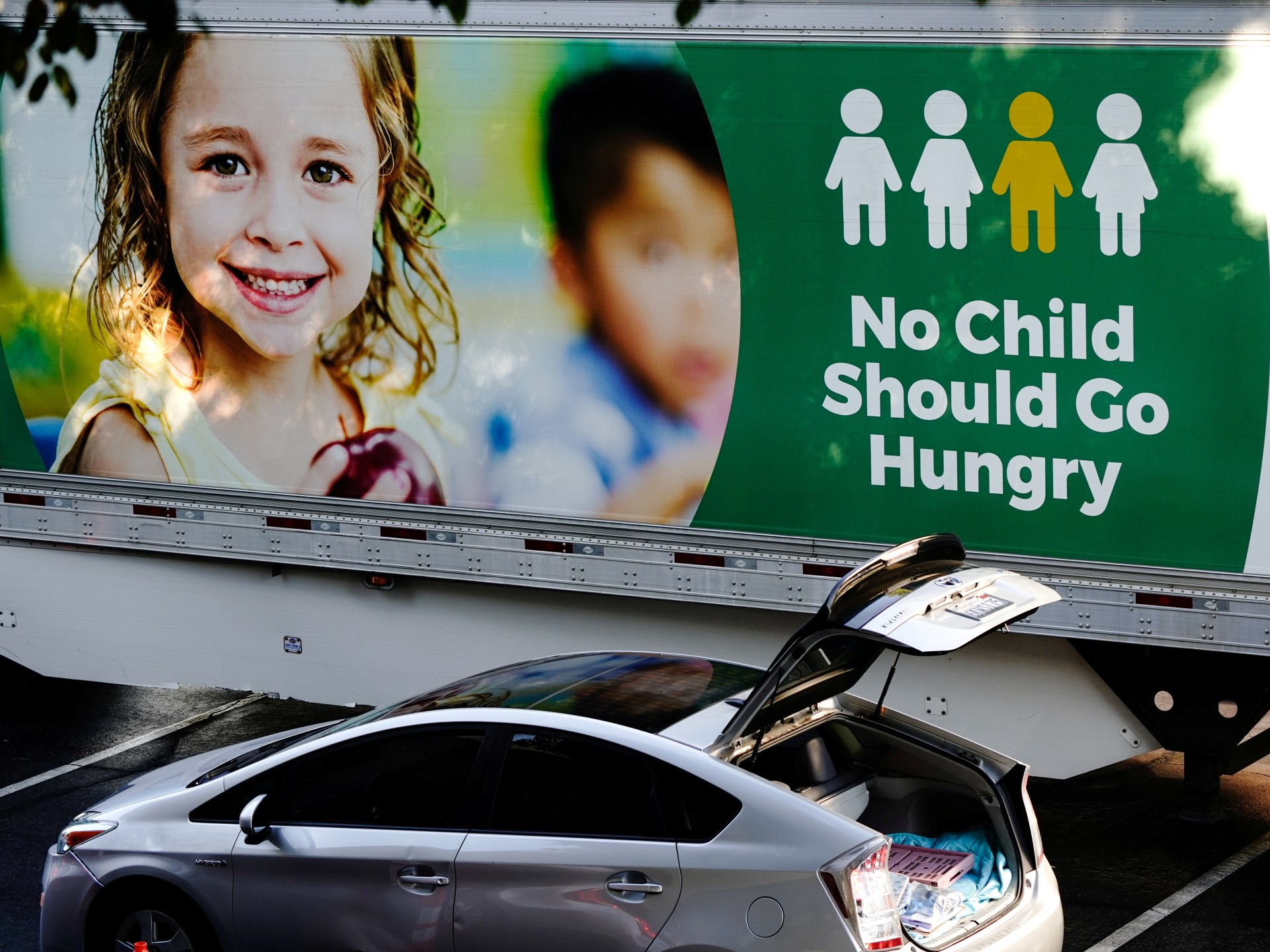
US gov’t cuts to food stamps will hit thousands of Californians. The state is set to vote on billionaire tax to make up lost funds.

San Francisco, United States – Greer Dove’s days are packed with studying business and finance, as well as doing administrative work at college, along with caring for her eight-year-old daughter with special needs. But once a week, Dove, a single mother, makes sure to drop in at the food bank in California’s Marin County to pick up vegetables, fruit and other food. Along with the federal government’s food benefits, they keep her housing running.

“We need this so we can keep functioning at a high level,” she says. “She loves fruit, so I make sure to get it,” she says of her daughter.

Dove, who is also looking for a full-time job, has worked in restaurants, event management, retail, television shows, office administration and payroll over the years. But she has been on the federal government’s Supplemental Nutritional Assistance Program (SNAP) for six years, and with the food bank, for more than three years. Before she got food benefits, Dove fed her daughter all she had and skipped meals or looked around for snacks in the offices she worked at to get her through the day.

United States President Donald Trump’s One Big Beautiful Bill Act (OBBBA), passed in June, cut SNAP benefits by more than $186bn over the next 10 years to make up for extending cuts to income tax. This could lead to more than 3 million people nationwide, and 665,000 recipients in California, losing such food benefits, according to estimates.

“This will bring a series of cuts that collectively present an existential threat to food benefits,” says Andrew Cheyne, managing director of government relations and public affairs at the County Welfare Directors Association of California.

California’s proposed billionaire tax, which seeks to impose a one-time 5 percent tax on the assets of the state’s more than 200 billionaires to make up for the funding gap created by the OBBBA, got more than 1.5 million signatures in April. It is likely to be on the ballot for the November midterm election.

While most of the nearly $100bn expected to be raised through the tax will go towards filling the gap in health insurance created by the OBBBA, 10 percent will be used to make up for the retrenchment in food benefits.

In California, where more than 5.3 million people, more than any other state, receive food benefits, the impacts of the cuts began to be felt in April when 72,000 immigrants started losing benefits. June onwards, nearly 600,000 recipients will be screened for work eligibility. Recipients, including those who are homeless, seniors, foster youth and veterans, will have to work, study or volunteer to receive food benefits. Failing the screening to meet work requirements for three months will lead to their food benefits being cut.

Brian Galle, professor of law at the University of California at Berkeley and one of the tax measure’s authors, says that in California, the state that introduced gig work, “jobs are increasingly precarious. You may find enough work or not. You may get tips or not. But nutrition needs are steady.”

On a recent Friday morning, new members lined up to enrol at a whitewashed, bunting-festooned La Ofrenda food bank in San Francisco’s Mission district. The food bank doles out fresh vegetables, fruit and bread that have been donated by large grocery stores once those products neared expiration date.

Gladys Lee had taken a 45-minute train ride after a friend told her about it. Lee worked at downtown San Francisco’s Hyatt hotel as a room cleaner for three decades until a back injury meant she could not push the heavy cleaning carts any more and had to leave. After seven years of struggling to find work, food was getting scarce, and Lee found her way to La Ofrenda. She packed what she could into a carton and held it in her arms for the train ride back.

Food benefit rolls have shrunk by more than 3.3 million nationally in the six months from July 2025, when the OBBBA was enacted, to January 2026.

In California, the rolls of Calfresh, as food benefits are known in the state, shrank by 288,000 or 6 percent from July 2025 to February 2026, according to analysis by the Center for Budget and Policy Priorities, a Washington, DC-based think tank. This reduction in rolls happened even before the OBBBA cuts began.

Brooke Rollins, the agriculture secretary, wrote in a recent essay that the shrinking of SNAP rolls reflected an ebullient economy and buoyant job growth.

“The drop in SNAP recipients affirms that many Americans are moving from welfare to work,” she wrote. “It is no secret that Trump’s massive tax cuts and deregulation efforts are unleashing robust, private sector-led economic growth, which are fueling trillions in investments, booming wage growth”.

But unemployment remained stable at about 4.4 percent since July 2025, according to the Bureau of Labor Statistics data, while SNAP rolls shrank.

“This last time we saw such a steep, quick decline, other than during natural disasters, is three decades ago when welfare reform was enacted,” says Dottie Rosenbaum, senior fellow and director of  Federal SNAP Policy at the Center for Budget and Policy Priorities.

Nationally, SNAP rolls shrank by 8 percent, while in California, they shrank by 5.5 percent, in part because the work eligibility requirements were delayed until June, while some other states have already implemented them.

At La Ofrenda, Roberto Alfaro, executive director of the nonprofit Homey, says he started the food bank when food costs went up during the pandemic. They have stayed high, he says. Now he sees people doing day jobs and night jobs and coming for food when they have paid rent.

“People are making impossible choices,” says Keely O’Brien, a policy advocate at the Western Center for Law and Poverty.

While California is the world’s fourth-largest economy, growth has come with a soaring cost-of-living crisis.

“With rising housing and utility costs, few households can dedicate that much of their income towards food,” O’Brien says.

The OBBA has also shifted the administrative cost of meeting work eligibility requirements to states, and beginning next year, part of the cost of SNAP will also fall on states.

“To make requirements more stringent, you are creating more government, more bureaucratic logjam,” says Jaren Sorkow, state director for the Children’s Defence Fund.

This has already led to a 51 percent drop in SNAP rolls in Arizona, which has begun implementing the OBBBA cuts, according to data by the Center for Budget and Policy Priorities.

Several measures to counter the $100bn gap in funding for health insurance and food benefits created by the OBBBA have been floated in California. The biggest of these is the one-time 5 percent tax on those with assets of more than a billion dollars. The tax will raise $100bn, its authors estimate.

As it seems set to be voted on in the November election, it faces mounting opposition from the state’s tech entrepreneurs who have funded measures to undercut the tax.

Tech entrepreneurs have called it an economic 9/11, saying taxing their assets, including shareholding in startups, will lead to a flight of capital and innovation from the state. Sergey Brin, a cofounder of Google Inc, now spends a week in Nevada and a week in his Bay Area offices and has spent more than $57m on opposing the billionaire tax. He has backed two measures that undercut the billion tax, which have also received 1.4 million and 1.5 million signatures and are also set to be on the ballot for the November election.

One of these measures prohibits future taxes on personal property, including financial assets, savings and retirement accounts, as well as intellectual property. The other would increase audits of taxpayer-funded programmes, and includes language that would essentially invalidate the billionaire tax.

In a recent statement to The New York Time

📰 மூல செய்தி (Source): https://www.aljazeera.com/economy/2026/5/10/with-food-benefit-cuts-looming-in-the-us-californians-eye-billionaire?traffic_source=rss

உலகம்

Trump-Xi summit live: US, China leaders holding talks on trade, tech, Iran

Published

on

Trump and Xi's summit comes at a crucial moment for the global economy, as the war on Iran continues to disrupt trade.

📰 மூல செய்தி (Source): https://www.aljazeera.com/news/liveblog/2026/5/14/trump-xi-summit-live-us-china-leaders-to-hold-talks-on-trade-tech-iran?traffic_source=rss

Continue Reading

உலகம்

Families demand release of Pakistani crew captured by Somali pirates

Published

on

Families demand release of Pakistani crew captured by Somali pirates

Families of 10 Pakistani crew members taken hostage by Somali pirates have rallied in Karachi to demand their release. The crew of the Honour 25 have been held for more than three weeks. Hijackings off the coast of Somalia are on the rise in the wake of the US-Israeli war on Iran.

📰 மூல செய்தி (Source): https://www.aljazeera.com/video/newsfeed/2026/5/14/families-demand-release-of-pakistani-crew-captured-by-somali-pirates?traffic_source=rss

Continue Reading

உலகம்

Iran war: Why the BRICS foreign ministers meeting in India matters

Published

on

The foreign ministers meeting is taking place before the 2026 BRICS summit in India in September.

A meeting of BRICS foreign ministers kicked off in the Indian capital New Delhi on Thursday, with the Iran war likely to cast a shadow on the two-day event, which coincides with United States President Donald Trump’s state visit to China.

This meeting is being held before the 18th BRICS summit, which New Delhi will host in September.

Here is more about the foreign ministers’ meeting, who is attending and why it matters.

BRICS is a grouping of major emerging economies seeking to coordinate security and economic policies to amplify the demands of the Global South within international organisations and on issues where the West has traditionally dominated economically and politically.

The acronym stands for Brazil, Russia, India, China and South Africa. The organisation was called BRIC in its initial form – Brazil, Russia, India and China – when its foreign ministers began meeting in 2006, and when it held its first summit in 2009. It became BRICS when South Africa joined in 2010.

In 2023, BRICS extended invitations to Egypt, Ethiopia, Iran, Saudi Arabia and the United Arab Emirates after these countries applied for membership. Saudi Arabia has yet to join formally, but the others have. An invitation was also extended to Argentina, but was turned down as President Javier Milei, elected in December 2023, had campaigned on the promise of bolstering ties with the West.

Indonesia joined the group in January 2025, after its membership was approved during the 2023 summit in Johannesburg.

The group sets priorities and holds discussions at an annual summit, which members take turns hosting. Last year, Brazil hosted the BRICS meeting and, in 2024, Russia hosted the annual meeting. This year, it is India’s turn to host.

This week’s meeting in New Delhi will bring together the foreign ministers of BRICS countries, who are expected to discuss economic cooperation and coordinate their positions on key global issues.

The BRICS foreign ministers’ meeting, held to prepare for the 18th BRICS summit in September, is taking place on Thursday, May 14, and Friday, May 15, in New Delhi, India’s Ministry of External Affairs said on Tuesday.

On Thursday, foreign ministers arrived at 10am (04:30 GMT), and sessions are expected to take place throughout the day, concluding with a dinner at 7pm (13:30 GMT).

On Friday, one session is expected to take place, starting at 10am (04:30 GMT).

All of the meetings except one will take place in Bharat Mandapam, an exhibition hall and convention centre close to the Supreme Court of India.

On Thursday at 1pm (07:30 GMT), Indian Prime Minister Narendra Modi will join the visiting leaders in a conference call from Seva Teerth, a new administrative complex that serves as the official headquarters of the prime minister’s office.

Foreign ministers from within and outside the BRICS group are expected to attend the meeting.

The Russian Ministry of Foreign Affairs has said Foreign Minister Sergey Lavrov will attend the meeting. South Africa’s Ronald Lamola and Brazil’s Mauro Vieira are also both attending.

Chinese Foreign Minister Wang Yi will not attend due to Trump’s visit to Beijing. Instead, China will be represented by its Ambassador to India Xu Feihong, Indian media have reported.

Iranian Foreign Minister Abbas Araghchi has landed in New Delhi to participate. Indonesia’s Foreign Minister Sugiono also arrived in New Delhi on Wednesday.

It is not clear who will be representing the UAE at the BRICS meeting, even as the US-Israel war on Iran exacerbates tensions between the UAE and Iran.

The theme of this meeting is “Building for Resilience, Innovation, Cooperation and Sustainability”, according to India’s External Affairs Ministry. This will focus on “people-centric and holistic healthcare, with an emphasis on collaboration on pressing health challenges, including communicable and non-communicable diseases”, it added.

However, the ongoing war on Iran is likely to dominate, and discussions will set the agenda for the annual BRICS summit in September, observers say.

“The Iran war is likely to cast a shadow over both the BRICS summit and the Trump-Xi meeting,” Rafael Loss, a policy fellow at the European Council on Foreign Relations (ECFR), told Al Jazeera.

The war on Iran entered its 76th day on Thursday, with diplomatic efforts to end the conflict hanging in the balance.

Iran’s Tasnim news agency reported that, as well as taking part in the main BRICS sessions, Araghchi will hold separate meetings with Indian Foreign Minister Subrahmanyam Jaishankar and other officials attending the meeting.

In April this year, India hosted a BRICS Deputy Foreign Ministers and Special Envoys for the Middle East and North Africa meeting in New Delhi. That gathering ended without a joint statement after Iran and the UAE clashed over how to address the US-Israel war on Iran, with the UAE also seeing itself as a victim of Iranian aggression.

Since then, tensions between Iran and the UAE have only risen, with Tehran’s war messaging increasingly targeting the UAE.

Israel’s genocidal war on Gaza is also another point of stress within the bloc. At the April meeting, India – recently an Israeli ally – attempted to soften criticism of Israel’s actions in Gaza, leading to a failure within the bloc to arrive at a consensus on the subject.

“The meeting in India occurs at a difficult time in which the cohesion of the BRICS confronts challenges due to the closer relations of India with the US and Israel, and the conflict in West Asia between Iran and the UAE,” Michael Dunford, emeritus professor at the School of Global Studies at the University of Sussex, told Al Jazeera.

Trump landed in China on Wednesday evening and, after a ceremonial welcome, headed straight to his hotel. On Thursday, he will hold bilateral talks with the Chinese president, and will also join President Xi for a working lunch on Friday, before flying back to the US.

“A consequence of the coincidence of Trump’s visit to China with the BRICS foreign ministers’ summit in India is that Wang Yi will not attend, with China represented by its Indian ambassador Xu Feihong,” Dunford said.

ECFR’s Rafael Loss predicted that Trump is likely to try to persuade Xi to put pressure on Iran to accommodate US demands to end the naval standoff in the Gulf and open the Strait of Hormuz.

In the past, he said, China avoided getting involved in protracted international conflict management efforts and instead attempted to “swoop in” to seal deals during the final stages, such as in the Iran-Saudi Arabia normalisation agreement of 2023, which has since collapsed.

“But if the price is right, and with Trump’s short-termism and disregard of traditional US allies, Xi could be persuaded to take a more vocal line vis-a-vis Iran,” Loss said. “Taiwan might end up bearing the brunt.”

This meeting of foreign ministers also comes amid an energy crisis triggered by the closure of the Strait of Hormuz during the US-Israel war on Iran.

Since early March, Iran has restricted shipping through the strait, a narrow waterway linking Gulf oil producers to the open ocean and through which 20 percent of the world’s oil and liquefied natural gas (LNG) supplies were shipped before the war. Iran has allowed passage by vessels from select countries, but they are required to negotiate transit with the Islamic Revolutionary Guard Corps (IRGC).

Iranian attacks on US assets and oil and gas facilities in the Gulf in the early weeks of the war have also affected energy supplies.

In April, the US announced a naval blockade on ships entering or leaving Iranian ports, further adding to the disruption of global oil and gas supplies.

This has had a direct impact on several BRICS members. India and China rely heavily on Gulf oil shipped through the strait. Saudi Arabia and the UAE ship oil through the strait. Brazil, Egypt and South Afri

📰 மூல செய்தி (Source): https://www.aljazeera.com/news/2026/5/14/iran-war-why-the-brics-foreign-ministers-meeting-in-india-matters?traffic_source=rss

Continue Reading

Trending

Copyright © 2024 by 7Tamil Media, All rights reserved.