Connect with us

முக்கியச் செய்திகள்

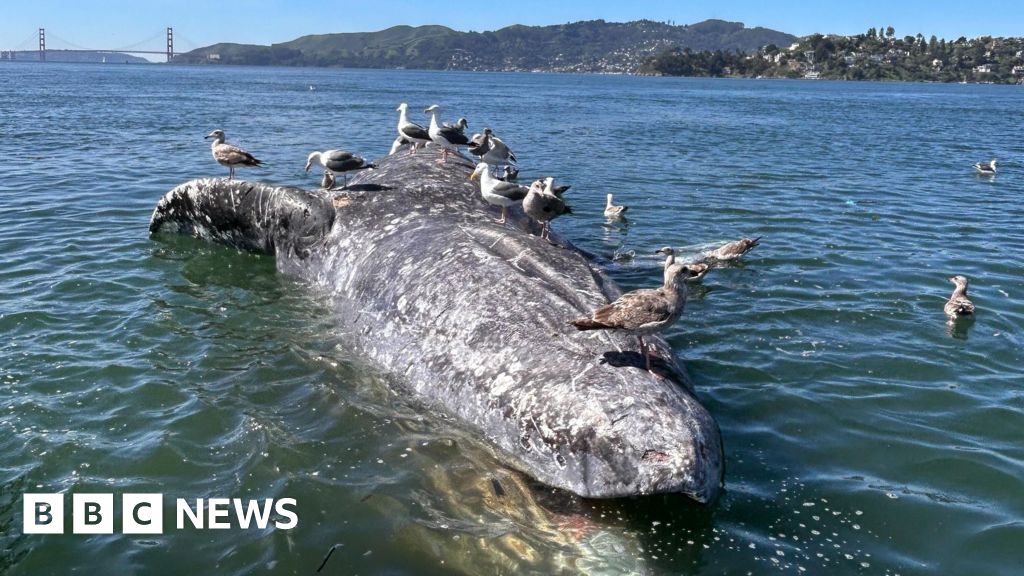
Why are gray whales dying in San Francisco's waters? US scientists search for clues

Published

on

California's blustery San Francisco Bay is home to the Golden Gate Bridge, commercial ports, public marinas and ferry boats. But more recently, a new sight is attracting locals' attention: Eastern North Pacific gray whales.

The whales have brought wonder, as residents and researchers now get to closely observe how they feed, breed and socially engage. They've also brought growing unease: why are so many of them undernourished and dying?

In 2025, a record number of 21 dead gray whales were found in the broader San Francisco Bay. So far this year, seven have died due to a combination of dwindling prey availability, climate change and human causes, researchers say.

The 4,140-sq-km bay is the largest estuary on the west coast of the US. Before 2018, this species of whales wasn't known to stop seasonally or consistently in the bay, bypassing it on their migration route down to Baja California and back up the Arctic, said Josephine Slaathaug, who led a recent study on gray whale mortality in the bay.

The impressive gray whales have the longest annual migration of any mammal, travelling an approximate 15,000-20,000km roundtrip to breed.

"It's a new habitat that they've chosen to utilise," the graduate student at Sonoma State University and the lead author of the paper tells the BBC, noting years of steep declines in their prey in the Arctic.

Many of those that turned up in the bay are adult and juvenile males that are heading to the Arctic. Notably, the whales observed are skinnier than they normally would be at this time of year, Slaathaug and several other researchers tell the BBC.

"They don't have the energy reserves necessary to complete the entire migration back to the Arctic, so they may be driven into the bay by hunger," she said.

Dead or dying gray whales have also cropped up in Washington state and Oregon. Although they weren't included in Slaathaug's study, researchers believe changes in their behaviours could be related.

While a lack of food may be driving whales into the bay, it's not necessarily starvation that's killing them. In recent years, nearly one-fifth of the gray whales that have swum into the San Francisco Bay have died there, usually after being struck by ships, according to Slaathaug's study published in the journal Frontiers in Marine Science this week.

Slaathaug's study examined hundreds of photographs of whales and carcasses found in the bay since 2018. Her team described "a very concerning high rate of death in San Francisco Bay" that continued to grow in 2025, with whales in the bay highly susceptible to vessel strikes.

Still, researchers say the factors that lead to these deaths are worth exploring. The bay is offering a rare opportunity to better understand migratory patterns and how climate change is shifting routes and food supplies.

"It's sad to see a dead whale. It's sadder to see a dead whale that you may have recognised from studying that particular whale. But there's also a lot that we can learn," said Kathi George, whose team assisted Slaathaug with her research and several necropsies – animal autopsies.

Whales, she said, can be harbingers of bigger changes under the surface of the ocean.

That the whale sightings and strandings have begun earlier in the season this year – beginning with two in January when peak numbers are usually in April – is a cause for concern, indicating that the creatures are in more trouble than initially thought.

Slaathaug and her colleagues have also seen very low calf counts, signalling a low birth rate. That could mean this population is neither recovering nor rebounding in the way that it has in previous times of population decline.

"That, in combination with the high rate of human-caused mortality in this area, really leads scientists to be concerned and look for ways to find solutions," Slaathaug said.

Moe Flannery, a co-author of the study, told the BBC that this is the first time in decades where the problem seems immediate. She says scientists are learning how to make the waters from Alaska to Mexico safer for the whales.

The population of gray whales that hug North America's west coast is not considered endangered. However, their numbers have dropped from 27,000 in 2016 to 12,500 in 2025 – a decrease that the US National Oceanic and Atmospheric Administration has dubbed an "unusual mortality event".

"It's an immediate crisis that needs to be addressed and this paper is just the first step in gathering the science that's needed to help inform conservation and management of this species that's in trouble," Flannery said.

That trouble becomes imminent for humans, too, when a 30-40 tonne gray whale begins floating in the bay, as happened earlier this year. The Army Corps of Engineers towed a body to a secluded beach for George and her team to perform a necropsy.

But in an unusual turn of events, George said her team hadn't yet made it to the first whale when they received a call about a second that needed immediate attention.

"Unfortunately, we had no place to put the whale, so it floated out of the bay," she said.

The bay area waters are somewhat closed off and relatively crowded with major container ships, ferries and public marinas, increasing the possibility of a whale – dead or alive – colliding with a vessel.

There's urgency "to get these whales out of traffic lanes as as quickly as possible", said Gary Reed, the director of vessel traffic for the US Coast Guard in San Francisco, who works with George and a coalition of industries to keep the harbour safe for whales and other wildlife.

The Coast Guard and ferry companies have implemented safety measures and captains are being trained to give the whales space, slow down and call in sightings. Reed hopes to soon install an infrared camera on the bay's Angel Island to monitor whales surfacing at night and in high traffic areas.

"Anything we can throw against the wall and see what sticks, we're willing to give it a try," he said.

Gray whales have mounted an incredible comeback before, notably when the US ended commercial whaling and introduced the Marine Mammal Protection Act in the early 1970s, said Michelle Barbieri Lino, a wildlife veterinarian with Washington state's SeaDoc Society. She was not part of the study.

"They are a species who can give us sense of awe of how these animals can recover from stressors and impact," she said, noting that grey whales are smart creatures that are probably experimenting with the bay as "a place to get a snack" on their long journey back to the Arctic.

This, she said, offers a glimmer of hope.

"If they have the protections they need in San Francisco Bay, this could be a place where they can successfully create a new foraging stopover to help them complete their migration and come back again and thrive," Lino said.

📰 மூல செய்தி (Source): https://www.bbc.com/news/articles/c9qdd8qvrplo?at_medium=RSS&at_campaign=rss

முக்கியச் செய்திகள்

Starmer would have blocked Mandelson over vetting failure, ministers say

Published

on

Sir Keir Starmer would have blocked the appointment of Lord Mandelson as US ambassador had he known he failed security vetting, ministers have said.

The prime minister has come under pressure after it emerged Mandelson was appointed despite security concerns, with No 10 saying red flags in the vetting process were not disclosed by the Foreign Office.

Technology Secretary Liz Kendall said on the BBC's Sunday with Laura Kuenssberg that Sir Keir was told Mandelson had been granted developed vetting status, adding: "If he had known that UK security vetting hadn't cleared him, he would not have made that appointment."

Sir Keir is set to face MPs on Monday to face questions about the appointment.

Opposition parties have called on the prime minister to resign, accusing him of misleading Parliament over his previous statements that due process had been followed in relation to the appointment.

Appearing on the BBC's Sunday with Laura Kuenssberg programme, Kendall was asked why Sir Keir had not updated the Commons since being made aware of Mandelson's vetting failure on Tuesday.

She said: "I think one thing we've learned from this whole torrid episode is the need to get the facts absolutely clear and right."

Kendall's defence of Sir Keir echoed remarks by Deputy Prime Minister David Lammy, who told the Guardian he had "absolutely no doubt at all" that the prime minister "would never, ever have appointed" Mandelson if he had known he failed vetting.

Lammy, who was foreign secretary at the time of Mandelson's appointment, said that neither he nor his advisers had been told about the vetting process.

The deputy prime minister said he was "surprised and shocked" by the departure of Sir Olly Robbins, the Foreign Office's most senior civil servant who was ousted this week over the vetting row.

Lammy pointed out Sir Olly had only been in the job for a few weeks when the vetting report was returned, and said there were "time pressures" on the Foreign Office to have Mandelson in place shortly after Donald Trump's return to the White House.

His successor in the Foreign Office, Yvette Cooper, previously confirmed Mandelson's vetting was made a "priority clearance", but insisted full checks were still carried out despite the process being fast-tracked.

Sir Keir has said it was "staggering" he had not been told sooner that Mandelson failed security vetting, which only began after the former minister was picked to be the UK's representative in Washington.

Speaking on Sunday, former senior civil servant Helen MacNamara said she did not think Sir Olly should have been sacked, adding: "One of the many frustrating things about this is that there's still no information."

She said the government had tried to find "new processes to blame, new people to blame" for the ill-fated Mandelson appointment.

Speculating about why Foreign Office officials awarded the clearance, she said it was possible there was a view the risks associated with Mandelson were "priced in", and it was for them to do "what the prime minister wanted", before putting in place "any mitigations in place to make sure there weren't any security concerns".

Also appearing on Sunday with Laura Kuenssberg, Conservative shadow Cabinet Office minister Alex Burqhart said: "I think there's one person who's responsible for everything that's happened, and that's the prime minister."

Robert Jenrick, Reform's Treasury spokesperson, said: "I don't know whether Keir Starmer is a liar or just grossly incompetent – what I do know… is that he's totally unfit to lead this country."

Liberal Democrat leader Sir Ed Davey, appearing on Sky's Sunday Morning with Trevor Phillips, said Sir Keir has shown "catastrophic misjudgment" on "many levels".

Dame Emily Thornberry, chair of the Foreign Affairs Committee, has said new revelations have "called into question" evidence Sir Olly gave to MPs in November, during which he did not disclose that the government's security vetting agency advised the Foreign Office to deny Mandelson a high-level security clearance.

Sir Olly is expected to be questioned by the Foreign Affairs Committee again on Tuesday.

His allies have said this week that he was bound by the confidential nature of the intrusive vetting process, hence why it was not disclosed to Downing Street at the time.

BBC News understands Sir Olly has not formally accepted the committee's invitation to give evidence, but friends of his said he was preparing to appear on Tuesday.

On Saturday, Cooper told the committee she had asked for a review of the information given to MPs by officials to ensure it was "fully accurate".

BBC News understands that those close to Mandelson believe the sacking of Sir Olly as permanent secretary is "egregious".

Cooper has also confirmed that Nick Dyer, who has held a number of other senior roles in government, had been asked to run the Foreign Office civil service on an interim basis.

📰 மூல செய்தி (Source): https://www.bbc.com/news/articles/c80m2z42pr1o?at_medium=RSS&at_campaign=rss

Continue Reading

முக்கியச் செய்திகள்

Watch: Runners v robots at China half marathon

Published

on

Robots competed in a half marathon race in Beijing on Sunday, with the fastest machine leaving its human rivals for dust.

The winning robot, Lightning, was developed by Chinese smartphone maker Honor and finished the race in 50 minutes and 26 seconds, according to race organisers.

Uganda's Jacob Kiplimo holds the men's half marathon world record, which he set in March in Lisbon with a time of 57 minutes and 20 seconds.

Around 40% of the robots raced autonomously, while the others were remotely controlled.

The escape of Neukgu, a two-year-old wolf, from a zoo in the city of Daejon captured national attention.

The Philippine President challenged anyone questioning his fitness to join him in the gym.

Asha Bhosle died in Mumbai on Sunday after being admitted to the hospital following a heart attack.

K-pop stars BTS kicked off their marathon world tour in South Korea, with a heavy nod to their new album Arirang.

The megastars kick off their grandest tour, the largest in K-pop history, in Seoul on Thursday after a nearly four-year hiatus.

Min Aung Hlaing presided over his last military parade in Myanmar before he takes up the role of president.

Drivers are queuing for hours at petrol stations in Myanmar as the Iran war continues to send shockwaves across the globe.

BBC News Asia Business Correspondent Suranajana Tewari spoke to people taking to the streets of Manila.

Some 260,000 fans are expected to watch BTS perform together on Saturday for the first time since 2022.

Eleven people were killed and dozens injured when a huge blaze engulfed a car parts factory in the central city of Daejeon.

Senior Kashmir leader Farooq Abdullah escaped unhurt after the incident and the suspect is in custody.

A young Japanese macaque at the Ichikawa City Zoo in Japan went viral, after videos showed him playing with a soft toy that zookeepers gave him for comfort.

Wanted for multiple counts of theft, the suspect was caught outside a temple on the outskirts of Bangkok.

A court is due to deliver its verdict in the insurrection trial of Yoon Suk Yeol.

The BBC's Arunoday Mukharji explains why India needs to capitalise on the momentum.

A Lakshmi goddess shrine at Bangkok shopping mall has become a place where young people come to pray for love.

BBC South Asia correspondent Azadeh Moshiri visited Sheikh Hasina's former residence which is now a memorial for the student protesters killed in the 2024 uprising.

It's the first election since the 2024 Gen Z uprising that toppled Bangladesh's long-serving prime minister Sheikh Hasina.

At least 31 people have been killed after a suicide bomber detonated a device at a Shia mosque, according to police.

A mayor in the Philippines has survived a rocket launcher attack on his vehicle in broad daylight.

📰 மூல செய்தி (Source): https://www.bbc.com/news/videos/cz0e54yrppno?at_medium=RSS&at_campaign=rss

Continue Reading

முக்கியச் செய்திகள்

Watch: Obama and Mamdani sing with children in New York

Published

on

Former US President Barack Obama and New York City mayor Zohran Mamdani met for the first time on Saturday at a child care centre in the Bronx where they sang to preschoolers.

Obama and Mamdani led the group in singing Wheels on the Bus and the children taught them Soda Pop from K-pop film Demon Hunters.

"You made the mayor feel really old," Obama joked as the children laughed.

"In between singing wheels on the bus, we discussed our administration's vision for this city – one where New York's cutest have the strongest start possible," Mamdani said about the meeting on an Instagram post.

The BBC spent time with the Canadian military in the country's northernmost region – this is what they taught us about dealing with extreme conditions.

The crew held its first press conference since splashing down from their historic 10-day trip.

The BBC rode along with the Rangers on the last leg of a historic trek as they assert their presence in Canada's far north.

The Canadian prime minister joined the Ottawa Charge team on the rink alongside the Finnish president during his first formal bilateral visit.

The four astronauts flew around the Moon in a nine-day voyage that took them further from Earth than any humans in history.

The four crew members of the Artemis II are back on Earth after their 10-day mission to the Moon.

The Artemis crew will return to Earth on 10 April after a 10-day mission that took them around the Moon.

The Orion spacecraft is scheduled to bring the Artemis II crew back to Earth on 10 April.

Watch the first lady's full statement from the White House as she addresses her links to the late sex offender.

The Orion spacecraft is expected to splash down off the coast of San Diego on 10 April.

Jeremy Hansen received a call from the prime minister as Canada's first astronaut to travel into deep space as part of the Artemis II mission.

The BBC’s Science Editor Rebecca Morelle has spoken to the Artemis II crew ahead of their likely splashdown on Saturday.

Jasveen Sangha was sentenced to 15 years in prison for selling drugs that led to the death of Friends actor Matthew Perry.

Rex Heuermann has pled guilty in the murder of eight women killed between 1993 and 2010 on Long Island.

Police were called when a homeowner found a nine-foot alligator in the pool area of his Tampa residence. A specialist later removed the animal.

The four astronauts in the Orion spacecraft set a new record for distance travelled from Earth.

Once contact was regained, astronaut Christina Koch said: "It is so great to hear from Earth again."

The crew broke a previous record of 248,655 miles (400,171km) set by the Apollo 13 crew in 1970, and they are still heading further away from Earth.

Artemis II Commander Reid Wiseman's wife died from cancer in 2020 at age 46.

Astronauts on the Artemis II mission are on the third day of their journey around the far side of the Moon.

📰 மூல செய்தி (Source): https://www.bbc.com/news/videos/c0le5pdgdzwo?at_medium=RSS&at_campaign=rss

Continue Reading

Trending

Copyright © 2024 by 7Tamil Media, All rights reserved.