Connect with us

உலகம்

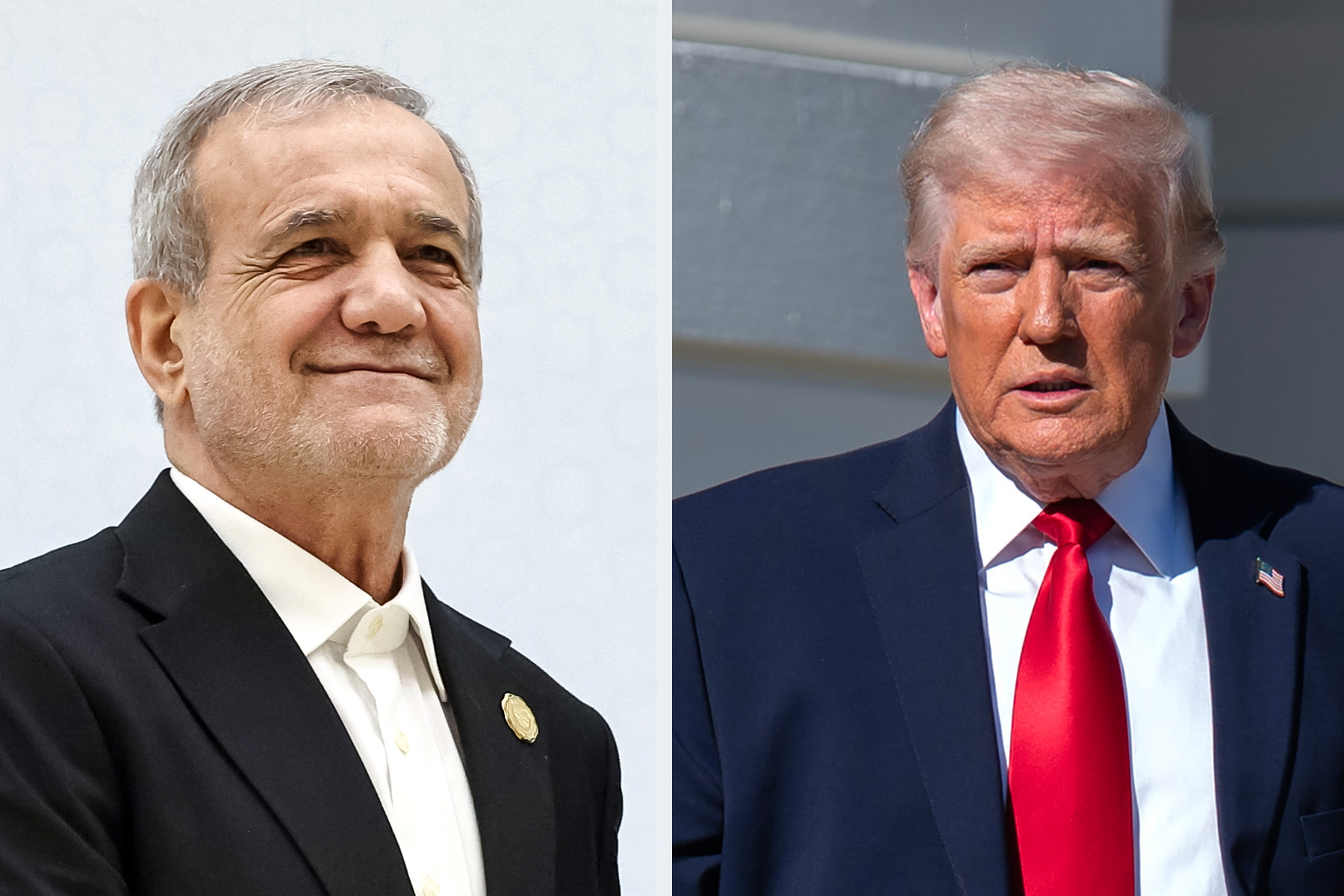
What’s in Iran’s latest proposal – and how has the US responded?

Published

on

Trump administration signals rejection of Iran’s offer which includes opening the Strait of Hormuz but postponing discussion around Tehran’s nuclear file.

The United States is considering a new proposal from Iran to end the ongoing war amid a fragile ceasefire between the longtime adversaries.

The offer focuses on reopening the strategic Strait of Hormuz while postponing a deal on Iran’s nuclear programme, arguably the most contentious issue between Tehran and Washington.

According to US media outlets, the proposal has drawn scrutiny in Washington, and officials there have expressed scepticism.

Early indications from the Trump administration suggest the plan is unlikely to be accepted in its current form, potentially further delaying any prospect of permanently ending the currently paused US-Israel war on Iran, which has killed thousands and sent global energy prices soaring.

Iran’s latest proposal aims for de-escalation in the Gulf without immediately placing restraints on its nuclear programme, as the US has demanded. Tehran has offered to reopen the Strait of Hormuz on the condition that the US lifts its naval blockade on Iranian ports and agrees to end the war.

Iran has effectively closed the strait to shipping, creating global economic pressure by driving up energy prices and disrupting supply chains. In peacetime, one-fifth of the world’s oil and liquefied natural gas (LNG) supplies are shipped through the narrow passage, which links Gulf oil producers to the open ocean.

Days after the ceasefire began on April 8, Trump announced a blockade on Iranian ports and ships, restricting Tehran’s ability to export oil and cutting off a crucial source of its revenue.

However, a central feature of Iran’s offer to reopen the Strait to all traffic is that discussions over Iran’s nuclear activities would be postponed until after the war ends.

The proposal was conveyed to Washington through Pakistan, which has been acting as a mediator.

“These messages concern some of the Islamic Republic of Iran’s red lines, including nuclear issues and the Strait of Hormuz,” Iranian state media Fars News Agency reported.

“Informed sources emphasise Mr Araghchi is acting entirely within the framework of the specified red lines and the diplomatic duties of the Ministry of Foreign Affairs.”

The news agency said the messages relayed were “unrelated to negotiations” and are “considered an initiative by Iran to clarify the regional situation”.

On Monday, Tehran’s envoy to the United Nations, Amir Saeid Iravani, said “lasting stability and security” in the Gulf and the wider region can only be achieved through a durable and permanent cessation of aggression against Iran.

Iranian analyst Abas Aslani said Iran’s latest proposal is based on an “altered” approach.

Aslani, a senior research fellow at the Centre for Middle East Strategic Studies, told Al Jazeera that Tehran believes its previous model – which was based on making compromises on its nuclear programme in exchange for economic sanctions relief – is no longer a “viable path towards a potential accord”.

“Iran believes this can also function as a trust-building measure to compensate for the trust-deficit issue,” he added.

Analyst Negar Mortazavi, a Center for International Policy senior fellow and host of The Iran Podcast, said the Iran proposal looks “reasonable” as the the situation in the Strait of Hormuz has created a “a global crisis and countries around the world want it resolved”.

“Both Tehran and Washington need to immediately focus on reforming the Strait,” Mortazavi added. “Tehran will not move if the US doesn’t lifts its blockade, and Washington will not do so if Iran does not open the strait. So this can be a good first step towards a more permanent ceasefire, and then after reducing tension, the two sides can talk about other issues.”

On the nuclear file, she said while it was a “top priority” issue for both Washington and Israel, it is a “complex issue”.

“Tehran once negotiated a successful nuclear deal with the Obama administration, which took two years of intense negotiations,” she said.

“Tehran also tried to negotiate on its nuclear programme with the Trump administration once last year and again this year, and both times the patience of the US president was very short and, in the middle of negotiations, Iran was attacked.”

As a result, Mortazavi said, the nuclear issue cannot be resolved “in a few hours in high-level meetings between the US vice president and the Iranian speaker of parliament”.

“The nuclear issue … needs serious negotiations with technical experts, and it has to be done with proper time and patience. It would be better if it happens after the war ends, in an atmosphere of peace and calm, and not during an active conflict between the different sides,” she added.

US President Donald Trump met with top security advisers on Monday to discuss the Iranian proposal, the White House confirmed.

However, according to media reports, the US response has been largely dismissive. According to Reuters, an unnamed US official said President Trump was unhappy with the proposal because it did not include provisions for Iran’s nuclear programme. The official noted that “he doesn’t love the proposal”.

Citing two people familiar with the matter, US media outlet CNN reported that Trump was unlikely to accept the proposal. It said Washington lifting its blockade of Iranian ports without resolving questions over Tehran’s nuclear programme “could remove a key piece of American leverage in the talks”.

Secretary of State Marco Rubio told Fox News on Monday that the proposal was “better than what we thought they were going to submit”, but questioned Tehran’s intentions.

“They’re very good negotiators,” he said. “We have to ensure that any deal that is made, any agreement that is made, is one that definitively prevents them from sprinting towards a nuclear weapon at any point.”

Al Jazeera’s Mike Hanna, reporting from Washington, said, “There’s been a complete lid over what was discussed” during the meeting between Trump and his national security team.

“It was so tight that we do not know exactly who in his national security team was present at that meeting,” Hanna added.

“Normally, there is some form of readout or some form of more information giving, fleshing out the details of a meeting like this.”

While the “US and Iran feel that time is on their side, the longer this goes on, the more difficult it’s going to be,” Mohamed Elmasry, an analyst for the Doha Institute of Graduate Studies, said.

“I really don’t think time is on anyone’s side. I really do think the Europeans are losing patience,” he told Al Jazeera.

On Monday, German Chancellor Merz stated that the “Iranians are negotiating very skilfully”, Elmasry noted. He said this shows that Trump is coming under increasing pressure from his allies, “who believe he [Trump] got them into this big mess and isn’t able to clean it up”.

“Trump isn’t going to be happy hearing that and the chancellor is hitting Trump where it hurts.”

📰 மூல செய்தி (Source): https://www.aljazeera.com/news/2026/4/28/whats-in-irans-latest-proposal-and-how-has-the-us-responded?traffic_source=rss

உலகம்

UAE leaves OPEC in blow to oil cartel amid war on Iran

Published

on

Announcement of May 1 exit comes as Gulf producers are already struggling to ship exports through the Strait of Hormuz.

The United ‌Arab Emirates (UAE) has announced its decision to quit OPEC and OPEC+ to focus on “national interests”, dealing ⁠a heavy ⁠blow to the oil-exporting groups at a time when the US-Israel war on Iran has caused ⁠a historic energy shock and rattled the global economy.

The move, which will take effective on May 1, reflects “the UAE’s long-term strategic and economic vision and evolving energy profile”, a statement carried by state media said on Tuesday.

“During our time in the organisation, we made significant contributions and even greater sacrifices for the benefit of all,” it added. “However, the time has come to focus our efforts on what our national interest dictates.”

The loss of the UAE, a longstanding OPEC member, could create disarray and weaken the bloc, which has usually sought to show a united ⁠front despite internal disagreements over a range of issues from geopolitics to production quotas.

UAE Energy Minister Suhail Mohamed al-Mazrouei said the decision was taken after a careful look at the regional power’s energy strategies. Asked whether the UAE consulted with OPEC heavyweight Saudi Arabia, he said the UAE did not raise the issue with ‌any other country.

“This is a policy decision, it has been done after a careful look at current and future policies related to level of production,” the energy minister told Reuters news agency.

OPEC Gulf producers have already been struggling to ship exports through the Strait of Hormuz, a ‌narrow chokepoint between Iran and Oman through which a fifth of the world’s crude oil and liquefied natural gas normally passes, because of threats and attacks against vessels amid the war.

United States President Donald Trump has previously accused OPEC of “ripping off the rest of the world” by inflating oil ⁠prices.

Trump has also linked US military support for ⁠the Gulf with oil prices, saying that while the US defends OPEC members, they “exploit this by imposing high oil prices”.

The UAE had been a member of OPEC first through its emirate of Abu Dhabi in 1967, and later when it became its own country in 1971.

The oil cartel based in Vienna has seen some of its market power wane as the US increased its production of crude oil in recent years.

Additionally, the UAE and Saudi Arabia have increasingly competed over economic issues and regional politics, particularly in the Red Sea area.

The two countries had joined in together in a coalition to fight against Yemen’s Iran-backed Houthi rebels in 2015. However, that coalition broke down into recriminations in late December, when Saudi Arabia bombed what it described as a weapons shipment bound for Yemeni separatists backed by the UAE.

Energy research company Rystad Energy said the UAE’s withdrawal marks a significant shift for the oil-producer group.

“Losing a member with 4.8 million barrels per day of capacity, and the ambition to produce more, takes a real tool out of the group’s hands,” Rystad Energy’s head of geopolitical analysis Jorge Leon said in a statement.

“With demand nearing a peak, the calculation for producers with low-cost barrels is changing fast, and waiting your turn inside a quota system starts to look like leaving money on the table,” he continued.

“Saudi Arabia is now left doing more of the heavy lifting on price stability, and the market loses one of the few shock absorbers it had left.”

📰 மூல செய்தி (Source): https://www.aljazeera.com/news/2026/4/28/uae-leaves-opec-and-opec?traffic_source=rss

Continue Reading

உலகம்

Kandice in southern Lebanon

Published

on

Kandice Ardiel works with the United Nations in southern Lebanon. The Israeli military’s  attacks damaged her apartment in Tyre, forcing her to move into a UN office in Naqoura. In her video, Kandice describes  life under fire: forced evacuations, nearby explosions and having to leave the cat behind.

📰 மூல செய்தி (Source): https://www.aljazeera.com/video/on-the-ground/2026/4/28/kandice-in-southern-lebanon?traffic_source=rss

Continue Reading

உலகம்

‘War crime’: Afghan-Pakistan truce under strain after university strike

Published

on

Civilian casualties in Kunar raise tensions as Pakistan denies role, casting shadow over ceasefire and peace talks.

Islamabad, Pakistan – Afghanistan’s Taliban authorities say Pakistani mortars and missiles struck a university and residential neighbourhoods in the eastern province of Kunar on Monday, killing at least seven people and wounding more than 80.

Taliban deputy spokesperson Hamdullah Fitrat said the strikes hit the city of Asadabad, the provincial capital, as well as surrounding districts.

Afghanistan’s Ministry of Higher Education said about 30 students and professors were among the wounded, with Sayed Jamaluddin Afghani University sustaining extensive damage to its buildings and grounds.

Fitrat called the attacks “unforgivable war crimes” against civilians and academic institutions.

Pakistan’s Ministry of Information and Broadcasting rejected the account, describing reports that Pakistani forces had struck the university as a “blatant lie”.

In a statement posted on X, the ministry said no strike had been carried out on the university and that Pakistan’s targeting is “precise and intelligence based”, though it did not explicitly rule out any attack within Afghan territory.

Afghan and Pakistani officials have separately confirmed to Al Jazeera that the two sides have been exchanging fire along their porous border, even though they are formally observing a ceasefire. Kunar is a border province.

The competing claims over the attack on the university have now raised fears that the already fragile ceasefire might completely collapse. The heightened tensions follow days after peace talks held in the Chinese city of Urumqi between the two sides that Afghan Foreign Minister Amir Khan Muttaqi described as “positive”.

The Urumqi talks, hosted by China in early April, brought delegations from both sides together for the first time since the conflict’s most intense phase in February and March, when Pakistan struck Kabul multiple times and declared it was in “open war” with Afghanistan.

Afghanistan described the discussions as “useful”. Pakistan said further progress would depend on Kabul. The talks ended without a formal agreement or joint statement.

Pakistan accuses the Afghan Taliban of providing sanctuary to the Pakistan Taliban, known by the acronym TTP, which emerged in 2007 and, while distinct from the Afghan Taliban, shares deep ideological, social and linguistic ties with the group. The TTP and other groups have carried out a sustained campaign of attacks across Khyber Pakhtunkhwa and Balochistan, according to Pakistani authorities.

Afghanistan rejects accusations that it is sheltering or aiding the TTP and other anti-Pakistan groups.

Mehmood Jan Babar, a Peshawar-based political and security analyst, said the engagement in Urumqi was thin from the start.

Delegations were at the level of diplomats, with no political contact throughout. Pakistan, he said, maintained a firm position and demanded action in writing.

“Until Afghanistan puts something in writing, no verbal commitment will be trusted,” Babar told Al Jazeera. “That is what was said in Urumqi, and that is where things stand.”

Tameem Bahiss, a Kabul-based security analyst, said the outcome reflected how little ground either side had shifted.

“The negotiations in Urumqi did not achieve a clear settlement or agreement,” he told Al Jazeera. “Both sides may agree to talks under pressure from regional countries, but once the talks end, the same problems return.”

Babar noted some softening on the Afghan side.

Muttaqi had reportedly instructed senior ministers to use more restrained language on Pakistan, he said, given how much Kabul has at stake in its relationship with Islamabad.

“But Pakistan’s core position has not changed,” Babar said.

This is not the first time a diplomatic opening has quickly unravelled.

A ceasefire mediated by Qatar and Turkiye in October 2025 was followed by continued low-level clashes.

A temporary Eid ceasefire in March after fighting had resumed in February – brokered at the request of Saudi Arabia, Qatar and Turkiye – was almost immediately disputed.

The Taliban alleged Pakistan carried out dozens of mortar strikes in Kunar while the truce was still in effect.

The most contentious episode came on March 16, when a Pakistani air strike destroyed the Omar Hospital in Kabul, a 2,000-bed addiction treatment facility.

Afghan officials put the death toll at more than 400. The United Nations recorded 143.

Pakistan insisted that its target was not the hospital, but nearby military installations and an ammunition depot. The incident remains the most disputed of the conflict.

Qatar, Saudi Arabia, Turkiye and China have all attempted to broker a lasting arrangement.

Babar said Pakistan had briefed all of them on its position that cross-border attacks on Pakistani soil had decreased when Pakistan carried out its own operations.

“That is a valid argument, and it is holding weight right now,” he said.

But Bahiss said the repeated failures point to something structural.

“The main problem is that Pakistan and Afghanistan have very different views of the security situation,” he said. “If both sides cannot even agree on the nature of the problem, it becomes very difficult for mediators to agree on a solution.”

The Kabul-based analyst added that internal pressures make compromise difficult on both sides.

“Pakistan risks looking weak domestically if it accepts vague assurances and the Taliban risks looking as though it is yielding to outside pressure [if it accepts Islamabad’s assertions],” he said.

At the core of the conflict is a dispute that predates the current fighting.

Kabul denies harbouring the TTP and has accused Islamabad of using attacks in Pakistan as a pretext for interference in Afghan affairs.

Pakistan maintains that the burden lies with Kabul to take verifiable action and has sought written assurances that it says have not been provided.

Bahiss said months of military pressure have yielded little.

“The Taliban have not accepted Pakistan’s main demand in the way Islamabad wants,” he said. “They may be unwilling because of ideological or historical links, or unable because acting against the TTP could create internal divisions. Whatever the reason, the outcome is the same: Pakistan’s demands remain unmet.”

Babar said the picture inside Afghanistan is more complex than a flat refusal.

Several factions within the Taliban hold differing views, he said, with some facing public pressure.

He added that the Afghan Taliban had arrested a significant number of TTP members and their families and transferred them from the eastern provinces deeper into Afghanistan, though it remained unclear whether this constituted a policy shift or a tactical adjustment.

Afghan officials, meanwhile, argue that Pakistan’s campaign has caused civilian casualties that harden public opinion without addressing the underlying drivers of violence.

China’s role as host of the Urumqi talks carries weight. Beijing is Pakistan’s largest trading partner and has significant infrastructure investments in both countries through the economic corridor. It has a direct interest in stabilising the border.

But Babar said no agreement is possible without a written guarantee and a guarantor to enforce it.

He pointed to the Doha accord in 2020, in which the Taliban gave a written commitment that Afghan soil would not be used against any country, a commitment Pakistan says was violated.

The Doha Agreement, signed in February 2020 between the United States and the Afghan Taliban, committed the Taliban to preventing Afghan soil from being used by any group to threaten US or allied security, in exchange for a full withdrawal of US and NATO forces from Afghanistan.

“Pakistan does not want to enter into any agreement that brings it no tangible benefit,” he said. “Until a written commitment comes, nothing else moves.”

Afghanistan has its own demands: That Pakistan keep borders

📰 மூல செய்தி (Source): https://www.aljazeera.com/news/2026/4/28/war-crime-afghan-pakistan-truce-under-strain-after-university-strike?traffic_source=rss

Continue Reading

Trending

Copyright © 2024 by 7Tamil Media, All rights reserved.