Connect with us

உலகம்

US Senate passes ICE funding resolution after ‘vote-a-rama’: What’s next?

Published

on

Republicans take first step, but long road remains to break impasse over funding of Trump’s immigration enforcement.

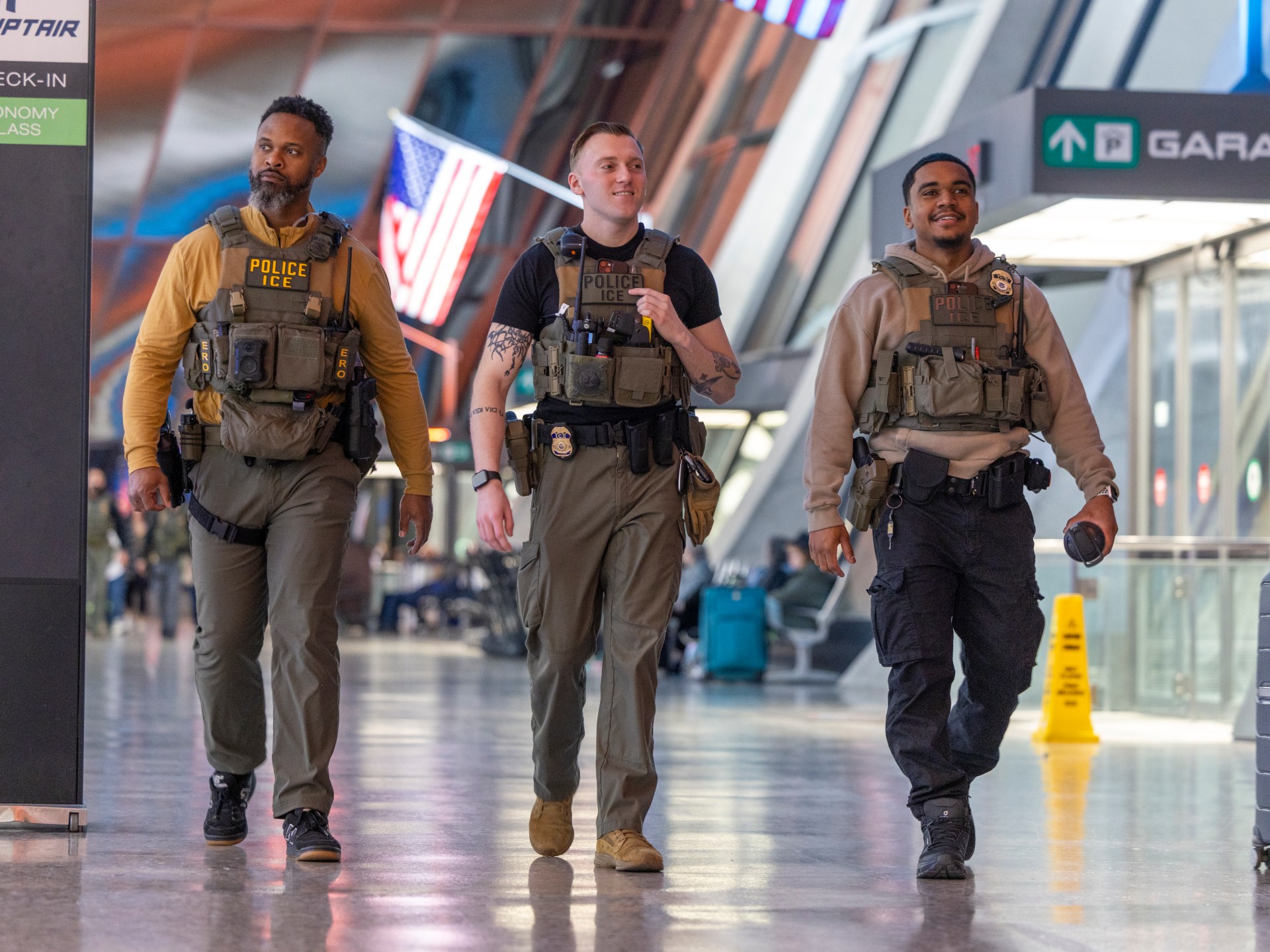
Republicans in the United States Senate have passed a resolution to fund US Immigration and Customs Enforcement (ICE) and Customs and Border Protection (CBP), the first step in ending a months-long standoff sparked by opposition to US President Donald Trump’s mass deportation drive.

Hours of debate gave way early Thursday to a vote on the resolution, in which Republicans, who hold a slim 53-47 majority in the chamber, used a tactic that allowed them to proceed with a simple majority rather than overcoming a 60-vote threshold.

In the end, 50 Republicans voted in favour, while two broke ranks and joined Democrats in voting against the resolution.

Still, Thursday’s vote was far from the final word on the matter. The Republican-controlled US House of Representatives must pass its own resolution.

Then, committees in the Senate and House must both craft the actual funding legislation, which will be subject to another round of votes.

Trump has said he wants the funding bill on his desk by June 1.

Condemnation of Trump’s hardline immigration drive crescendoed in January, when two US citizens, Renee Nicole Good and Alex Pretti, were fatally shot by federal agents in Minneapolis, Minnesota.

Democrats, who had been increasingly criticised for inaction during Trump’s second term, derailed pending legislation to fund the US Department of Homeland Security (DHS), which oversees ICE.

Many noted the department and ICE had already received a massive discretionary windfall in a Republican-backed tax bill passed last year.

The move was a risky gambit, forcing the effective shutdown of DHS and leading to several knock-on effects, including Transportation Security Administration (TSA) staffing shortages that snarled airport traffic.

Trump subsequently signed an executive order to pay TSA staff, temporarily alleviating the problem, although officials have warned they face a funding cliff.

Still, Democrats have largely wagered it is more politically toxic to be seen as supporting Trump’s immigration policies, which have become increasingly unpopular among the US public, than to be blamed for the shutdown, which has stretched on for 68 days.

The Republican resolution effectively allows Senate committees to increase the federal government deficit by about $140bn to fund ICE and Border Patrol. However, top Republican officials have said the final legislation will likely total $70bn to fund both agencies for three and a half years.

Typically in the Senate, the minority party can use a so-called “filibuster” to block legislation. A party needs 60 votes to overcome a filibuster.

With Democrats dug in in their opposition, Republicans are instead pursuing a convoluted process known as a “budget reconciliation”.

Passing funding via reconciliation requires only a simple majority, but it is generally a cumbersome, multi-step process that, among other drawbacks, eats up time that could be used on other legislation.

Under Senate rules, debate on budget resolutions is limited to 50 hours, which lawmakers reached shortly before passing the measure early on Thursday.

While Republican tactics neutralised Democrats’ ability to filibuster the resolution, the minority party still employed another tactic to both delay the final vote and to force Republicans to take positions on potentially politically fraught issues.

After the 50 hours of debate expired, Democrats conducted a so-called “vote-a-rama”, in which they introduced rapid-fire, often symbolic amendments, which were immediately voted on.

Prior to the early morning manoeuvre, the top Democrat in the Senate, Chuck Schumer, said the party would use the “vote-a-rama” to portray Republicans as out of touch with citizens’ affordability concerns, a key issue ahead of the midterm elections in November.

“This will be a reconciliation of contrasts, and we are relishing that fight,” Schumer said. “Republicans want to shell out billions of dollars to Donald Trump’s private army without any common-sense restraints or reforms. Democrats want to put money in people’s pockets by lowering their costs.”

Three Republicans broke from their party to support an amendment aimed at addressing the high rate of health insurance company delays and denials of claims, underscoring the issue’s salience for those facing punishing re-election campaigns.

Three Republicans also supported an amendment to slash prescription drug prices, introduced by progressive Senator Bernie Sanders.

Meanwhile, Senator John Kennedy, a Republican, sought to lay the groundwork to include the Trump-backed SAVE America Act, which supporters say will increase election security and detractors say will disenfranchise millions of voters, in the final funding legislation.

The push failed, with four Republicans voting against including Kennedy’s amendment.

The resolution passed by Republicans in the Senate is essentially a set of instructions for committees to build the eventual funding legislation. Republicans in the House could seek to change the parameters of those instructions, requiring lawmakers in both chambers to mediate the differences.

Once both sides approve the parameters, the real work of hammering out the final legislation will begin. It will eventually also be subject to another 50-hour debate process, which could then give way to yet another “vote-a-rama”.

Once both chambers pass the final legislation, it will go to US President Donald Trump’s desk for signing. Republicans have said they hope to advance the final legislation by next month.

📰 மூல செய்தி (Source): https://www.aljazeera.com/news/2026/4/23/us-senate-passes-ice-funding-resolution-after-vote-a-rama-whats-next?traffic_source=rss

Continue Reading
Click to comment

Leave a Reply

Your email address will not be published. Required fields are marked *

உலகம்

Chornobyl’s surviving ‘liquidators’ return 40 years after nuclear disaster

Published

on

About 600,000 soldiers, firefighters, engineers, miners and medics cleaned up after the explosion of the Soviet Union’s Chornobyl Nuclear Power Plant.

Ukraine is marking 40 years since the explosion at the Chornobyl Nuclear Power Plant, the world’s worst civilian nuclear disaster, with survivors of the cleanup operation returning to the site amid renewed debate over its human and environmental toll.

At 1:23am on April 26 (22:23 GMT, April 25), 1986, a botched safety test triggered a catastrophic blast in reactor four at the Chornobyl plant in northern Ukraine, then part of the Soviet Union.

The explosion tore through the building and sent an enormous plume of radioactive smoke into the atmosphere.

Nuclear fuel burned for more than 10 days as helicopters dumped thousands of tonnes of sand, clay and lead in a desperate bid to smother the fire.

The International Atomic Energy Agency (IAEA) later blamed “severe deficiencies in the design of the reactor and the shutdown system” as well as violations of operating procedures.

Radiation heavily contaminated large areas of Ukraine, Belarus and Russia, before spreading across Europe.

About 600,000 “liquidators” – soldiers, firefighters, engineers, miners and medics – were mobilised from across the Soviet Union over the next four years to contain and clean up the disaster.

Their tasks ranged from flying above the exposed core to wash and seal it, to scrubbing radioactive dust from buildings and roads, burying poisoned machinery, clearing forests and even hunting animals to slow the spread of contamination.

Many had little understanding of the dangers they faced. Before the anniversary, a group of liquidators from Ukraine’s Poltava region returned to Chornobyl for a day’s visit to the site where they once worked in hastily issued uniforms and improvised protective gear.

They spoke of duty carried out without hesitation, the loss they endured, and of a catastrophe that continues to haunt Ukraine.

The nearby city of Pripyat, once home to 48,000 people, remains a decaying ghost town inside an exclusion zone, spanning thousands of square kilometres in northern Ukraine and neighbouring Belarus.

Once open to tourists, the area has been closed since Russia’s invasion in 2022, leaving nature to reclaim the landscape and rare species, such as endangered Przewalski’s horses, to roam among the ruins.

📰 மூல செய்தி (Source): https://www.aljazeera.com/gallery/2026/4/26/survivors-return-to-chernobyl-40-years-after-devastating-explosion?traffic_source=rss

Continue Reading

உலகம்

What to know about Cole Allen, alleged WH correspondents’ dinner shooter

Published

on

Suspect arrested as the US president evacuated from the stage after firing at the White House correspondents’ dinner.

Police in the United States have arrested a suspected gunman who stormed the lobby outside the White House Correspondents’ Association (WHCA) dinner, attended by US President Donald Trump, at a hotel in Washington, DC.

The firing prompted the evacuation of Trump, along with the members of his cabinet, from the media gala, being held at the Washington Hilton on Saturday evening. The president later called the incident an attack by a “would-be assassin”.

Security personnel shot at the suspect after he forced his way through a checkpoint just outside the hotel ballroom, where the president, First Lady Melania Trump, top officials and hundreds of formally dressed guests were assembled.

The man, identified as 31-year-old Cole Tomas Allen in US media reports, was arrested at the scene. Official confirmation has yet to be released.

People dived under tables in chaotic scenes as Secret Service teams swarmed into the glitzy WHCA dinner, held annually at the Washington Hilton in the US capital.

“A man charged a security checkpoint armed with multiple weapons, and he was taken down by some very brave members of the Secret Service,” Trump told a news conference at the White House shortly after the incident.

“They seem to think he was a lone wolf, and I feel that too,” he said, after posting video of the suspect sprinting past security as guards drew their weapons.

So, what do we know about the suspect, and where is he now?

Law enforcement officials, who have not released the suspect’s name, say he lives in Torrance, California, a coastal city in the South Bay region near Los Angeles along Santa Monica Bay.

The chief of Washington, DC’s police department said investigators think the suspect was staying as a guest at the Washington Hilton, where the annual dinner was held, though they have not yet established a motive.

Facebook posts appearing to be linked to Allen indicate he was recognised as “Teacher of the Month” in December 2024 by the Torrance branch of C2 Education, a national private tutoring and test-preparation company for college-bound students.

A LinkedIn profile under the suspect’s name describes him as a “mechanical engineer and computer scientist by degree, independent game developer by experience, teacher by birth”.

Allen contributed $25 to a Democratic Party political action committee in support of Kamala Harris for president in 2024, according to federal campaign finance records.

Meanwhile, speaking to reporters, Trump said it was unlikely the shooting was linked to the US-Israel war on Iran.

“It’s not going to deter me from winning the war in Iran. I don’t know if that had anything to do with it, I really don’t think so, based on what we know,” Trump told reporters.

The interim chief for the Metropolitan Police Department of the District of Columbia, Jeffery Carroll, told reporters on Saturday that investigators believe the suspect was staying in the hotel, and that is how he apparently entered it at the time of the event.

The hotel was closed to the public beginning at 2pm (18:00 GMT) on Saturday in anticipation of the dinner, which began at 8pm (00:00 GMT). Outside, dozens of protesters gathered in the rain, mostly directing their criticism at the media attending the event.

Access to the hotel was restricted to hotel guests, people with tickets to the dinner, an invitation to one of the receptions held at the hotel before or after the dinner, or documents from the WHCA indicating affiliation with the dinner.

The 2,300 guests at the event in the hotel’s cavernous subterranean ballroom had to pass through several additional checks to enter the room, including showing tickets to association volunteers and hotel staff and passing through magnetometers crewed by the Secret Service and the Transportation Security Administration.

Security camera footage released by Trump on social media shortly after the incident shows the suspect running past security officers who appear to be disassembling the metal detectors.

Once the president was seated in the ballroom, additional attendees were not permitted to enter the secured area, which is why they were taking them down.

“It shows that our multilayered protection works,” Secret Service Director Sean Curran said. His comments were echoed by Carroll, who said the security plan for the evening was developed by the Secret Service and “that security plan did work this evening”.

However, Richard Gaisford, reporting for Al Jazeera from Washington, DC, said, “All eyes will now be on whether there was enough security in place.”

“This isn’t the first time that someone has tried to kill the president if that was the main aim of this evening’s attack,” he said.

“The man is being held, and we’re told, will be asked these questions. And certainly, we’ll get a clearer picture of the intent and more details of what happened tomorrow.”

Trump has been the target of several assassination attempts and numerous death threats during both his presidency and his campaigns.

The most serious incident occurred in July 2024 at a rally in Butler, Pennsylvania, when a gunman reached a rooftop overlooking the stage where the then-candidate was speaking. A spectator was killed, Trump was wounded in the ear, and Secret Service agents shot dead the attacker, identified as 20-year-old Thomas Crooks.

A few months later, in September, authorities said an armed man lay in wait near Trump’s golf course in West Palm Beach, Florida, intending to kill him.

Prosecutors said the suspect, Ryan Routh, spent weeks planning the attack and aimed a rifle through bushes as Trump played golf, but a Secret Service agent spotted him before he could shoot, and he was arrested shortly afterwards. Routh was convicted last year of attempting to kill the president and received a life sentence in February.

The same month, 21-year-old Austin Tucker Martin was shot dead after entering Trump’s Mar-a-Lago resort in Florida with a shotgun; Trump was not on the property at the time.

📰 மூல செய்தி (Source): https://www.aljazeera.com/news/2026/4/26/who-is-the-suspected-correspondent-dinner-shooter-cole-tomas-allen?traffic_source=rss

Continue Reading

உலகம்

Raghu Rai, legendary Indian photographer, dies at 83

Published

on

A Magnum Photos icon, Rai’s photographs preserved India’s memory through some of its pathbreaking events spanning decades.

Internationally acclaimed photographer Raghu Rai, widely regarded as one of the foremost chroniclers of independent India, has died at the age of 83.

The photographer’s family on Sunday announced Rai’s death in a statement, paying tribute to “our beloved”.

A construction engineer by training, Rai was born in a village in what is now Pakistan’s Punjab province before the 1947 partition of the Indian subcontinent.

He went on to become an iconic photographer documenting the complex social and political life of India, with his work ranging from historic turning points to intimate portraits.

Some of his best-known works include documenting the 1971 independence war of Bangladesh and the 1984 gas leak in the central Indian city of Bhopal that killed an estimated 25,000 people.

His photographs from Bhopal became defining visual records of India’s worst industrial disaster.

In 1972, Rai was awarded the Padma Shri, one of India’s highest civilian honours, for his exceptional work. He also won the inaugural Academie des Beaux-Arts Photography Award, cementing his place on the global stage.

“He didn’t just take photographs, he preserved our nation’s memory,” India’s main opposition leader, Rahul Gandhi, posted in his tribute on X.

Known for portraits of India’s political and social elite and photographing its culture and masses with equal alacrity, Rai published dozens of photo-books, including one on the iconic Mughal monument to love, the Taj Mahal.

His intimate portraits of Nobel Peace Prize winner Mother Teresa hold a particularly special place in Rai’s work.

Rai was a member of Magnum Photos, nominated to the prestigious New York-based cooperative by Henri Cartier-Bresson, who is known worldwide for his defining candid photography.

“To the world, he was an incomparable master of photography, the visionary who captured the pulsating heart and soul of India,” Indian parliamentarian and author Shashi Tharoor said in a tribute. “Your vision will forever be the lens through which India is seen.”

According to the Indian Express newspaper, Rai was introduced to photography by his photographer brother six decades ago and published his first picture, a donkey gazing straight into his camera, in The Times of London.

Rai later moved to photojournalism, working with some of the nation’s best-known media houses of his time through the 1960s and 70s, before going solo in his quest to depict his vast country’s complexity.

Rai’s work spans shooting on film and digital formats, both black and white and colour. He worked all his life in India, and once said, “I can never be true to my experiences without a camera.”

📰 மூல செய்தி (Source): https://www.aljazeera.com/news/2026/4/26/raghu-rai-legendary-indian-photographer-dies-at-83?traffic_source=rss

Continue Reading

Trending

Copyright © 2024 by 7Tamil Media, All rights reserved.