Connect with us

உலகம்

What to know about Cole Allen, alleged WH correspondents’ dinner shooter

Published

on

Suspect arrested as the US president evacuated from the stage after firing at the White House correspondents’ dinner.

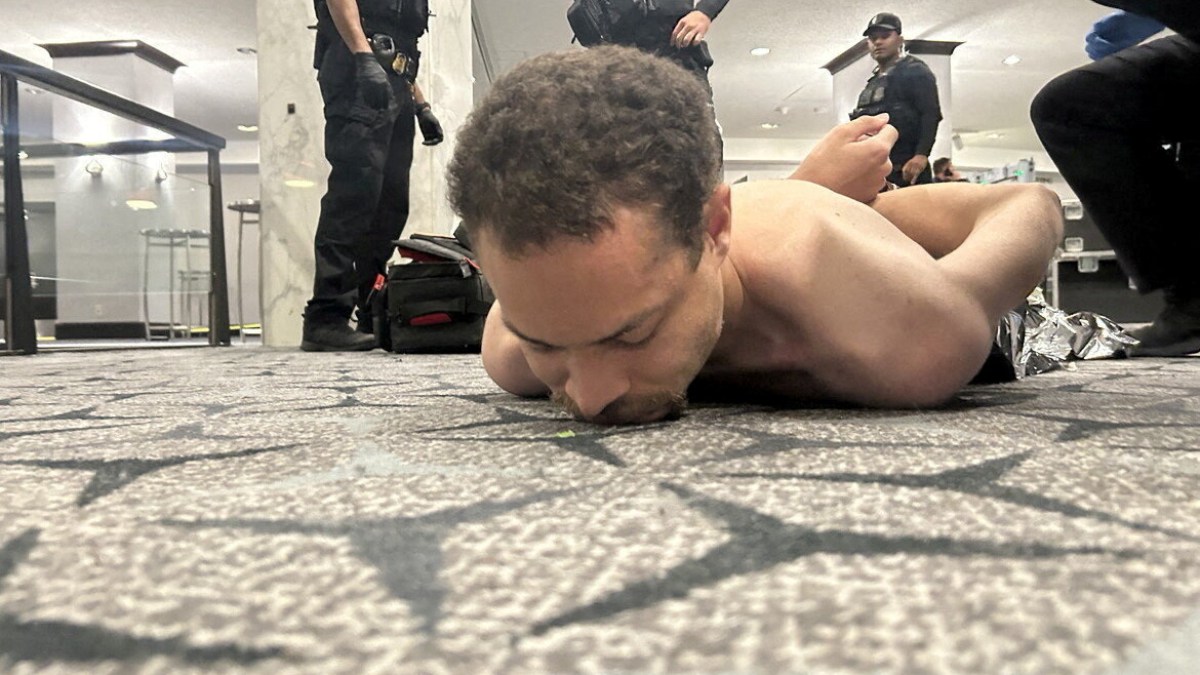
Police in the United States have arrested a suspected gunman who stormed the lobby outside the White House Correspondents’ Association (WHCA) dinner, attended by US President Donald Trump, at a hotel in Washington, DC.

The firing prompted the evacuation of Trump, along with the members of his cabinet, from the media gala, being held at the Washington Hilton on Saturday evening. The president later called the incident an attack by a “would-be assassin”.

Security personnel shot at the suspect after he forced his way through a checkpoint just outside the hotel ballroom, where the president, First Lady Melania Trump, top officials and hundreds of formally dressed guests were assembled.

The man, identified as 31-year-old Cole Tomas Allen in US media reports, was arrested at the scene. Official confirmation has yet to be released.

People dived under tables in chaotic scenes as Secret Service teams swarmed into the glitzy WHCA dinner, held annually at the Washington Hilton in the US capital.

“A man charged a security checkpoint armed with multiple weapons, and he was taken down by some very brave members of the Secret Service,” Trump told a news conference at the White House shortly after the incident.

“They seem to think he was a lone wolf, and I feel that too,” he said, after posting video of the suspect sprinting past security as guards drew their weapons.

So, what do we know about the suspect, and where is he now?

Law enforcement officials, who have not released the suspect’s name, say he lives in Torrance, California, a coastal city in the South Bay region near Los Angeles along Santa Monica Bay.

The chief of Washington, DC’s police department said investigators think the suspect was staying as a guest at the Washington Hilton, where the annual dinner was held, though they have not yet established a motive.

Facebook posts appearing to be linked to Allen indicate he was recognised as “Teacher of the Month” in December 2024 by the Torrance branch of C2 Education, a national private tutoring and test-preparation company for college-bound students.

A LinkedIn profile under the suspect’s name describes him as a “mechanical engineer and computer scientist by degree, independent game developer by experience, teacher by birth”.

Allen contributed $25 to a Democratic Party political action committee in support of Kamala Harris for president in 2024, according to federal campaign finance records.

Meanwhile, speaking to reporters, Trump said it was unlikely the shooting was linked to the US-Israel war on Iran.

“It’s not going to deter me from winning the war in Iran. I don’t know if that had anything to do with it, I really don’t think so, based on what we know,” Trump told reporters.

The interim chief for the Metropolitan Police Department of the District of Columbia, Jeffery Carroll, told reporters on Saturday that investigators believe the suspect was staying in the hotel, and that is how he apparently entered it at the time of the event.

The hotel was closed to the public beginning at 2pm (18:00 GMT) on Saturday in anticipation of the dinner, which began at 8pm (00:00 GMT). Outside, dozens of protesters gathered in the rain, mostly directing their criticism at the media attending the event.

Access to the hotel was restricted to hotel guests, people with tickets to the dinner, an invitation to one of the receptions held at the hotel before or after the dinner, or documents from the WHCA indicating affiliation with the dinner.

The 2,300 guests at the event in the hotel’s cavernous subterranean ballroom had to pass through several additional checks to enter the room, including showing tickets to association volunteers and hotel staff and passing through magnetometers crewed by the Secret Service and the Transportation Security Administration.

Security camera footage released by Trump on social media shortly after the incident shows the suspect running past security officers who appear to be disassembling the metal detectors.

Once the president was seated in the ballroom, additional attendees were not permitted to enter the secured area, which is why they were taking them down.

“It shows that our multilayered protection works,” Secret Service Director Sean Curran said. His comments were echoed by Carroll, who said the security plan for the evening was developed by the Secret Service and “that security plan did work this evening”.

However, Richard Gaisford, reporting for Al Jazeera from Washington, DC, said, “All eyes will now be on whether there was enough security in place.”

“This isn’t the first time that someone has tried to kill the president if that was the main aim of this evening’s attack,” he said.

“The man is being held, and we’re told, will be asked these questions. And certainly, we’ll get a clearer picture of the intent and more details of what happened tomorrow.”

Trump has been the target of several assassination attempts and numerous death threats during both his presidency and his campaigns.

The most serious incident occurred in July 2024 at a rally in Butler, Pennsylvania, when a gunman reached a rooftop overlooking the stage where the then-candidate was speaking. A spectator was killed, Trump was wounded in the ear, and Secret Service agents shot dead the attacker, identified as 20-year-old Thomas Crooks.

A few months later, in September, authorities said an armed man lay in wait near Trump’s golf course in West Palm Beach, Florida, intending to kill him.

Prosecutors said the suspect, Ryan Routh, spent weeks planning the attack and aimed a rifle through bushes as Trump played golf, but a Secret Service agent spotted him before he could shoot, and he was arrested shortly afterwards. Routh was convicted last year of attempting to kill the president and received a life sentence in February.

The same month, 21-year-old Austin Tucker Martin was shot dead after entering Trump’s Mar-a-Lago resort in Florida with a shotgun; Trump was not on the property at the time.

📰 மூல செய்தி (Source): https://www.aljazeera.com/news/2026/4/26/who-is-the-suspected-correspondent-dinner-shooter-cole-tomas-allen?traffic_source=rss

Continue Reading
Click to comment

Leave a Reply

Your email address will not be published. Required fields are marked *

உலகம்

Chornobyl’s surviving ‘liquidators’ return 40 years after nuclear disaster

Published

on

About 600,000 soldiers, firefighters, engineers, miners and medics cleaned up after the explosion of the Soviet Union’s Chornobyl Nuclear Power Plant.

Ukraine is marking 40 years since the explosion at the Chornobyl Nuclear Power Plant, the world’s worst civilian nuclear disaster, with survivors of the cleanup operation returning to the site amid renewed debate over its human and environmental toll.

At 1:23am on April 26 (22:23 GMT, April 25), 1986, a botched safety test triggered a catastrophic blast in reactor four at the Chornobyl plant in northern Ukraine, then part of the Soviet Union.

The explosion tore through the building and sent an enormous plume of radioactive smoke into the atmosphere.

Nuclear fuel burned for more than 10 days as helicopters dumped thousands of tonnes of sand, clay and lead in a desperate bid to smother the fire.

The International Atomic Energy Agency (IAEA) later blamed “severe deficiencies in the design of the reactor and the shutdown system” as well as violations of operating procedures.

Radiation heavily contaminated large areas of Ukraine, Belarus and Russia, before spreading across Europe.

About 600,000 “liquidators” – soldiers, firefighters, engineers, miners and medics – were mobilised from across the Soviet Union over the next four years to contain and clean up the disaster.

Their tasks ranged from flying above the exposed core to wash and seal it, to scrubbing radioactive dust from buildings and roads, burying poisoned machinery, clearing forests and even hunting animals to slow the spread of contamination.

Many had little understanding of the dangers they faced. Before the anniversary, a group of liquidators from Ukraine’s Poltava region returned to Chornobyl for a day’s visit to the site where they once worked in hastily issued uniforms and improvised protective gear.

They spoke of duty carried out without hesitation, the loss they endured, and of a catastrophe that continues to haunt Ukraine.

The nearby city of Pripyat, once home to 48,000 people, remains a decaying ghost town inside an exclusion zone, spanning thousands of square kilometres in northern Ukraine and neighbouring Belarus.

Once open to tourists, the area has been closed since Russia’s invasion in 2022, leaving nature to reclaim the landscape and rare species, such as endangered Przewalski’s horses, to roam among the ruins.

📰 மூல செய்தி (Source): https://www.aljazeera.com/gallery/2026/4/26/survivors-return-to-chernobyl-40-years-after-devastating-explosion?traffic_source=rss

Continue Reading

உலகம்

Raghu Rai, legendary Indian photographer, dies at 83

Published

on

A Magnum Photos icon, Rai’s photographs preserved India’s memory through some of its pathbreaking events spanning decades.

Internationally acclaimed photographer Raghu Rai, widely regarded as one of the foremost chroniclers of independent India, has died at the age of 83.

The photographer’s family on Sunday announced Rai’s death in a statement, paying tribute to “our beloved”.

A construction engineer by training, Rai was born in a village in what is now Pakistan’s Punjab province before the 1947 partition of the Indian subcontinent.

He went on to become an iconic photographer documenting the complex social and political life of India, with his work ranging from historic turning points to intimate portraits.

Some of his best-known works include documenting the 1971 independence war of Bangladesh and the 1984 gas leak in the central Indian city of Bhopal that killed an estimated 25,000 people.

His photographs from Bhopal became defining visual records of India’s worst industrial disaster.

In 1972, Rai was awarded the Padma Shri, one of India’s highest civilian honours, for his exceptional work. He also won the inaugural Academie des Beaux-Arts Photography Award, cementing his place on the global stage.

“He didn’t just take photographs, he preserved our nation’s memory,” India’s main opposition leader, Rahul Gandhi, posted in his tribute on X.

Known for portraits of India’s political and social elite and photographing its culture and masses with equal alacrity, Rai published dozens of photo-books, including one on the iconic Mughal monument to love, the Taj Mahal.

His intimate portraits of Nobel Peace Prize winner Mother Teresa hold a particularly special place in Rai’s work.

Rai was a member of Magnum Photos, nominated to the prestigious New York-based cooperative by Henri Cartier-Bresson, who is known worldwide for his defining candid photography.

“To the world, he was an incomparable master of photography, the visionary who captured the pulsating heart and soul of India,” Indian parliamentarian and author Shashi Tharoor said in a tribute. “Your vision will forever be the lens through which India is seen.”

According to the Indian Express newspaper, Rai was introduced to photography by his photographer brother six decades ago and published his first picture, a donkey gazing straight into his camera, in The Times of London.

Rai later moved to photojournalism, working with some of the nation’s best-known media houses of his time through the 1960s and 70s, before going solo in his quest to depict his vast country’s complexity.

Rai’s work spans shooting on film and digital formats, both black and white and colour. He worked all his life in India, and once said, “I can never be true to my experiences without a camera.”

📰 மூல செய்தி (Source): https://www.aljazeera.com/news/2026/4/26/raghu-rai-legendary-indian-photographer-dies-at-83?traffic_source=rss

Continue Reading

உலகம்

Yemen’s landmine crisis endures despite truce and de-mining efforts

Published

on

Landmines in Yemen continue to kill and maim, even amid ceasefire efforts and ongoing de-mining initiatives.

Sanaa, Yemen – It was August 2023, and Enaya Dastor was reading a school textbook while also keeping an eye on her goats as they grazed near her village, Jabal Habashy, in central Yemen’s Taiz governorate.

Whenever the livestock moved away, the then-13-year-old would walk or run to bring them back to the pasture near her house.

That afternoon, she was following them as usual when an explosion rang out.

“People gathered around me after the blast, and I was taken to the hospital immediately. It was a horrible moment, ” Dastor told Al Jazeera. Surgeons were forced to amputate her left leg, leaving her with a lifelong disability.

The incident took place more than a year after fighting between Yemen’s government and Houthi forces largely stopped, following a ceasefire in April 2022.

But landmines left behind on former battlefields and front lines continue to kill and injure Yemenis.

The hidden risks have turned fields, roads, and villages into areas of ongoing danger. Landmines and other explosives have killed at least 339 children and injured 843 since the 2022 truce, according to Save the Children. The organisation found that nearly half of child casualties related to the conflict were due to landmines and explosive remnants of war.

The parties to Yemen’s conflict planted thousands of mines during the civil war, which began in 2014.

Two months before Dastor’s incident, a boy in a nearby village had stepped on a landmine. One of the boy’s legs was amputated in the explosion, she told Al Jazeera.

“Landmines are sleeping killers, waiting for the innocents to step on them or move them without caution. That is how they wake up to shed blood and take human souls,” said Dastor.

“I used to go with other girls to the pasture. We grazed the cattle and play for hours. We were not aware of the danger, and we did not know when these deadly objects were planted,” she added.

After the landmine explosion took her leg, her family and others fled the village, which had previously been on a front line.

To date, Dastor’s family has not returned. They now live in the city of Taiz.

“I do not want to see another child harmed or hear another landmine explosion. I loathe walking on the soil under which mines were planted,” she said.

In the first half of 2025 alone, 107 civilians were killed or injured, most of them children, according to Save the Children. Included in that number are five children who were killed while playing football on a dirt field in Taiz.

From 2015 through 2021, ground fighting was brutal, and warplanes continuously bombed across Yemen, killing and injuring thousands of civilians.

The landmines have added a lasting layer of danger. A study carried out in 2022 by Yemeni human rights groups found that 534 children and 177 women were killed by mines between April 2014 and March 2022.

In addition, 854 children, 255 women, and 147 elderly people were injured during the same period in 17 Yemeni provinces, with the heavily fought-over Taiz recording the highest number.

In 2018, Mohammed Mustafa lost his left leg in a landmine explosion in Taiz’s Maqbna district. He was only 20 years old. Eight years on, he can still recall the details of that moment.

“I stepped on a landmine when I was walking in a mountainous area at sunset time. After the blast, I looked towards my feet, and I found my left leg was gone,” he told Al Jazeera.

Mustafa was in a rural area with no hospitals nearby. He had to travel five hours by ambulance to the city of Taiz, and the distance he covered to reach a healthcare centre added to his pain.

“I fainted repeatedly on the way to Taiz city. The next day, I woke up in the hospital, and saw my leg amputated up to the knee,” he said.

With support from family, relatives and friends, he recovered. Mustafa is now a member of the Yemeni Amputee Football Federation, a father, and a small business owner.

“My family and friends stood by me, lifted my morale, and accompanied me on outings in the city to help me forget my pain and worry. I realised I was not alone,” he said.

Efforts to remove landmines from many areas in Yemen continue. But totally ridding the country of the problem remains complex, particularly as no final deal has been agreed upon to end the war.

Project Masam, a de-mining team funded and initiated by Saudi Arabia, said in a statement in March that, since the project’s launch in July 2018, a total of 549,452 mines, unexploded ordnance, and improvised explosive devices (IEDs) had been removed by March 20, 2026.

During the same period, the project’s teams cleared explosives from 7,799 hectares (19,272 acres) in Yemen. Similarly, the Danish Refugee Council (DRC) said early this month it has cleared more than 23,302 square metres (250,820sq ft) of Yemeni land from mines and explosive remnants of war.

Adel Dashela, a Yemeni researcher and non-resident fellow at the MESA Global Academy, focusing on conflict and peace building studies, said that many factors make the de-mining process challenging.

“The mines have been planted indiscriminately in different areas, and some of the territories are under the control of different armed groups, which makes them inaccessible to de-miners,” Dashela told Al Jazeera.

“Other challenges facing the de-mining process in Yemen include the lack of clear maps and the lack of qualified local personnel to handle these mines effectively. There is also a shortage of government’s modern equipment for detecting these devices and explosives,” he added.

Dashela noted that flash floods, such as those Yemen experienced in August 2025, sweep away explosives from one area to another, complicating the clearance process and exposing more people to further risks.

This means many more Yemenis will likely suffer.

The loss of a limb might bring lasting sorrow to landmine survivors, but some, like Dastor, are determined not to dwell on the past. She is focusing on the future.

“Today, I am in tenth grade, and I will finish high school in two years,” she said. “After that, I will enrol in law college and will graduate as a lawyer. I want to defend those who face injustice.”

“The injury has changed how I move or walk, and separated my family from our home,” she said. “But it cannot disable my mind or stop my dreams.”

📰 மூல செய்தி (Source): https://www.aljazeera.com/features/2026/4/26/yemens-landmine-crisis-endures-despite-truce-and-de-mining-efforts?traffic_source=rss

Continue Reading

Trending

Copyright © 2024 by 7Tamil Media, All rights reserved.