Connect with us

முக்கியச் செய்திகள்

Two police officers 'seriously injured' and 14 arrests during Celtic disorder

Published

on

Two police officers were "seriously injured" and 14 arrests were made during trouble in Glasgow after Celtic's Premiership title win against Hearts.

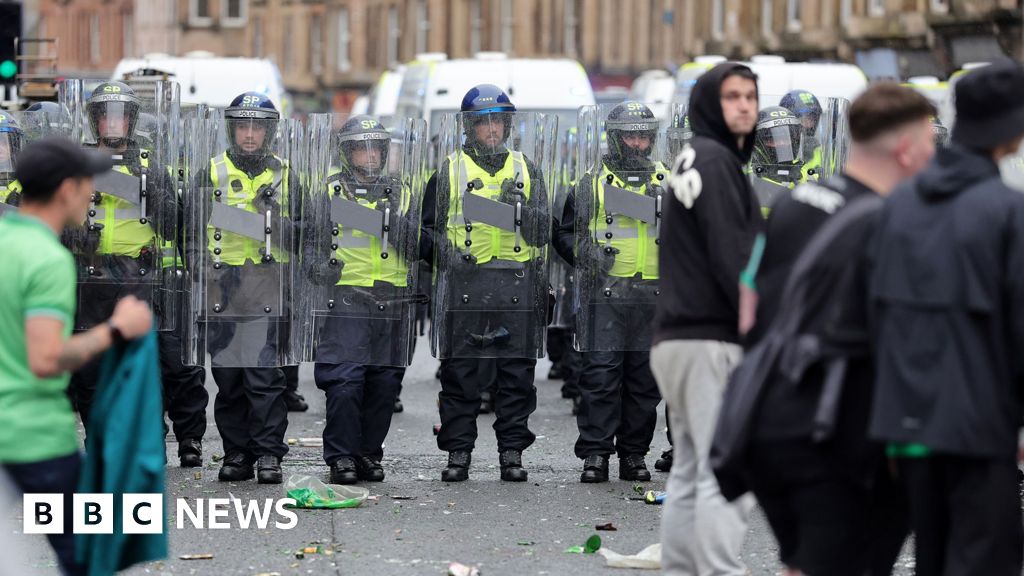
Bottles and other missiles were thrown at officers as around 3,000 Hoops fans gathered in the Trongate area of the city after Saturday's play-off.

Assistant Chief Constable Mark Sutherland said he was "disgusted and frustrated" by the violence shown towards officers.

He said Celtic FC needed to "step forward" to ensure there was no repeat of the disorder next year. The club has been contacted for comment.

Police Scotland said there were 10 arrests in the Trongate and four arrests at Celtic Park – with more expected in the coming days as CCTV footage is reviewed. A further four people were arrested in Edinburgh.

A major incident portal has been set up and police are urging members of the public to upload any footage or photographs from Parkhead or the Trongate area that could be useful to the investigation.

After Celtic's 3-1 win over Heart of Midlothian to take their fifth successive Premiership title, fans gathered in the Trongate as they have done in previous years.

Initially the mood was lively with green flares let off and fans drinking but by early evening it had turned uglier.

Police officers who were assisting paramedics attending a medical emergency were pelted with bottles, and riot police were then used to disperse the crowd.

Sutherland said one officer was left with facial injuries while the other had been left with bruising to his body after being struck by bottles.

"First and foremost, I'm so grateful that only two officers have suffered serious injury," he told BBC Scotland News.

"But when you see the footage and you see the incoming bottles and missiles being rained on our officers, I'm so grateful and we are very fortunate that only two officers have been injured on this occasion."

By Sunday morning the rubbish strewn streets had been largely cleared up and traffic lights which were damaged by fans climbing on them were being repaired.

As a precautionary measure glass had already been removed from bus shelters ahead of Saturday's title play-off.

Daniel Cohen was in Trongate on Saturday and said he could see bottles "flying through the sky" towards the police, and people "were bleeding".

He said there had been "arguing and fighting", and that he saw families changing the direction they were walking in to avoid being hit.

He said the crowd "started to have some tension with the police, so they started to push the police back," he said.

"It was quite sad to see such a thing happen… it was affecting all the businesses in this area and it's really sad to see such a thing," he said.

He added that he also saw last year's trouble, but that "it wasn't as bad as this year".

"I would say huge thanks to Police Scotland, they managed to push them back."

He added that he felt it would be better to have a pre-planned event in a designated space, such as a park.

Police Scotland had been critical of Celtic ahead of the game, saying that despite talks on the issue, the club had "failed" to bring forward a plan for fans to celebrate safely in the event of victory.

"Celtic must step forward into this space with the authorities, with the broader partnership and ensure that this isn't happening again next year," said Sutherland.

Glasgow City Council said the majority of fans had celebrated in the right way and complied with a request to stay away from Trongate.

"However, the behaviour of some people in the aftermath of yesterday's match was, quite frankly, an embarrassment," it added in a statement.

"They let down the city, their club and their fellow fans."

At the end of Saturday's game, the Glasgow side's fans had also spilled onto the pitch as the third goal went into the net, with some reports that Hearts players were confronted by Celtic supporters.

Sutherland said the force was working with Hearts to establish what had happened and would be "carrying out an inquiry and reviewing CCTV to understand if any player has been assaulted or any other fan has been assaulted".

The match, which was approaching the end of the indicated eight minutes of added time, did not restart after the pitch invasion.

The Hearts players and staff made a hasty exit from the ground, with some players still in their match kit on the team bus as they headed back to Edinburgh.

In a statement Hearts has condemned the "menacing and threatening atmosphere inside the stadium".

"Hearts' entire staff had no alternative but to leave immediately, without undertaking post-match media duties," it said.

"The pitch invasion caused a chaotic end and nobody seemed to know whether or not the match had been brought to a finish."

Later on Sunday Celtic FC issued a statement saying it regretted that the victory was followed by supporters entering the field of play.

It said: "We again emphasise that there is no justification for this behaviour which, for the vast majority of Celtic supporters, only detracts from the joy of such occasions."

The club promised to co-operate fully with any investigation.

It added: "We also apologise to Hearts for the situation encountered by their players and staff at the conclusion of the game, and for the fact that these events prevented them from saluting their own supporters at the end of an enthralling campaign, to which they have contributed so much."

The Celtic statement did not address the concerns raised by Police Scotland over disorder in the city centre.

The Scottish Professional Football League (SPFL) condemned the pitch invasion but said that prior to awarding the trophy it was informed by the referee that the match had concluded, and had not been abandoned.

In a statement it said it would wait to assess the referee and match delegate's report before making a decision about any potential punishment.

BBC Scotland understands the league body also intends to speak to the Scottish government about finding new ways to tackle the issue of pitch invasions.

In England and Wales it has been a criminal offence to enter the field of play since 1991.

The SFA are already investigating after on-field disorder following a cup match between Rangers and Celtic in March.

📰 மூல செய்தி (Source): https://www.bbc.com/news/articles/c0e2xxz5rl9o?at_medium=RSS&at_campaign=rss

Continue Reading
Click to comment

Leave a Reply

Your email address will not be published. Required fields are marked *

முக்கியச் செய்திகள்

UAE reports strike near Abu Dhabi nuclear power plant

Published

on

The United Arab Emirates said a drone strike had triggered a fire near its nuclear power station on Sunday, calling the incident a "dangerous escalation".

Officials are investigating the source of the strike. The country's defence ministry said three drones had entered the UAE from the "western border direction".

While two were intercepted, the third drone struck an electrical generator "outside the inner perimeter" of the Barakah Nuclear Power Plant in Abu Dhabi, sparking a fire.

No injuries were reported and there was no impact on radiological safety levels, local authorities said.

The UAE's foreign ministry called the strike an "unacceptable act of aggression" and said it had the right to respond to any hostilities.

It added that "the targeting of peaceful nuclear energy facilities is a flagrant violation of international law, the UN charter, and the principles of humanitarian law".

The country's defence ministry meanwhile said it would "firmly confront any attempts to undermine the country's security".

Officials have not said from where the drone was launched. The UAE has previously accused Iran of being behind attacks on its energy and economic infrastructure since war broke out in the region in February.

The Abu Dhabi Media Office said the fire "broke out in an electric generator" and confirmed precautionary measures had been taken at the plant, which is operating as normal.

The UN's nuclear watchdog said it was monitoring the situation closely and that its director general Rafael Grossi expressed "grave concern" about the incident.

Grossi said "military activity that threatens nuclear safety is unacceptable", according to a statement shared by the International Atomic Energy Agency on X, and called for "maximum military restraint".

Tehran began launching strikes across the region in retaliation to the US and Israel's attacks against Iran on February 28.

It has since accused the UAE and other American allies in the Gulf of allowing the US to carry out attacks from their territory.

At the same time, the UAE has denied Iranian claims that it has actively carried out attacks of its own.

The US and Iran agreed a ceasefire in April, but sporadic exchanges of fire have continued.

President Donald Trump said the truce was on "massive life support" on Monday, after rejecting Iran's demands to end the war and reopen the Strait of Hormuz – a crucial shipping lane which has been effectively closed since the war began.

📰 மூல செய்தி (Source): https://www.bbc.com/news/articles/cwy27pkj1l1o?at_medium=RSS&at_campaign=rss
Continue Reading

முக்கியச் செய்திகள்

How worrying is the Ebola outbreak in DR Congo?

Published

on

The outbreak of Ebola in the Democratic Republic of Congo is concerning.

It has been spreading for weeks undetected in a part of the world where civil war makes getting on top of the virus difficult, and the species of Ebola involved is rare, so there are fewer tools to stop a virus that kills around a third of people infected.

This is a critical moment in an outbreak where there is uncertainty about how far it has spread, but there are already almost 250 suspected cases and 80 deaths.

Most Ebola outbreaks tend to be small, but specialists are haunted by the 2014-16 outbreak. Then, 28,600 people in West Africa were infected in the largest ever outbreak of the disease.

The declaration of a public health emergency of international concern by the World Health Organization (WHO) does not mean we are in the early stages of a Covid-style pandemic.

The risk Ebola poses to the whole world remains tiny. Even in the 2014-16 outbreak, there were only three cases in the UK and all were healthcare workers who had volunteered to help.

"But it does reflect that the situation is complex enough to require international coordination," says Dr Amanda Rojek, from the Pandemic Sciences Institute at the University of Oxford.

After all, there is still a significant threat to neighbouring countries like Uganda, South Sudan and Rwanda, considered high risk because of close trade and travel links.

Two people have already been confirmed to have the virus in Uganda, of whom one has died.

Ebola is a severe and deadly disease, although it is thankfully rare. Ebola viruses naturally infect animals – mainly fruit bats – but people can become infected if they come into close contact.

This outbreak is being caused by the Bundibugyo species of Ebola – it is one of three species known to cause outbreaks but is relatively unfamiliar.

Bundibugyo has caused only two outbreaks before – in 2007 and 2012 – where it killed around 30% of people infected.

Bundibugyo poses a series of challenges. There are no approved vaccines or drug treatments for Bundibugyo, although there are some experimental ones, unlike other species of Ebola virus.

And tests to determine whether somebody has the infection do not appear to work well. Initial results in the outbreak were negative for Ebola virus, and more sophisticated laboratory tools were required to confirm Bundibugyo was involved.

Dealing with Bundibugyo is "one of the most significant concerns" in this outbreak, says Prof Trudie Lang from the University of Oxford.

Symptoms are thought to appear between two and 21 days after somebody is infected.

Initially they are like developing the flu – fever, headache and tiredness. But as Ebola progresses, it leads to vomiting, diarrhoea, and the body's organs not working. Some patients develop internal and external bleeding.

With no approved drugs designed to target Bundibugyo virus, treatment relies on "optimised supportive care" including managing pain, other infections, fluids and nutrition. Early care improves the odds of surviving.

Ebola spreads through infected bodily fluids such as blood and vomit, although this does not normally occur until symptoms have appeared.

The first known case was a nurse who developed symptoms on April 24. It has since taken three weeks to confirm an outbreak is happening.

"Ongoing transmission has occurred for several weeks, and the outbreak has been detected very late, which is concerning," said Dr Anne Cori from Imperial College London.

It means health officials are behind where they would like to be in stopping the outbreak, which the WHO says points towards a "potentially much larger outbreak than what is currently being detected and reported".

The main method will be rapidly identifying who is infected, and to whom they may have passed the virus.

There will also be efforts to prevent Ebola spreading through hospitals and other treatment centres, which will be dealing with patients when they are most infectious. And to ensure anyone who dies and whose body remains infectious has a safe burial.

This will be a challenge due to the number already infected, and made worse as it is taking place in a conflict-torn part of DR Congo that has more than 250,000 people displaced from their homes.

"Many of the affected areas are mining towns with highly mobile and transient populations. This mobility increases risk as people move between communities and across borders," says Lang.

However, DR Congo does have extensive experience in dealing with Ebola outbreaks and the response is "significantly stronger today than it was a decade ago", says Dr Daniela Manno from the London School of Hygiene & Tropical Medicine.

Whether this outbreak can be quickly contained or spirals into a repeat of what happened just over a decade ago will be determined by the response now.

📰 மூல செய்தி (Source): https://www.bbc.com/news/articles/c9q311nj5r3o?at_medium=RSS&at_campaign=rss

Continue Reading

முக்கியச் செய்திகள்

England see off spirited France to clinch Six Nations

Published

on

England lift the 6 nations achieving the grand slam and beating out France

Tries: Bourdon Sansus (2), Grando, Bourdon Cons: Arbez (4)

Tries: Bern, Kildunne (2), Breach (2), Cokayne Cons: Harrison (5) Pens: Harrison

England combined nerve and accuracy to overcome France and a raucous record crowd to clinch their eighth successive Women's Six Nations title in Bordeaux.

The visitors seemed to have the contest under control when a Zoe Harrison penalty shortly after half-time put them 29-7 clear.

But France, who had scored the first try of the match, found a second wind that threatened to carry them all the way to victory.

Tries from Anais Grando and Pauline Bourdon Sansus cut the favourites' lead to eight points as the volume rose in Stade Atlantique.

However a well-worked try from Jess Breach, the sin-binning of France's replacement scrum-half Alexandra Chambon and a strong performance by England's replacements quelled the danger.

Amy Cokayne crowned victory with a 76th-minute try, throwing the ball into the stands in celebration, triggering a chorus of jeers.

The Red Roses' run in the tournament surpasses their own record of seven titles in a row between 2006 and 2012 and takes them to five straight Grand Slams and 38 successive Test victories.

France had to settle with a new home Women's Six Nations attendance record, with 35,062 fans beating a figure of 28,000 at this fixture in 2024.

Although it did not match the drama of the meeting between the two countries at the conclusion of the men's Six Nations two months ago – few matches do – it provided an enthralling, high-quality conclusion to a tournament that has attracted more people and attention than ever before.

'Grand Slam baby!' – reaction as England celebrate eighth successive Women's Six Nations title

'it came from desire from Meg Jones' as Kildunne put England ahead

France have grown formidably over the past six weeks and belief that they could end a17-match losing streak against England was evident in the volume of the anthem and the tears streaking down number eight's Lea Campon's face as it died away.

The fired-up hosts flooded into the England 22m in the opening two minutes, with forwards Axelle Berthoumieu and Madoussou Fall Raclot trampling over white shirts.

Cokayne's brave turnover, clamping down in the shadow of her own posts, repelled that attack. But the early storm was far from over.

After turning the screw at the scrum, England seemed have wrestled their way into the ascendancy, only for France to strip the ball from MacKenzie Carson deep in their own half and launch a spectacular coast-to-coast effort to strike first on the scoreboard.

Wing Lea Murie shrugged off Sadia Kabeya and Lucy Packer, fed inside to Campon, who in turn released scrum-half Bourdon Sansus, the only survivor from the France team that last beat England back in 2018, to gleefully splash over.

But an England side missing a clutch of frontline stars who won the Rugby World Cup in September, showed the depth of their squad and togetherness.

Prop Sarah Bern muscled her way over to level the scores on 20 minutes, before Meg Jones hacked on a loose ball and Ellie Kildunne gathered to stretch away on the half hour.

Five minutes later, Breach's neat stop-go spurt of speed took her into the corner and, with the clock in the red, Helena Rowland launched a long pass wide for Kildunne to walk in her second after good work by Maddie Feaunati and Abi Burton.

With Harrison maintaining her high standard off the tee, England's execution had earned them a slightly flattering 26-7 half-time lead.

England recognised it themselves. A minute into the second half, from close to the French posts, Harrison opt to kick a penalty to push the visitors' advantage out to beyond three scores.

'Straight of the training park' as Breach runs home a key try

France roared back into the contest with Grando scooting into the corner after England's defence had been sucked in tight and then Bourdon Sansus darting off the back a scrum and between Packer and Harrison to score.

Eight points adrift, but with momentum and more than 20 minutes on the clock, a France comeback loomed ominously.

But a well-worked wrap-around move off first-phase ball, levered open a corridor of space for Breach to streak away to score and suck the life out the stadium.

France, who have finished strongly throughout the tournament, rallied again, with huge hits levelling Kildunne and Claudia MacDonald Moloney. However the referee ruled that Chambon had strayed high in the latter collision, reducing France to 14 for the remainder of the match.

England, who had been politely welcomed to Bordeaux over the tannoy before kick-off, were offered less kind words from the stands as teenage replacement Demelza Short verbally shot back at a pair of French players and then Cokayne's pointed celebration drew more ire.

Rose Bernadou barged over late on to turn the home jeers to cheers, but, by then, England already had completed a triumph that has forced them deep into their well of talent and togetherness.

Bourdon Sansus' opening try was one of the scores of the tournament, sweeping from one end to the other

Captain Meg Jones (centre) stepped into the role at the start of this year with the pregnant Zoe Stratford sitting out the tournament

France: Barrat; Grando, Rousset, T Feleu, Murie; Arbez, Bourdon Sansus; Mwayembe, Lazarko, Khalfaoui, Soqueta, Fall Raclot, Berthoumieu, M Feleu (c), Champon

Replacements: Riffonneau, Brousseau, Bernadou, Zago, Correa, Escudero, Chambon, Queyroi

England: Kildunne; Breach, Jones (capt), Rowland, Moloney-MacDonald; Harrison, L Packer; Carson, Cokayne, Bern, Ives Campion, Burns, Burton, Kabeya, Feaunati.

Replacements: Powell, Crake, Muir, Short, M Packer, Robinson, Aitchison, Sing.

Assistant referees: Aimee Barrett-Theron (South Africa) and Amber Stamp-Dunstan (Wales)

Foul Play Review Officer (FPRO): Leo Colgan (Ireland)

Italy condemn Wales to another Six Nations Wooden Spoon

Ireland thrash Scotland in front of record crowd

📰 மூல செய்தி (Source): https://www.bbc.com/sport/rugby-union/articles/c62x0np51y6o?at_medium=RSS&at_campaign=rss
Continue Reading

Trending

Copyright © 2024 by 7Tamil Media, All rights reserved.