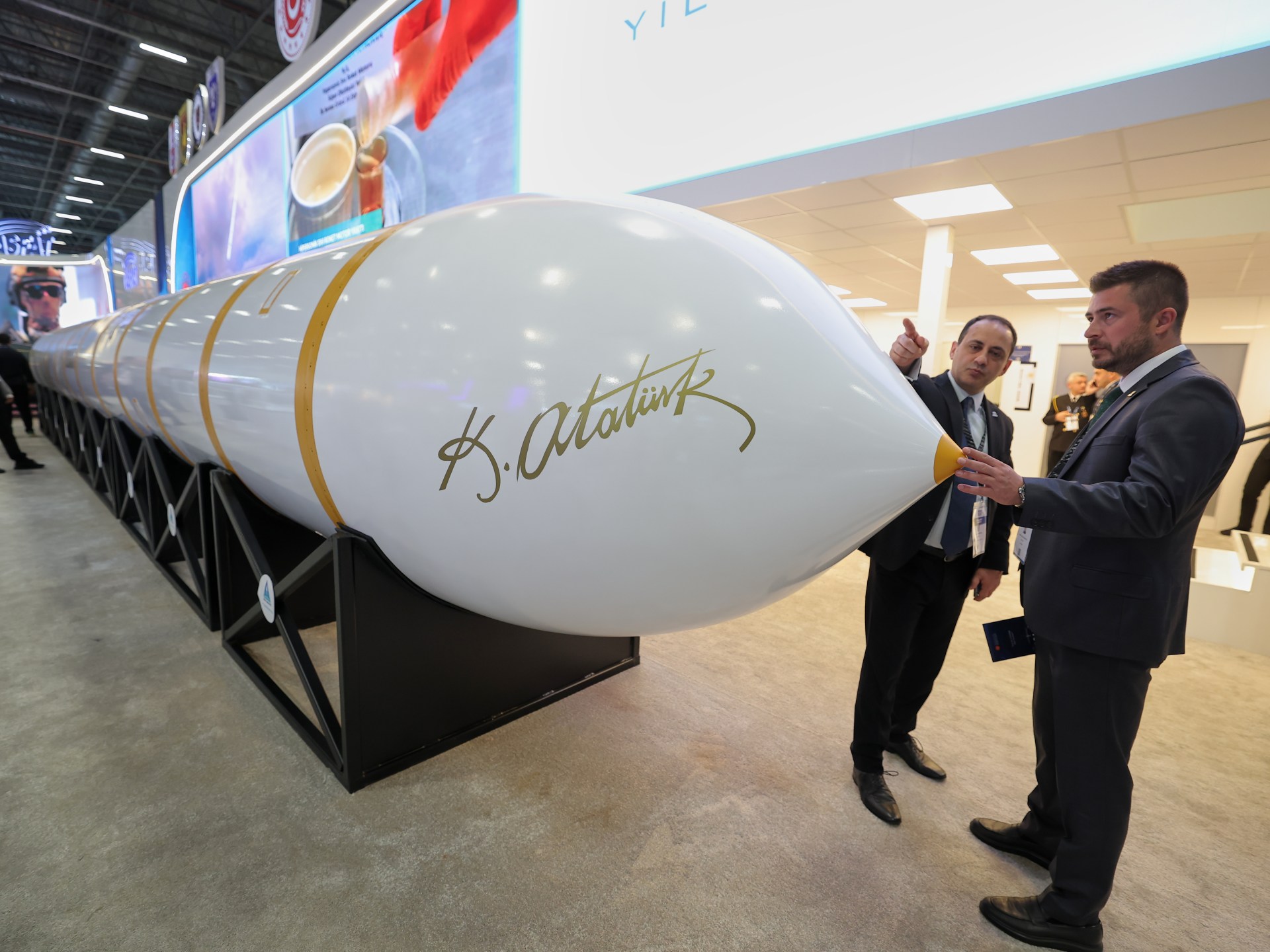
The Yildirimhan ICBM has a range 6,000km, with a maximum speed of Mach 25 and a payload capacity of 3,000kg.
Turkiye has unveiled a prototype of an intercontinental ballistic missile (ICBM) as part of a push to become self-reliant and to gain a foothold as a key defence player in the Middle East and among its NATO allies.
The ICBM, named Yildirimhan, meaning “lightning” in Turkish and developed by the Defence Ministry’s research and development centre, was unveiled on Tuesday at the SAHA 2026 Defence and Aerospace Exhibition at the Istanbul Expo Centre.
Why is this ICBM model significant, and what does it mean for Turkiye’s defence industry? Here’s what we know:
The Yildirimhan has a range of 6,000km (3,278 miles). According to the Federation of American Scientists, ballistic missiles with a range exceeding 5,500km (roughly 3,418 miles) are classed as ICBMs. If launched from Turkiye, the Yildirimhan will be able to hit targets across Europe, Africa and Asia.
According to the Turkish news agency Anadolu, the ICBM’s maximum speed is Mach 25, which is 25 times the speed of sound. It has four rocket propulsion engines and is fuelled by liquid nitrogen tetroxide. Its warhead has a payload capacity of 3,000kg.
Turkiye has not begun the production of the missile yet.
Addressing the exhibition in Istanbul on Tuesday, Defence Minister Yasar Guler said, “In this era where economic cost has become an asymmetric weapon, Turkiye offers its allies not only weapon systems but also technology and a sustainable security economy.”
Experts say the launch of a Turkish ICBM is significant for a number of reasons.
Ozgur Unluhisarcikli, regional director at the German Marshall Fund of the United States think tank, told Al Jazeera, “In my view, Turkiye does not need ICBMs to deter any immediate security threat it is facing. Therefore, it is not the ICBM, but the capability to produce it that is significant for Turkiye.”
Burak Yildirim, an Istanbul-based security and defence analyst, said the Yildirimhan said the design of an ICBM was indirectly important for Turkey’s civilian space launch efforts; specifically the Delta-V programme, which is entirely civil and commercial in mandate, and aims to place Turkish satellites into orbit using the country’s own rockets.
“The physics of reaching orbit and the physics of intercontinental ballistic trajectory are closely related; the technology overlaps. In that sense, an ICBM-class capability is a natural if politically consequential-derivative of a serious space programme,” he told Al Jazeera.
“That said, we should be precise about what was actually unveiled at SAHA 2026: a concept, presented in mock-up form. There are no confirmed flight tests, technical specifications remain limited, and critical subsystems have not been publicly accounted for in any consistent detail. Even the most likely future test facility – a base in Somalia – has not yet been constructed. This is an announced ambition, not a fielded capability,” he added.
Ali Bakir, a senior nonresident fellow at the Middle East Council on Global Affairs, said the prototype marks a breakthrough for Ankara.
“This development symbolises a leap in its missile capabilities and technological advancement, enabling Turkiye to join the exclusive ranks of a handful of countries possessing such advanced defensive technologies,” he told Al Jazeera.
“Furthermore, this milestone underscores Ankara’s commitment not only to enhance its military power and defensive capabilities but also to strengthen its deterrence, positioning itself as a key ultra-regional power,” Bakir added.
The unveiling of the new missile comes amid serious tensions in the Middle East. While a fragile ceasefire between the warring sides in the US-Israel war on Iran holds following six weeks of strikes, a naval battle is playing out in the Gulf as Tehran continues to block the Strait of Hormuz and the US enforces a naval blockade of Iranian ports. Meanwhile, Israel continues to violate “ceasefires” reached in Lebanon and the Gaza Strip.
In March, when Iran was retaliating against the US-Israeli strikes by attacking US military assets and infrastructure in the Middle East, Ankara reported that NATO’s air defences shot down ballistic missiles fired towards Turkiye on March 4 and 9. Tehran denied firing any missiles at Turkiye and suggested Israel could be behind them as acts of sabotage.
In February, just days before the US-Israel war on Iran began, former Israeli Prime Minister Naftali Bennett, whose party is projected to do well in the national election this year, was the latest prominent politician to declare Turkiye a threat to Israel.
Speaking at a conference, Bennett said Israel must not “turn a blind eye” to Turkiye, accusing it of being part of a regional axis “similar to the Iranian one”.
“A new Turkish threat is emerging,” Bennett said. “We must act in different ways, but simultaneously against the threat from Tehran and against the hostility from Ankara.”
Other Israeli politicians have made similar comments in the past few months. Turkiye, which has been seen as growing closer to other regional powers, including Saudi Arabia and Egypt, has strongly criticised Israel’s genocidal war on Gaza as well as violence inflicted on Palestinians in the occupied West Bank by Israeli settlers, often with support from Israeli forces.
While Israel has had an openly antagonistic relationship with Iran since the 1979 Islamic revolution, Israel-Turkiye relations have taken a more pragmatic line. However, since coming to power in the early 2000s, Turkish President Recep Tayyip Erdogan has been increasingly critical of Israel.
“The blood-stained genocide network continues to kill innocent children, women, and civilians without any rule or principle, ignoring all kinds of human values,” Erdogan said about Israel while addressing an international conference in Istanbul in April.
Bakir told Al Jazeera that fears around Israel are not the main factor behind the development of the ICBM, but the timing and nature of Turkiye’s advances with ballistic missiles are clearly intended to send messages to both allies and adversaries, including to “an increasingly hegemonic, expansive and aggressive Israel”.
“This development aligns with the long-term vision of the Justice and Development Party [AKP] and President Erdogan to reduce reliance on foreign defence equipment, increase self-sufficiency and establish a robust domestic defence industry that meets global standards,” he said.
“This initiative aims to address national needs, strengthen the country’s strategic autonomy, and tackle regional and international threats to Ankara’s national security and interests. This policy is proactive rather than reactionary,” Bakir added.
Yildirim, the Istanbul-based security analyst, said Israel’s demonstrated willingness to conduct deep strikes across the Middle East, including against state actors, has not gone unnoticed in Ankara.
“Turkiye and Israel have no formal conflict, but their strategic interests have diverged sharply, and the political relationship has deteriorated significantly in recent years. When Turkish officials speak of systems capable of reaching distant targets, the geography speaks for itself,” he said.
“But reducing this [unveiling of the ICBM] to a Turkey-Israel dynamic would be too narrow. Turkey is simultaneously managing a post-war Syria on its border, an unresolved situation in the Eastern Mediterranean, ongoing tensions with actors in Iraq and, critically, it recently experienced ballistic missiles fired from Iran being intercepted by NATO assets over its territory. Turkey is encircled by instability, and it is drawing the conclusion that abstract alliance guarantees are insufficient. It wants hard, sovereign deterrence,” he added.
The Yildirimhan announcement, he said, “is less about a specific threat and more about Turkiye declaring that it intends to be the kind of country that cannot be coe
📰 மூல செய்தி (Source): https://www.aljazeera.com/news/2026/5/7/turkiye-unveils-its-first-intercontinental-ballistic-missile-what-we-know?traffic_source=rss


















 உலகம்9 years ago