Connect with us

முக்கியச் செய்திகள்

The British White Lotus? A group trip goes wrong in BBC drama Two Weeks in August

Published

on

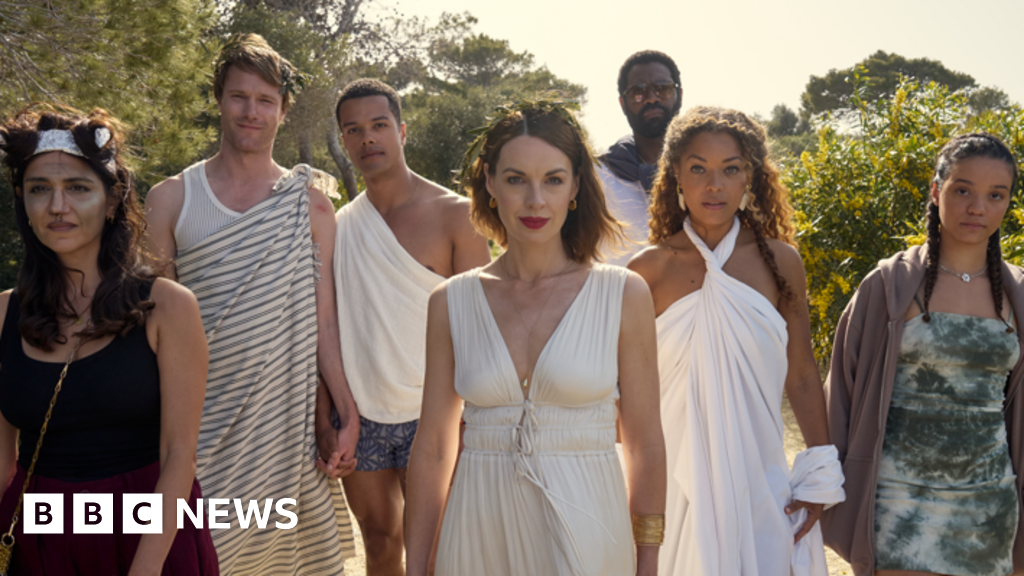
"It's a group holiday gone wrong," says actress Jessica Raine about new BBC drama Two Weeks in August.

Set on a sun-soaked Greek island, the drama follows a group of university friends reuniting for a long-awaited summer holiday.

Now older, the friends are still connected, but marriage, children and mental health struggles have reshaped their relationships.

Beneath the cocktails, boat trips and villa life, tensions simmer and emotions rise. Then an illicit kiss threatens to change their lives forever.

For its cast, the series felt instantly recognisable. "I've been on this holiday," says Damien Molony. "I know who these people are."

At the center is Zoe, played by Raine, a teacher and mother quietly struggling under the pressure of holding everything together.

Molony plays her husband Dan, whose depression hangs heavily over the trip, as cracks in their marriage begin to show.

Raine says she was drawn in by the script's exploration of modern expectations placed on women.

"I think it chimes really well with my generation of people-pleasing," she says.

"There's this idea that in order to be a 'good woman', you have to sacrifice yourself for your children or your husband… and the notion that you can have it all is a complete lie."

Molony says he was initially struck by how dark his character's early scenes felt when he first read the scripts.

"I didn't know it was a comedy at first," exclaims the Irish actor. "It felt quite tragic." He describes Dan as someone who is visibly struggling but unable to express it in a way that helps him.

"He's constantly trying to smile for the camera," he says. "But he doesn't really know how anymore."

From the outset, Dan's dark and emotional scenes put into motion a series of events that strain the wider group.

Antonia Thomas, who plays Jess, says the series captures what happens when people who once knew each other intimately realise how much they've changed.

"There's a real hopefulness about booking a nice villa somewhere and thinking everyone's going to have a great time together," says Antonia.

"But people change. They're not the same people they were 10 years ago."

Thomas says that gap between expectation and reality creates a particular tension within the group.

"It becomes a kind of pressure cooker," she explains. "Everyone falls back into old roles, even if they don't fit anymore."

She adds that Jess's place in the group reflects that sense of quiet disconnection, "She tries to connect, but doesn't always get it right."

You wouldn't be wrong to think of Two Weeks in August as something of a British White Lotus, a comparison its writer Catherine Shepherd has addressed.

Speaking in a recent interview with the Royal Television Society, Shepherd said that the tone and intent of the two shows are different.

She said that "the White Lotus is about people who are super rich", whereas Two Weeks in August focuses on "relatively normal people with normal concerns".

That distinction is key to the series' tone, less glossy satire and more grounded discomfort. Filmed in Malta and Gozo, the series also stars Leila Farzad and Hugh Skinner, whose performances lean further into the show's dark comedy.

For Nicholas Pinnock, who plays successful actor Solomon, that realism is what makes the show feel distinctly British in its outlook.

"There's a real stiff upper lip Britishness about it," he says. "People are trying to avoid the thing that's staring them in the face and brushing things under the carpet until eventually it all ignites."

But as the holiday begins to unravel, Two Weeks in August gradually weaves in Greek mythology increasing the group's tense dynamic.

For Raine, that was one of the script's biggest surprises. "It sort of sideswipes you," she says. "You're not expecting it."

The actress also points to the mythological figures known as The Fates or Moirai, who appear throughout the series and become increasingly central to Zoe's emotional unravelling.

In Greek mythology The Fates are three women who control the thread of human life, deciding how long a person lives.

"It's scary," she says. "She starts seeing them in the corner of her eye, almost like ghosts."

Two Weeks in August will air on BBC One and BBC iPlayer on the 23rd May.

📰 மூல செய்தி (Source): https://www.bbc.com/news/articles/cy0252zn0vno?at_medium=RSS&at_campaign=rss

முக்கியச் செய்திகள்

Robert paid £726 to skip the driving test waiting list. New laws mean others won't be able to

Published

on

Robert Kamugisha had been desperate to sit his driving test. But the waiting list stretched for months, and every week without a licence meant more pressure – financially and personally.

So when he was offered earlier test dates for a hefty fee, he took the risk.

The 21-year-old criminology student from Croydon spent most of his savings – £726 – on three test slots, all bought through resellers who snap up appointments and sell them on at inflated prices. The actual cost to take a test is £62.

New government rules now mean only a learner driver can book their own test, part of a crackdown on third party operators using bots to hoover up thousands of slots. But it was too late for Robert.

"I spent most of my savings," he tells the BBC after passing in December, on his third attempt. "I felt like I was being scammed."

Driving instructors say the black market trade has exploded as waiting times across the UK have soared, and thousands of learner drivers have struggled to get driving tests without a long wait.

Figures provided to the BBC from the Driver and Vehicle Standards Agency (DVSA) earlier this week revealed the national average wait time for a practical driving test in April 2026 in Great Britain was 22.3 weeks.

Across the nations, Scotland's wait time was 22.9 weeks, in England it was 22.7 weeks, and Wales was slightly shorter at 17.3 weeks.

Robert says his driving instructor encouraged him to use a reseller to secure an earlier test date, reassuring him it was legitimate. The reseller logged in with Robert's details, booked the test, and the DVSA sent him a confirmation.

"Once I got the booking confirmation, that's when I felt a bit of relief," Robert tells the BBC after contacting BBC Your Voice. "The expense though was crazy."

Robert paid £242 per test, plus £150 each time to use his instructor's car, bringing his total cost to £1,176 – a figure that does not include the cost of his lessons.

Sophie Stuchfield, a driving instructor from Watford, tells the BBC the black market has taken advantage of the demand for earlier test slots.

"People have found ways to manipulate the system to be able to book thousands of driving tests themselves to then be able to resell on for a massively high inflated fee," she adds.

The use of automated booking programmes, or bots, has plagued the DVSA booking system since a huge test backlog built up during the pandemic.

Illicit operators moved in to exploit the demand and used bots to book tests on the official website and resell them.

Sophie has been added to messaging lists where third parties advertise driving tests for sale around Britain for hundreds of pounds.

"I've had 3,341 messages from people trying to sell me driving tests," Sophie says.

"Many people [learner drivers] message me on social media telling me that they are being asked to pay £200, £250, £300 for a driving test and sometimes it's unfortunately from their own instructor."

Sophie has refused to charge learners extra fees on the day of their driving tests to use her car, which has angered other instructors in her area who do.

She says some instructors wait until a week before a learner's test to tell them it's an extra £300 on test day to use their car.

"I've had phone calls from other local driving instructors in this area and they're asking me why do I not charge a fee to take someone on a driving test?"

"My response is always, 'I don't believe I should,'" she says. "I already feel sorry for that person on how much they're having to spend on learning to drive."

The new rules introduced this week mean it is now against the law for anyone apart from the learner driver to book their driving test with the DVSA and the government hopes this will stop third parties accessing the booking system using learner drivers details.

From now, it means anyone selling or changing a test on someone else's behalf will be breaking the law.

Those rules won't have a direct impact on waiting times for test slots, but should result in fewer wasted tests and help the DVSA measure where real demand is – helping the agency divert resources to testing centres that need it most.

But Carly Brookfield, chief executive of the Driving Instructors Association, doubts the changes will fix the problem.

She says the rule change scapegoats the majority of instructors who were doing the right thing, and she is already hearing reports of frustrated learners who now cannot be assisted by their instructor to book a test.

"There have been things the agency's done that have been productive to stop the rot of the bots," she tells the BBC. "But the reality is we've also got this massive test supply issue that if there's not enough tests going in, people will still not be able to get a test anywhere."

Simon Lightwood, the Minister for Roads and Buses, said the government had inherited record waiting times and a huge backlog of learners waiting for tests, with the system seeing too many people paying over the odds to third-party touts.

"But we're taking action and seeing results, delivering almost two million tests over the past year, more than 158,000 extra tests since June 2025, and military driving examiners now on the ground helping boost capacity across the country," he added.

Further changes will be introduced in June which will allow learners to swap their driving tests to only three of their local test centres.

📰 மூல செய்தி (Source): https://www.bbc.com/news/articles/cx219pn5g70o?at_medium=RSS&at_campaign=rss
Continue Reading

முக்கியச் செய்திகள்

Soprano Dame Felicity Lott dies aged 79

Published

on

Dame Felicity Lott, one of Britain's best-loved sopranos, has died at the age of 79.

The singer died on 15 May after a recent interview she gave to the BBC in which she announced she had been diagnosed with terminal cancer.

The acclaimed soprano built an international career spanning four decades, in which she performed at opera houses and concert halls around the world, singing works by composers including Richard Strauss, Schubert and Mozart.

Dame Felicity's agent told the BBC that "in her work, she was sublime; inhabiting every performance with precision, depth and beauty".

"But it was her humanity and kindness that really touched people… [We] will miss her warmth, sparkle and gloriously self-deprecating humour," the agent said.

Dame Felicity lived with "her illness with great dignity and acceptance" and "was characteristically classy and elegant to the end", the agent added.

Born on 8 May, 1947 in Cheltenham, Dame Felicity was musical from an early age.

At five-years-old she was playing the piano and by 12 she was singing and playing violin.

She went on to study at the Royal Academy of Music, and made her operatic debut and breakthrough role as a last minute stand-in as the character Pamina in Mozart's The Magic Flute in 1975.

At home, she was seen frequently on television, sang regularly at the BBC Proms and was made a Dame in 1996.

She was also the recipient of the Légion d'Honneur, France's highest cultural award.

📰 மூல செய்தி (Source): https://www.bbc.com/news/articles/cpqp1938d8do?at_medium=RSS&at_campaign=rss

Continue Reading

முக்கியச் செய்திகள்

Bangaranga! Bulgaria wins Eurovision – but UK comes last

Published

on

Bulgarian pop star Dara has won the Eurovision Song Contest with her pneumatic dance anthem Bangaranga.

The 27-year-old topped both the public and the jury vote in a nail-biting conclusion, soaring ahead of Israel in second and Romania in third to score a massive 516 points.

Dara was far from a front-runner going into the contest, but her intricate choreography and naggingly catchy chorus helped her eclipse the competition – giving Bulgaria its first ever Eurovison title.

The UK, however, continued its run of disastrous results. Look Mum No Computer's song Eins, Zwei, Drei took last place, with one solitary point from the Ukrainian jury.

The musician predicted his downfall earlier in the week, admitting that his synth-driven track was "Marmite – you either love it or hate it".

But he put a positive spin on the situation. "I always say to expect nothing," he said, "because if you expect nothing, you lose nothing".

"He gave it his all," said Graham Norton as the results became clear. "It just clearly didn't shine with the audiences across Europe."

It is the third time since 2020 that the UK has placed last.

The top five of the leaderboard looked like this:

Unlike Look Mum No Computer, who is best known for a YouTube channel where he builds eccentric contraptions, Dara is a major pop star in her home country.

Her songs and videos have amassed over 80 million listens and views, including the number one single Thunder, and she is a coach on the country's version of the TV talent show The Voice.

To the uninitiated, Bangaranga seems cast in the mould of nonsensical Eurovision songs like Diggi-Loo, Diggi-Ley – but the title actually means "uproar" in Jamaican patois.

The lyrics address Dara's commitment to overcoming anxiety and ADHD, which she was diagnosed with last year.

"Bangaranga is something that everyone's got in themselves," she explained.

"It's the moment you choose to lead with love, not fear."

Her performance came with whiplash-inducing choreography, based on the ancient Bulgarian tradition of Kukeri, in which masked performers chase away evil spirits.

Before the grand final, it also earned the singer an award for the year's best staging, voted for by commentators, including the UK's Graham Norton.

The UK was among the many countries who gave Bangaranga 12 points in the public vote.

Speaking backstage after lifting the crystal microphone trophy, Dara said: “I want to thank everybody who felt the Bangaranga and felt connected to the force.”

Bulgarian National Television also confirmed next year‘s contest will be held in the country’s capital, Sofia.

The run-up to this year's contest was overshadowed by protests over Israel's participation, due to the death toll of the war in Gaza.

Five countries boycotted the event, including Spain, Iceland and seven-time winners Ireland. In Vienna, there were protests in the city centre ahead of the grand final.

Protests were also anticipated during Israel's performance, after singer Noam Bettan was heckled with anti-Israel chants during Tuesday's semi-final.

However, there were no disturbances during his song, Michelle – a heartfelt Mediterranean love song, that took second place.

Czechia's performance, meanwhile, was interrupted by a technical error, during which the video feed was interrupted and singer Daniel Žižka temporarily disappeared.

"That did not happen at any of the rehearsals, the distorted picture," said Graham Norton on BBC One. "I think the camera[man] fell, I'm not quite sure."

Žižka asked for a chance to reprise his performance, but organisers declined, saying his "performance and audio were not affected" by the "small camera issue".

Surprisingly, the contest's two presumed favourites were pushed out of the top three altogether.

Finnish duo Pete Parkkonen and Linda Lampenius topped bookmakers' odds for weeks – but although their stormy duet was called Liekinheitin (flamethrower), it failed to catch fire, ending in sixth place.

Meanwhile, some commentators believed Delta Goodrem could become Australia's first ever Eurovision winner, with her Celine Dion-adjacent power ballad Eclipse.

She delivered the night's most jaw-dropping vocal, rising above the arena on a platform she allegdly borrowed from Beyoncé. But ultimately, the song proved too dated to top the leaderboard, coming fourth.

This year's contest was held in Vienna, Austria, after 25-year-old JJ lifted last year's trophy in Basel, Switzerland, with his song Wasted Love.

The show opened with a recap of that song – before the competition started in earnest with Denmark's Søren Torpegaard Lund.

Writhing with dancers in a sweaty plastic box, his performance set the tone for a night dominated by stories of obsession and animal passion.

Germany's Sarah Engels was "on fire", Norway's Jonas Lovv had "no self control" and Sweden's Felicia gave us an image that's hard to forget: "You're in my head, my heart, my body parts". TMI, Felicia.

As for Serbia, the lead singer of rock band Lavina was so tortured by someone who "trampled on his heart" that he ended his song with a blood-curdling scream.

Representing Romania, meanwhile, Alexandra Căpitănescu provoked controversy with the lyrics to her song Choke Me.

Campaigners criticised the track for glamourising sexual violence – but Căpitănescu said it was really about suffocating under the weight of self-doubt.

Performed second-to-last, her powerful performance – essentially Lady Gaga fronting the nu metal band Evansecence – proved tantalising enough to take third place.

More on the Eurovision Song Contest 2026:

Italy's Sal Da Vinci delivered a sweetly nostalgic slice of 70s disco, with a song dedicated to his wife, Per Sempre, which came fifth.

And Greece's Akylas had the most kaleidoscopic performance – sliding down a fireman's pole, raiding a bank vault and dancing with a Greek statue during his techno banger, Ferto.

It was a lot to take in – but the maximalism hid a sweet message about working overtime to pull his parents out of poverty.

Dancing to electro-pop like a robot from 1984 was Lithuanian singer Lion Ceccah.

His song, Sólo Quiero Más, was all about breaking free of algorithms and reclaiming our humanity – a struggle he illustrated by painting himself head-to-toe in silver.

Croatian band Lelek also wore face paint, with symbols representing the resistance of Catholic women during the Ottoman Empire, a topic they addressed with haunting folkloric harmonies on their song Andromeda.

The evening also marked the 70th anniversary of Eurovision, which launched in 1956 under the name European Grand Prix.

Back then, only seven nations took part, with Swiss singer Lys Assia taking the first title.

To mark the platinum anniversary, organisers staged a spectacular tribute featuring some of the most memorable songs of last seven decades.

Former winners Lordi played a heavy metal version of Brotherhood of Man's Save Your Kisses For Me; while Ukranian comedian Verka Serduchka played Sandie Shaw's Puppet On A String with an Oompah band.

Erika Vikman recreated Abba's Waterloo – 1974's Eurovision winner – while Alexander Rybak gave Cliff Richard's Congratulations the hoedown treatment.

The performance ended with a mass singalong to Nel blu, dipinto di blu, originally by Italian singer Domenico Modugno.

Placing third at Eurovision in 1958, it sold more than 18 million copies worldwide.

Whether any of this year's entries reach such heights remains to be seen.

📰 மூல செய்தி (Source): https://www.bbc.com/news/articles/c8d87v9v660o?at_medium=RSS&at_campaign=rss
Continue Reading

Trending

Copyright © 2024 by 7Tamil Media, All rights reserved.