Connect with us

முக்கியச் செய்திகள்

'Look Mum, one point': Why does the UK keep getting Eurovision wrong?

Published

on

Another year, another flop. The UK has self-destructed at Eurovision all over again.

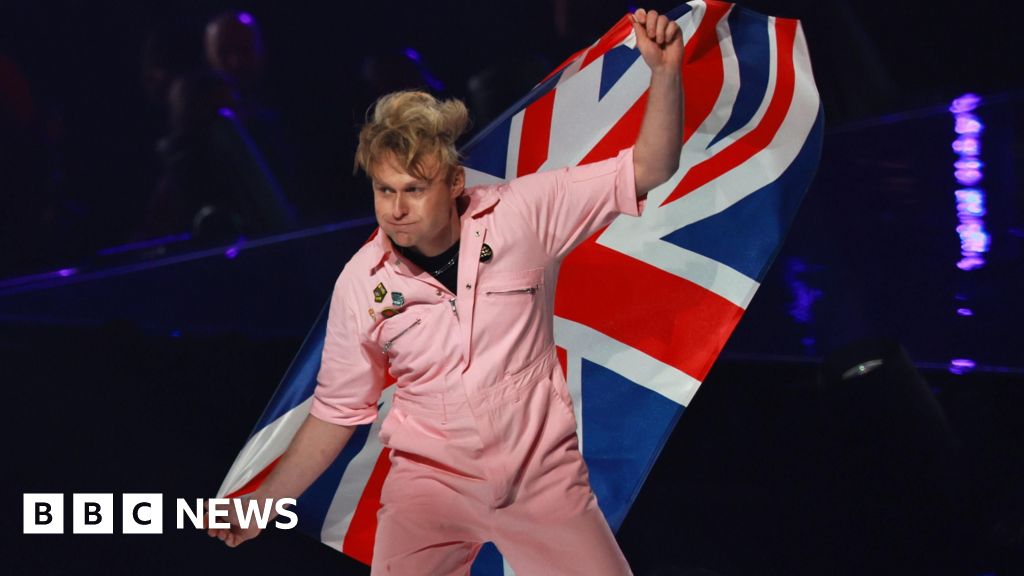
Look Mum No Computer, aka musician Sam Battle, got one solitary point, ending up in last place.

It's the third time we've been at the bottom of the table since 2020. We've made the top 10 once since 2010. This is the fourth consecutive year I've written a post-mortem on our failure.

Believe me, I don't want to be here – but here we are.

In the run-up to the contest, there was little hope that Sam's shouty synth-pop banger Eins, Zwei, Drei, would fare well.

But the musician gave it his all, stomping around the stage in a bright pink boiler suit while singing about quitting his office job so he could go to Germany and count to three (I am not making this up).

It was, as Graham Norton observed, "a big swing".

If anything, our previous Eurovision entries played it too safe, pandering to a cliché of polished electro-pop.

Sam was different. Eccentric and engaging, with the uncontainable energy of a shaken-up Coke bottle, he came up with a song that, for once, sounded uniquely British.

"I have to applaud the BBC for the ambition," says Adrian Bradley of the Euro Trip podcast, which follows the competition's ups-and-downs.

"They took a risk on something that maybe people won't like, but which some people might pick up the phone and vote for."

"I think it's a very interesting song in terms of production," agrees Satoshi, who represented Moldova at this year's contest.

"The distortion on the voice, the synths that he uses. Everything has that British imprint – but I can definitely see that it's not everyone's cup of tea."

"What we're doing is Marmite," he told BBC News before the contest. "You either love it or hate it – but I think there's a slot open for our sort of thing."

The song's hiccupy beat, and zany references to jam roly poly and custard left Europe bewildered. Juries awarded it one point. The public gave it zero.

"I think the song, honestly, is not a great song for the UK," says Filippo Baglini, a journalist for the Italian station London One Radio.

"The UK is the best at music all around the world. You have the Beatles and everything. So this is not good enough."

"I really wish the BBC would take it more seriously," agrees Thomas Tammegger, an Austrian Eurovision fan, living in Denmark.

"They look at it through a lens of it being a funny event and then you have to send novelty entries or joke entries and it never really does well.

"When they do make an effort, like with Sam Ryder, voila! It's second place and it works."

Ah yes, Sam Ryder. A drop of water in 15 years of drought. He was the runner-up in 2022, armed with the cunning plan of writing a good song – the 70s glam rock pastiche Space Man – and being good at performing it.

Well, in the words of Will Young, who turned down the chance to represent the UK in 2015, Eurovision is considered a "poisoned chalice".

No established recording artist wants to represent the UK in case it damages their career. When they do – like Olly Alexander in 2024 – they're stung by the reaction.

Alexander, who went into debt to his record label to pay for the staging, called the experience "brutal" and advised future contestants to "get a good therapist".

Since then, the BBC has relied on less-established talent. Both Look Mum No Computer and 2025 contestants Remember Monday are independent artists, without the backing of a major record label.

When I explain the situation to other Eurovision contestants in Vienna, they're shocked.

"In the UK there's a bad perception of representing your country at Eurovision?" asks a perplexed Satoshi. "Well, that's not good.

"I can understand that the UK has delivered so many powerful acts to the world that you don't have to rely on Eurovision to get awareness, but I think it's a wonderful contest to emphasise your musical potential."

Dara, who won the contest with her song Bangaranga, agrees.

Aa a pop star with 10 years of hits under her belt, she says big artists need to shed their prejudices about Eurovision.

"I don't know what's stopping them from experiencing this amazing place," she said at her post-victory press conference.

"You might be from bigger country than Bulgaria, but whatever. Don't be afraid to jump into a new reality, into risk, and to try new things. That's what makes life fun, and you will feel alive."

The UK’s scorn for Eurovision is something Finland also used to struggle with.

After Lordi's victory in 2006, the country experienced a devastating 15-year slump.

In that time, Finland never made the top 10 again. On seven occasions, they even failed to qualify from the semi-finals.

"We were pessimists for many years," says Katariina Kähkönen, a reporter at Finland's MTV Uutiset. "People were always like, 'No, it doesn't matter – the Eurovision thing. Finland will never win.'"

But since the pandemic, they've turned things around, entering classics like Käärijä's Cha Cha Cha (second place, 2023) and coming sixth this year with Linda Lampenius and Pete Parkkonen's Liekenheiten.

To find out what changed, we went straight to the man responsible – Matti Myllyaho.

He's the show producer for Finland, and also organises Uuden Musiikin Kilpailu (UMK), a massive televised contest that's selected the country's entry every year since 2012.

He credits pop diva Erika Vikman with turning the tide, after appearing at UMK in 2020.

"She had this song Cicciolina, which was outrageously quirky – but it got artistic acclaim, and then it did really well commercially.

"That started a snowball effect. A lot of artists after that were like, 'Wait, this could be something for me'."

Cicciolina came second at UMK, but suddenly established rock acts like The Rasmus were willing to consider playing Eurovision.

Myllyaho also recognised the value of leaning into Finland's eccentricity, with Käärijä's rave metal anthem Cha Cha Cha becoming the breakout hit of Eurovision 2023 in Liverpool.

Then Vikman returned last year with the sexually suggestive Ich Komme – which she performed astride a giant airborne microphone, cementing her place in Eurovision history.

It only came 11th (a travesty), but Myllyaho says winning is overrated.

"When Olly Alexander received zero points from the public two years ago, he immediately came backstage and said, 'Honestly, that's kind of iconic'.

"There's virtue in owning that. Ultimately, success is about creating pop culture moments."

So what would he do if he was put in charge of the UK's entry?

"In Finland, we started to realise our strengths, and own our slight weirdness," he says.

"It's hard to speak for the UK, but I think the path I'd recommend any Eurovision project to follow would be to, like, just own your quirkiness."

Except the BBC went down the wacky route this year, only to fail again.

The problem is that, in order to succeed, you need to 10 things to align: The right song; an artist who can sing it live, who is preferably recognisable, with a relatable story to tell; impressive staging; public support; good promotion; an advantageous place in the running order; pre-show buzz; and a pinch of good old fashioned luck.

The BBC typically has the jigsaw almost complete, only to lose two of the pieces under the floorboards.

Myllyaho admits that getting the balance right is hard work.

"We're in touch with labels and artists all year round – but as more hits and stars and stories come out of Eurovision, it's a self-reinforcing loop.

"Because there's nothing quite like it. It's such a unique opportunity to put on a high-production performance in front of millions of people. You can't really get that anywhere else, can you?"

More on the Eurovision Song Contest 2026:

Having squandered the good-will created by Sam Ryder's success, the BBC delegation now has the tricky task of pushing the boulder back up the hill.

Perhaps the next couple of months could be spent courting record labels and songwriters, instead of leaning on

📰 மூல செய்தி (Source): https://www.bbc.com/news/articles/cy72e81dp28o?at_medium=RSS&at_campaign=rss
முக்கியச் செய்திகள்

Robert paid £726 to skip the driving test waiting list. New laws mean others won't be able to

Published

on

Robert Kamugisha had been desperate to sit his driving test. But the waiting list stretched for months, and every week without a licence meant more pressure – financially and personally.

So when he was offered earlier test dates for a hefty fee, he took the risk.

The 21-year-old criminology student from Croydon spent most of his savings – £726 – on three test slots, all bought through resellers who snap up appointments and sell them on at inflated prices. The actual cost to take a test is £62.

New government rules now mean only a learner driver can book their own test, part of a crackdown on third party operators using bots to hoover up thousands of slots. But it was too late for Robert.

"I spent most of my savings," he tells the BBC after passing in December, on his third attempt. "I felt like I was being scammed."

Driving instructors say the black market trade has exploded as waiting times across the UK have soared, and thousands of learner drivers have struggled to get driving tests without a long wait.

Figures provided to the BBC from the Driver and Vehicle Standards Agency (DVSA) earlier this week revealed the national average wait time for a practical driving test in April 2026 in Great Britain was 22.3 weeks.

Across the nations, Scotland's wait time was 22.9 weeks, in England it was 22.7 weeks, and Wales was slightly shorter at 17.3 weeks.

Robert says his driving instructor encouraged him to use a reseller to secure an earlier test date, reassuring him it was legitimate. The reseller logged in with Robert's details, booked the test, and the DVSA sent him a confirmation.

"Once I got the booking confirmation, that's when I felt a bit of relief," Robert tells the BBC after contacting BBC Your Voice. "The expense though was crazy."

Robert paid £242 per test, plus £150 each time to use his instructor's car, bringing his total cost to £1,176 – a figure that does not include the cost of his lessons.

Sophie Stuchfield, a driving instructor from Watford, tells the BBC the black market has taken advantage of the demand for earlier test slots.

"People have found ways to manipulate the system to be able to book thousands of driving tests themselves to then be able to resell on for a massively high inflated fee," she adds.

The use of automated booking programmes, or bots, has plagued the DVSA booking system since a huge test backlog built up during the pandemic.

Illicit operators moved in to exploit the demand and used bots to book tests on the official website and resell them.

Sophie has been added to messaging lists where third parties advertise driving tests for sale around Britain for hundreds of pounds.

"I've had 3,341 messages from people trying to sell me driving tests," Sophie says.

"Many people [learner drivers] message me on social media telling me that they are being asked to pay £200, £250, £300 for a driving test and sometimes it's unfortunately from their own instructor."

Sophie has refused to charge learners extra fees on the day of their driving tests to use her car, which has angered other instructors in her area who do.

She says some instructors wait until a week before a learner's test to tell them it's an extra £300 on test day to use their car.

"I've had phone calls from other local driving instructors in this area and they're asking me why do I not charge a fee to take someone on a driving test?"

"My response is always, 'I don't believe I should,'" she says. "I already feel sorry for that person on how much they're having to spend on learning to drive."

The new rules introduced this week mean it is now against the law for anyone apart from the learner driver to book their driving test with the DVSA and the government hopes this will stop third parties accessing the booking system using learner drivers details.

From now, it means anyone selling or changing a test on someone else's behalf will be breaking the law.

Those rules won't have a direct impact on waiting times for test slots, but should result in fewer wasted tests and help the DVSA measure where real demand is – helping the agency divert resources to testing centres that need it most.

But Carly Brookfield, chief executive of the Driving Instructors Association, doubts the changes will fix the problem.

She says the rule change scapegoats the majority of instructors who were doing the right thing, and she is already hearing reports of frustrated learners who now cannot be assisted by their instructor to book a test.

"There have been things the agency's done that have been productive to stop the rot of the bots," she tells the BBC. "But the reality is we've also got this massive test supply issue that if there's not enough tests going in, people will still not be able to get a test anywhere."

Simon Lightwood, the Minister for Roads and Buses, said the government had inherited record waiting times and a huge backlog of learners waiting for tests, with the system seeing too many people paying over the odds to third-party touts.

"But we're taking action and seeing results, delivering almost two million tests over the past year, more than 158,000 extra tests since June 2025, and military driving examiners now on the ground helping boost capacity across the country," he added.

Further changes will be introduced in June which will allow learners to swap their driving tests to only three of their local test centres.

📰 மூல செய்தி (Source): https://www.bbc.com/news/articles/cx219pn5g70o?at_medium=RSS&at_campaign=rss

Continue Reading

முக்கியச் செய்திகள்

Soprano Dame Felicity Lott dies aged 79

Published

on

Dame Felicity Lott, one of Britain's best-loved sopranos, has died at the age of 79.

The singer died on 15 May after a recent interview she gave to the BBC in which she announced she had been diagnosed with terminal cancer.

The acclaimed soprano built an international career spanning four decades, in which she performed at opera houses and concert halls around the world, singing works by composers including Richard Strauss, Schubert and Mozart.

Dame Felicity's agent told the BBC that "in her work, she was sublime; inhabiting every performance with precision, depth and beauty".

"But it was her humanity and kindness that really touched people… [We] will miss her warmth, sparkle and gloriously self-deprecating humour," the agent said.

Dame Felicity lived with "her illness with great dignity and acceptance" and "was characteristically classy and elegant to the end", the agent added.

Born on 8 May, 1947 in Cheltenham, Dame Felicity was musical from an early age.

At five-years-old she was playing the piano and by 12 she was singing and playing violin.

She went on to study at the Royal Academy of Music, and made her operatic debut and breakthrough role as a last minute stand-in as the character Pamina in Mozart's The Magic Flute in 1975.

At home, she was seen frequently on television, sang regularly at the BBC Proms and was made a Dame in 1996.

She was also the recipient of the Légion d'Honneur, France's highest cultural award.

📰 மூல செய்தி (Source): https://www.bbc.com/news/articles/cpqp1938d8do?at_medium=RSS&at_campaign=rss
Continue Reading

முக்கியச் செய்திகள்

The British White Lotus? A group trip goes wrong in BBC drama Two Weeks in August

Published

on

"It's a group holiday gone wrong," says actress Jessica Raine about new BBC drama Two Weeks in August.

Set on a sun-soaked Greek island, the drama follows a group of university friends reuniting for a long-awaited summer holiday.

Now older, the friends are still connected, but marriage, children and mental health struggles have reshaped their relationships.

Beneath the cocktails, boat trips and villa life, tensions simmer and emotions rise. Then an illicit kiss threatens to change their lives forever.

For its cast, the series felt instantly recognisable. "I've been on this holiday," says Damien Molony. "I know who these people are."

At the center is Zoe, played by Raine, a teacher and mother quietly struggling under the pressure of holding everything together.

Molony plays her husband Dan, whose depression hangs heavily over the trip, as cracks in their marriage begin to show.

Raine says she was drawn in by the script's exploration of modern expectations placed on women.

"I think it chimes really well with my generation of people-pleasing," she says.

"There's this idea that in order to be a 'good woman', you have to sacrifice yourself for your children or your husband… and the notion that you can have it all is a complete lie."

Molony says he was initially struck by how dark his character's early scenes felt when he first read the scripts.

"I didn't know it was a comedy at first," exclaims the Irish actor. "It felt quite tragic." He describes Dan as someone who is visibly struggling but unable to express it in a way that helps him.

"He's constantly trying to smile for the camera," he says. "But he doesn't really know how anymore."

From the outset, Dan's dark and emotional scenes put into motion a series of events that strain the wider group.

Antonia Thomas, who plays Jess, says the series captures what happens when people who once knew each other intimately realise how much they've changed.

"There's a real hopefulness about booking a nice villa somewhere and thinking everyone's going to have a great time together," says Antonia.

"But people change. They're not the same people they were 10 years ago."

Thomas says that gap between expectation and reality creates a particular tension within the group.

"It becomes a kind of pressure cooker," she explains. "Everyone falls back into old roles, even if they don't fit anymore."

She adds that Jess's place in the group reflects that sense of quiet disconnection, "She tries to connect, but doesn't always get it right."

You wouldn't be wrong to think of Two Weeks in August as something of a British White Lotus, a comparison its writer Catherine Shepherd has addressed.

Speaking in a recent interview with the Royal Television Society, Shepherd said that the tone and intent of the two shows are different.

She said that "the White Lotus is about people who are super rich", whereas Two Weeks in August focuses on "relatively normal people with normal concerns".

That distinction is key to the series' tone, less glossy satire and more grounded discomfort. Filmed in Malta and Gozo, the series also stars Leila Farzad and Hugh Skinner, whose performances lean further into the show's dark comedy.

For Nicholas Pinnock, who plays successful actor Solomon, that realism is what makes the show feel distinctly British in its outlook.

"There's a real stiff upper lip Britishness about it," he says. "People are trying to avoid the thing that's staring them in the face and brushing things under the carpet until eventually it all ignites."

But as the holiday begins to unravel, Two Weeks in August gradually weaves in Greek mythology increasing the group's tense dynamic.

For Raine, that was one of the script's biggest surprises. "It sort of sideswipes you," she says. "You're not expecting it."

The actress also points to the mythological figures known as The Fates or Moirai, who appear throughout the series and become increasingly central to Zoe's emotional unravelling.

In Greek mythology The Fates are three women who control the thread of human life, deciding how long a person lives.

"It's scary," she says. "She starts seeing them in the corner of her eye, almost like ghosts."

Two Weeks in August will air on BBC One and BBC iPlayer on the 23rd May.

📰 மூல செய்தி (Source): https://www.bbc.com/news/articles/cy0252zn0vno?at_medium=RSS&at_campaign=rss

Continue Reading

Trending

Copyright © 2024 by 7Tamil Media, All rights reserved.