Connect with us

உலகம்

More than 6 million Somalis face hunger amid climate shocks and conflict

Published

on

Drought, failed rains, and conflict drive 6.5 million Somalis into hunger; children face acute malnutrition risks.

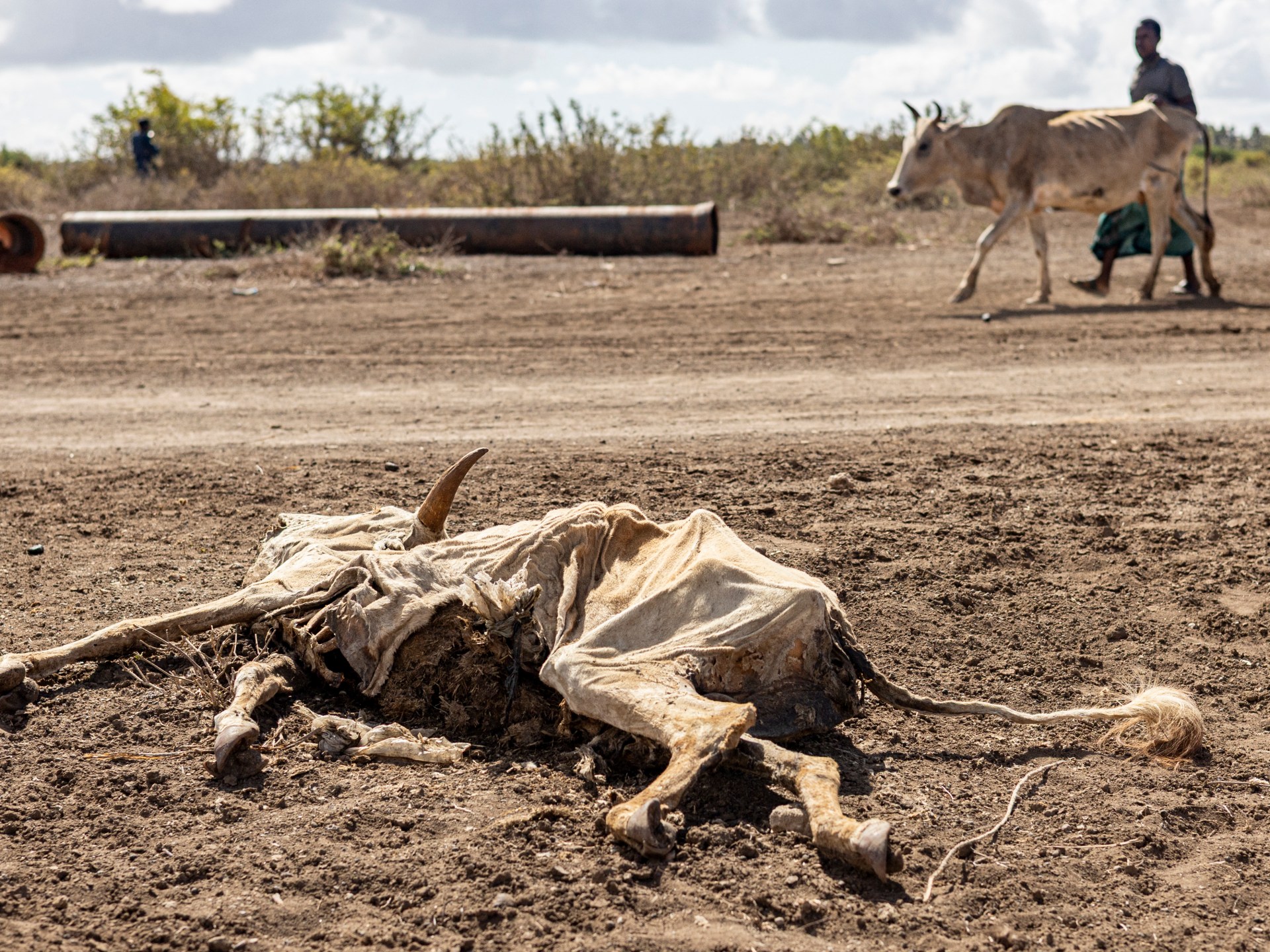
On the outskirts of Somalia’s southern port city, the land has become an open graveyard for cattle. Some are left where they fell, while others are buried in shallow graves after consecutive failed rainy seasons.

For many families here, pastoralists who rely on livestock for milk, meat, and income, animals were everything, but what was once a lifeline of food and income has now become a stark symbol of loss.

The impact is not just felt in Kismayo, but across the country, with 6.5 million people forced to skip meals and go hungry every day. Drought and rising costs only pushing the country deeper into crisis.

The humanitarian director at Save the Children, Francesca Sangiorgi, says the crisis is being driven by repeated climate shocks that are compounding over time. “We’re seeing multiple rainy seasons that have failed across the country,” she tells Al Jazeera, adding that even when rain arrives, it is often too uneven and too late to restore livelihoods that have already collapsed.

The scale of Somalia’s hunger crisis is severe and rapidly worsening.

With a third of the population facing severe food insecurity (classified as IPC Phase 3 and above), many households are struggling to get enough food to meet their basic daily requirements (PDF) — and in some cases going without food altogether, leaving them more vulnerable to malnutrition and illnesses such as diarrhoea, measles, and other infections.

Of these, more than 2 million people are in the most critical conditions short of famine (IPC Phase 4 or emergency levels), where families are facing extreme shortages and are increasingly forced into displacement in search of basic needs, moving towards already overcrowded aid camps where resources are rapidly dwindling.

Children are among the most affected. According to the UN, an estimated 1.8 million children under five in Somalia are at risk of acute malnutrition, putting their survival in immediate danger.

Sangiorgi notes that the deterioration has been unfolding rapidly, its effects already evident.

“The situation of children across the country is extremely concerning,” she explains. “We’re seeing the spread of child illnesses across the country. Dropout rates are extremely high right now, and they continue to rise because of the drought. We want to make sure that children have a chance at life—access to the health and nutrition services they need, as well as education.”

According to Doctors Without Borders, known by its French initials MSF, more than 3.3 million people have been displaced, severely straining the already limited resources and basic services in these communities.

What does the crisis look like on the ground?

Near Kismayo, one of Somalia’s largest camps for displaced people has formed, sheltering families who have nothing to eat and have travelled from across Jubbaland.

One woman describes how her herd has fallen from 200 cattle to just four, ending her very livelihood.

Barwaqo Aden, a displaced Jamame resident in Lower Juba, arrived at the camp only recently, but her eight-month-old daughter is already in the local hospital with severe malnutrition due to the lack of resources.

Others arrive after exhausting journeys, fleeing areas controlled by the armed group al-Shabab. A displaced resident, Hodhan Mohamed, walked for days and crossed the River Juba by boat before reaching a crowded settlement, unsure what she would find. Like many new arrivals, she now waits for assistance that is limited and uncertain.

Sangiorgi explains that secondary displacement – when people who have already been forced from their homes are displaced again – is becoming increasingly frequent. “As services and commodities continue to shrink across the country, the prices of essential goods keep rising as well.”

More than 3.8 million Somalis are currently displaced, making up 22 percent of the population. Many have been uprooted multiple times, moving from one settlement to another as aid resources dwindle and access to support becomes more limited.

At its core, the crisis is primarily driven by climate shocks.

Somalia has had three consecutive failed rainy seasons in recent years, drying out rivers, wells, and pasturelands.

For livestock-dependent communities, the impact has been immediate: animals are dying, and with them, livelihoods are disappearing.

As local production collapses, families are forced to buy from markets even as food, fuel, and water prices continue to rise. In rural areas, especially, incomes no longer stretch far enough to meet needs.

Insecurity caused by armed conflict adds further strain, displacing communities and limiting access for aid workers in some regions.

Beyond Somalia, the global economic crisis linked to the US–Israeli war on Iran has also played a role in constricting supply chains. A UN aid chief told the Reuters news agency in March that these disruptions are compounding costs and weakening the ability to deliver assistance, as humanitarian systems come under growing strain.

MSF reported last month that transport costs have risen by up to 50 percent in parts of Somalia, making it harder for people to reach health facilities and increasing the cost of delivering care as fuel prices climb.

The organisation also said more than 200 health and nutrition facilities have closed since early 2025 due to sharp funding cuts, leaving critical gaps in already overstretched health services.

As the need for aid rises, humanitarian funding and response capacities are only shrinking.

The UN response plan for Somalia is currently funded at just 20 percent of what is required — with $1.42bn needed but only $288m received. That discrepancy has forced major cuts, reducing the number of people targeted for assistance from 6 million to just 1.3 million.

For Somalia, which relies heavily on imported food and external assistance, the consequences are immediate. Fewer supplies are reaching ports, while the cost of delivering essentials continues to rise, testing an already fragile system.

As UN humanitarian chief Tom Fletcher told Reuters in March, “These [constraints] will damage our humanitarian supply chains, reduce ‌the ⁠humanitarian supplies we can get to people who need them, but they’ll also drive up energy costs and food costs across the region, this really is a perfect storm of factors right now, and I’m seriously worried,” he stated.

The humanitarian response has been cut by 75 percent, meaning millions of Somalis are no longer receiving assistance, even as the crisis deepens on the ground.

📰 மூல செய்தி (Source): https://www.aljazeera.com/news/2026/4/23/more-than-6-million-somalis-face-hunger-amid-climate-shocks-and-conflict?traffic_source=rss

Continue Reading
Click to comment

Leave a Reply

Your email address will not be published. Required fields are marked *

உலகம்

Chornobyl’s surviving ‘liquidators’ return 40 years after nuclear disaster

Published

on

About 600,000 soldiers, firefighters, engineers, miners and medics cleaned up after the explosion of the Soviet Union’s Chornobyl Nuclear Power Plant.

Ukraine is marking 40 years since the explosion at the Chornobyl Nuclear Power Plant, the world’s worst civilian nuclear disaster, with survivors of the cleanup operation returning to the site amid renewed debate over its human and environmental toll.

At 1:23am on April 26 (22:23 GMT, April 25), 1986, a botched safety test triggered a catastrophic blast in reactor four at the Chornobyl plant in northern Ukraine, then part of the Soviet Union.

The explosion tore through the building and sent an enormous plume of radioactive smoke into the atmosphere.

Nuclear fuel burned for more than 10 days as helicopters dumped thousands of tonnes of sand, clay and lead in a desperate bid to smother the fire.

The International Atomic Energy Agency (IAEA) later blamed “severe deficiencies in the design of the reactor and the shutdown system” as well as violations of operating procedures.

Radiation heavily contaminated large areas of Ukraine, Belarus and Russia, before spreading across Europe.

About 600,000 “liquidators” – soldiers, firefighters, engineers, miners and medics – were mobilised from across the Soviet Union over the next four years to contain and clean up the disaster.

Their tasks ranged from flying above the exposed core to wash and seal it, to scrubbing radioactive dust from buildings and roads, burying poisoned machinery, clearing forests and even hunting animals to slow the spread of contamination.

Many had little understanding of the dangers they faced. Before the anniversary, a group of liquidators from Ukraine’s Poltava region returned to Chornobyl for a day’s visit to the site where they once worked in hastily issued uniforms and improvised protective gear.

They spoke of duty carried out without hesitation, the loss they endured, and of a catastrophe that continues to haunt Ukraine.

The nearby city of Pripyat, once home to 48,000 people, remains a decaying ghost town inside an exclusion zone, spanning thousands of square kilometres in northern Ukraine and neighbouring Belarus.

Once open to tourists, the area has been closed since Russia’s invasion in 2022, leaving nature to reclaim the landscape and rare species, such as endangered Przewalski’s horses, to roam among the ruins.

📰 மூல செய்தி (Source): https://www.aljazeera.com/gallery/2026/4/26/survivors-return-to-chernobyl-40-years-after-devastating-explosion?traffic_source=rss

Continue Reading

உலகம்

What to know about Cole Allen, alleged WH correspondents’ dinner shooter

Published

on

Suspect arrested as the US president evacuated from the stage after firing at the White House correspondents’ dinner.

Police in the United States have arrested a suspected gunman who stormed the lobby outside the White House Correspondents’ Association (WHCA) dinner, attended by US President Donald Trump, at a hotel in Washington, DC.

The firing prompted the evacuation of Trump, along with the members of his cabinet, from the media gala, being held at the Washington Hilton on Saturday evening. The president later called the incident an attack by a “would-be assassin”.

Security personnel shot at the suspect after he forced his way through a checkpoint just outside the hotel ballroom, where the president, First Lady Melania Trump, top officials and hundreds of formally dressed guests were assembled.

The man, identified as 31-year-old Cole Tomas Allen in US media reports, was arrested at the scene. Official confirmation has yet to be released.

People dived under tables in chaotic scenes as Secret Service teams swarmed into the glitzy WHCA dinner, held annually at the Washington Hilton in the US capital.

“A man charged a security checkpoint armed with multiple weapons, and he was taken down by some very brave members of the Secret Service,” Trump told a news conference at the White House shortly after the incident.

“They seem to think he was a lone wolf, and I feel that too,” he said, after posting video of the suspect sprinting past security as guards drew their weapons.

So, what do we know about the suspect, and where is he now?

Law enforcement officials, who have not released the suspect’s name, say he lives in Torrance, California, a coastal city in the South Bay region near Los Angeles along Santa Monica Bay.

The chief of Washington, DC’s police department said investigators think the suspect was staying as a guest at the Washington Hilton, where the annual dinner was held, though they have not yet established a motive.

Facebook posts appearing to be linked to Allen indicate he was recognised as “Teacher of the Month” in December 2024 by the Torrance branch of C2 Education, a national private tutoring and test-preparation company for college-bound students.

A LinkedIn profile under the suspect’s name describes him as a “mechanical engineer and computer scientist by degree, independent game developer by experience, teacher by birth”.

Allen contributed $25 to a Democratic Party political action committee in support of Kamala Harris for president in 2024, according to federal campaign finance records.

Meanwhile, speaking to reporters, Trump said it was unlikely the shooting was linked to the US-Israel war on Iran.

“It’s not going to deter me from winning the war in Iran. I don’t know if that had anything to do with it, I really don’t think so, based on what we know,” Trump told reporters.

The interim chief for the Metropolitan Police Department of the District of Columbia, Jeffery Carroll, told reporters on Saturday that investigators believe the suspect was staying in the hotel, and that is how he apparently entered it at the time of the event.

The hotel was closed to the public beginning at 2pm (18:00 GMT) on Saturday in anticipation of the dinner, which began at 8pm (00:00 GMT). Outside, dozens of protesters gathered in the rain, mostly directing their criticism at the media attending the event.

Access to the hotel was restricted to hotel guests, people with tickets to the dinner, an invitation to one of the receptions held at the hotel before or after the dinner, or documents from the WHCA indicating affiliation with the dinner.

The 2,300 guests at the event in the hotel’s cavernous subterranean ballroom had to pass through several additional checks to enter the room, including showing tickets to association volunteers and hotel staff and passing through magnetometers crewed by the Secret Service and the Transportation Security Administration.

Security camera footage released by Trump on social media shortly after the incident shows the suspect running past security officers who appear to be disassembling the metal detectors.

Once the president was seated in the ballroom, additional attendees were not permitted to enter the secured area, which is why they were taking them down.

“It shows that our multilayered protection works,” Secret Service Director Sean Curran said. His comments were echoed by Carroll, who said the security plan for the evening was developed by the Secret Service and “that security plan did work this evening”.

However, Richard Gaisford, reporting for Al Jazeera from Washington, DC, said, “All eyes will now be on whether there was enough security in place.”

“This isn’t the first time that someone has tried to kill the president if that was the main aim of this evening’s attack,” he said.

“The man is being held, and we’re told, will be asked these questions. And certainly, we’ll get a clearer picture of the intent and more details of what happened tomorrow.”

Trump has been the target of several assassination attempts and numerous death threats during both his presidency and his campaigns.

The most serious incident occurred in July 2024 at a rally in Butler, Pennsylvania, when a gunman reached a rooftop overlooking the stage where the then-candidate was speaking. A spectator was killed, Trump was wounded in the ear, and Secret Service agents shot dead the attacker, identified as 20-year-old Thomas Crooks.

A few months later, in September, authorities said an armed man lay in wait near Trump’s golf course in West Palm Beach, Florida, intending to kill him.

Prosecutors said the suspect, Ryan Routh, spent weeks planning the attack and aimed a rifle through bushes as Trump played golf, but a Secret Service agent spotted him before he could shoot, and he was arrested shortly afterwards. Routh was convicted last year of attempting to kill the president and received a life sentence in February.

The same month, 21-year-old Austin Tucker Martin was shot dead after entering Trump’s Mar-a-Lago resort in Florida with a shotgun; Trump was not on the property at the time.

📰 மூல செய்தி (Source): https://www.aljazeera.com/news/2026/4/26/who-is-the-suspected-correspondent-dinner-shooter-cole-tomas-allen?traffic_source=rss

Continue Reading

உலகம்

Raghu Rai, legendary Indian photographer, dies at 83

Published

on

A Magnum Photos icon, Rai’s photographs preserved India’s memory through some of its pathbreaking events spanning decades.

Internationally acclaimed photographer Raghu Rai, widely regarded as one of the foremost chroniclers of independent India, has died at the age of 83.

The photographer’s family on Sunday announced Rai’s death in a statement, paying tribute to “our beloved”.

A construction engineer by training, Rai was born in a village in what is now Pakistan’s Punjab province before the 1947 partition of the Indian subcontinent.

He went on to become an iconic photographer documenting the complex social and political life of India, with his work ranging from historic turning points to intimate portraits.

Some of his best-known works include documenting the 1971 independence war of Bangladesh and the 1984 gas leak in the central Indian city of Bhopal that killed an estimated 25,000 people.

His photographs from Bhopal became defining visual records of India’s worst industrial disaster.

In 1972, Rai was awarded the Padma Shri, one of India’s highest civilian honours, for his exceptional work. He also won the inaugural Academie des Beaux-Arts Photography Award, cementing his place on the global stage.

“He didn’t just take photographs, he preserved our nation’s memory,” India’s main opposition leader, Rahul Gandhi, posted in his tribute on X.

Known for portraits of India’s political and social elite and photographing its culture and masses with equal alacrity, Rai published dozens of photo-books, including one on the iconic Mughal monument to love, the Taj Mahal.

His intimate portraits of Nobel Peace Prize winner Mother Teresa hold a particularly special place in Rai’s work.

Rai was a member of Magnum Photos, nominated to the prestigious New York-based cooperative by Henri Cartier-Bresson, who is known worldwide for his defining candid photography.

“To the world, he was an incomparable master of photography, the visionary who captured the pulsating heart and soul of India,” Indian parliamentarian and author Shashi Tharoor said in a tribute. “Your vision will forever be the lens through which India is seen.”

According to the Indian Express newspaper, Rai was introduced to photography by his photographer brother six decades ago and published his first picture, a donkey gazing straight into his camera, in The Times of London.

Rai later moved to photojournalism, working with some of the nation’s best-known media houses of his time through the 1960s and 70s, before going solo in his quest to depict his vast country’s complexity.

Rai’s work spans shooting on film and digital formats, both black and white and colour. He worked all his life in India, and once said, “I can never be true to my experiences without a camera.”

📰 மூல செய்தி (Source): https://www.aljazeera.com/news/2026/4/26/raghu-rai-legendary-indian-photographer-dies-at-83?traffic_source=rss

Continue Reading

Trending

Copyright © 2024 by 7Tamil Media, All rights reserved.