Connect with us

உலகம்

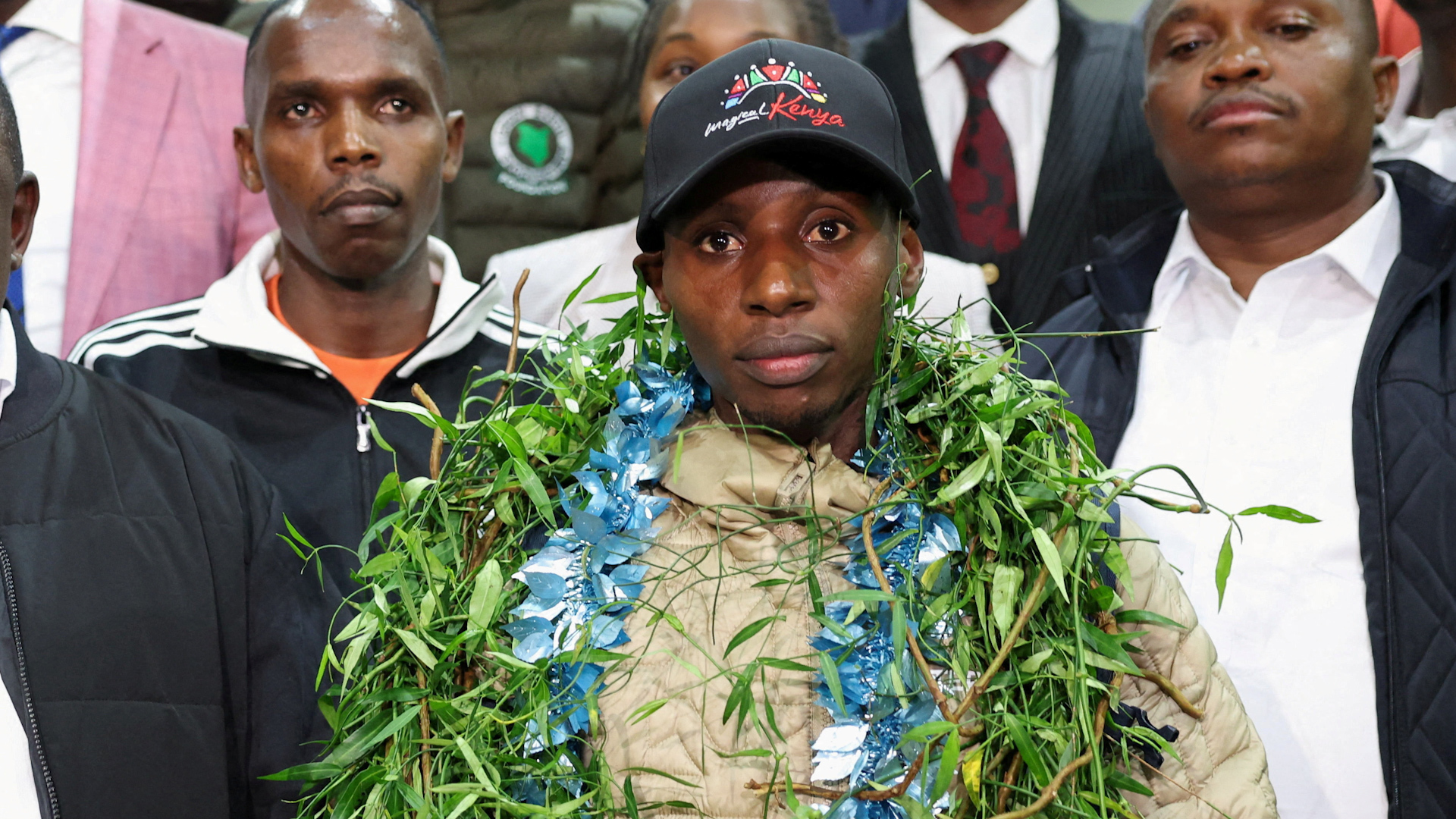
Marathon record breaker Sabastian Sawe returns to hero’s welcome in Kenya

Published

on

Marathon record breaker Sabastian Sawe returns to hero’s welcome in Kenya

Kenyan long-distance runner Sabastian Sawe has returned home to a hero’s welcome after becoming the first person to run a marathon in under two hours. Al Jazeera’s Catherine Soi spoke to fans in Nairobi when he arrived who say Sawe’s inspired them to pursue their dreams.

📰 மூல செய்தி (Source): https://www.aljazeera.com/video/newsfeed/2026/4/30/marathon-record-breaker-sabastian-sawe-returns-to-heros-welcome-in-kenya?traffic_source=rss

உலகம்

Hormuz effect? How US, China are ramping up tensions over the Panama Canal

Published

on

Rising tensions over Panama Canal prompt US-China showdown in global shipping power struggle.

The Panama Canal has emerged as the latest maritime flashpoint, with the United States and China exchanging barbs in recent weeks over influence in what is one of the world’s most important shipping routes.

Earlier this week, Washington and its allies in the region accused Beijing of detaining and holding up Panama-linked ships – and claimed China’s actions were a “blatant attempt to politicise maritime trade”.

On Wednesday, China strongly denied the allegations, calling them “hypocritical” and accusing the US of politicising global commerce and undermining sovereignty.

Analysts have warned that any disruption to the canal, even temporarily, could “disrupt global trade significantly”. “It would lead to temporary supply bottlenecks, stock market volatility, inflationary upward pressure and could dampen global GDP measurably if prolonged,” Ferdinand Rauch, a professor of economics at the University of St Gallen in Switzerland, told Al Jazeera.

This latest standoff comes as tensions between the US and Iran continue to foment over another key waterway, the Strait of Hormuz, which has been in effect closed for weeks since the launch of US-Israeli attacks on Iran, and which has been the site of multiple attacks and seizures of ships during that time.

Together, these frictions point to a broader shift in international shipping, demonstrating that major powers are increasingly willing to contest control of global shipping lanes, raising questions over whether longstanding international laws governing the world’s seas are beginning to unravel.

So, what is the latest dispute over the Panama Canal all about, and what does it mean for the future of maritime law and safety?

In a joint statement on Tuesday with Bolivia, Costa Rica, Guyana, Paraguay, Trinidad and Tobago, the US condemned what it called “China’s targeted economic pressure” and actions that have “affected Panama‑flagged vessels”.

The countries accused China of detaining Panama-flagged ships in its own ports and said these actions are “a blatant attempt to politicise maritime trade and infringe on the sovereignty of the nations of our hemisphere”.

Calling Panama “a pillar of our maritime trading system” that must remain “free from any undue external pressure”, they warned that “any attempts to undermine Panama’s sovereignty are a threat to us all” and pledged to keep the Americas “a region of freedom, security, and prosperity”.

China appears to be denying that it has detained Panama-flagged ships. Addressing the crisis on Wednesday, Lin Jian, a spokesperson for China’s Ministry of Foreign Affairs, said the US accusations “are completely unfounded and distort reality”.

“Who occupied the Panama Canal for a long time, invaded Panama with its military, and arbitrarily trampled on its sovereignty and dignity? Who covets the Panama Canal, seeks to turn this international waterway – meant to remain permanently neutral – into its own territory, and disregards the sovereignty of regional countries? The answer is self-evident,” Jian told a news conference. “The one who has politicised and securitised the issue of ports is the United States.”

On Wednesday, Panamanian President Jose Raul Mulino said in a statement that he welcomed the “solidarity of friendly countries” regarding the Panamanian-flagged ships held in Chinese ports, while appearing to try to ease tensions.

“We do not wish to engage in controversy, as we value respectful relations with all nations,” he said.

In January, Panama’s Supreme Court scrapped a longstanding concession held by a Hong Kong-linked company to operate the Balboa and Cristobal ports.

That decision came amid sustained US pressure on Panama to curb Chinese influence around the canal.

US President Donald Trump has suggested multiple times since his second term began that the US could take control of the Panama Canal, while accusing China, without evidence, of managing the strategic waterway, which accounts for about six percent of global trade.

China slammed the Panama court’s ruling, saying that Panama had “willingly succumbed” to hegemonic power. In the weeks since, Beijing has been accused by Washington of detaining or delaying dozens of Panama-flagged ships.

According to the US Federal Maritime Commission, there has been “a surge in detentions” of Panama‑flagged vessels, “far exceeding historical norms” since the court’s ruling, it said last month.

US Secretary of State Marco Rubio described China’s alleged actions as “bullying”, saying they raised “serious concerns” about using economic leverage to undermine Panama’s “sovereignty”. Beijing has denied the charges, calling them “groundless”.

What makes the Panama Canal dispute more heightened is the fact that it is unfolding alongside a wider erosion of maritime norms, most notably in the Strait of Hormuz.

The tensions there have caused major disruption to global energy markets since the US and Israel started bombing Iran on February 28. Tehran responded by effectively closing the strait, through which one-fifth of the world’s oil and liquefied natural gas (LNG) supplies are shipped during peacetime, causing oil prices to soar. Later, Iran began charging tolls for passage through – a move until now unheard of for a strait.

Despite a fragile ceasefire, Washington, in an attempt to pressure Iran, has imposed a naval blockade targeting Iranian shipping and ports.

Currently, some 2,000 vessels are stranded at either end of the strait, while others have been rerouted, come under fire or even been seized in the strait and the open sea. Last week, Iran captured two foreign container ships attempting to traverse the Hormuz strait, while firing at a third one.

Two days earlier, the US military seized the Iranian container ship Touska close to the Gulf, claiming it was attempting to cross the Arabian Sea through the Strait of Hormuz and was heading towards the Iranian port of Bandar Abbas.

Abdul Khalique, a professor at Liverpool John Moores University in the UK, said “rising geopolitical rivalry” is increasingly “spilling into maritime chokepoints, from the Panama Canal to the Strait of Hormuz”.

“While not yet a permanent ‘new normal’, the pattern of coercive signalling, accusations, and counter-accusations suggests higher baseline risk, politicised shipping lanes, and more frequent disruptions to commercial flows and insurance markets globally,” Khalique told Al Jazeera.

James Kraska, Charles H Stockton Chair of International Law at the US Naval War College, told Al Jazeera, however, that the ongoing maritime crisis between the US and Iran, is unlikely to become a permanent feature of global shipping.

“My personal view is that the straits will be open through some sort of negotiated agreement between Iran and the United States,” Kraska said. “And so I believe and hope that this does not become a new normal in the Strait of Hormuz.”

Kraska said strong international opposition to the unilateral closure of major sea lanes will be a key factor driving a resolution, “regardless of the tension or conflict between the United States and Iran”.

This will come because of the spike in global energy costs, which [has] “galvanised attention toward this issue”, Kraska said.

Other waterways such as the Panama Canal, he said, operate under “completely different legal regimes” from straits, and are already allowed to charge fees for “services provided to maintain the infrastructure”.

It will be notable to see whether other coastal states try to copy Iran by extracting payments for passage through natural straits, Kraska said, adding that some commentators point to Denmark in the Baltic Sea as a hypothetical example.

“Here again, I am optimistic,” he said.  “I believe that states understand their position in the world… in terms of legitimacy …. is going to be enhanced by adhering to the rule of law and the law of the sea rather

📰 மூல செய்தி (Source): https://www.aljazeera.com/news/2026/4/30/hormuz-effect-how-us-china-are-ramping-up-tensions-over-the-panama-canal?traffic_source=rss

Continue Reading

உலகம்

Has the US Supreme Court weakened the Voting Rights Act – and how?

Published

on

The ruling, deemed a ‘big win’ by Trump, will result in redistricting in Louisiana, but it will have farther-reaching effects.

The United States Supreme Court has voided a key provision of a landmark civil rights law by ruling that the electoral map of Louisiana had been drawn up unconstitutionally to create two Black-majority districts.

The decision represents a major reinterpretation of the landmark Voting Rights Act of 1965 – in particular, its provision designed to protect minority voters from having their political power diluted.

It is unclear how much of that provision – Section 2 of the act – remains in force.

Wednesday’s Supreme Court ruling is seen as a major win for Louisiana Republicans and President Donald Trump’s administration and is expected to make it harder for minorities to challenge electoral maps as racially discriminatory under the 1965 law.

Louisiana Governor Jeff Landry told Republican candidates for the House of Representatives on Wednesday that he planned to suspend next month’s primary elections to allow state lawmakers time to approve a new congressional map, The Washington Post reported, quoting two people with knowledge of the calls.

The latest ruling comes during a wider battle over congressional redistricting before midterm elections in November.

The court held that a map that created two Black-majority congressional districts in Louisiana was unconstitutional. The 6-3 ruling by justices blocks an electoral map that had given Louisiana a second Black-majority US congressional district.

The court’s conservative majority found that the Louisiana district represented by Democrat Cleo Fields relied too heavily on race.

Chief Justice John Roberts described the 6th Congressional District as a “snake” that stretches more than 320km (200 miles) to link parts of Shreveport, Alexandria, Lafayette and Baton Rouge.

The ruling was authored by Justice Samuel Alito and joined by his five fellow conservative justices. The dissenting justices are liberals.

“That map is an unconstitutional gerrymander,” Alito wrote on behalf of the six conservatives.

The Voting Rights Act was a piece of follow-up legislation to the Civil Rights Act, signed into law by President Lyndon B Johnson in 1964. It bans discrimination on the basis of race, colour, religion, sex or national origin.

The 1965 law primarily ended common discriminatory practices against Black voters that were prevalent in many states, including literacy tests, that were designed to prevent them from voting.

Section 2 of the act prohibits voting practices or procedures that discriminate on the basis of race, colour or membership of a language-minority group.

The section has long been understood to bar electoral maps that dilute the voting strength of minority communities, even when there is no direct evidence of racist intent.

The law also established a process known as preclearance, which required that all or parts of 15 states with a history of discriminatory practices in voting obtain federal approval before making changes to the way they hold elections.

Gerrymandering refers to the practice by politicians of redrawing the boundaries of electoral districts to give themselves a political advantage.

Redrawing electoral boundaries is not always done with the deliberate aim of securing an advantage in elections. When there is no such intent, the process is known simply as redistricting, rather than gerrymandering.

Section 2 of the act was amended by Congress in 1982 to prohibit electoral maps that would result in undermining the clout of minority voters, even without direct proof of racist intent.

For more than four decades, plaintiffs could win a Section 2 claim by showing that a voting map had a racially discriminatory impact under this legal standard, known as the “results test”.

The Supreme Court’s ruling on Wednesday, however, has in effect applied an “intent test” to Section 2, experts said. In the ruling, Alito wrote that the focus of Section 2 must now be to enforce the US Constitution’s prohibition on intentional racial discrimination under its 15th Amendment.

The 15th Amendment, ratified in 1870 after the US Civil War, which ended slavery, authorises Congress to pass laws ensuring that the right to vote is not denied “on account of race, colour or previous condition of servitude”.

Interpreting Section 2 to “outlaw a map solely because it fails to provide a sufficient number of majority-minority districts would create a right that the amendment does not protect”, Alito concluded.

“I love it,” Trump told reporters after hearing of the decision, adding that he believes Republican-led states will now want to reconfigure their voting maps.

In a social media post, Trump praised Alito as “brilliant” and called the ruling “a BIG WIN for Equal Protection under the Law, as it returns the Voting Rights Act to its Original Intent, which was to protect against intentional Racial Discrimination”.

The Trump administration had backed the challenge made in the Louisiana case to the Voting Rights Act, advocating for raising the bar for proving a Section 2 violation.

US House Speaker Mike Johnson, a Republican from Louisiana, said the Supreme Court had reached the “obvious result” in the case.

“We’ll see what effect it has,” Johnson told reporters. “We have, as you know, a primary coming up in about two weeks. So we’ll see if the state legislature deems it appropriate to go in and draw new maps.”

Former President Barack Obama, a Democrat, warned that the ruling will free state legislatures to reconfigure electoral districts to “systematically dilute and weaken the voting power of racial minorities – so long as they do it under the guise of ‘partisanship’ rather than explicit ‘racial bias'”.

“This is a devastating and profound step backwards for American Democracy,” Democratic Senator Raphael Warnock wrote on social media.

Justice Elena Kagan, in a dissent joined by the two other liberal justices on the Supreme Court, said the ruling rendered the Voting Rights Act “all but a dead letter” and predicted “grave” consequences.

“Under the court’s new view of Section 2, a state can, without legal consequence, systematically dilute minority citizens’ voting power,” Kagan wrote. “Of course, the majority does not announce today’s holding that way. Its opinion is understated, even antiseptic. The majority claims only to be ‘updating’ our Section 2 law, as though through a few technical tweaks.”

“But in fact, those ‘updates’ eviscerate the law, so that it will not remedy even the classic example of vote dilution given above,” Kagan added.

The Congressional Black Caucus, a group of African American US lawmakers, condemned the ruling.

“Without the protections of the VRA [Voting Rights Act], Republicans now have the ability to move forward with a nationwide scheme to rig congressional maps in their favor – to manufacture more districts for themselves by eliminating majority-Black districts, while stripping away the ability to challenge those racist, anti-Black maps in court,” it said in a statement.

Warnock, a member of the caucus, said the ruling gutted the protections that civil rights champion Martin Luther King Jr “marched for [and] the protections made possible by civil rights protesters who spilled blood in pursuit of a more perfect union”.

The effect of the ruling may be felt more strongly in 2028 because most filing deadlines for this year’s congressional races have already passed. Louisiana, though, may have to redraw its congressional districts now to comply with the decision.

With November’s congressional elections looming, the court’s decision could prompt Republican-led states to seek to redraw electoral maps to weaken US House seats considered safely Democratic.

The ruling was made during a battle unfolding in Republican-governed and Democratic-led states around the country involving the redrawing of electoral maps to change the composition of US House dis

📰 மூல செய்தி (Source): https://www.aljazeera.com/news/2026/4/30/has-the-us-supreme-court-weakened-the-voting-rights-act-and-how?traffic_source=rss

Continue Reading

உலகம்

Indonesian soldiers accused of acid attack. What happened and why?

Published

on

Analysts say the attack is part of a wider pattern of repression amid concerns over the growing role of the military.

The trial of four Indonesian soldiers accused of carrying out an acid attack on an activist who had campaigned against the expanding role of the armed forces in government has begun in a military court in Jakarta.

The case has drawn national and international attention with experts describing the soldiers’ alleged actions as part of a broader pattern of repression amid growing concerns over rising military influence and democratic backsliding in Indonesia.

The trial, which began on Wednesday, centres on an attack that took place on March 12 when Andrie Yunus, a 27-year-old activist with the Commission for Missing Persons and Victims of Violence, was riding a motorbike in Jakarta.

Two men on another motorbike threw acid at him, leaving him blind in one eye and with burns on more than 20 percent of his face and body, according to military prosecutor Mohammad Iswadi.

Prosecutors have charged the four soldiers, all of whom are linked to the military’s Strategic Intelligence Agency, with premeditated assault, which carries a maximum sentence of 12 years in prison. The agency’s chief has since stepped down, but no reason has been publicly given for the resignation.

Prosecutors have alleged the suspects were motivated by anger over Yunus’s activism but said they were not acting under official orders.

The United Nations has condemned the attack with High Commissioner for Human Rights Volker Turk calling it a “cowardly act of violence” and Special Rapporteur Mary Lawlor describing it as “horrific”.

Yunus has been a vocal critic of recent efforts to expand the military’s role in civilian governance in Indonesia.

He protested against an amendment passed last year that allows active-duty military personnel to hold a wider range of government positions, including in the attorney general’s office and in disaster management and counterterrorism agencies.

Days before the law was passed, Yunus disrupted a closed-door parliamentary meeting discussing the amendment, shouting objections before being forcibly removed.

At the time of the attack against him, Yunus had just recorded a podcast criticising what he described as the “militarisation” of government under President Prabowo Subianto, himself a former general.

Rights groups said there are serious concerns about impunity and whether the full scope of the acid attack will be investigated.

Amnesty International regional researcher Chanatip Tatiyakaroonwong told Al Jazeera it also has significant concerns about the fairness of the trial. In particular, he said, trying the case in a military court could weaken accountability.

“We could see many challenges around fair trial in this case, particularly due to the use of military courts,” Tatiyakaroonwong said. “Amnesty International previously documented that military courts in Indonesia often lacked the impartiality, independence and transparency required under international legal standards on fair trial.”

He added: “Civil society has already raised concerns about the indictment that included only four military officers, even though other investigations indicated that at least 14 individuals might have been involved in this acid attack.”

Observers said the attack was no isolated incident but part of a broader trend in Indonesia of pressure on activists and journalists.

Wijayanto, director of the Center for Media and Democracy at the Institute for Economic and Social Research, Education and Information (LP3ES) in Indonesia, told Al Jazeera the case reflects a steady rise in repression over the past decade.

“Andrie Yunus is just one example. … This is a symptom of democratic decline in Indonesia and one of the signs of the increasing role of the military,” he said.

In March 2025, investigative news outlet Tempo received packages containing a severed pig’s head and rat carcasses. The incident was widely seen as an attempt to intimidate journalists working there.

At the centre of concerns about this trial is the growing role of Indonesia’s military in the government as the boundaries between political power and the armed forces become increasingly blurred, analysts said.

Under Prabowo, who has served as president since 2024 and is a former special forces general and son-in-law of former President Soeharto, the military’s role in public life has expanded, according to experts.

Soeharto’s three-decade rule was marked by political repression and widespread human rights abuses. Despite this legacy, he was posthumously named a “national hero” during Prabowo’s presidency, a move that drew criticism from rights groups and democracy activists.

The shift comes amid new legislation allowing active-duty military officers to take up civilian posts without resigning from their military posts, reversing reforms introduced after Soeharto’s fall in 1998 when Indonesia moved to limit the military’s role in government and political affairs.

Civil society groups have challenged the changes in the Constitutional Court, warning it could erode democratic safeguards and weaken civilian oversight.

Wijayanto said the changes risk undermining both governance and public trust. “We doubt whether the military can really run civilian projects. They don’t have the skills,” he said.

“More importantly, it has a political effect. The military should be for defence, not for interfering in civilian life. It makes people afraid to criticise the government.”

Concerns about military influence have grown alongside broader public dissatisfaction.

In early 2025, students took to the streets to protest against budget cuts and the expansion of military powers. Later in the year, demonstrations intensified, driven by the rising cost of living, inequality and anger about corruption.

Protesters have pointed to mounting economic pressures, including inflation and stagnant wages, as well as benefits for lawmakers.

Reports that 580 parliamentarians receive a monthly housing allowance of 50 million rupiah ($3,000) in addition to their salaries have fuelled public anger. The allowance, introduced last year, is nearly 10 times the Jakarta minimum wage and about 20 times the minimum wage in poorer parts of the country.

Wijayanto said economic inequality is deepening political frustration. “The grievance of the people is not just about less freedom of speech but also about the economic gap,” he said. “Inequality is increasing while people are getting poorer. That creates a grievance.”

The attack on Yunus encapsulates a deeper shift in Indonesia, raising questions about whether criticism of the military is becoming more dangerous, whether accountability mechanisms are weakening and whether democratic reforms introduced after 1998 are being rolled back.

Rights groups said the case also reflects a broader pattern in how authorities have responded to dissent. Tatiyakaroonwong said: “These protests have all been met with severely repressive responses from Indonesian authorities, including killings, assaults and intimidation against protesters as well as journalists reporting on these protests and human rights defenders providing assistance to the protesters.”

As the trial continues, rights groups said the key question is whether it will lead to wider scrutiny of the military’s role in public life.

Tatiyakaroonwong said Yunus’s case is emblematic of broader developments in the country.

“What we are documenting in Indonesia is the entrenchment of authoritarian practices with serious human rights consequences. These include expanding military powers, shrinking space for peaceful protest and independent journalism, and new laws … that facilitate repression rather than accountability,” he said.

“During the past 18 months since President Prabowo came to power, Amnesty International has documented many cases where individuals like Andrie who spoke out against the militarisation of Indones

📰 மூல செய்தி (Source): https://www.aljazeera.com/news/2026/4/30/indonesian-soldiers-accused-of-acid-attack-what-happened-and-why?traffic_source=rss

Continue Reading

Trending

Copyright © 2024 by 7Tamil Media, All rights reserved.