Rising tensions over Panama Canal prompt US-China showdown in global shipping power struggle.
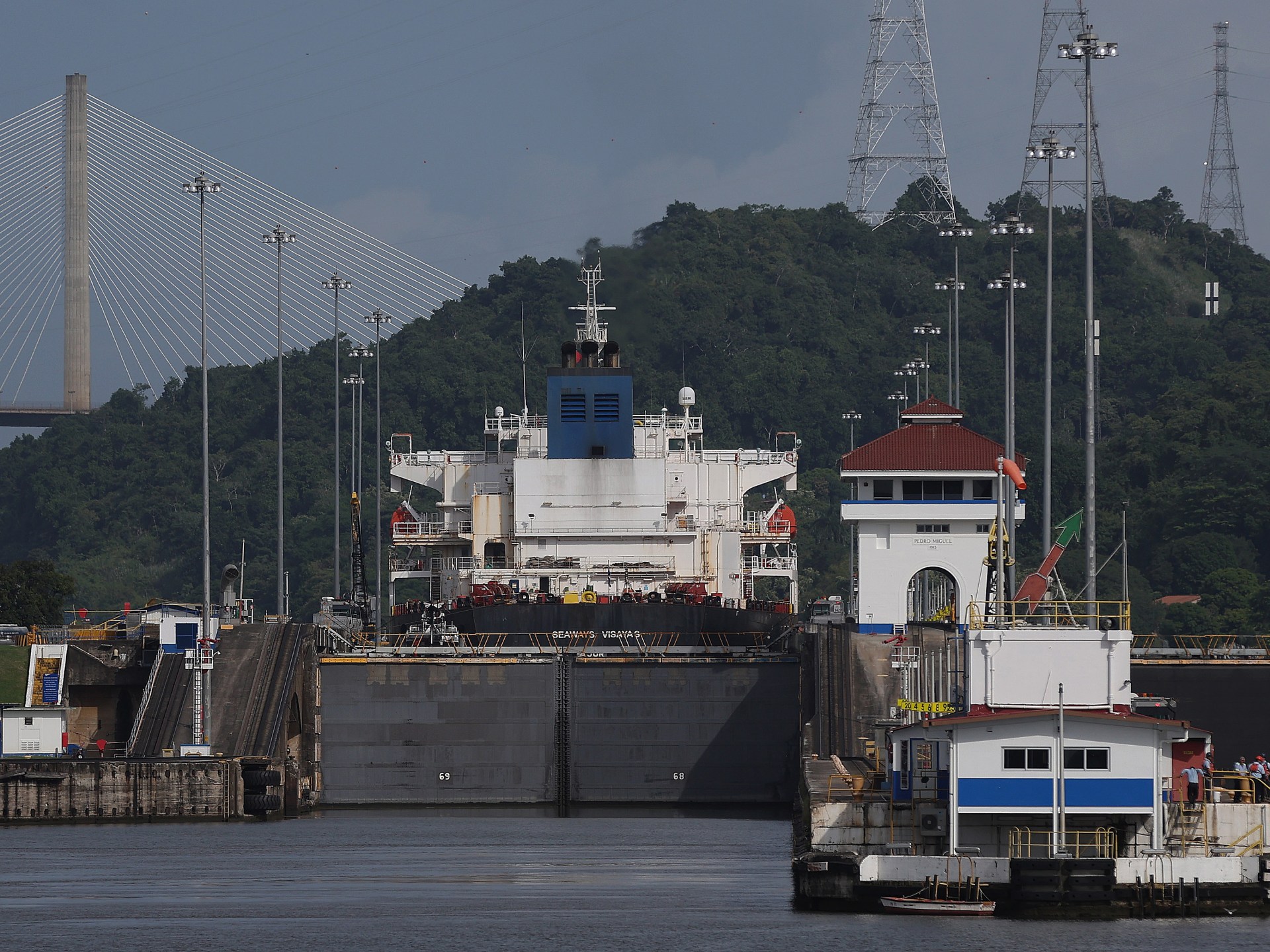
The Panama Canal has emerged as the latest maritime flashpoint, with the United States and China exchanging barbs in recent weeks over influence in what is one of the world’s most important shipping routes.
Earlier this week, Washington and its allies in the region accused Beijing of detaining and holding up Panama-linked ships – and claimed China’s actions were a “blatant attempt to politicise maritime trade”.
On Wednesday, China strongly denied the allegations, calling them “hypocritical” and accusing the US of politicising global commerce and undermining sovereignty.
Analysts have warned that any disruption to the canal, even temporarily, could “disrupt global trade significantly”. “It would lead to temporary supply bottlenecks, stock market volatility, inflationary upward pressure and could dampen global GDP measurably if prolonged,” Ferdinand Rauch, a professor of economics at the University of St Gallen in Switzerland, told Al Jazeera.
This latest standoff comes as tensions between the US and Iran continue to foment over another key waterway, the Strait of Hormuz, which has been in effect closed for weeks since the launch of US-Israeli attacks on Iran, and which has been the site of multiple attacks and seizures of ships during that time.
Together, these frictions point to a broader shift in international shipping, demonstrating that major powers are increasingly willing to contest control of global shipping lanes, raising questions over whether longstanding international laws governing the world’s seas are beginning to unravel.
So, what is the latest dispute over the Panama Canal all about, and what does it mean for the future of maritime law and safety?
In a joint statement on Tuesday with Bolivia, Costa Rica, Guyana, Paraguay, Trinidad and Tobago, the US condemned what it called “China’s targeted economic pressure” and actions that have “affected Panama‑flagged vessels”.
The countries accused China of detaining Panama-flagged ships in its own ports and said these actions are “a blatant attempt to politicise maritime trade and infringe on the sovereignty of the nations of our hemisphere”.
Calling Panama “a pillar of our maritime trading system” that must remain “free from any undue external pressure”, they warned that “any attempts to undermine Panama’s sovereignty are a threat to us all” and pledged to keep the Americas “a region of freedom, security, and prosperity”.
China appears to be denying that it has detained Panama-flagged ships. Addressing the crisis on Wednesday, Lin Jian, a spokesperson for China’s Ministry of Foreign Affairs, said the US accusations “are completely unfounded and distort reality”.
“Who occupied the Panama Canal for a long time, invaded Panama with its military, and arbitrarily trampled on its sovereignty and dignity? Who covets the Panama Canal, seeks to turn this international waterway – meant to remain permanently neutral – into its own territory, and disregards the sovereignty of regional countries? The answer is self-evident,” Jian told a news conference. “The one who has politicised and securitised the issue of ports is the United States.”
On Wednesday, Panamanian President Jose Raul Mulino said in a statement that he welcomed the “solidarity of friendly countries” regarding the Panamanian-flagged ships held in Chinese ports, while appearing to try to ease tensions.
“We do not wish to engage in controversy, as we value respectful relations with all nations,” he said.
In January, Panama’s Supreme Court scrapped a longstanding concession held by a Hong Kong-linked company to operate the Balboa and Cristobal ports.
That decision came amid sustained US pressure on Panama to curb Chinese influence around the canal.
US President Donald Trump has suggested multiple times since his second term began that the US could take control of the Panama Canal, while accusing China, without evidence, of managing the strategic waterway, which accounts for about six percent of global trade.
China slammed the Panama court’s ruling, saying that Panama had “willingly succumbed” to hegemonic power. In the weeks since, Beijing has been accused by Washington of detaining or delaying dozens of Panama-flagged ships.
According to the US Federal Maritime Commission, there has been “a surge in detentions” of Panama‑flagged vessels, “far exceeding historical norms” since the court’s ruling, it said last month.
US Secretary of State Marco Rubio described China’s alleged actions as “bullying”, saying they raised “serious concerns” about using economic leverage to undermine Panama’s “sovereignty”. Beijing has denied the charges, calling them “groundless”.
What makes the Panama Canal dispute more heightened is the fact that it is unfolding alongside a wider erosion of maritime norms, most notably in the Strait of Hormuz.
The tensions there have caused major disruption to global energy markets since the US and Israel started bombing Iran on February 28. Tehran responded by effectively closing the strait, through which one-fifth of the world’s oil and liquefied natural gas (LNG) supplies are shipped during peacetime, causing oil prices to soar. Later, Iran began charging tolls for passage through – a move until now unheard of for a strait.
Despite a fragile ceasefire, Washington, in an attempt to pressure Iran, has imposed a naval blockade targeting Iranian shipping and ports.
Currently, some 2,000 vessels are stranded at either end of the strait, while others have been rerouted, come under fire or even been seized in the strait and the open sea. Last week, Iran captured two foreign container ships attempting to traverse the Hormuz strait, while firing at a third one.
Two days earlier, the US military seized the Iranian container ship Touska close to the Gulf, claiming it was attempting to cross the Arabian Sea through the Strait of Hormuz and was heading towards the Iranian port of Bandar Abbas.
Abdul Khalique, a professor at Liverpool John Moores University in the UK, said “rising geopolitical rivalry” is increasingly “spilling into maritime chokepoints, from the Panama Canal to the Strait of Hormuz”.
“While not yet a permanent ‘new normal’, the pattern of coercive signalling, accusations, and counter-accusations suggests higher baseline risk, politicised shipping lanes, and more frequent disruptions to commercial flows and insurance markets globally,” Khalique told Al Jazeera.
James Kraska, Charles H Stockton Chair of International Law at the US Naval War College, told Al Jazeera, however, that the ongoing maritime crisis between the US and Iran, is unlikely to become a permanent feature of global shipping.
“My personal view is that the straits will be open through some sort of negotiated agreement between Iran and the United States,” Kraska said. “And so I believe and hope that this does not become a new normal in the Strait of Hormuz.”
Kraska said strong international opposition to the unilateral closure of major sea lanes will be a key factor driving a resolution, “regardless of the tension or conflict between the United States and Iran”.
This will come because of the spike in global energy costs, which [has] “galvanised attention toward this issue”, Kraska said.
Other waterways such as the Panama Canal, he said, operate under “completely different legal regimes” from straits, and are already allowed to charge fees for “services provided to maintain the infrastructure”.
It will be notable to see whether other coastal states try to copy Iran by extracting payments for passage through natural straits, Kraska said, adding that some commentators point to Denmark in the Baltic Sea as a hypothetical example.
“Here again, I am optimistic,” he said. “I believe that states understand their position in the world… in terms of legitimacy …. is going to be enhanced by adhering to the rule of law and the law of the sea rather
📰 மூல செய்தி (Source): https://www.aljazeera.com/news/2026/4/30/hormuz-effect-how-us-china-are-ramping-up-tensions-over-the-panama-canal?traffic_source=rss
















 உலகம்9 years ago