Connect with us

உலகம்

Is Russia ‘simulating diplomacy’ because of war losses in Ukraine?

Published

on

President Putin has talked about a ceasefire, but some analysts say it’s a ploy to buy time while Moscow’s soldiers are on the back foot.

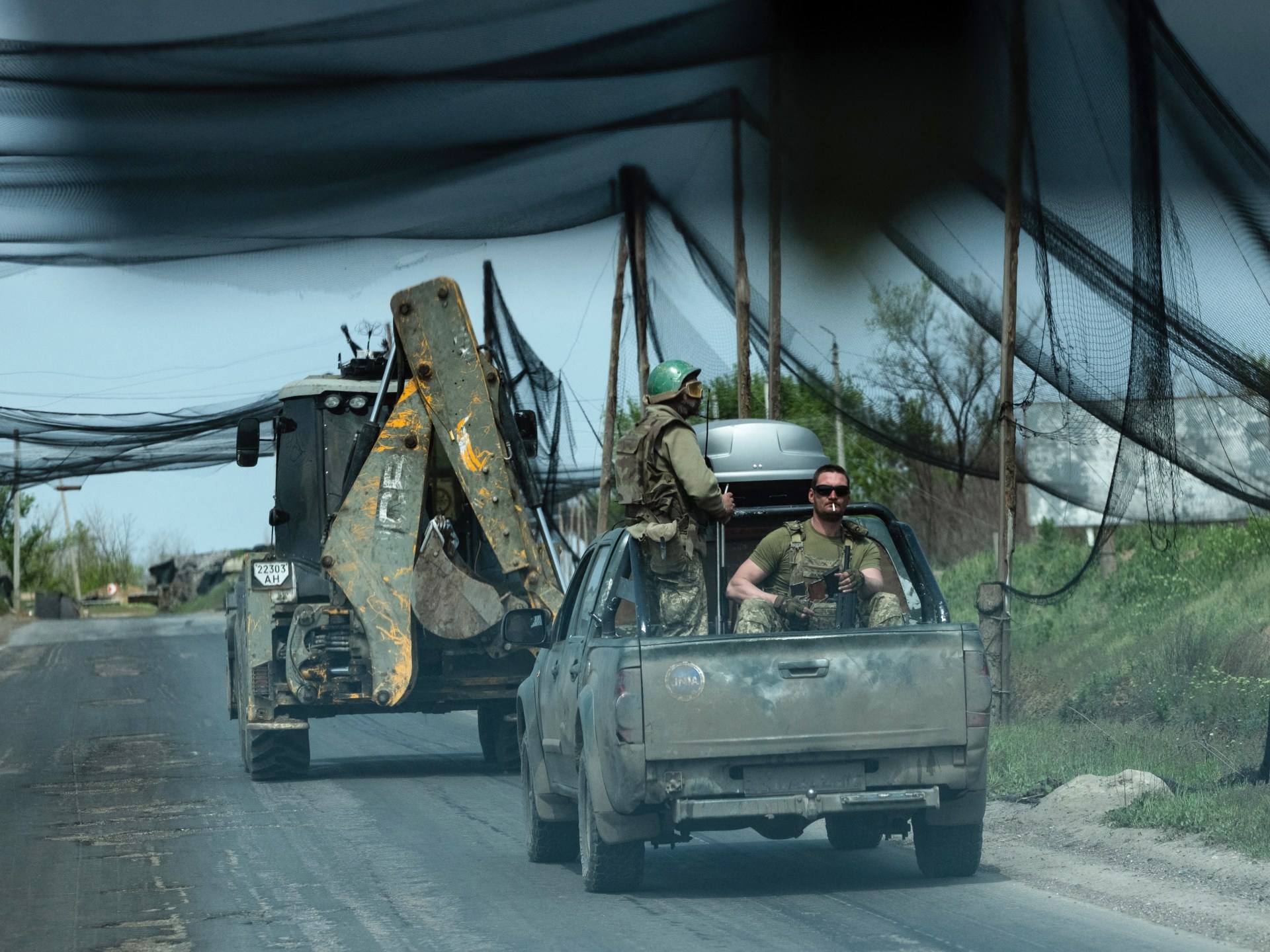
While Kyiv has recently come under frequent bombardment, the residents of Moscow have largely felt safe.

At least three people, including an Indian citizen, were killed in a drone strike on the Russian capital on Sunday. That day, the Russian Ministry of Defence declared it had shot down more than 1,000 drones in 24 hours.

The attacks come a little over a week after Russian President Vladimir Putin said the war in Ukraine, which has now raged for more than four years and claimed hundreds of thousands of lives, may soon be “coming to an end”. They also followed a Russian assault on Kyiv that killed 24.

Putin made the remarks hinting at winding down the war to reporters during Moscow’s pared-back Victory Day parade on May 9. He even expressed a willingness to meet with his Ukrainian counterpart, Volodymyr Zelenskyy, in a neutral country to sign peace accords but added: “Victory has always been and will be ours.”

This is, of course, not the first time the possibility of peace has been raised.

Before beginning his second term in the White House in January last year, United States President Donald Trump repeatedly promised to end the fighting “within 24 hours”. This has clearly not happened although a three-day ceasefire was brokered by Trump this month.

So naturally, many met Putin’s words with scepticism.

“For this announced ceasefire, not even the announced prisoner exchange has actually taken place, the least that I expected, even that didn’t happen,” Simon Schlegel, Ukraine director at the Center for Liberal Modernity in Berlin, told Al Jazeera. “And then, of course, there is no seamless transition from the things where there are overlapping interests – that both countries get their prisoners and bodily remains back – to the zero-sum games that concern territory, security guarantees, Ukraine’s future geopolitical alignment.”

After the weekend attacks, Kremlin spokesman Dmitry Peskov told reporters: “The peace process is on pause.”

The Russian and Ukrainian positions are seemingly intractable.

In the past, Putin has insisted there can be no peace until Ukraine relinquishes all territory Russia has claims to, including land not yet under Russian control. If necessary, he warned in December, the territory will be seized by force.

Zelenskyy has countered that he is constitutionally barred from officially ceding any Ukrainian land and, in any case, Russia should not be allowed to claim its invasion as a success. However, Zelenskyy has proposed a ceasefire along the current front lines with a promise that territorial questions will be resolved diplomatically. He has also agreed to abandon Ukraine’s bid for NATO membership in exchange for security guarantees from Ukraine’s Western allies.

Although Russian troops are slowly advancing, they have yet to fully conquer the Donbas region of eastern Ukraine, which Moscow lays claim to.

Last year, sources close to the Russian government told the Moscow Times that the Kremlin was dragging out negotiations on purpose to consolidate battlefield gains and diplomats were playing for time while soldiers advanced.

“It’s a war of attrition. And right now, Russia is not winning this war,” Schlegel said.

“The Ukrainians gained the upper hand in the production of drones [and] deep strike capabilities that they didn’t have a year ago, which allowed them to compromise Russian oil exports. They have kept the interception rate of drones and cruise missiles very high despite the Russians more than doubling the numbers of drones and cruise missiles that they can send in the course of a year.”

The Russians, however, can adapt and overcome using their superior manpower.

“And that’s why they want to play for time. And simulating diplomacy is a good way of doing that,” Schlegel explained. “There is no movement in Moscow’s demands. There is no movement in Ukraine’s war objectives. A new element that was introduced for the May holidays is that Russia now signals that they want to involve Europe in some way in these negotiations.”

Earlier in May, European Council President Antonio Costa said the European Union was willing to negotiate with the Kremlin as well although he later clarified his remarks. It was not yet the “right moment”, he said, and the EU does not wish to disrupt Trump’s efforts.

Putin has suggested former German Chancellor Gerhard Schroeder represent the EU in any talks, a proposition met with scepticism in Brussels.

“Schroeder has been a high-level lobbyist for Russian state-owned companies. So it’s clear why Putin wants him to be the person so that actually, you know, he would be sitting on both sides of the table,” EU foreign policy chief Kaja Kallas said.

“Moscow is generally open to negotiations. The Russian leadership has repeatedly stated this,” Alexey Nechaev of the Moscow-based Digoria Expert Club, told Al Jazeera. “However, the problem is that, so far, European politicians’ statements about dialogue have been accompanied by actions that are directly contrary: expanding military support for Ukraine, developing joint defence production, creating new military-political mechanisms in Northern Europe and strengthening NATO infrastructure on Russia’s borders. This is precisely why Russia is currently cautious about such initiatives. The main question is whether European countries are ready to discuss the root causes of the crisis and Russia’s fundamental security interests. If politicians in Europe emerge who are willing to engage in such a meaningful conversation, Moscow will likely reciprocate.”

While the EU’s position remains strongly pro-Ukrainian for now – especially after Hungarian Prime Minister Viktor Orban, widely considered sympathetic to Russia, recently was voted out of office – Schlegel noted that may change after forthcoming elections, presenting another reason for Moscow to drag out negotiations.

“If next year the National Rally wins the [French] elections, we don’t know what this is going to mean for European support to Ukraine, but it’s certainly not going to get better,” he said.

“You’ve got Reform breathing down the neck of Labour in the United Kingdom. You’ve got the AfD polling as the strongest party in Germany. … And if Putin manages to play for time long enough, then there might still be a chance for him to influence European politics in such a way that Ukraine ends up with a lot less assistance.”

But the passage of time may be more favourable to Ukraine as well as Kyiv intensifies strikes on Russian equipment, infrastructure and supply lines.

The Ukrainians “have got a lot more leverage now than they had a year ago when Trump came into office and told them they had no cards”, Schlegel said.

“So we’re getting closer to a situation where Ukraine might be actually able to talk to Russia on Ukraine’s terms, but we’re still not anywhere close to any of the sides collapsing, and that’s going to be the moment when talks start in earnest.”

Nevertheless, observers such as Ilya Budraitskis, a Russian social scientist at the University of California in Berkeley, believe the Russian leadership is averse to any serious concessions at this stage. Budraitskis told Al Jazeera that Putin must fulfil the goals he set at the start of the full-scale invasion of Ukraine in 2022.

“And if none of these goals are achieved, he will look weak and defeated,” he said. “It’s important for him to demonstrate at least one of these targets has been achieved, and to realise this, he is prepared to sacrifice tens of thousands more Russian soldiers.”

But Budraitskis made a distinction between the interests of Putin’s government and Russia as a whole, which has suffered from sanctions, Ukrainian counterattacks and other disruptions to everyday life. If the interests of Russia’s population and international security could be decoupled from those of Putin, he argue

📰 மூல செய்தி (Source): https://www.aljazeera.com/news/2026/5/20/is-russia-simulating-diplomacy-because-of-war-losses-in-ukraine?traffic_source=rss

உலகம்

Protesters torch cars, buildings in Belfast after knife attack

Published

on

Unrest comes after a Sudanese man was arrested over a stabbing attack in north Belfast, UK.

Belfast plunged into chaos as vehicles set ablaze following stabbing attack

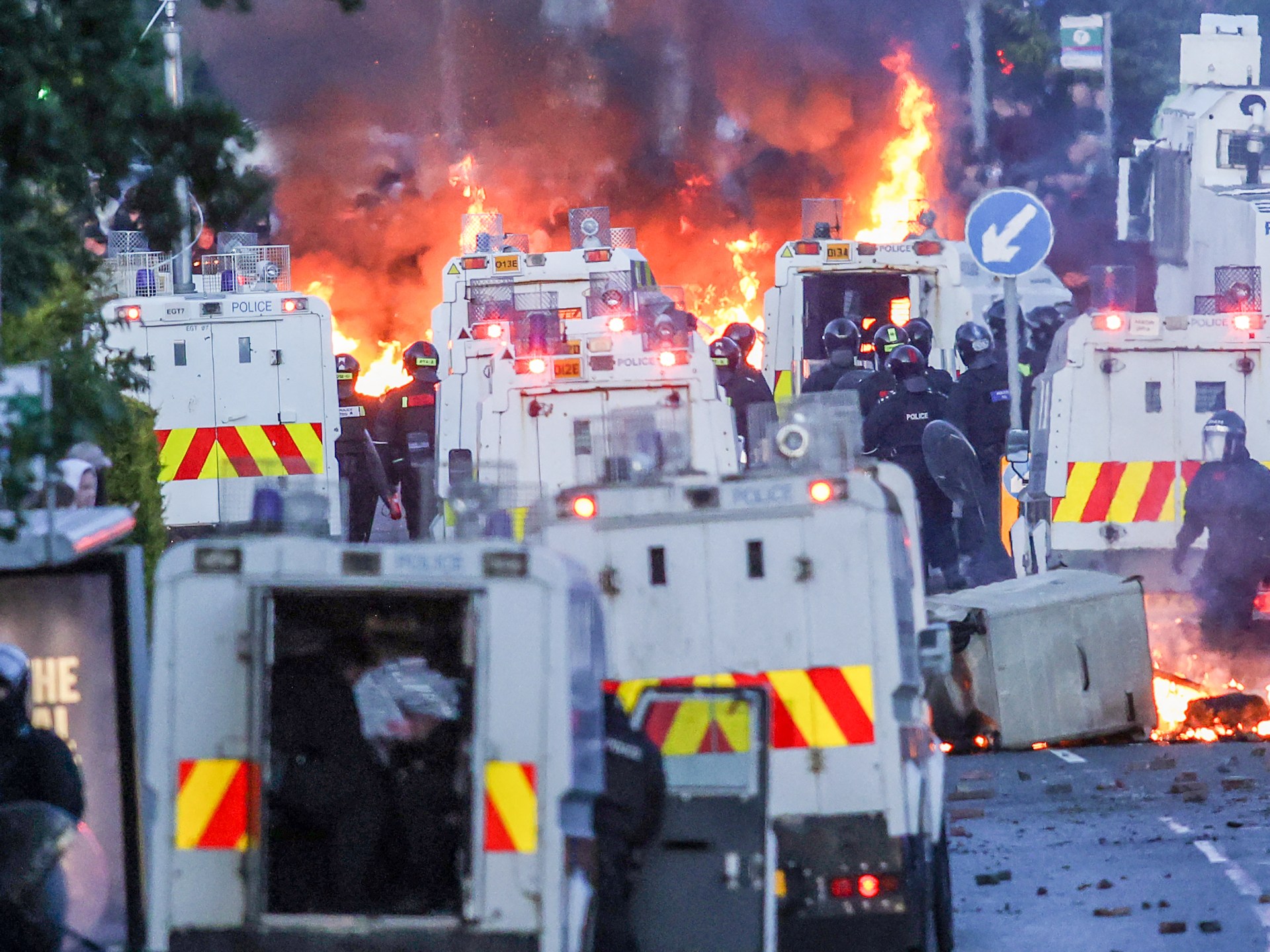
Anti-immigrant protesters in the city of Belfast in the United Kingdom have torched vehicles and buildings after a Sudanese man was arrested over a knife attack that left one person with serious injuries.

Hundreds of protesters, many of them masked, gathered at several locations across the city on Tuesday, setting fire to a bus and several cars.

A building near the city centre was also set alight, with residents telling the AFP news agency that the protesters started a fire in the bins and went on to throw petrol bombs.

Crowds also gathered in Antrim, about 25km (15 miles) west of Belfast.

Michelle O’Neill, the first minister of Northern Ireland, slammed the protests and urged calm.

“Groups of masked men burning families out of their homes is nothing less than disgusting cowardice,” she wrote on X.

“Racism, intimidation and violence are wrong wherever they occur. There can be no excuse and no justification for these attacks tonight. No one wants to see this on our streets and I again appeal for calm”.

The suspect in the knife attack, which took place in north Belfast late on Monday, was charged late on Tuesday with attempted murder, possession of a bladed weapon in a public place, and making threats to kill.

The 30-year-old man, whose name has not been released, is due to appear in court on Wednesday.

The victim, a man in his 40s, suffered significant injuries to his eyes and slash wounds to his face and back during the attack with a kitchen knife found at the scene, police said.

“I understand that last night’s attempted murder will leave people feeling a range of emotions, from fear to anger,” Northern Ireland’s Assistant Chief Constable Ryan Henderson told ⁠a news conference, as he declared the unrest a “critical incident”.

“I appeal for calm and the safety of all of our communities in ⁠response to this”, he said.

Footage of the knife attack in north Belfast showed several members of the public trying to fight off the ⁠attacker before police arrived, and they were credited by senior officers with saving the man’s life.

UK Prime Minister Keir Starmer called the attack “horrific” and “sickening” on X. “I have absolutely no tolerance for abhorrent scenes of violence like this on our streets,” he said.

His office said that “it is time for calm”, adding: “It’s important that police have the time and space to investigate appropriately.”

The attack, which is ⁠not being treated as terrorism, comes at a time of heightened tensions in the UK following the murder of a student in Southampton who was handcuffed by police as he lay dying from stab wounds after his killer, a Sikh man, had falsely alleged a racist attack.

Although the victim and convicted killer were both British, protesters on Tuesday stood outside a Southampton hotel that had housed asylum seekers, holding signs that read, “Illegal Migration Is Destroying Our Civilisation”.

The attack in Belfast, meanwhile, sparked immediate questions about the suspect’s immigration status, including from some politicians.

Gavin Robinson, the leader of the Democratic Unionist Party, urged authorities to curb “uncontrolled immigration”, while anti-immigration figures, including Reform UK party leader Nigel Farage and Restore Britain leader Rupert Lowe, demanded details about the attacker.

Northern Ireland’s chief constable, Jon Boutcher, told reporters that the suspect was living in the UK on a five-year visa granted in September 2023.

Boutcher said he was believed to have travelled from Sudan to Paris and Dublin before claiming asylum in Belfast.

“There is no trace of this suspect on any of our national security databases, and he was not known to the Police Service of Northern Ireland,” he added.

Northern ‌Ireland’s ‌main political party leaders jointly condemned the knife attack, calling it “horrific” and saying that “there is no place in our society for this kind of brutality”.

They also called for calm, saying that disturbances would only damage their communities.

📰 மூல செய்தி (Source): https://www.aljazeera.com/news/2026/6/10/protesters-torch-cars-buildings-in-belfast-after-knife-attack?traffic_source=rss

Continue Reading

உலகம்

Iran attacks Bahrain, Kuwait, Jordan in retaliation for US strikes

Published

on

Strikes come after US attacked Iranian ports and islands in the Strait of Hormuz over the downing of a helicopter.

Iran’s Islamic Revolutionary Guard Corps (IRGC) has claimed attacks on United States military bases in Bahrain, Kuwait and Jordan in retaliation for US strikes on Iranian ports and islands in the Strait of Hormuz.

In a statement carried by state media on Wednesday, the IRGC said it launched drone attacks on the US Fifth Fleet in Bahrain and the Ali Al Salem airbase in Kuwait, as well as a long-range missile strike on an airbase in Azraq, Jordan.

It said it attacked 21 US targets and destroyed four of them, including an F-35 fighter jet hangar at the base in Jordan.

It also claimed to have shot down a US MQ-9 drone in the skies over the Iranian city of Jam.

The latest flare-up comes after the US military attacked Qeshm Island and ports along the Iranian coast in the Strait of Hormuz after blaming Iran for downing a US Apache helicopter earlier on Tuesday.

The IRGC said the US’s attacks had caused damage to a telecommunications tower in the town of Sirik and destroyed two water tanks there.

It warned that its forces remain fully prepared to deliver a “crushing and decisive” response to any US military actions and that Washington would bear full responsibility for the consequences of further escalation.

There was no immediate comment from the US.

In Jordan, the military said it intercepted and shot down five missiles launched from Iran towards Azraq, adding that the operation “resulted in the fall of shrapnel without any human injuries or material damage”.

The attacks prompted air raid alarms in Bahrain and Kuwait.

The Kuwaiti military said earlier that it was intercepting “hostile aerial targets” in the country’s airspace, without elaborating further.

Trita Parsi, executive vice president of the Quincy Institute for Responsible Statecraft in the US, said Iran’s swift response to Washington’s attacks signalled a new doctrine.

“They believe they have to respond proportionately, but very harshly and swiftly, against any American attack. Because otherwise, a new normal is established, one in which the United States can strike at Iran with more or less impunity,” he said.

The Iranians, he said, were making clear that any attack on them would be responded to, regardless of the size and the scope.

“But at the end of the day, every time these different types of events have occurred, the sense I have gotten from both sides is that their confidence and their trust in the ability of reaching a deal is starting to diminish,” he added.

This new round of strikes came a day after Iran and Israel exchanged fire in their most serious escalation since a ceasefire took effect in April. The war began with US and Israeli strikes on Iran on February 28, and has shaken the global economy and driven up the cost of fuel and food.

Progress towards a peace deal remains slow, complicated further by Israel’s intensifying campaign in Lebanon against the Iranian-backed Hezbollah.

Al Jazeera’s Mohamed Vall, reporting from Tehran, said that despite the latest strikes, neither side wanted a return to full-scale war.

“Whether the Americans are going to absorb this latest retaliation from the Iranians and end their operation or whether there will be new attacks will become clear in the next few hours,” he said.

“But the understanding is that both sides would like to go back to negotiations, even though the Iranians say they don’t trust any American initiative with regards to peace.”

📰 மூல செய்தி (Source): https://www.aljazeera.com/news/2026/6/10/iran-strikes-bahrain-and-jordan-in-retaliation-for-us-attacks-in-hormuz?traffic_source=rss

Continue Reading

உலகம்

Bolivia approves military measures against nationwide protests

Published

on

Bolivia approves military measures against nationwide protests

Bolivian President Rodrigo Paz has authorised military force against protesters amid the country’s worst economic crisis in 40 years, after roadblocks paralysed the nation. At least 10 people have been killed since the unrest began.

📰 மூல செய்தி (Source): https://www.aljazeera.com/video/newsfeed/2026/6/10/bolivia-approves-military-measures-against-nationwide-protests?traffic_source=rss

Continue Reading

Trending

Copyright © 2024 by 7Tamil Media, All rights reserved.