Families choose imitation jewellery and gold-plated ornaments as record prices push pure gold jewelry out of reach.
Srinagar, Indian-administered Kashmir – Uzma Bashir sleeps most nights with her phone beside her pillow. She often wakes, not to check her messages, but she is getting married in the summer and is monitoring the price of gold.
“In [Indian-administered] Kashmir, gold is not just an ornament, it is dignity. It determines how you will be treated in your in-laws’ home,” said the 29-year-old, an accountant at a consultancy firm in the region’s main city of Srinagar.
Bashir makes less than $100 a month. She had hoped to buy her wedding jewellery with her own earnings to avoid burdening her parents.
Across South Asia, where patriarchy often defines weddings, gold has long travelled with a bride into her new home, not just as an ornament, but also as protection from harassment – and even violence – as in-laws often demand a hefty dowry from the bride’s family.
“How much gold a woman owns often becomes equal to how she will be valued,” Bashir told Al Jazeera. “My parents have already done enough for me. But I can’t afford even a single ring. It costs nearly three months of my salary”.
Record gold prices this year have hit jewellery purchases across South Asia, with the precious metal hitting a high of $5,595 per ounce on January 29 and currently trading at around $4,861.
As India – the world’s second-largest consumer of gold – last weekend celebrated the popular gold-buying Hindu festival of Akshaya Tritiya, gold futures closed at $1,670 per 10 grams – 63 percent higher than last year’s festival.
The World Gold Council says demand for gold jewellery in India fell by 24 percent in 2025 compared to the year before.
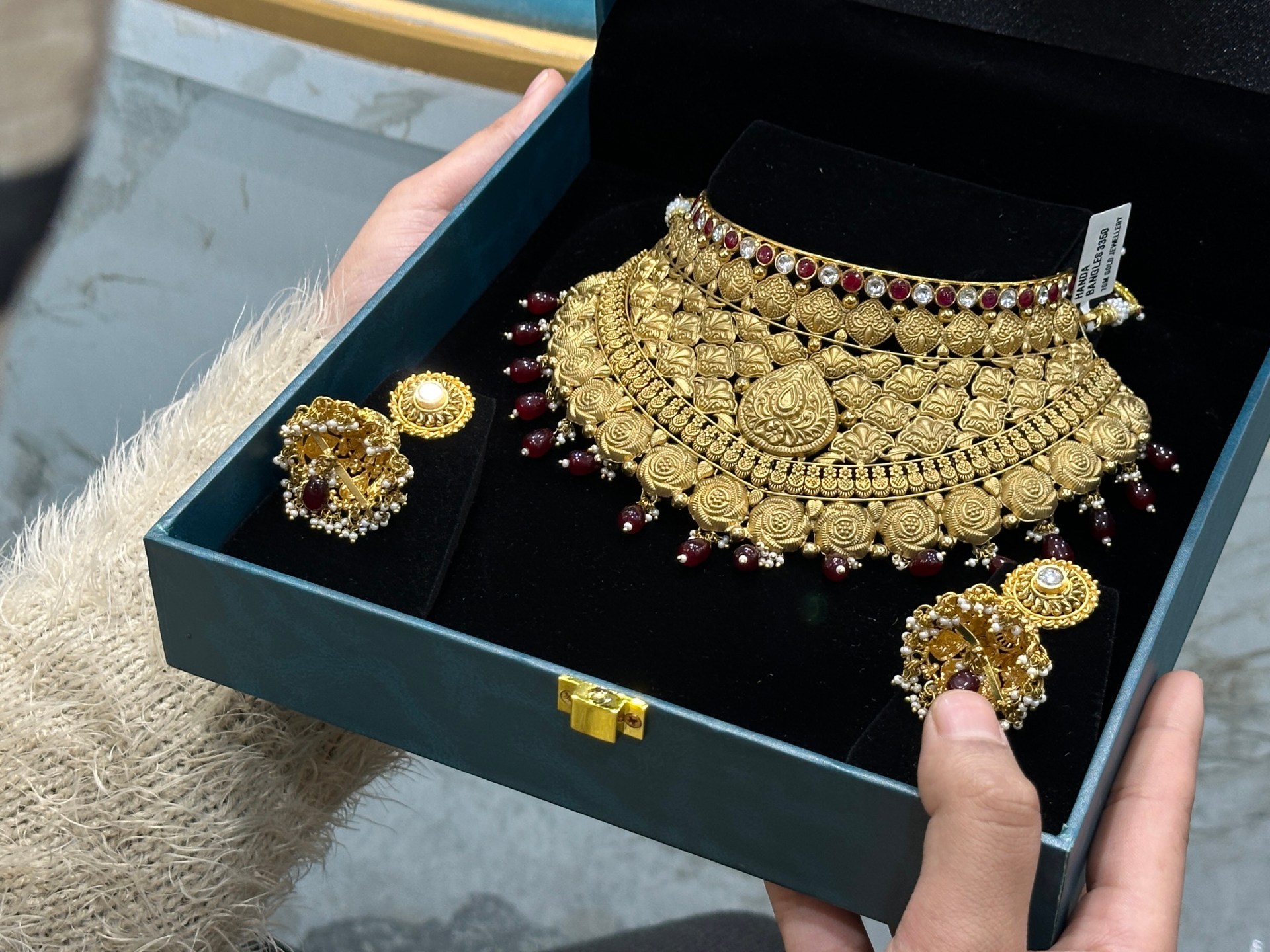
The surge in prices has also affected the way people plan their weddings, as jewellers report more and more customers abandoning pure gold and turning instead to imitation jewellery, gold-plated ornaments or lower-carat alternatives.
Customers such as Uzma Bashir, who discovered a concept called “one-gram gold jewellery” – ornaments made from base metals but coated with a thin layer of 24-carat gold.
“For me, it has emerged as a lifesaver,” she said. “Now I can wear it on my wedding day and no one would point a finger”.
Many families across South Asia are also making that choice.
Fatima Begum, who lives in Laxmi Nagar, a dense working-class neighbourhood in New Delhi, is checking out stores at the bustling Karol Bagh market, where dozens of shops specialise in imitation jewellery.
The mother of five children is looking for a shop selling one-gram gold.
“How much gold can a middle-class family living in New Delhi really afford?” she asked. “My youngest daughter is getting married and I’m trying to reduce the cost of the wedding by replacing real gold jewellery with one-gram gold. I did the same when my eldest daughter got married”.
Fatima said when she got married in 1996, her father gave her nearly 60 grams of gold, apart from other gifts as part of her dowry. “Today, I cannot give even half of that to my daughters,” she told Al Jazeera. “I have given them some of my old jewellery along with a few one-gram pieces, so they won’t feel embarrassed at their own weddings”.
Shiv Yadav, a goldsmith working in Mumbai’s jewellery hub of Zaveri Bazaar for more than three decades, says the market today is increasingly dominated by artificial jewellery.
“If 10 people walk into the shop, only one ends up buying gold; the rest turn to artificial jewellery,” Yadav told Al Jazeera. “I had never seen such a dramatic shift”.
In neighbouring Bangladesh, similar economic pressures are redefining marriages. Last month, the price of 22-carat gold in Dhaka climbed to a record $2,200 per 11.668 gram (“bhori” in the local Bangla language), according to the Bangladesh Jewellers Association.
In a country with a per capita income of around $2,600, gold has simply become unaffordable for most people.
“I don’t think we can casually wear gold anymore, the way our mothers used to. It has simply become too expensive,” said Sadia Islam as she browsed shops in Dhaka’s Chawkbazar. It is a busy wholesale hub, where the Hazi Selim Tower alone houses more than 100 jewellery outlets.
Store owner Enayet Hossain said demand for imitation jewellery has grown sharply as gold becomes too expensive for most. Smaller imitation items such as earrings cost as little as 200 to 500 taka [$1.5-$4], while larger sets sell for a few thousand, depending on the design.
“Customers want pieces that look like real gold but cost much less, and the designs are often more varied than traditional jewellery,” he told Al Jazeera, adding that many of his products are imported from India, where imitation jewellery is a huge industry.
For Sadia Islam, safety is another reason to avoid wearing real gold.
“What if I wear real gold to a wedding and it gets stolen?” she asked. “I can’t take that risk”.
Instead, she buys imitation jewellery to match specific outfits for family events. “So before family functions, I come to these shops to buy imitation jewellery that matches my clothes,” she said. “I feel much safer wearing it”.
In Pakistan too, jewellers say pure gold jewellery is increasingly becoming a luxury reserved mainly for the wealthy.
Traders say sales of gold jewellery have fallen by about 50 percent over the past year. As prices increase, many customers have turned to lower-carat options, such as 18 or 12-carat gold.
Others are abandoning gold altogether in favour of gold-plated jewellery.
“It’s not that we don’t want to wear real gold. Of course we do,” said Ayesha Khan as she shopped for jewellery for a family wedding. “But the circumstances in Pakistan are very difficult right now”.
Gold prices have reached around 540,000 Pakistani rupees ($1,938) per tola (11.668 grams). “That makes it impossible for ordinary families to buy jewellery the way people used to,” Khan told Al Jazeera.
Imitation jewellery, she added, allows families to preserve the appearance of tradition without the financial burden. “It lets us still look elegant at weddings without spending a fortune”.
The price difference is stark. A gold-plated bridal set can cost between 40,000-60,000 Pakistani rupees ($143-215). The same design made from real gold can cost hundreds of thousands or even millions of rupees.
Back in Indian-administered Kashmir, Shabana Khan and her fiancé Shahbaaz Khan confront the same reality. Their wedding is expected in two months.
“I always dreamed of wedding jewellery,” said Shabana from the remote Kupwara district. “But real gold is too expensive”.
Shahbaaz says Shabana had always imagined wearing a heavy necklace on her wedding day. “But I cannot spend $6,000 to $7,000 on gold jewellery,” he told Al Jazeera.
After the couple came across social media videos offering “one-gram gold jewellery”, they travelled to Srinagar, around 85km (53 miles) away, to visit a showroom there.
“The jewellery looked just like real gold,” Shahbaaz said. “At least with this concept, she can enjoy her dream”.
But one-gram gold jewellery doesn’t work for everyone.
Rihanna Ashraf, 40, grew up in a family of artisans that survived on traditional embroidery work. After her father died when she was still a child, she started supporting her widowed mother and four siblings.
Meanwhile, marriage proposals came but often ended in the same manner.
“One family agreed,” she told Al Jazeera. “My mother was so happy. But when we met them, they demanded gold worth more than everything we had. The proposal fell through”.
Rihanna says she has heard of one-gram gold. “But what is the benefit? It is not pure. It does not feel authentic”.
She remains unmarried, like nearly 50,000 women in Srinagar alone who are considered “past their marriage age”, according to community leaders, as financial barriers, mainly gold, play a key role.
Nisar Ahmad Bhat, who runs a jewellery store in Srinagar, said attitu
📰 மூல செய்தி (Source): https://www.aljazeera.com/news/2026/4/24/south-asias-gold-obsession-faces-soaring-price-challenges-at-weddings?traffic_source=rss


















 உலகம்9 years ago