Connect with us

உலகம்

Fifty-two hours on an Israeli prison ship

Published

on

A flotilla activist recounts his detention after Israeli forces intercepted a Gaza-bound solidarity mission at sea.

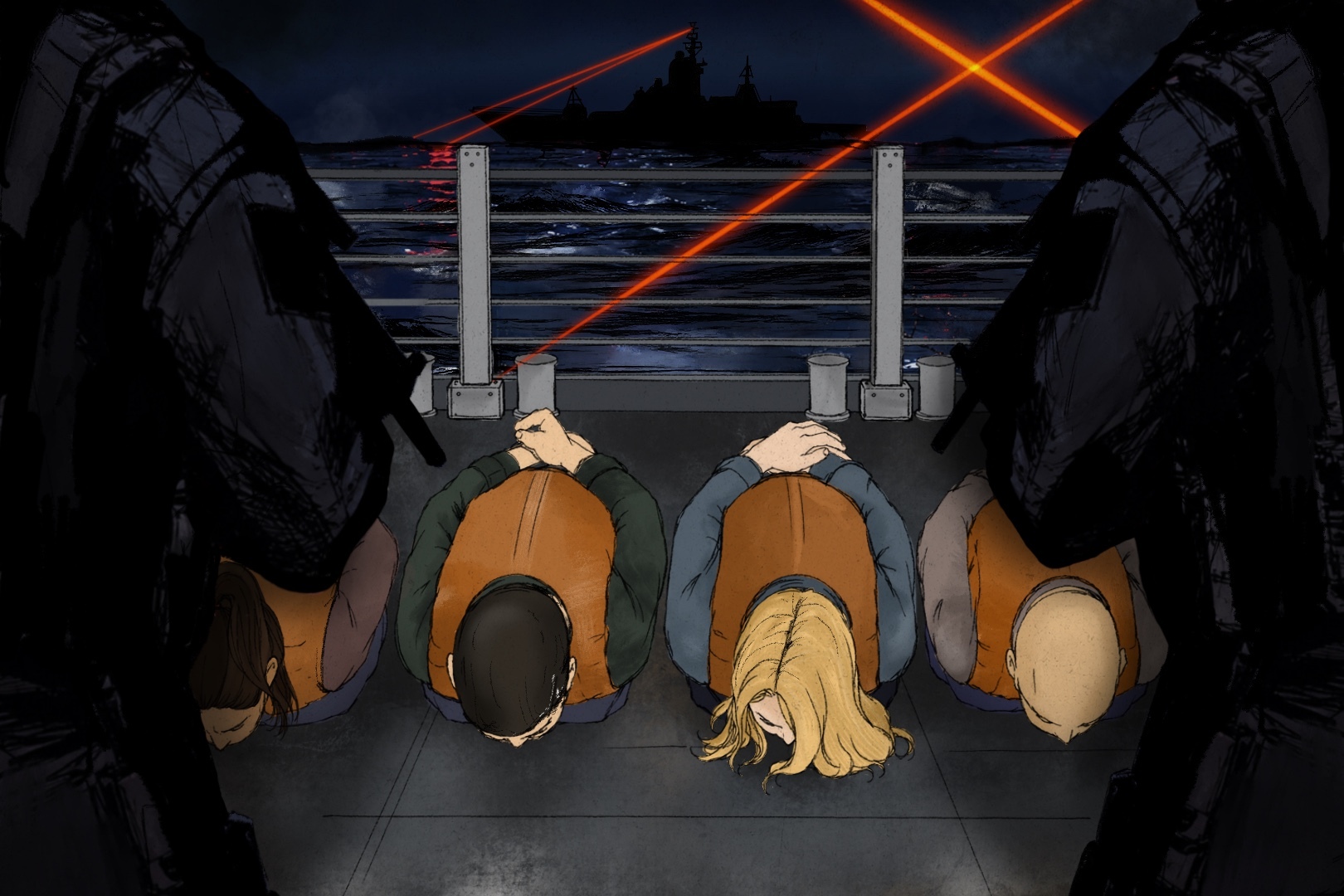
They had just pushed Eleni next to me, forcing her to her knees, her face squeezed against the cold metallic container.

She turned to me and whispered, “How are you?”

“Been better, to be honest,” I thought to myself. That’s all I could think of, as if a mediocre attempt at humour might make the guards looming over us disappear. But I said nothing. I nodded back at her before being dragged around 90 degrees to face someone typing on a computer. The person opposite me was in a face mask, like they all were, a desk-based commando who wanted to know my first and last name, my birthdate, and my passport number.

But I didn’t have my passport. It had been left on our sailboat with the others. We were held at gunpoint by commandos who were unambiguous: No personal items, no shoes, no passports.

We were part of the Global Sumud Flotilla, a fleet of more than 50 sailboats carrying activists in an act of solidarity and providing symbolic humanitarian aid to the people of Gaza.

We set off on Thursday, May 14, from Marmaris, Turkiye, for Gaza in a bid to challenge Israel’s illegal naval blockade. But on the following Monday afternoon, May 18, Israeli naval forces intercepted our vessel, La Sirena, in international waters near Cyprus. Over the next two days, they boarded all of our boats, detaining 428 activists from more than 45 countries. The seven of us on board La Sirena were taken at gunpoint and transferred to the Nahshon, one of the two Israeli military landing crafts converted into floating prisons for the operation.

The name Nahshon is sometimes linked to the Hebrew word for serpent, and it belongs to a figure from the Book of Exodus – the leader who, according to Midrash, initiated the Hebrews’ passage through the Red Sea. So we had become prisoners on a ship named for a man who walked into the sea to free his people – held captive in the name of liberation by those who had turned that legacy into a tool of siege.

The desk-based commando opposite me didn’t seem bothered by the symbolism. He simply wanted to know my passport number. But I couldn’t remember it, and we had to settle on my name and nationality. There was something almost procedural about how I was being processed at that moment. What I didn’t know was that it would be the last moment of that ordeal, more than 50 hours in all, that wasn’t governed by deliberate cruelty.

Soon after, I was thrown into a metal shipping container that the soldiers had repurposed as a processing chamber, or so it seemed at first. But then, a leg, possibly a knee, took me to my own knees. As I fell, a hard blow landed on my left ear, and I heard nothing but buzzing. I was being beaten – and then, seconds later, I was spinning towards a white door on the right, still on my knees, like a human pinball.

I flew through a door and landed in a compound. At first, I must have mirrored the terrified gaze I saw on others’ faces when they exited after me. We were all convinced that we had just entered the next level of whatever this place was.

Immediately, I was greeted with soothing hugs, sips of water and the warm gazes of those who went through the container before me. Together, we spent minutes that turned into hours, listening to the repetitive cacophony of sounds coming from behind the white door.

Kicks and screams were followed by the buzz of Taser guns, more screams, bangs on the metal container, and yet more screams. At the end of each cycle, the white door flew open, revealing a comrade rolling or limping, holding their chest or head or pulling their pants up, always with the same look of terror.

“What level of hell have I just entered?” they seemed to wonder.

The compound we landed in was open to the elements. It was outlined by six containers arranged in a rectangle. Four of them were accessible to us, two on each long side, while the remaining two formed the short ends and were sealed shut. One was reserved for the wounded, one was already filled to the brim, and another was what I understood to be a torture container.

To get out of the cold, we made our way towards the fourth, the one opposite the white door we had all just been spat out of, slowly venturing past the black tape on the floor just past its entrance. We were warned by comrades who came through before us that our captors didn’t want us crossing that line; they wanted us outside and crammed as far away from the white door as possible. But we made it in.

From there, I could see a sticker on the container door. “F*** Hamas,” it read, along with Israeli and US flags. There was a guard at each of the four corners of the deck above, always pointing their guns straight towards us in the compound. Over our entire prison journey, these guards never said a word. A metallic tube protruded beside the guard opposite the torture container, rising and curving into an L that leaned towards us, pointing straight into the compound. All night long, the guards opposite our container would flash strobe lights and point the laser beams of their weapons at comrades unfortunate enough to be crammed next to the container opening.

The bangs and screams as comrades were spat out of the white door continued for hours. Some of us retreated into the container; others remained in the compound. Towards the end of that first day – whatever a “day” or an “end” might mean under these circumstances – some news arrived.

Some of our comrades had caught sight of birds, possibly pigeons. With that, we rationalised that because pigeons were land birds that never strayed too far from shore, it must have meant we were approaching land.

A little later, a female comrade from France walked into our container, triumphant and cautious in equal measure, unable to suppress a grin. It wasn’t just the pigeons – someone had also spotted a couple of guards trying on lifejackets. We were approaching land – that was now clear. She suggested that we start packing our belongings and discreetly get ready without letting our captors know, but most of us didn’t have much with us.

Her message: Don’t get too excited, but allow yourself a sigh and a slight grin.

To terrify us, our captors stormed into the compound several times, each with a loud bang. The door would swing open, and stun grenades were thrown randomly towards us – into an opening, onto bodies; it really didn’t matter. The Israeli naval commandos would form a wall with their shields, and with their guns protruding at us, another stun grenade and then another. We would crouch together at the far corner away from the white door, trying to stay safe and as far away from our captors as possible.

But moments after our French comrade triumphantly announced our imminent departure, the door swung open once again. We heard two bangs from the stun grenades, and our captors formed their usual shield wall. There we were, once again in our small corner, but this time something was different. Our captors stayed around, and they ordered us all into a container for the first time. I could not stop grinning on the inside. I sensed that something had changed. I considered the pigeon, the lifejackets, the cramming. Surely, we were going home, I thought.

Our captors were looking for a volunteer or two to clean up our rubbish. They wanted us to sweep the place clean before we left. Two people put their hands up. The rest of us would have happily helped had we been asked to do so – or had we been given the chance. Why wouldn’t we? We were going home at last.

The two volunteers picked up all the rubbish and stacked it in a corner. We, in turn, were stacked inside our container, where we struggled to breathe. We devised a clever system where we took turns walking in front of the opening of the container. At some point, as we walked around in circles, I missed our captors retreating through their usual white door.

They left behind

📰 மூல செய்தி (Source): https://www.aljazeera.com/features/2026/6/7/fifty-two-hours-on-an-israeli-prison-ship?traffic_source=rss

உலகம்

Why has the Pentagon raised the risk of Israeli spying to the highest level?

Published

on

The US agencies warn of Israel intensifying efforts to collect information on the talks to end the war, according to media reports.

The US defence department has reportedly raised its assessment of the espionage threat posed by Israel to the highest category of “critical”, according to media reports citing American intelligence and defence officials.

The assessment, first published by NBC News on Friday and followed by The New York Times, comes at a time when Washington is pursuing diplomatic engagement with Iran, while its ally Israel is opposed to the talks aimed at ending the conflict now 100 days long on Sunday.

US President Donald Trump and Israeli Prime Minister Benjamin Netanyahu have publicly diverged in their approach to the war – Washington wants to extricate itself amid political pressure, while Israel is still pushing to topple the Iranian government.

This is not the first time Israel has been accused of espionage against the US – its closest ally and benefactor – with which it maintains extensive security and intelligence cooperation.

According to NBC News and The New York Times (NYT), citing anonymous current and former US officials, the Pentagon’s Defense Intelligence Agency (DIA) arm recently upgraded Israel’s counterintelligence threat level from “high” to “critical”, the most serious designation in its internal assessment system.

The warning was based on Israeli intelligence agencies intensifying efforts to collect information on US military personnel, government officials and policy discussions.

The news reports said the concern was focused on American officials involved in shaping Washington’s approach towards Iran, as the two foes continue to negotiate an end to the war that has sent global energy prices soaring.

“An intensified Israeli effort to learn about US positions in talks with Iran has crossed a line, according to some American officials,” the NYT said.

According to the news outlet, intelligence assessments pointed to increased Israeli surveillance efforts in recent weeks targeting US military and government figures.

They include Trump envoy and key negotiator Steve Witkoff; the Pentagon’s top policy official, Elbridge A Colby; and one of his deputies, Michael P DiMino IV, the NYT reported.

Witkoff was chief negotiator in the nuclear talks before Israel and the US launched the attack on Iran on 28 February.

The reports also referenced incidents in which US defence personnel working in Israel allegedly discovered software on their phones “to tap their communications had been surreptitiously installed on their phones”, the NYT added.

The newspaper said the DIA reports found Israeli spying on the US, which has occurred before, surged from late 2024 onwards, coinciding with US President Joe Biden’s administration stepping up pressure on Israel over its genocide in Gaza.

The reported increase in spying continued after Trump was elected to a second term in November 2024 and began shaping his administration’s policy towards Iran.

Tensions between Trump and Netanyahu have come to the surface in the past week, amid reports the US president called the Israeli prime minister “f****ing crazy”, due to Israel’s escalation in Lebanon. At least 3,500 people have been killed in Israeli attacks in Lebanon.

Trump has been pressing Israel to halt its attacks on Lebanon, but the bombardment in the south has continued, undermining a potential deal with Iran which insists both issues are inseparable.

While intelligence gathering between friendly nations is not unusual, some US officials reportedly believe recent Israeli activities have gone beyond what Washington traditionally considers acceptable among allies.

According to officials cited in the reports, US intelligence agencies have become increasingly concerned that Israel is seeking greater insight into US policy discussions and negotiating positions, specifically with Iran.

According to NBC, the Israeli embassy in Washington said it was “completely false” that the country spies on US government officials or American institutions.

“Israel does not gather intelligence on American entities, let alone US government officials,” NBC quoted the spokesperson as saying.

A White House official also reportedly dismissed the NBC report, saying the “entire story is false and sourced to someone who doesn’t have any knowledge of what’s going on”.

Al Jazeera could not independently verify the media reports and the US and Israeli responses.

Yes. Israel has previously been involved in espionage cases targeting the US, although such incidents have not been spoken about much given their close ties.

The most famous example is the Jonathan Pollard affair. The civilian intelligence analyst working for the US Navy was arrested in 1985 after passing large quantities of classified information to Israel. He later pleaded guilty to espionage and served 30 years in prison before being released on parole in 2015.

The Pollard case remains one of the most significant espionage scandals in the history of US-Israeli relations and continues to shape perceptions within parts of the American intelligence community.

However, espionage between close allies is not uncommon, says academic Andreas Kreig.

“Israel has a particularly long track record of conducting intelligence operations inside the United States,” the professor at the Department of Security at King’s College London told Al Jazeera.

“Over decades, Israel has sought to penetrate US policymaking circles through both formal and informal networks, including intelligence and lobbying channels, in order to gain insight into American strategic thinking and decision-making,” he added.

Nevertheless, Washington has for years provided billions in military aid and weapons sales to Israel, including throughout the ongoing Israeli genocide in Gaza.

The US Congress is also currently debating a section of a new defence bill, which would integrate the two countries’ research and development for weaponry to an unprecedented degree. The US has also provided diplomatic cover to Israel at the UN and other international bodies.

According to academic Kreig, Israel is “deeply concerned” about the trajectory of US negotiations with Iran.

“From the Israeli perspective, the recent conflict with Iran was effectively a joint US-Israeli war, yet the United States is now in a position to shape the diplomatic endgame,” he told Al Jazeera.

“The principal Israeli concern is that Washington could agree to a deal that establishes an enduring diplomatic framework, potentially lasting years or even decades, which would constrain Israeli freedom of military manoeuvre against Iran in the future. Israeli policymakers therefore have a strong incentive to stay ahead of US deliberations and understand negotiations in real time.”

Moreover, Kreig said Israeli intelligence gathering also serves a “strategic purpose”, which is to identify “opportunities to influence, derail, or undermine negotiations if Israeli leaders judge the process to be contrary to their security interests”.

“While Israel sees the United States as its indispensable patron and closest strategic partner, it has simultaneously treated the US as a legitimate intelligence target whenever interests diverge,” he added.

“What surprises many observers is the extent to which Israel, despite being heavily dependent on American military, diplomatic and financial support, has developed the capacity to penetrate multiple layers of US policymaking and cultivate influence across key institutions involved in American statecraft.”

According to analyst and Iran expert Negar Mortazavi, Israel’s reported espionage in the current context is not new and has past precedent. Israel’s opposition to US-Iran negotiations goes back to the time of US President Barack Obama when he signed a nuclear deal with Iran in 2015, which the US under Trump withdrew from in 2018.

“The Israeli Prime Minister Netanyahu did not want any deals or

📰 மூல செய்தி (Source): https://www.aljazeera.com/news/2026/6/7/why-has-the-pentagon-raised-the-risk-of-israeli-spying-to-the-highest-level?traffic_source=rss

Continue Reading

உலகம்

Israel strikes southern suburbs of Lebanon’s capital Beirut

Published

on

Videos show the aftermath of an Israeli attack on Beirut’s southern suburbs, with multiple explosions reported. Israel says it targeted Hezbollah headquarters, while Lebanese media says residential apartments were hit. The attack comes just days after US President Donald Trump told Benjamin Netanyahu that Beirut was off limits as Washington pursues a deal with Iran.

📰 மூல செய்தி (Source): https://www.aljazeera.com/video/newsfeed/2026/6/7/israel-strikes-southern-suburbs-of-lebanons-capital-beirut?traffic_source=rss

Continue Reading

உலகம்

Marc Marquez hits 100 career wins with Hungarian MotoGP victory

Published

on

The seven-time MotoGP world champion beat KTM’s Pedro Acosta to claim his first grand prix victory of the season.

Marc Marquez ‌claimed his 100th victory across all classes with a commanding win at the Hungarian Grand Prix on Sunday ⁠at Balaton Park, less than ⁠a month after surgery on his shoulder and foot.

The 33-year-old Spaniard beat KTM’s Pedro Acosta to the chequered flag for his first win since the San Marino Grand Prix last year and his ⁠74th in MotoGP.

The seven-time MotoGP champion’s triumph was particularly sweet as it also marked Ducati’s 100th victory while his team mate Francesco Bagnaia finished third.

“Super happy. Expensive win because after last year it changed everything,” said Marquez, who also won ⁠Saturday’s sprint from pole position.

“But the sport is like this. From one day to the other, one can change everything. I learned this in 2020 (after a season-ending crash).”

It became a nightmare race for Aprilia when Jorge Martin lost his balance on the first lap at turn one and crashed into three riders, including his teammate and championship leader Marco Bezzecchi.

The ‌crash also took out Gresini Racing’s Fermin Aldeguer and Trackhouse rider Raul Fernandez, as three Aprilia bikes were taken out of contention.

“I didn’t do a good start and when I started to brake, I just saw something arriving so fast,” Bagnaia said.

“It was Martin arriving (at) double the speed, so maybe it was two (riders) on the inside and locked the front, because the new tarmac on corner one was very slippery.”

Both Martin and Bezzecchi were taken to the medical centre, with Aprilia later confirming Martin had bruising on his back and right foot while Bezzecchi suffered contusions on his ⁠right leg and hand, though neither rider showed visible fractures.

Up ⁠front, Acosta seized the initiative on lap two, diving inside to take the lead in a thrilling battle that saw the KTM rider and Marquez trade fastest laps while leaving Bagnaia far behind in third.

The decisive moment came on lap 14 when Marquez made his move, only for Acosta to ⁠respond immediately, with the KTM rider even nudging aside his compatriot near the final turn, but Marquez was not to be denied.

Taking the lead at the chicane on the next ⁠lap, Marquez then streaked away, building a commanding advantage before cruising to victory ⁠as Acosta seemed to struggle with tyre wear.

In a moment of pure joy, he stood on his bike as he crossed the finish line, before celebrating with a red flag emblazoned with the number 100.

The milestone puts Marquez in exclusive company as only the third rider to reach a century of wins, ‌joining motorcycling greats Giacomo Agostini (122) and Valentino Rossi (115).

“We come back and we work hard. Some difficulties this first part of the season but I knew that here was a big chance to win,” Marquez added.

“I want to say thanks to the ‌people ‌that believed in me – the doctors, the physios, a lot of hours at home working. The prize was expensive but I’m happy to (make) another comeback.”

Trackhouse rider Ai Ogura finished fourth while Honda’s Luca Marini completed the top five.

📰 மூல செய்தி (Source): https://www.aljazeera.com/sports/2026/6/7/marc-marquez-hits-100-career-wins-with-hungarian-motogp-victory?traffic_source=rss

Continue Reading

Trending

Copyright © 2024 by 7Tamil Media, All rights reserved.