Connect with us

உலகம்

Fifty-two hours on an Israeli prison ship

Published

on

A flotilla activist recounts his detention after Israeli forces intercepted a Gaza-bound solidarity mission at sea.

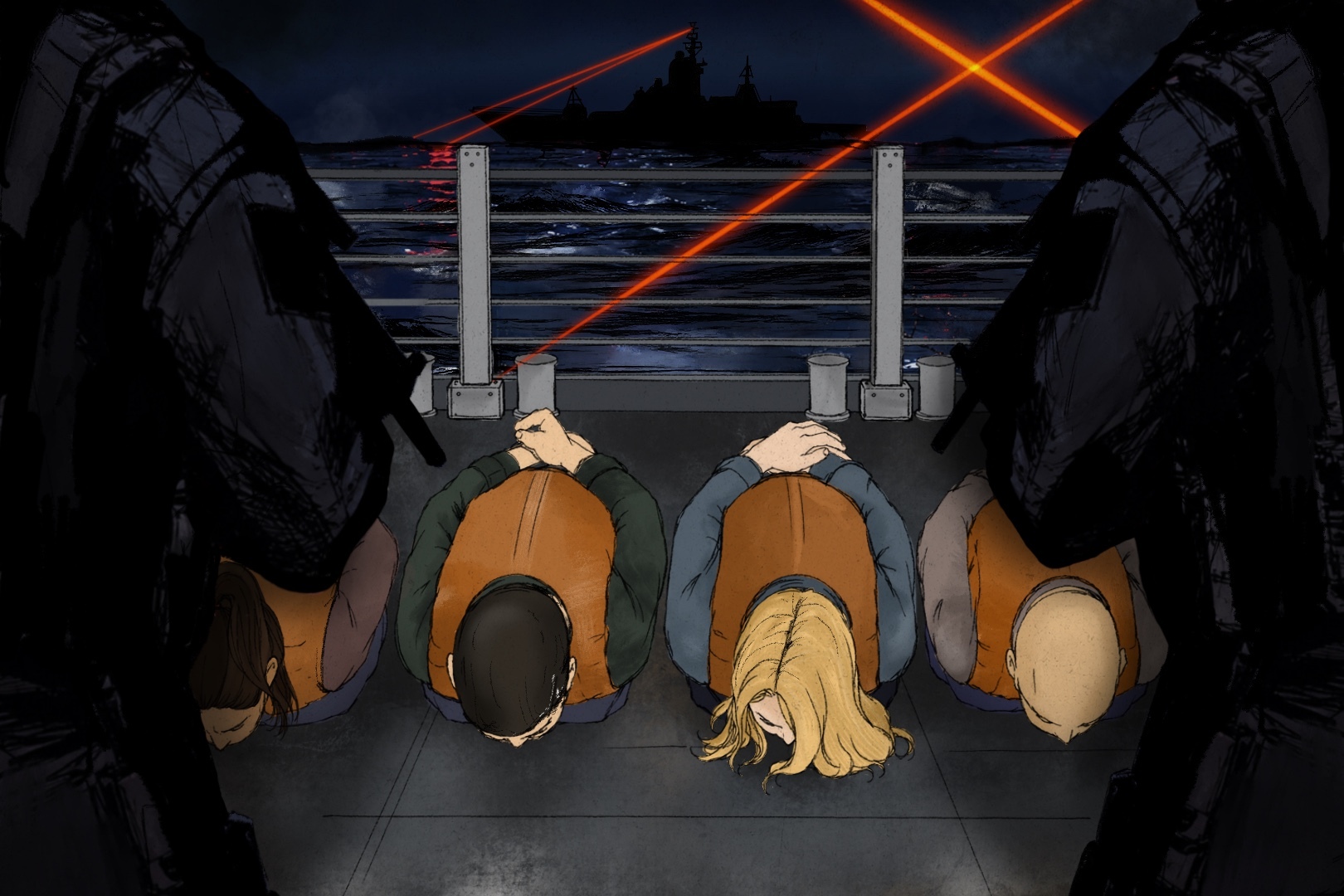
They had just pushed Eleni next to me, forcing her to her knees, her face squeezed against the cold metallic container.

She turned to me and whispered, “How are you?”

“Been better, to be honest,” I thought to myself. That’s all I could think of, as if a mediocre attempt at humour might make the guards looming over us disappear. But I said nothing. I nodded back at her before being dragged around 90 degrees to face someone typing on a computer. The person opposite me was in a face mask, like they all were, a desk-based commando who wanted to know my first and last name, my birthdate, and my passport number.

But I didn’t have my passport. It had been left on our sailboat with the others. We were held at gunpoint by commandos who were unambiguous: No personal items, no shoes, no passports.

We were part of the Global Sumud Flotilla, a fleet of more than 50 sailboats carrying activists in an act of solidarity and providing symbolic humanitarian aid to the people of Gaza.

We set off on Thursday, May 14, from Marmaris, Turkiye, for Gaza in a bid to challenge Israel’s illegal naval blockade. But on the following Monday afternoon, May 18, Israeli naval forces intercepted our vessel, La Sirena, in international waters near Cyprus. Over the next two days, they boarded all of our boats, detaining 428 activists from more than 45 countries. The seven of us on board La Sirena were taken at gunpoint and transferred to the Nahshon, one of the two Israeli military landing crafts converted into floating prisons for the operation.

The name Nahshon is sometimes linked to the Hebrew word for serpent, and it belongs to a figure from the Book of Exodus – the leader who, according to Midrash, initiated the Hebrews’ passage through the Red Sea. So we had become prisoners on a ship named for a man who walked into the sea to free his people – held captive in the name of liberation by those who had turned that legacy into a tool of siege.

The desk-based commando opposite me didn’t seem bothered by the symbolism. He simply wanted to know my passport number. But I couldn’t remember it, and we had to settle on my name and nationality. There was something almost procedural about how I was being processed at that moment. What I didn’t know was that it would be the last moment of that ordeal, more than 50 hours in all, that wasn’t governed by deliberate cruelty.

Soon after, I was thrown into a metal shipping container that the soldiers had repurposed as a processing chamber, or so it seemed at first. But then, a leg, possibly a knee, took me to my own knees. As I fell, a hard blow landed on my left ear, and I heard nothing but buzzing. I was being beaten – and then, seconds later, I was spinning towards a white door on the right, still on my knees, like a human pinball.

I flew through a door and landed in a compound. At first, I must have mirrored the terrified gaze I saw on others’ faces when they exited after me. We were all convinced that we had just entered the next level of whatever this place was.

Immediately, I was greeted with soothing hugs, sips of water and the warm gazes of those who went through the container before me. Together, we spent minutes that turned into hours, listening to the repetitive cacophony of sounds coming from behind the white door.

Kicks and screams were followed by the buzz of Taser guns, more screams, bangs on the metal container, and yet more screams. At the end of each cycle, the white door flew open, revealing a comrade rolling or limping, holding their chest or head or pulling their pants up, always with the same look of terror.

“What level of hell have I just entered?” they seemed to wonder.

The compound we landed in was open to the elements. It was outlined by six containers arranged in a rectangle. Four of them were accessible to us, two on each long side, while the remaining two formed the short ends and were sealed shut. One was reserved for the wounded, one was already filled to the brim, and another was what I understood to be a torture container.

To get out of the cold, we made our way towards the fourth, the one opposite the white door we had all just been spat out of, slowly venturing past the black tape on the floor just past its entrance. We were warned by comrades who came through before us that our captors didn’t want us crossing that line; they wanted us outside and crammed as far away from the white door as possible. But we made it in.

From there, I could see a sticker on the container door. “F*** Hamas,” it read, along with Israeli and US flags. There was a guard at each of the four corners of the deck above, always pointing their guns straight towards us in the compound. Over our entire prison journey, these guards never said a word. A metallic tube protruded beside the guard opposite the torture container, rising and curving into an L that leaned towards us, pointing straight into the compound. All night long, the guards opposite our container would flash strobe lights and point the laser beams of their weapons at comrades unfortunate enough to be crammed next to the container opening.

The bangs and screams as comrades were spat out of the white door continued for hours. Some of us retreated into the container; others remained in the compound. Towards the end of that first day – whatever a “day” or an “end” might mean under these circumstances – some news arrived.

Some of our comrades had caught sight of birds, possibly pigeons. With that, we rationalised that because pigeons were land birds that never strayed too far from shore, it must have meant we were approaching land.

A little later, a female comrade from France walked into our container, triumphant and cautious in equal measure, unable to suppress a grin. It wasn’t just the pigeons – someone had also spotted a couple of guards trying on lifejackets. We were approaching land – that was now clear. She suggested that we start packing our belongings and discreetly get ready without letting our captors know, but most of us didn’t have much with us.

Her message: Don’t get too excited, but allow yourself a sigh and a slight grin.

To terrify us, our captors stormed into the compound several times, each with a loud bang. The door would swing open, and stun grenades were thrown randomly towards us – into an opening, onto bodies; it really didn’t matter. The Israeli naval commandos would form a wall with their shields, and with their guns protruding at us, another stun grenade and then another. We would crouch together at the far corner away from the white door, trying to stay safe and as far away from our captors as possible.

But moments after our French comrade triumphantly announced our imminent departure, the door swung open once again. We heard two bangs from the stun grenades, and our captors formed their usual shield wall. There we were, once again in our small corner, but this time something was different. Our captors stayed around, and they ordered us all into a container for the first time. I could not stop grinning on the inside. I sensed that something had changed. I considered the pigeon, the lifejackets, the cramming. Surely, we were going home, I thought.

Our captors were looking for a volunteer or two to clean up our rubbish. They wanted us to sweep the place clean before we left. Two people put their hands up. The rest of us would have happily helped had we been asked to do so – or had we been given the chance. Why wouldn’t we? We were going home at last.

The two volunteers picked up all the rubbish and stacked it in a corner. We, in turn, were stacked inside our container, where we struggled to breathe. We devised a clever system where we took turns walking in front of the opening of the container. At some point, as we walked around in circles, I missed our captors retreating through their usual white door.

They left behind

📰 மூல செய்தி (Source): https://www.aljazeera.com/features/2026/6/7/fifty-two-hours-on-an-israeli-prison-ship?traffic_source=rss

உலகம்

Police in Belfast use water cannon as anti-immigrant unrest continues

Published

on

Clashes come as family of knife attack victim calls for calm and condemns violence targeting immigrants.

Unrest in Northern Ireland: Second day of anti-immigration protests in Belfast

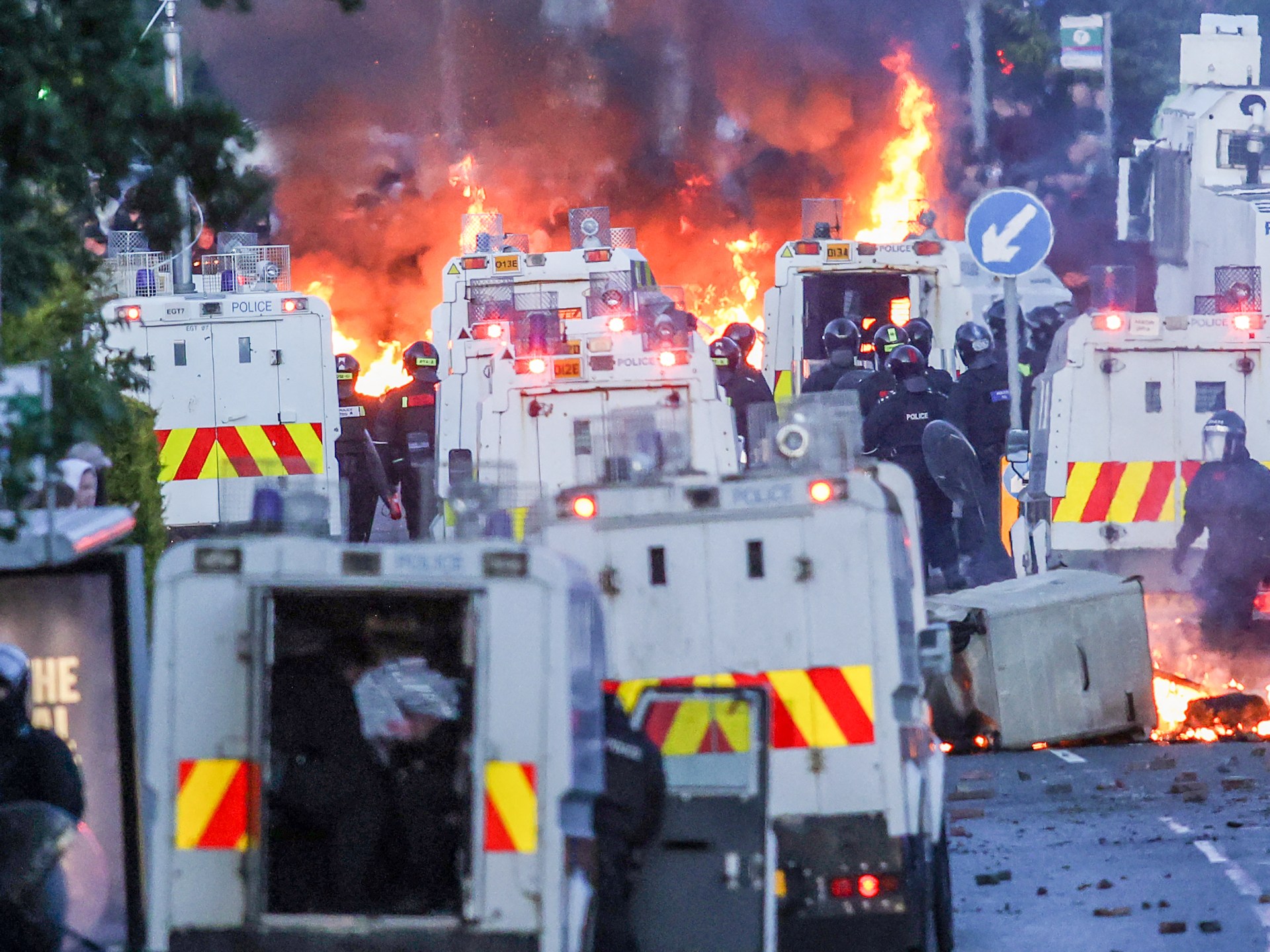
Police in the United Kingdom city of Belfast have used water cannon to disperse dozens of far-right protesters during a second night of unrest triggered by a knife attack involving a Sudanese refugee.

The clashes on Wednesday came as the family of the stabbing victim appealed for calm and condemned the wave of anti-immigrant violence in the city in Northern Ireland.

Police said the protesters threw “missiles” such as rocks and bottles at officers, while images from the scene showed several fires burning on the streets.

Police said officers deployed “water cannon in an attempt to maintain public order”.

But the unrest was markedly less severe than on Tuesday evening, when hundreds of masked men burned families out of their homes and set vehicles alight.

“We want to make it absolutely clear that overnight unrest is not welcome, and peaceful protest is the only way forward,” the family of the victim, Stephen Ogilvie, said in a statement.

“We have many migrants who make a deeply valuable contribution to our country… We do not want this terrible tragedy to be used to divide people or fuel hostility,” it said.

The family added that Ogilvie, who lost an eye and suffered serious wounds to his neck and face, was in a stable condition.

Their appeal came as the suspect in the attack, a 30-year-old ‌Sudanese national named Hadi Alodid, appeared in court on charges including attempted murder.

He was remanded in custody, and the case was adjourned to July 8.

Videos of the stabbing attack circulated online all day on Tuesday, sparking calls on social media for violent protest. Police had to help one family escape from a burning house, according to the Reuters news agency, while several cars and a bus were set on fire and reduced to shells.

Local politicians and a pastor said many of those targeted were Black.

UK minister Ruth Anderson said at least 27 people were made homeless in Belfast “because people went door-to-door to try and target foreign nationals”.

Resident Jamie Corry, 33, said he could only watch on as his house went up in flames.

“I was actually standing right there watching my whole house just go up, slowly but surely,” he told Reuters. “I told them and all, when they were lighting a car up on fire, ‘that’s my property, that’s my property’… and they still didn’t care.”

The attack comes at a time of heightened tensions in the UK following the murder of a student in Southampton who was handcuffed by police as he lay dying from stab wounds after his killer, a Sikh man, had falsely alleged a racist attack.

Tech billionaire Elon Musk reposted many messages that blamed migration on violence in the UK, sharing a post that argued that the “very deliberate policy of mass uncontrolled immigration and open borders” is increasing tensions.

Amid calls from Musk, other far-right agitators like Tommy Robinson called for more protests on Wednesday, Northern Ireland’s police chief said ⁠an extra 200 officers were being deployed on the streets.

“These idiots didn’t just target ethnic minority groups… they targeted society,” Chief ⁠Constable Jon Boutcher said of Tuesday night’s rioters.

Officers had to take a family that included a two-month-old baby to safety during Tuesday’s violence, which he branded “a huge act of self-harm by mindless idiots”.

Speaking in London, UK Prime Minister Keir Starmer said the knife attack raised serious questions, but that “driving people out of their homes is not … the right way to respond”.

He condemned the unrest as “shocking and completely unacceptable”.

Anna Turley, the chairwoman of the UK’s governing Labour Party, meanwhile, said that online platforms were “playing a role in driving” the unrest and suggested Musk was one of the “bad faith actors” inflaming tensions.

The United Nations human rights chief Volker Turk condemned what he called “incitement” on social media. “Dehumanisation of whole groups within a society is totally unacceptable and frankly despicable,” he told reporters in Geneva, adding that the violence in both Northern Ireland and Southampton had been “really shocking”.

Social media providers, he insisted, must take seriously their responsibility to prevent hate speech and incitement to violence.

Immigration has historically been low in Northern Ireland, partly due to the three-decade conflict between mainly Catholic Irish nationalists seeking Irish unity and predominantly Protestant pro-British “loyalists” wanting to stay in the UK and the British military.

However, migration has increased in recent years, and there has been an increasing sentiment against it in both Northern Ireland and parts of the Republic of Ireland.

📰 மூல செய்தி (Source): https://www.aljazeera.com/news/2026/6/11/police-in-belfast-use-water-cannon-as-anti-immigrant-unrest-continues?traffic_source=rss

Continue Reading

உலகம்

Dahiyeh crowds rally in favour of Iranian support against Israel

Published

on

Dahiyeh crowds rally in favour of Iranian support against Israel

Defiant crowds of Hezbollah supporters rallied in Beirut’s Dahiyeh neighbourhood to support Iran’s role in standing against Israel, and rejecting efforts to separate Lebanon’s war from Iran’s. Al Jazeera’s Heidi Pett reports.

📰 மூல செய்தி (Source): https://www.aljazeera.com/video/newsfeed/2026/6/11/dahiyeh-crowds-rally-in-favour-of-iranian-support-against-israel?traffic_source=rss

Continue Reading

உலகம்

OpenAI says China-based actors stoking opposition to AI data centres

Published

on

AI company says ChatGPT accounts sought to ‘exploit and amplify existing public concerns’ about energy prices.

China-based actors are likely behind the use of ChatGPT for “covert influence operations” aimed at stoking opposition to data centres in the United States, OpenAI has said.

In a research report released on Wednesday, the company behind the world’s most popular AI chatbot said it had banned a cluster of accounts likely based in China for attempting to “manipulate a legitimate debate about American AI”.

OpenAI, whose release of ChatGPT in 2022 kicked off a global frenzy around AI, said the accounts were used to generate social media comments and images that blamed data centres for rising electricity prices in communities across the US.

Among other content, the accounts generated a comic strip showing a cigar-chomping businessman holding bags marked with dollar signs as a family reacted in shock to their electricity bill, according to the San Francisco-based company.

OpenAI said a second cluster of accounts had generated content casting US tariffs as an effort to “dominate technological competition” with China, and specified that the material should not mention Chinese leader Xi Jinping.

While the campaign sought to “exploit and amplify existing public concerns” about energy prices, OpenAI found no evidence that it had a “meaningful” influence, the company said.

“Foreign influence operations have long sought to latch onto existing local issues and sincerely held beliefs, using them to build credibility, amplify divisions or exacerbate public distrust,” the ChatGPT creator said.

“In this case, the operators attempted to covertly insert themselves into an ongoing American debate about the future of the country’s AI capabilities while hiding who they were and what motivated them.”

China’s embassy in Washington, DC, said it was not familiar with the report but that it opposed “any groundless attacks or smears against China”.

“AI is profoundly changing the way people work and live. It is a new frontier for all humanity,” an embassy spokesperson said in a statement provided to Al Jazeera.

“China believes in a people-centered approach to AI and advocates openness and inclusiveness to ensure AI is a force for good and for all.”

OpenAI is the latest prominent voice to suggest foreign influence could be behind opposition to AI in the US.

In May, Secretary of the Interior Doug Burgum told a policy event hosted by Breitbart News that the public’s increasingly negative sentiment towards the construction of data centres was not “organic” and could, in some cases, be linked to “foreign-sourced dark money”.

Darren Linvill, a professor at Clemson University in Clemson, South Carolina, who studies foreign influence campaigns, expressed doubt that the campaign identified by OpenAI or any other coordinated effort would have much impact on the “volume or tone” of the public debate.

“My team is very familiar with the work of various Chinese influence actors, and the AI work China has done to date has been interesting but not effective,” Linvill told Al Jazeera.

“It’s getting better with each passing month, and I’m concerned what they may be capable of in the future, but they aren’t there yet.”

“If China were really serious about meaningfully influencing the discourse around data centres using AI chat bots, I question if they would use OpenAI to do it,” Linvill added.

Opposition to the construction of data centres has been on the rise in the US, with at least 36 projects blocked or delayed between May 2024 and June 2025, according to Data Center Watch, a research project by AI security company 10a Labs.

In March, Senator Bernie Sanders and House Representative Alexandria Ocasio-Cortez announced legislation that would impose a moratorium on new data centres until the introduction of national safeguards to mitigate the risks of AI.

The legislation has little chance of becoming law in the near future due to US President Donald Trump’s laissez-faire approach to AI regulation and Republicans’ control of both chambers of Congress.

Opposition to data centres has been driven in part by the huge amounts of energy they consume supporting the computing power needed to train and run AI models such as ChatGPT.

The facilities accounted for 1.5 percent of global electricity use in 2024, with consumption growing 12 percent annually over the last five years, according to the International Energy Agency.

📰 மூல செய்தி (Source): https://www.aljazeera.com/economy/2026/6/11/openai-says-china-based-actors-stoking-opposition-to-ai-data-centres?traffic_source=rss

Continue Reading

Trending

Copyright © 2024 by 7Tamil Media, All rights reserved.