Connect with us

முக்கியச் செய்திகள்

Casemiro's fond farewell – how Brazilian turned Man Utd career around

Published

on

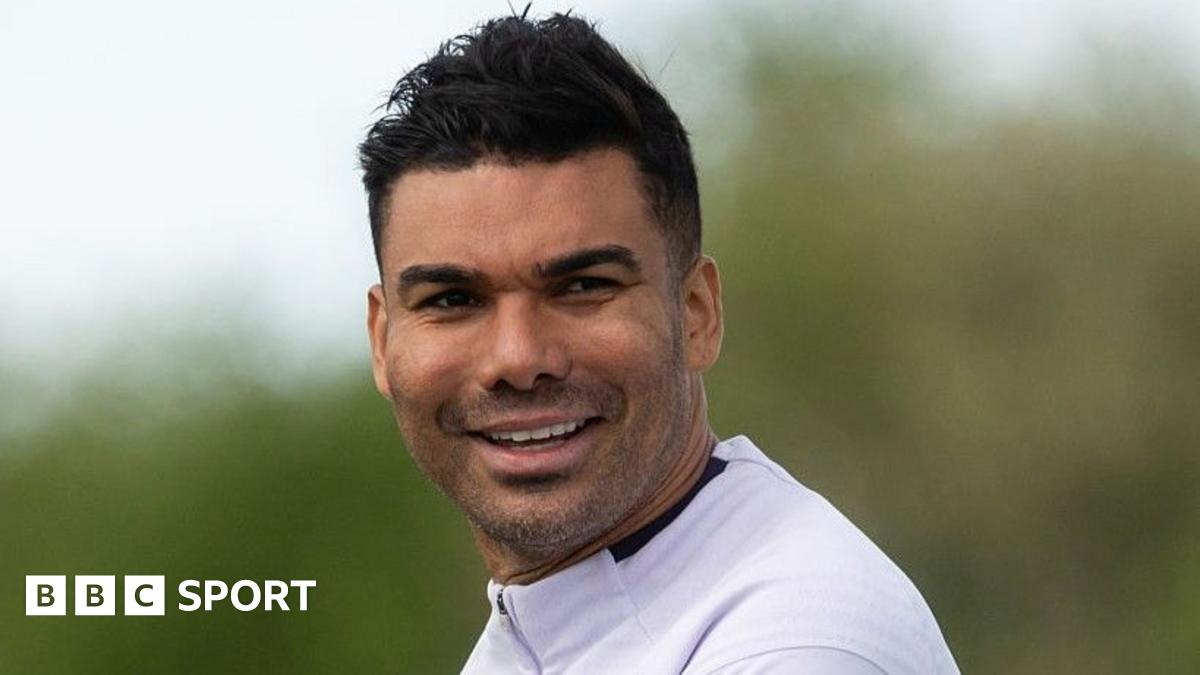
Casemiro has made 159 appearances and scored 26 goals for Manchester United

"One more year, one more year, Casemiro."

They know it won't happen, but it won't stop Manchester United's fans belting out their ode to the Brazilian when he makes his final Old Trafford appearance for the club against Nottingham Forest on Sunday.

It has been sung frequently at United games over the second half of the season, especially when Casemiro has scored, and most recently when he gave his side an early lead in a key Premier League game against Brentford last month.

The 34-year-old responded by kissing and pointing to the badge on his shirt.

It was all a far cry from 30 December 2024. That was a day of infamy among the normally loyal and vociferous United fanbase as they turned on striker Joshua Zirkzee, when he was substituted in just the 33rd minute by Ruben Amorim during a particularly woeful home defeat by Newcastle.

The unspoken reality of that day was that, while the reaction to Zirkzee's exit was bad, had Casemiro's number been held up, it would have been even worse, such was the veteran's ineffective contribution to a dreadful team performance.

As it turned out, the midfielder was replaced after 64 minutes. He didn't play again for a month and didn't start for nearly seven weeks. As Amorim reflected at the time: "Even Toby [Collyer] was sometimes playing in front of him."

That was nine months after Jamie Carragher's damning "leave the football before the football leaves you" comment following a 4-0 defeat at Crystal Palace in May 2024 that led Erik ten Hag to the brink of dismissal as manager, before the FA Cup final success later that month in which Casemiro was left out completely.

In January 2025, there were few external criticisms of Carragher's assessment, which Casemiro branded "disrespectful" in an interview on Rio Ferdinand's podcast, which was published earlier this week.

Amorim felt Casemiro – a five-time Champions League winner with Real Madrid – did not have the physical capabilities to be effective in the Premier League.

Manchester United's Casemiro (left) with midfield partner Kobbie Mainoo

It took three months of hard work to change Amorim's mind.

On 6 March 2025, he started the first leg of the Europa League last-16 draw with Real Sociedad. He kept his place for the league game against Arsenal and, from that point, has started every major game United have played.

"Football changes. Life changes," Casemiro said in his recent interview with former United captain Ferdinand.

"For me, [with] the best players in the world, it's about the mentality. I might not play good – I'm not a robot and I know. But the next [game], I give everything on the pitch. The mentality is next, next, next."

It is a mentality that has brought Casemiro back into the Brazil squad – he is expected to be Carlo Ancelotti's captain at this summer's tournament.

This season, the 34-year-old's influence has noticeably increased.

Of all the players in Michael Carrick's squad, it is widely accepted if Casemiro had been injured in February, after the transfer deadline had closed, his absence would have been the hardest to cover in the ultimately successful quest for Champions League qualification.

"He has been an absolute pleasure to work with," Carrick says in his programme notes for the Forest game.

"He will always have a special connection with Manchester United."

Carrick has felt the early clarity around Casemiro's exit – announced on 22 January, days after the manager's own return as Amorim's temporary replacement – has been beneficial for player and club.

Aside from the mentality aspect, the player's influence at Old Trafford should extend far longer than his physical presence.

When Casemiro arrived from Real Madrid in 2022 in a deal worth up to £70m, Kobbie Mainoo, then aged 17, felt he would learn huge amounts from one of the most decorated players in the game.

Amid the Brazilian's collapse in form, Mainoo ended up battling for a start with Casemiro, which wasn't a situation he envisaged.

The clear by-product of Amorim's exit has been the partnership between the pair, who have played alongside each other in 13 of Carrick's 15 matches in charge – a one-match absence for both players because of minor injuries the only reason it was not 15 out of 15.

"Kobbie is my friend," Casemiro explained earlier this month in a separate interview with the respected United We Stand fanzine.

"I have an excellent relationship with him. We are always joking – in English because he doesn't speak Portuguese.

"He is a complete player, the present and the future of Manchester.

"Why? Because he has already taught us that he can play to a high level for his club and country. The one thing he needs to improve is to play more with the ball, to touch the ball more, because he has so much quality.

"Then it's the decision-making which comes with experience. That improves with age."

Manchester United midfielder Casemiro kisses the badge on his shirt after scoring against Brentford

Helping Mainoo fulfil his potential and utilise the talent if felt as if everyone could see, except Amorim, would be a fitting postscript for Casemiro, who will always return to Old Trafford a hero no matter what the future holds. A move to Major League Soccer has been predicted after the World Cup is done.

The immediate focus, though, is Forest and his Old Trafford farewell, with those "one more year" chants echoing around the stadium once more.

"It's incredible, just incredible," Casemiro told United We Stand.

"My son (five-year-old Caio) is a Manchester United fan. He knows the songs and sings them at home. When the team loses, he cries.

"Our box is right on top of where the noisy United fans are. They feel this spirit.

"The most important thing about this club are the fans. Many times, we lose a game but in the next game they support us more. For me, that's incredible. I've never experienced that in my career."

Latest Manchester United news, analysis and fan views

Ask about Man Utd – what do you want to know?

📰 மூல செய்தி (Source): https://www.bbc.com/sport/football/articles/cy42r3vjjejo?at_medium=RSS&at_campaign=rss

முக்கியச் செய்திகள்

Robert paid £726 to skip the driving test waiting list. New laws mean others won't be able to

Published

on

Robert Kamugisha had been desperate to sit his driving test. But the waiting list stretched for months, and every week without a licence meant more pressure – financially and personally.

So when he was offered earlier test dates for a hefty fee, he took the risk.

The 21-year-old criminology student from Croydon spent most of his savings – £726 – on three test slots, all bought through resellers who snap up appointments and sell them on at inflated prices. The actual cost to take a test is £62.

New government rules now mean only a learner driver can book their own test, part of a crackdown on third party operators using bots to hoover up thousands of slots. But it was too late for Robert.

"I spent most of my savings," he tells the BBC after passing in December, on his third attempt. "I felt like I was being scammed."

Driving instructors say the black market trade has exploded as waiting times across the UK have soared, and thousands of learner drivers have struggled to get driving tests without a long wait.

Figures provided to the BBC from the Driver and Vehicle Standards Agency (DVSA) earlier this week revealed the national average wait time for a practical driving test in April 2026 in Great Britain was 22.3 weeks.

Across the nations, Scotland's wait time was 22.9 weeks, in England it was 22.7 weeks, and Wales was slightly shorter at 17.3 weeks.

Robert says his driving instructor encouraged him to use a reseller to secure an earlier test date, reassuring him it was legitimate. The reseller logged in with Robert's details, booked the test, and the DVSA sent him a confirmation.

"Once I got the booking confirmation, that's when I felt a bit of relief," Robert tells the BBC after contacting BBC Your Voice. "The expense though was crazy."

Robert paid £242 per test, plus £150 each time to use his instructor's car, bringing his total cost to £1,176 – a figure that does not include the cost of his lessons.

Sophie Stuchfield, a driving instructor from Watford, tells the BBC the black market has taken advantage of the demand for earlier test slots.

"People have found ways to manipulate the system to be able to book thousands of driving tests themselves to then be able to resell on for a massively high inflated fee," she adds.

The use of automated booking programmes, or bots, has plagued the DVSA booking system since a huge test backlog built up during the pandemic.

Illicit operators moved in to exploit the demand and used bots to book tests on the official website and resell them.

Sophie has been added to messaging lists where third parties advertise driving tests for sale around Britain for hundreds of pounds.

"I've had 3,341 messages from people trying to sell me driving tests," Sophie says.

"Many people [learner drivers] message me on social media telling me that they are being asked to pay £200, £250, £300 for a driving test and sometimes it's unfortunately from their own instructor."

Sophie has refused to charge learners extra fees on the day of their driving tests to use her car, which has angered other instructors in her area who do.

She says some instructors wait until a week before a learner's test to tell them it's an extra £300 on test day to use their car.

"I've had phone calls from other local driving instructors in this area and they're asking me why do I not charge a fee to take someone on a driving test?"

"My response is always, 'I don't believe I should,'" she says. "I already feel sorry for that person on how much they're having to spend on learning to drive."

The new rules introduced this week mean it is now against the law for anyone apart from the learner driver to book their driving test with the DVSA and the government hopes this will stop third parties accessing the booking system using learner drivers details.

From now, it means anyone selling or changing a test on someone else's behalf will be breaking the law.

Those rules won't have a direct impact on waiting times for test slots, but should result in fewer wasted tests and help the DVSA measure where real demand is – helping the agency divert resources to testing centres that need it most.

But Carly Brookfield, chief executive of the Driving Instructors Association, doubts the changes will fix the problem.

She says the rule change scapegoats the majority of instructors who were doing the right thing, and she is already hearing reports of frustrated learners who now cannot be assisted by their instructor to book a test.

"There have been things the agency's done that have been productive to stop the rot of the bots," she tells the BBC. "But the reality is we've also got this massive test supply issue that if there's not enough tests going in, people will still not be able to get a test anywhere."

Simon Lightwood, the Minister for Roads and Buses, said the government had inherited record waiting times and a huge backlog of learners waiting for tests, with the system seeing too many people paying over the odds to third-party touts.

"But we're taking action and seeing results, delivering almost two million tests over the past year, more than 158,000 extra tests since June 2025, and military driving examiners now on the ground helping boost capacity across the country," he added.

Further changes will be introduced in June which will allow learners to swap their driving tests to only three of their local test centres.

📰 மூல செய்தி (Source): https://www.bbc.com/news/articles/cx219pn5g70o?at_medium=RSS&at_campaign=rss

Continue Reading

முக்கியச் செய்திகள்

Soprano Dame Felicity Lott dies aged 79

Published

on

Dame Felicity Lott, one of Britain's best-loved sopranos, has died at the age of 79.

The singer died on 15 May after a recent interview she gave to the BBC in which she announced she had been diagnosed with terminal cancer.

The acclaimed soprano built an international career spanning four decades, in which she performed at opera houses and concert halls around the world, singing works by composers including Richard Strauss, Schubert and Mozart.

Dame Felicity's agent told the BBC that "in her work, she was sublime; inhabiting every performance with precision, depth and beauty".

"But it was her humanity and kindness that really touched people… [We] will miss her warmth, sparkle and gloriously self-deprecating humour," the agent said.

Dame Felicity lived with "her illness with great dignity and acceptance" and "was characteristically classy and elegant to the end", the agent added.

Born on 8 May, 1947 in Cheltenham, Dame Felicity was musical from an early age.

At five-years-old she was playing the piano and by 12 she was singing and playing violin.

She went on to study at the Royal Academy of Music, and made her operatic debut and breakthrough role as a last minute stand-in as the character Pamina in Mozart's The Magic Flute in 1975.

At home, she was seen frequently on television, sang regularly at the BBC Proms and was made a Dame in 1996.

She was also the recipient of the Légion d'Honneur, France's highest cultural award.

📰 மூல செய்தி (Source): https://www.bbc.com/news/articles/cpqp1938d8do?at_medium=RSS&at_campaign=rss

Continue Reading

முக்கியச் செய்திகள்

The British White Lotus? A group trip goes wrong in BBC drama Two Weeks in August

Published

on

"It's a group holiday gone wrong," says actress Jessica Raine about new BBC drama Two Weeks in August.

Set on a sun-soaked Greek island, the drama follows a group of university friends reuniting for a long-awaited summer holiday.

Now older, the friends are still connected, but marriage, children and mental health struggles have reshaped their relationships.

Beneath the cocktails, boat trips and villa life, tensions simmer and emotions rise. Then an illicit kiss threatens to change their lives forever.

For its cast, the series felt instantly recognisable. "I've been on this holiday," says Damien Molony. "I know who these people are."

At the center is Zoe, played by Raine, a teacher and mother quietly struggling under the pressure of holding everything together.

Molony plays her husband Dan, whose depression hangs heavily over the trip, as cracks in their marriage begin to show.

Raine says she was drawn in by the script's exploration of modern expectations placed on women.

"I think it chimes really well with my generation of people-pleasing," she says.

"There's this idea that in order to be a 'good woman', you have to sacrifice yourself for your children or your husband… and the notion that you can have it all is a complete lie."

Molony says he was initially struck by how dark his character's early scenes felt when he first read the scripts.

"I didn't know it was a comedy at first," exclaims the Irish actor. "It felt quite tragic." He describes Dan as someone who is visibly struggling but unable to express it in a way that helps him.

"He's constantly trying to smile for the camera," he says. "But he doesn't really know how anymore."

From the outset, Dan's dark and emotional scenes put into motion a series of events that strain the wider group.

Antonia Thomas, who plays Jess, says the series captures what happens when people who once knew each other intimately realise how much they've changed.

"There's a real hopefulness about booking a nice villa somewhere and thinking everyone's going to have a great time together," says Antonia.

"But people change. They're not the same people they were 10 years ago."

Thomas says that gap between expectation and reality creates a particular tension within the group.

"It becomes a kind of pressure cooker," she explains. "Everyone falls back into old roles, even if they don't fit anymore."

She adds that Jess's place in the group reflects that sense of quiet disconnection, "She tries to connect, but doesn't always get it right."

You wouldn't be wrong to think of Two Weeks in August as something of a British White Lotus, a comparison its writer Catherine Shepherd has addressed.

Speaking in a recent interview with the Royal Television Society, Shepherd said that the tone and intent of the two shows are different.

She said that "the White Lotus is about people who are super rich", whereas Two Weeks in August focuses on "relatively normal people with normal concerns".

That distinction is key to the series' tone, less glossy satire and more grounded discomfort. Filmed in Malta and Gozo, the series also stars Leila Farzad and Hugh Skinner, whose performances lean further into the show's dark comedy.

For Nicholas Pinnock, who plays successful actor Solomon, that realism is what makes the show feel distinctly British in its outlook.

"There's a real stiff upper lip Britishness about it," he says. "People are trying to avoid the thing that's staring them in the face and brushing things under the carpet until eventually it all ignites."

But as the holiday begins to unravel, Two Weeks in August gradually weaves in Greek mythology increasing the group's tense dynamic.

For Raine, that was one of the script's biggest surprises. "It sort of sideswipes you," she says. "You're not expecting it."

The actress also points to the mythological figures known as The Fates or Moirai, who appear throughout the series and become increasingly central to Zoe's emotional unravelling.

In Greek mythology The Fates are three women who control the thread of human life, deciding how long a person lives.

"It's scary," she says. "She starts seeing them in the corner of her eye, almost like ghosts."

Two Weeks in August will air on BBC One and BBC iPlayer on the 23rd May.

📰 மூல செய்தி (Source): https://www.bbc.com/news/articles/cy0252zn0vno?at_medium=RSS&at_campaign=rss

Continue Reading

Trending

Copyright © 2024 by 7Tamil Media, All rights reserved.