Connect with us

உலகம்

Africa sees winners and losers as Iran war pushes up oil prices

Published

on

Several countries on the continent have sought financial help due to economic uncertainty caused by the US-Israeli war on Iran.

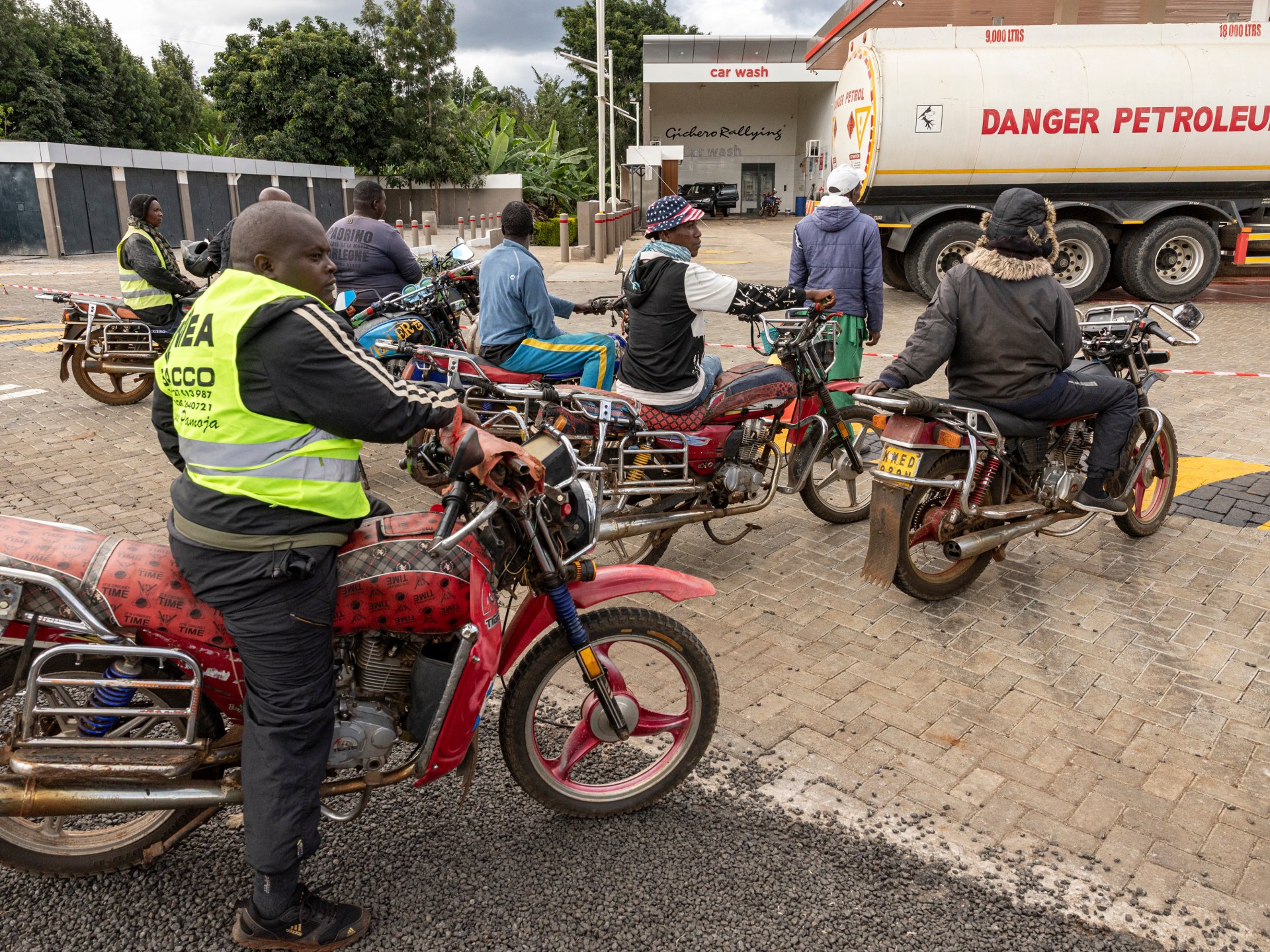
Eric Wainaina, a motorcycle taxi driver in Nairobi, Kenya, was already bracing for a loss in income when the rainy season hit in March, but the war on Iran, which erupted on 28 February, has also taken its toll.

Kenya is the latest in a series of African nations to experience the economic fallout caused by the United States and Israel’s assault on Iran, with rising energy prices leading to spiralling costs for businesses, small and large, across the continent.

Wainaina works six days a week, usually starting at 6:30am, to help support a wife and three children. Before the war, he would drive up to 180km a day, but now, due to rising energy costs, he covers only 90km, resulting in his monthly income dropping by half.

“We can’t work as much as we usually would because the price of petrol is so high,” he told Al Jazeera.

Soaring energy prices have seen winners and losers on the African continent, with oil-rich nations enjoying huge windfalls, while resource-sparse nations are paying the price, resulting in mounting deficits and subsidy costs.

The crisis could see Kenya, which falls in the latter category, seek a loan of up to $600m from the World Bank, according to Bloomberg, as it attempts to shield its economy from the shocks of the global energy crisis. Fuel prices have already surged there, with the price of a litre of diesel rising during the war by 24 percent to about $1.60, with the higher cost of filling car and motorcycle tanks having a profound effect on Kenyans’ everyday lives.

“Normally, I’d get 20 to 30 customers a day, but now I’m getting fewer than 10,” said Wainaina. “Passengers can’t afford it anymore. I’ve had to significantly increase fares because of the rise in petrol prices and the wet season. Usually, I’d only charge slightly higher fares due to the heavy rain.”

If the situation doesn’t improve soon, Eric says he and his family might be forced to live on land inherited from his grandfather in the rural hinterlands of Kenya. He expects other relatives to do the same, even if it means making a new life in makeshift homes and a lower standard of living.

The Iran war has triggered what the International Energy Agency (IEA) describes as the most severe oil supply shock in history.

Goldman Sachs estimates that the massive disruption of trade in the Strait of Hormuz, along with attacks on regional energy infrastructure, has reduced global oil production by 14.5 million barrels per day – equivalent to a 57 percent decline.

Despite being one of the world’s largest oil-producing regions – accounting for roughly 12 percent of global reserves – Africa still imports more than 70 percent of its refined fuel, according to the Africa Finance Corporation (AFC), a multilateral financial institution created by African states. This left many nations there, particularly those like Kenya with no or few biocarbon reserves, exposed to market volatility, when the Iran war broke out.

Last month, the AFC warned that the continent is on course for an 86-million-tonne fuel shortfall by 2040, underscoring the widening gap between domestic production capacity and growing energy demands.

Insufficient refining capacity is another of Africa’s biggest energy challenges. In its 2026 outlook report, the African Energy Chamber cautioned that the continent might struggle to fully capitalise on its vast oil reserves if it continues exporting low-value crude while importing high-value refined products.

Yet, Africa’s energy woes are not isolated to the continent but part of a wider trend affecting countries across the world, Amaka Anku, head of Eurasia Group’s Africa practice, told Al Jazeera.

“When you have a global shock like this, it affects everyone. The media has this very narrow framing that Africa is going to be impacted the worst. However, rising inflation is hurting us all,” she said.

“It’s not an Africa story – it’s a global story. For instance, the supply chain shock has been worse in Asia due to its dependence on the Gulf for petroleum products.”

Nigeria, Africa’s largest oil producer and exporter, has benefitted from a surge in energy prices, boosting its export revenues. US investment firm Vanguard reported last month that Nigerian oil companies had earned a $4bn windfall from the rise in oil prices. Its analysis found that Nigerian Bonny Light crude had risen by 66 percent since the start of the Iran war, from about $70.14 per barrel to an average of $116.84, while other African countries could benefit from growing demand for minerals.

“Nigeria is seen as one of the winners of the war. If you’re an oil company in Nigeria, it’s going to be easier to raise cash for investments. The Democratic Republic of [the] Congo is also benefitting in some ways because it has the critical minerals that will be needed to replace US defence systems that have been destroyed in the Iran war. The conflict has created opportunities that didn’t exist before,” Anku told Al Jazeera.

However, she says Kenya is “quite exposed” to the economic fallout from the Middle East crisis, with the government already facing fiscal pressure ahead of next year’s general election – a situation compounded by the country’s dependence on energy imports from the Gulf.

Over the past decade, Gulf investment in Africa has surged, with a strong emphasis on the renewable energy sector as MENA states seek to diversify their economies from hydrocarbons. In February, the Clean Air Task Force reported that Saudi Arabia and the United Arab Emirates had made $175bn in funding commitments between 2010 and 2024, largely directed towards renewable energy generation and hydrogen projects. China has also invested heavily in the continent’s renewable energy sector and remains Africa’s single largest investor in green energy.

However, Ebenezer Obadare, a senior fellow at the Council on Foreign Relations focusing on Africa, said that even if the US and Israeli war on Iran has caused financial hardship for some countries on the continent, many will maintain close ties with Washington due to the economic benefits from this relationship.

“A massive shift by African countries towards other international partners seems highly unlikely, and it seems more probable that they will continue to weigh their options. Many African countries, having campaigned for the renewal of the African Growth and Opportunity Act (AGOA), it seems unlikely they will cut ties so quickly after securing reauthorisation until December this year,” Obadare said, referring to the trade programme that provides eligible sub-Saharan African nations with duty-free access to the US market.

“Moreover, a growing number of African countries have signed bilateral agreements with the US as part of the latter’s America First Global Health Strategy, and they may be reluctant to put those agreements at risk. All in all, we may expect the current pattern of deep ties with the US to continue for the foreseeable future, with the important caveat that things could change depending on the course of the war and how long it lasts.”

📰 மூல செய்தி (Source): https://www.aljazeera.com/news/2026/5/7/africa-sees-winners-and-losers-as-iran-war-pushes-up-oil-prices?traffic_source=rss

உலகம்

Madrid captain Carvajal in race against time for Spain’s World Cup squad

Published

on

Spain international Dani ⁠Carvajal injured his right foot during a training session for Real Madrid last week.

Spain manager ‌Luis de la Fuente says ⁠Dani ⁠Carvajal could still make his World Cup squad but the right back must prove his ⁠fitness and form after suffering a foot injury in training ⁠with his club Real Madrid last week.

“Carvajal is a very important figure in our dressing room,” de la Fuente said on Wednesday.

“I actually spoke with him yesterday, so I’m aware ‌of what’s going on. He doesn’t have a specific injury, nothing serious, but he needs time to get back to his usual level.

“We’ll see in the remaining matches whether he truly gets the opportunity and delivers the performances.”

De ⁠la Fuente added that Carvajal, ⁠who made just one appearance for Spain in 2025, would understand if he is left out of the squad for the ⁠World Cup, which is being held in the United States, Canada ⁠and Mexico from June 11 to ⁠July 19.

He joins a list of players who have sustained injuries in the weeks before the World Cup with Spanish teammate Lamine Yamal among them.

Carvajal, 34, is approaching the final weeks of his contract with Real and has struggled for game time this season ‌amid competition from Trent Alexander-Arnold.

Spain begin their World Cup campaign against Cape Verde on June 15 ‌and ‌also face Saudi Arabia and Uruguay in Group H.

📰 மூல செய்தி (Source): https://www.aljazeera.com/sports/2026/5/7/madrid-captain-carvajal-in-race-against-time-for-spains-world-cup-squad?traffic_source=rss

Continue Reading

உலகம்

US reinstates deportation proceedings against Mohsen Mahdawi

Published

on

Palestinian student Mohsen Mahdawi accuses government of weaponising the immigration system to silence his advocacy for Palestinian rights.

The United States Board of Immigration Appeals has reinstated ⁠deportation proceedings against Palestinian student Mohsen Mahdawi, according to a court filing from his lawyers.

Immigration judge Nina Froes in February had blocked the Trump administration’s efforts to deport the Columbia University student, who ⁠was arrested last year following his participation in pro-Palestinian protests.

Froes ruled that the Trump administration had failed to meet the burden of proof and dismissed its evidence as inadmissible. Last month, Froes was fired by the Trump administration.

The Board of Immigration Appeals, part of the Department of Justice’s Executive Office for Immigration Review, overturned Froes’s decision.

In a statement cited by the Reuters news agency on Wednesday, Mahdawi accused the Trump administration of weaponising the immigration system to silence his advocacy for Palestinian rights.

“The government is trying to punish and deport me, a stateless Palestinian refugee from the occupied West Bank, because it opposes my peaceful advocacy for human dignity and equal rights for Palestinians. But I remain unafraid and faithful that justice will prevail in America and in Palestine,” he said, in the statement shared by his legal team.

Mahdawi was arrested last year during an interview with Immigration and Customs Enforcement (ICE). He was detained for two weeks and not charged with a crime. His legal team said he was arrested under an obscure legal provision that allows Secretary of State Marco Rubio to seek the deportation of individuals deemed to pose “adverse foreign policy consequences” for the US.

Trump has cracked down on ⁠pro-Palestinian movements by attempting to deport foreign protesters, threatening to freeze funds for universities where protests were held and scrutinising immigrants’ online speech.

Experts and activists have accused his administration of stifling free speech ⁠and academic freedom. The crackdown also faced legal and judicial roadblocks.

In March, the Trump administration filed a lawsuit against Harvard University worth billions of dollars after accusing the institution of violating the civil rights of Jewish and Israeli students in the aftermath of Israel’s genocidal war on Gaza.

📰 மூல செய்தி (Source): https://www.aljazeera.com/news/2026/5/7/us-reinstates-deportation-proceedings-against-mohsen-mahdawi?traffic_source=rss

Continue Reading

உலகம்

What are US proposals to end war, and will Iran agree to them?

Published

on

Iran says it is reviewing a US proposal to end the US-Israel war on it that has caused a global energy crisis.

Iran says US proposal to end the war is still 'under review'

Iran has said that it was reviewing a United States peace proposal that sources said would formally end the war, while leaving unresolved the key US demands that Iran suspend its nuclear programme and reopen the Strait of Hormuz.

An Iranian Foreign Ministry spokesperson quoted by Iran’s ISNA news agency said on Wednesday that Tehran would convey its response. US President Donald Trump said he believed Iran wanted an agreement.

“They want to make a deal. We’ve had very good talks over the last 24 hours, and it’s very possible that we’ll make a deal,” Trump told reporters in the Oval Office on Wednesday.

A day before, Trump paused “Project Freedom” to reopen the blockaded strait, citing progress in peace talks. The de facto blockade of the waterway threatens to cause a global recession. Iran has been pressing to keep Hormuz under its control, through which a fifth of global oil and gas supply passes.

Here is more about the US proposal to end the war, and how experts think Iran would respond.

US media outlet Axios said the two sides were “getting close” to an agreement on a 14-point document. Under the memorandum, Iran would agree not to develop a nuclear weapon and halt enrichment of uranium for at least 12 years, it said.

The US would lift sanctions and release billions of dollars in frozen Iranian assets, and both sides, which have imposed competing blockades in the Strait of Hormuz, would reopen the critical waterway within 30 days of signing.

Iran has been under US sanctions for decades, and the lifting of some sanctions under the 2015 nuclear agreement was reversed after Trump walked out of the landmark deal signed under his predecessor, President Barack Obama. Billions of dollars of Iranian assets remain frozen in foreign banks due to the sanctions.

It is unclear how this memorandum differs from a 14-point plan proposed by Iran last week.

The Reuters news agency reported on Thursday, citing a source briefed on the mediation, that the US negotiations were being led by Trump’s envoy Steve Witkoff and son-in-law Jared Kushner. If both sides agreed on the preliminary deal, that would start the clock on 30 days of detailed negotiations to reach a full agreement.

The full agreement would end the competing US and Iranian blockades on the strait, lift US sanctions and release frozen Iranian funds. It would also include certain curbs on Iran’s nuclear programme, which was allowed by the United Nations nuclear watchdog.

While the sources said the memorandum would not initially require concessions from either side, they did not mention several key demands Washington has made in the past, which Iran has rejected, such as curbs on Iran’s missile programme and an end to its support for armed proxy groups in the Middle East.

The sources also made no mention of Iran’s existing stockpile of more than 400kg (900lb) of near-weapons-grade uranium.

Israeli Prime Minister Benjamin Netanyahu, Trump’s ally, said on Wednesday the two leaders agreed that all enriched uranium must be removed from Iran to prevent it from developing a nuclear bomb.

The US and Israel bombed Iranian nuclear sites last June during the 12-day war, after which Trump claimed that Tehran’s nuclear programme was obliterated. A significant portion of Iran’s enriched uranium stockpile remains buried inside the bombed nuclear sites.

Tehran denies wanting to acquire a nuclear weapon. It insists its programme is for civilian purposes as allowed within its position as a signatory to the non-proliferation treaty.

Iran has yet to formally respond to the latest US proposal. However, Iranian leaders have pushed back against it.

Iranian lawmaker Ebrahim Rezaee, a spokesperson for the parliament’s powerful foreign policy and national security committee, described the text as “more of an American wish-list than a reality”.

Iran’s Parliament Speaker Mohammad Bagher Ghalibaf appeared to mock reports that the two sides were close, writing on social media in English that “Operation Trust Me Bro failed.”

Al Jazeera’s Resul Serdar Atas, reporting from Tehran, said on Thursday that Iran is still reviewing the US proposal, after which a response is expected to be given to the Pakistani mediators later today.

The Pakistani Ministry of Foreign Affairs said on Thursday that it welcomes the news of a potential agreement between Iran and the US, adding that it will not disclose additional information at this stage.

“As mediators, we will not lose the trust of both parties by revealing details,” it said in a statement quoted by Al Jazeera Arabic.

Atas said, “Iranians are saying that, at this stage, they’re not negotiating their nuclear programme; it’s only about ending the war on all fronts.”

He added that Tehran wants direct guarantees from the UN Security Council, a lifting of sanctions and the reopening of the Strait of Hormuz.

“If that is achieved, in a second phase, they’re ready to discuss their nuclear programme.”

Al Jazeera’s Almigdad Alruhaid reported from Tehran on Tuesday that Iran has set “a very firm red line” on the nuclear file. “The nuclear enrichment programme is non-negotiable,” he said.

According to former US Assistant Secretary of State Mark Kimmitt, Trump’s reported demand that Iran halt all uranium enrichment is unrealistic and unlikely to be accepted by Tehran.

“If there is anything the Iranians are going to insist upon in these negotiations, it is their right to enrich uranium to the 3.67 percent level, which is allowed under nuclear non-proliferation treaties,” he told Al Jazeera.

Kimmitt added that even the 2015 nuclear deal permitted Iran to continue enrichment. Iran boosted its enrichment up to 60 percent after Trump withdrew from the deal in 2018, during his first term.

However, Kimmitt postulated that Trump might want Iran’s existing stockpile of enriched uranium outside of Iran. He added that Iran might either agree to move the enriched uranium outside the country or dilute it down to a non-enriched state.

Alruhaid, the Al Jazeera correspondent, however, said Iran is resisting handing over its existing stockpile of enriched uranium.

Iran is believed to have about 440kg (970lb) of uranium enriched to 60 percent. A 90 percent threshold of enriched uranium is needed to produce a nuclear weapon.

Al Jazeera’s Alruhaid said “the sovereignty on the Strait of Hormuz is becoming one of the main issues on the negotiating table.

“We are seeing the Iranians are tightening their control. They are setting new protocol, new mechanism for controlling that strategic chokepoint for each vessel that is to pass through.”

The US allies in the Gulf, who faced the brunt of Iranian retaliatory strikes, have been pushing for the restoration of navigation in the strait without any conditions. Iran carried out attacks on the Gulf nations, mainly targeting US military assets, after the US and Israel launched attacks on it on February 28.

Trump has repeatedly played up the prospect of an agreement that would end the war, so far without success. The two sides remain at odds over a variety of difficult issues, such as Iran’s nuclear ambitions and its control of the Strait of Hormuz.

A Pakistani source and another source briefed on the mediation told Reuters that an agreement was close on a one-page memorandum that would formally end the conflict, the agency reported on Thursday.

This agreement would kick off discussions to unblock shipping through the strait, lift US sanctions on Iran and set curbs on Iran’s nuclear programme, the sources said.

Al Jazeera, however, could not confirm the veracity of the reports.

📰 மூல செய்தி (Source): https://www.aljazeera.com/news/2026/5/7/what-are-us-proposals-to-end-war-and-will-iran-agree-to-them?traffic_source=rss

Continue Reading

Trending

Copyright © 2024 by 7Tamil Media, All rights reserved.