Connect with us

உலகம்

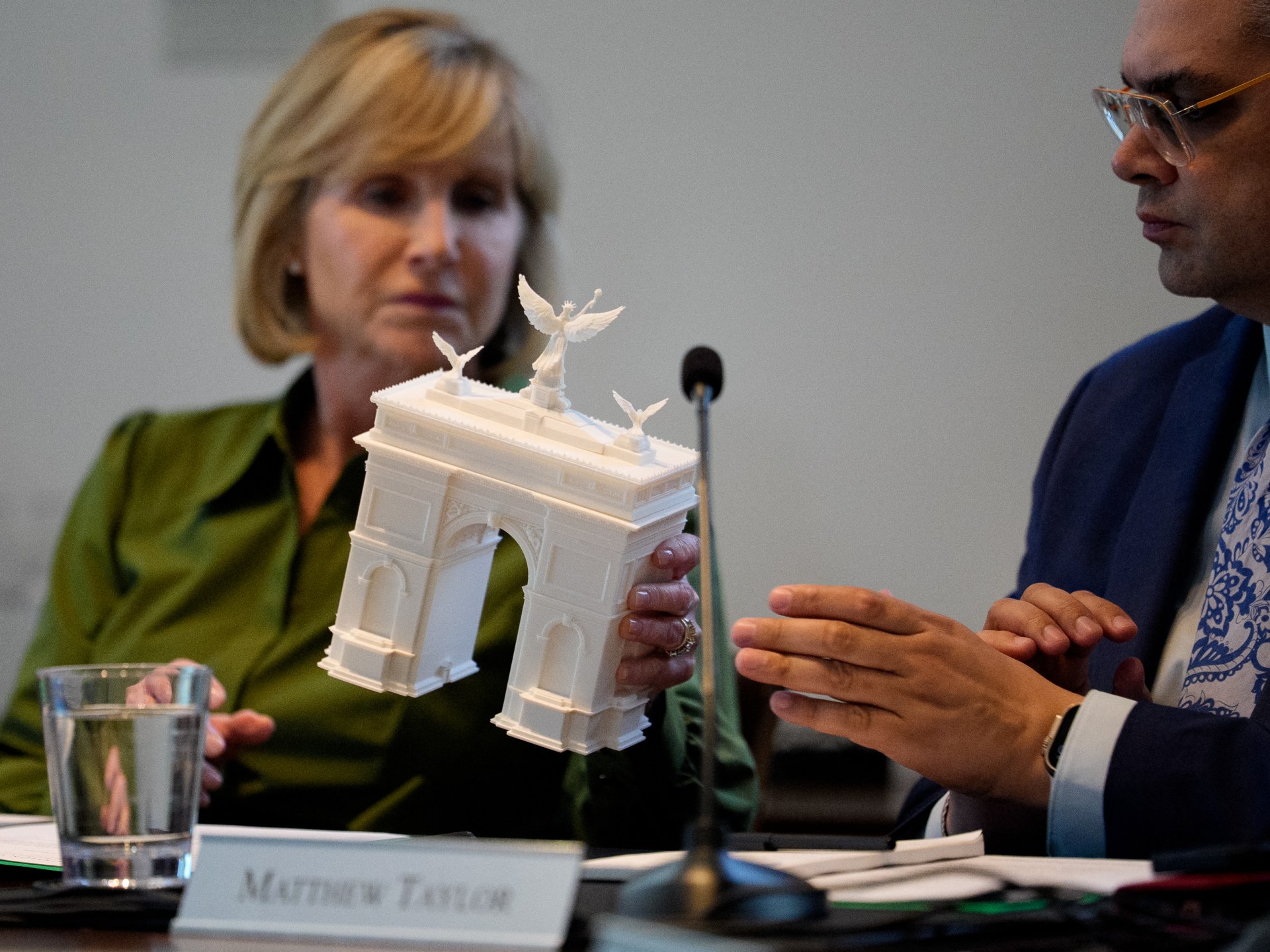
US panel approves Trump’s design for massive arch in Washington, DC

Published

on

The proposed 76-metre arch would tower over other iconic landmarks in Washington, DC, and has attracted scrutiny.

United States President Donald Trump’s goal of erecting a colossal arch in Washington, DC, has taken another step forward, with a key agency approving his proposed design for the monument.

The US Commission of Fine Arts, whose members were appointed by Trump, gave its go-ahead to the president’s design for a lofty 76-metre-high (250-foot) arch.

If given final approval, the arch would be built on Memorial Circle, between the Arlington National Cemetery and the Lincoln Memorial. It would tower above other landmarks in the national capital.

White House spokesperson Davis Ingle hailed the commission’s approval as a “step in accomplishing President Trump’s promise to the American people from the campaign trail — to Make America Safe and Beautiful Again”.

But the arch has faced criticism, including for potentially obscuring views of the national cemetery, a resting place for war veterans.

Public Citizen Litigation Group is representing some Vietnam War veterans in a lawsuit against the proposed construction, which they argue needs congressional approval.

Even the vice chair of the Commission of Fine Arts, James McCrery II, suggested that Trump’s proposed “Triumphal Arch” ditch the winged statue and eagles on its top. He also opposed the lions at its base, pointing out that African animals are “not a beast natural to the North American continent”.

The enormous arch is another effort by the US president to leave his mark on the physical landscape of Washington, DC.

In January, he told reporters he wants the arch to be the “biggest one of all”. The commission still needs to vote on final approval for the proposal after reviewing updated designs.

Current plans show the arch would be significantly larger than the Lincoln Memorial, which is 99 feet (30 metres) tall, and about twice as tall as the famous Arc de Triomphe in Paris, which the design resembles.

The phrases “One Nation Under God” and “Liberty and Justice for All” would be written in gold lettering atop either side of the monument.

About three out of every four people who delivered public comments about the project expressed opposition, many of them citing its enormous size.

But the arch is one of several Trump projects that have received public pushback.

Trump has sought to paint the granite of the Eisenhower Executive Office Building white, and his allies plan to close the Kennedy Center for the Performing Arts, a national theatre complex, for two years of renovations, after adding Trump’s name to the exterior.

One of the most permanent changes so far has been the abrupt demolition of the White House’s East Wing, in order to make room for an enormous ballroom, long one of Trump’s priorities.

But that project is likewise entangled in legal battles, with critics arguing that congressional approval is required.

On Wednesday, Judge Richard Leon clarified that construction on underground structures at the ballroom site could continue, as part of an exemption he previously allowed for national security concerns.

But he maintained his short-term injunction against construction on the ballroom itself, batting down Trump’s position that the whole project should proceed.

“Defendants argue that the entire ballroom construction project, from tip to tail, falls within the safety-and-security exception and therefore may proceed unabated,” Leon wrote in Thursday’s ruling.

“That is neither a reasonable nor a correct reading of my Order!”

The president responded on social media by calling Leon an “out of control Trump hating” judge. Leon was appointed in 2002 under Republican President George W Bush.

📰 மூல செய்தி (Source): https://www.aljazeera.com/news/2026/4/16/us-panel-approves-trumps-design-for-massive-arch-in-washington-dc?traffic_source=rss

உலகம்

Mazzucato on the Iran war’s economic shock: Who pays the price?

Published

on

Redi Tlhabi speaks to economist Mariana Mazzucato on the Iran war’s economic fallout and who’s really paying the price.

The world is reckoning with the biggest oil supply disruption in history, one that has sent energy prices soaring, rattled stock markets and exposed the deep vulnerabilities of economies still hooked on fossil fuels. While millions face higher fuel and energy bills, top oil and gas companies are reportedly profiting about $30m per hour since the war began.

This week on UpFront, Redi Tlhabi speaks with renowned economist Mariana Mazzucato about what a genuine green industrial strategy looks like, why the World Bank has fallen short, and how her concept of the “common good economy” offers a new compass for governments navigating crises.

📰 மூல செய்தி (Source): https://www.aljazeera.com/video/upfront/2026/4/18/mazzucato-on-the-iran-wars-economic-shock-who-pays-the-price?traffic_source=rss

Continue Reading

உலகம்

Will Keir Starmer resign?

Published

on

The Mandelson scandal has resurfaced in the United Kingdom, and Prime Minister Keir Starmer is in the line of fire again.

This time, it’s because he appointed Peter Mandelson as ambassador to the United States – even though he failed the government’s security clearance.

Starmer says he did not know. But the opposition isn’t convinced.

As the fallout deepens, the calls for him to step down are growing.

Mandelson’s links to the late sex offender Jeffrey Epstein have cast a shadow over Starmer’s government.

So, will the prime minister survive the crisis?

Denis MacShane – Former UK Foreign Office Minister of State and Labour MP

Jennifer Nadel – Cofounder of the cross-party think tank Compassion in Politics

Giles Kenningham – Founder of Trafalgar Strategy and former communications director for the UK Conservative Party

📰 மூல செய்தி (Source): https://www.aljazeera.com/video/inside-story/2026/4/18/will-keir-starmer-resign?traffic_source=rss

Continue Reading

உலகம்

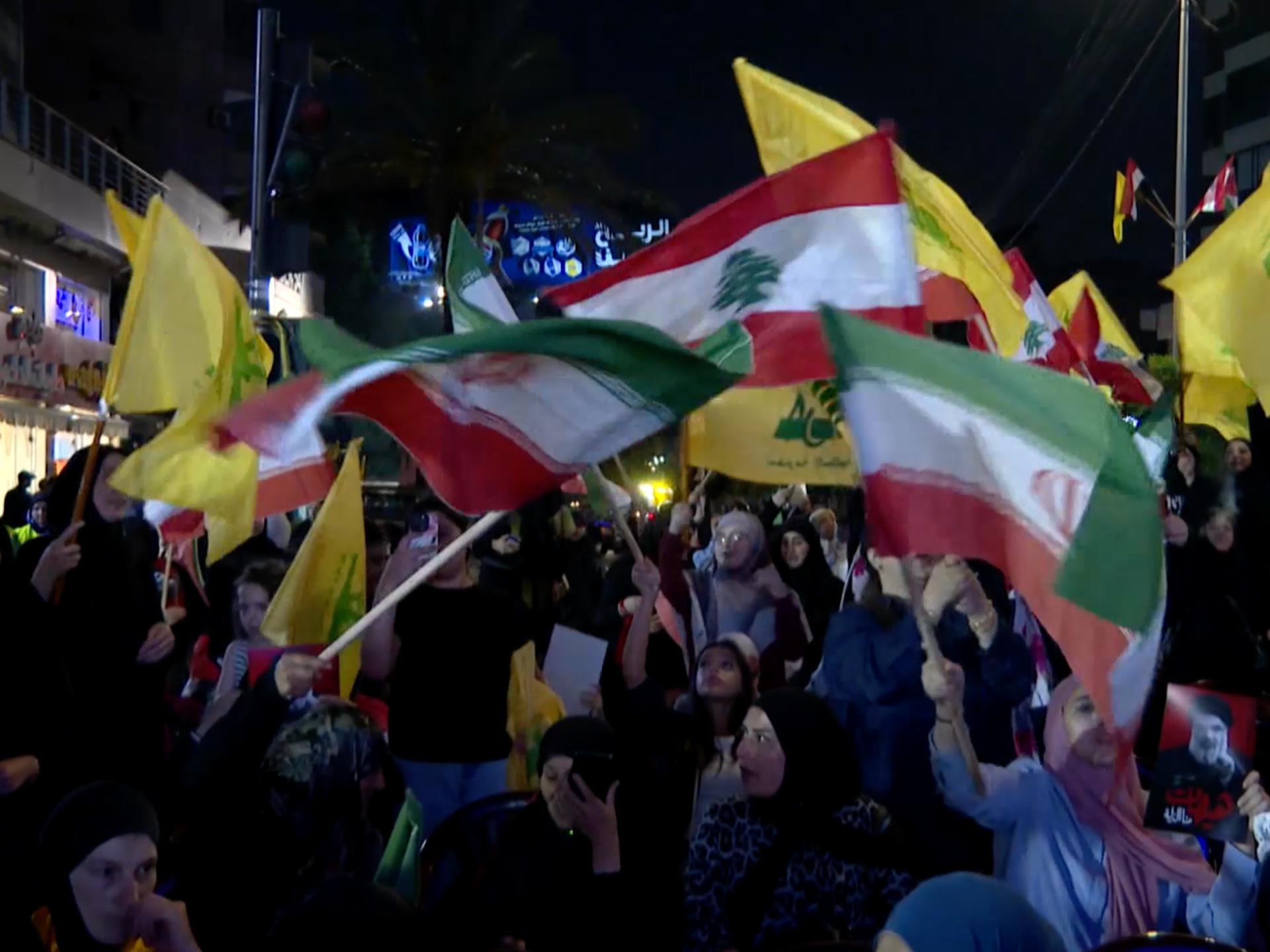
Israel says established a ‘yellow line’ in Lebanon, as it has in Gaza

Published

on

It is the first time Israel has referred to such a ‘yellow line’ in Lebanon, after using a similar measure in Gaza.

Israeli forces say they have established a so-called “yellow line” in southern Lebanon, similar to an Israeli military measure in the besieged Gaza Strip.

The Israeli military said in a statement on Saturday that over the previous 24 hours, its forces “operating south of the Yellow Line in southern Lebanon identified terrorists who violated the ceasefire understandings and approached the forces from north of the Yellow Line in a manner that posed an immediate threat”.

It is the first time the Israeli military has referred to such a “yellow line” in Lebanon, and comes after a 10-day ceasefire between Israel and Lebanon came into effect on Thursday.

Since a “ceasefire” in Gaza took effect in October, Israel’s so-called “yellow line” has divided the Palestinian territory into separate zones, with an eastern area controlled by the Israeli military and a western area where Palestinians face fewer restrictions on their movement.

Israeli troops routinely fire on anyone approaching the line, and they have demolished hundreds of homes in the zone under their control. Israeli attacks have killed at least 773 people and wounded more than 2,000 since the start of the “ceasefire”.

Reporting from Ramallah, in the occupied West Bank, Al Jazeera’s Nour Odeh said the Israeli military’s announcement of a “yellow line” in Lebanon appeared to represent the “continuation of the ‘Gazafication’ of southern Lebanon”.

“Israeli Minister of Defence Israel Katz had said that the army has been instructed to demolish the Lebanese villages on the border based on the Beit Hanoon and Rafah models, and we know exactly what that looks like because there’s nothing left there,” she said.

“In Lebanon, it may not be, at least for now, to expand the area occupied in southern Lebanon. But, certainly, the demolition of Lebanese villages continues, and the minister of defence has also drawn an equivalence between Shia villages and Hezbollah infrastructure in the same way he considered Palestinians in Gaza to represent Hamas and to be an equal threat to Israel,” she added.

Despite the ceasefire, Israel has continued to carry out attacks in southern Lebanon. Israeli artillery attacks on Saturday hit the southern Lebanese towns of Beit Leif, Qantara and Touline, while the military has continued razing homes across several areas.

In a statement, the military said it waged the attacks in response to fighters approaching areas where Israeli soldiers are still stationed in southern Lebanon, claiming they posed “an imminent threat”.

“Actions taken in self-defence and to remove immediate threats are not restricted by the ceasefire,” the military added.

Later on Saturday, Hezbollah Secretary-General Naim Qassem said that the ongoing 10-day truce with Israel cannot continue unless both sides uphold it.

“A ceasefire means a complete cessation of all hostilities. Because we do not trust this enemy, the resistance fighters will remain in the field with their hands on the trigger, and they will respond to violations accordingly,” Qassem said in a statement read out on TV.

“There is no ceasefire from the side of the resistance only; it must be from both sides.”

Qassem also demanded that Israel completely withdraw from Lebanon.

The next steps, Qassem said, would focus on the release of prisoners and the return of residents to their homes in the border areas.

A final step, he said, would involve a significant reconstruction campaign, coupled with international Arab support.

He also added that Hezbollah is “open to cooperation with the [state] in Lebanon on a new page” based on achieving their “national sovereignty and preventing strife”.

Thursday’s ceasefire between Israel and Hezbollah comes after a previous one, which had ostensibly been in effect since November 27, 2024. But the United Nations has counted more than 10,000 Israeli ceasefire violations since then, as well as hundreds of Lebanese deaths.

Israel has repeatedly told the Lebanese government that Hezbollah must be disarmed for any truce to last.

For its part, Hezbollah has said that Israel needs to withdraw from the country’s southern region first as part of the 2024 ceasefire deal agreed between the armed group and Israel.

The Lebanese government has been uneasy about Hezbollah’s influence in the country. Last December, the government said it was close to completing the disarmament of Hezbollah south of the Litani River before a year-end deadline as part of the 2024 ceasefire deal with Israel.

At the start of the latest conflict, the Lebanese government also outlawed Hezbollah’s military wing. But the government has also always been apprehensive of Israel’s actions. Lebanon’s President Joseph Aoun also previously refused to speak directly with Israeli Prime Minister Benjamin Netanyahu about their differences.

On Thursday, while announcing the ceasefire between Lebanon and Israel, US President Donald Trump revealed that Israel’s Prime Minister Netanyahu and Lebanon’s President Aoun could meet ⁠in Washington over ⁠the ⁠next week or two for negotiations on ending the fighting.

📰 மூல செய்தி (Source): https://www.aljazeera.com/news/2026/4/18/israel-says-established-a-yellow-line-in-lebanon-as-it-has-in-gaza?traffic_source=rss

Continue Reading

Trending

Copyright © 2024 by 7Tamil Media, All rights reserved.