Connect with us

முக்கியச் செய்திகள்

Chernobyl's last wedding: The couple who married as a nuclear disaster unfolded

Published

on

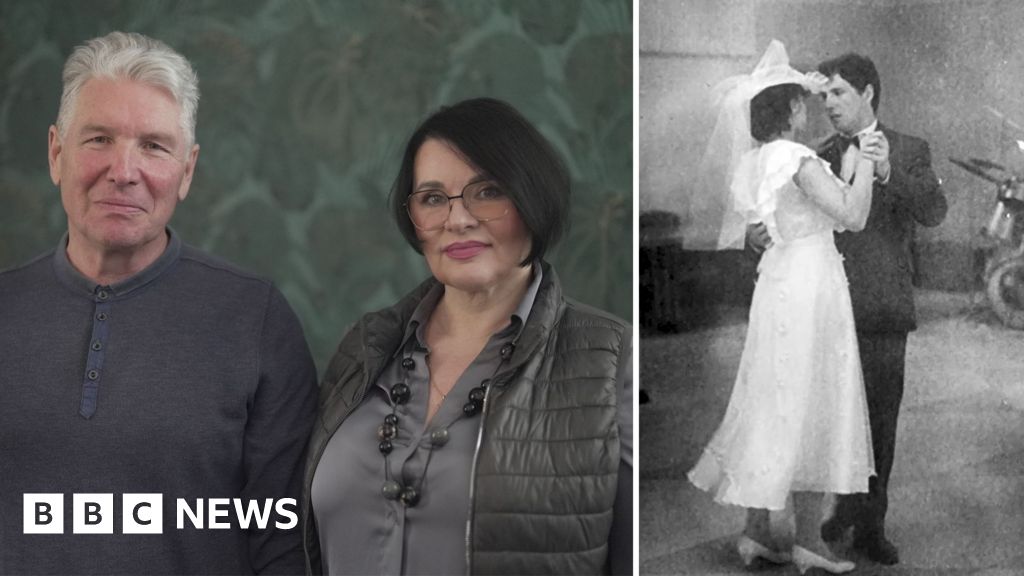
It was just after midnight. Iryna Stetsenko had finished doing her nails for her wedding, opened the balcony door and was battling her nerves to get to sleep.

In a nearby apartment packed with guests, her fiancé Serhiy Lobanov was asleep on a mattress in the kitchen.

Then a "rumble" disturbed the quiet, says Iryna. "It was as if a lot of planes were flying overhead, everything was humming and the glass in the windows shook."

Serhiy says he "felt a shake, as if some kind of wave passed", wondered if it was a mild earthquake, and fell back to sleep.

The 19-year-old trainee teacher and power plant engineer, who was 25, were looking forward to married life in the newly built Soviet city of Pripyat. They had no idea that the world's worst ever nuclear accident was unfolding less than 2.5 miles (4km) away.

Reactor number four at the Chernobyl power plant – in what is now northern Ukraine – had exploded, spewing out radioactive material that would spread across swathes of Europe.

Forty years later, the highly radioactive remains of the plant are in a warzone. The couple now live in Berlin, having uprooted their lives a second time – this time to escape conflict, not a nuclear disaster.

But on the morning of 26 April 1986, Serhiy remembers waking around 6am, full of excitement, to find his wedding day had dawned gloriously sunny.

He had errands to do – bed linen to take to a friend's apartment where he and Iryna planned to sleep that night, and flowers to buy.

He says he saw soldiers in gas masks outside, and men washing the street with a foamy solution. Some men he knew from his work at the nuclear plant told him they had been called in urgently because "something happened", but they did not know what.

As he looked out from the friend's high-rise apartment, he spotted smoke rising from reactor four.

It would later become clear that firefighters and power plant workers had spent the night risking lethal doses of radiation to tackle a huge toxic blaze.

"I felt a bit anxious," he says. Drawing on his training, he took some fabric, wet it and put it across the apartment entrance as a precaution to catch radioactive dust, he adds.

He then rushed to the market. Unusually for a Saturday morning, it was deserted, so he picked five tulips for the bouquet.

Iryna, who was staying with her mother in the family's apartment, says the phone kept ringing overnight. Her mother sounded "alarmed", she says, by neighbours calling to say "something terrible" had happened. But there was little detail.

Information was strictly controlled in the Soviet Union. They turned on the radio, but there was no mention of any incident.

In the morning, her mother rang the authorities: "They told her not to panic, all planned events in the city should go ahead."

Officially, everything carried on as usual. Children were sent to school.

Later in the day, the bride, groom and guests drove in a line of cars to the Palace of Culture, known for hosting both ceremonial events and popular discos.

They made their vows standing on a cloth embroidered with their names, then moved with their guests to a nearby café.

But the wedding banquet felt "sad", not celebratory, says Serhiy. "Everyone understood that something had happened, but no one knew the details".

For their first dance, they had practised a traditional waltz. But with the growing realisation that a tragedy was unfolding, "from the first steps we went out of rhythm", recalls Iryna. "We just hugged each other and moved in the hug."

Then – exhausted but finally man and wife – they returned to the friend's apartment.

But, Serhiy says, in the early hours of Sunday morning, another friend knocked on the door, telling them to rush to an evacuation train, due to leave at 5am.

The only extra clothing Iryna had with her was a flimsy dress for the second day of the celebrations, so she put her wedding dress back on to hurry back to her mother's apartment to change. Also, her shoes had given her blisters. "I was in a wedding dress and I was running barefoot through the puddles," says Iryna.

It was still dark as they saw the glow of the collapsed reactor from the train. It was "as if you were looking into the eye of a volcano," says Serhiy.

The official announcement, when it came, described the evacuation as "temporary".

"We left for three days, but ended up going for our entire lives," he adds.

The Soviet Union was heavily criticised for its slowness in revealing the scale of the disaster. It was only two days after the explosion – after radiation was detected in Sweden – that it acknowledged an accident had happened. It was more than two weeks before Soviet leader Mikhail Gorbachev spoke about it publicly.

A safety test had gone badly wrong. An estimate cited by the International Atomic Energy Agency (IAEA) and World Health Organization suggests the explosions released 400 times more radioactive material than the bomb at Hiroshima.

Nikolai Solovyov was working as a lead engineer in the turbine hall at the time.

"It was like an earthquake beneath us," he recalls. "We saw the roof collapsing… A blast of air came towards us and brought all this black dust… And the siren started."

He says he and colleagues raced towards the site thinking a generator had exploded – unable to imagine it could be the reactor itself.

One checked their monitors and said radiation levels were "off the charts", Nikolai remembers.

He says they found another colleague standing on one of the turbines, apparently unhurt but vomiting – a sign of radiation sickness. "He was one of the first to die," he says.

The official death toll from the incident is 31 people – two were killed by the explosion itself, while 28 died from Acute Radiation Sickness, and one from cardiac arrest, in the weeks afterwards.

The wider impact of the disaster is contested and difficult to determine. No comprehensive long-term medical study was set up at the time.

In 2005, a study by several UN agencies concluded 4,000 people could die as a result of the accident. Other estimates suggest the number could be tens of thousands.

An operation was launched to stop the exposed reactor pouring out radiation.

Helicopter flights dropped sand and other materials on it. The authorities brought in hundreds of thousands of people from all over the Soviet Union to contain the disaster.

Extreme radiation levels caused machines to break down, so some work had to be done by hand.

Jaan Krinal and Rein Klaar were deployed from Estonia, then part of the Soviet Union, and were part of a group sent to clear debris from the roof of reactor three.

"You wore lead plates – one in front, one on your back, and one between your legs. It was heavy, 20kg or more," says Jaan.

"On your head: a standard Soviet construction helmet – goggles, gloves and a dosimeter [to measure radiation] in your pocket," he says.

Rein recalls being sent to work in bursts of a single minute to limit their exposure. "Nobody could tell what was what… There was no time to think," he says.

As the clean-up began, Iryna and Serhiy were staying with her grandmother, about 300km away in the Poltava region, east of Kyiv.

A few days after they arrived, doctors monitoring the evacuees for radiation gave them unexpected news – Iryna was three months pregnant.

She remembers weeping as she discovered doctors were warning that radiation exposure may have affected unborn babies, and advising women who had been exposed to have abortions: "I was scared to have a baby, and scared to have an abortion."

But a sympathetic female doctor encouraged her to proceed with the pregnancy, and Iryna gave birth to a healthy girl, Katya. Decades on, she has become a mother herself and Serhiy and Iryna now have a 15-year-old granddaughter.

The couple feel the nuclear accident has affected their health, though this has not been confirmed by doctors.

Iryna has had to have both knees replaced, and believes radiation may have weakened her bones. They t

📰 மூல செய்தி (Source): https://www.bbc.com/news/articles/c0q92lx8q75o?at_medium=RSS&at_campaign=rss

முக்கியச் செய்திகள்

Trump warns Taiwan against declaring independence, hours after summit with China's Xi

Published

on

Donald Trump has cautioned Taiwan against formally declaring independence from China.

"I'm not looking to have somebody go independent," the US president told Fox News on Friday, at the end of his two-day summit with his Chinese counterpart Xi Jinping in Beijing.

Trump earlier said he had "made no commitment either way" about the self-governing island – which China claims as part of its territory and has not ruled out taking by force.

The US has long supported Taiwan, including being bound by law to provide it with a means of self-defence, but has frequently had to square this alliance with maintaining a diplomatic relationship with China.

Washington's established position is that it does not support Taiwanese independence, with continued ties with Beijing being contingent on its acceptance that there is only one Chinese government.

Many Taiwanese consider themselves to be part of a separate nation – though most are in favour of maintaining the status quo in which Taiwan neither declares independence from China nor unites with it.

In his interview with Fox News, Trump reiterated that US policy on the matter had not changed.

"You know, we're supposed to travel 9,500 miles (15,289km) to fight a war. I'm not looking for that. I want them to cool down. I want China to cool down."

On the flight back to Washington, the US president had told reporters that he and Xi had spoken "a lot" about the island, but said he had declined to discuss whether the US would defend it.

Xi "feels very strongly" about the island and "doesn't want to see a movement for independence", Trump said.

"The Taiwan question is the most important issue in China-US relations," Xi warned during the talks, according to Chinese state media, adding: "If mishandled, the two nations could collide or even come into conflict."

Asked if he foresaw a conflict with China over Taiwan, Trump had said: "No, I don't think so. I think we'll be fine. [Xi] doesn't want to see a war."

China has ramped up military drills around the island in recent years, raising tensions in the region and testing the balance that Washington has struck.

Late last year, the Trump administration announced an $11bn ($8bn) package of weapons to be sold to Taiwan, including advanced rocket launchers and a variety of missiles, which Beijing condemned.

Trump said he would soon decide whether that sale could go ahead, adding that he and Xi had discussed it "in great detail" and that he would speak to Taiwan's President Lai Ching-te first.

"I may do it. I may not do it," he told Fox News.

"We're not looking to have wars, and if you kept it the way it is, I think China's going to be OK with that. But we're not looking to have somebody say, 'Let's go independent because the United States is backing us'."

The US has previously provoked anger from China for seeming to soften its stance on independence.

Its State Department dropped a statement from its website reiterating Washington's opposition to Taiwanese independence in February 2025 – something Beijing said "sends a wrong… signal to separatist forces".

US officials in Taiwan said at the time: "We have long stated that we oppose any unilateral changes to the status quo from either side."

Taiwan's Foreign Minister Lin Chia-lung said his team had been monitoring the US-China summit, and had maintained good communication with the US and other countries "to ensure the stable deepening of Taiwan-US relations and safeguard Taiwan's interests".

He said Taiwan had always been a "guardian of peace and stability" in the region and accused China of escalating risk with its "aggressive military actions and authoritarian oppression".

📰 மூல செய்தி (Source): https://www.bbc.com/news/articles/ce8p61v7l68o?at_medium=RSS&at_campaign=rss
Continue Reading

முக்கியச் செய்திகள்

Burnham cleared to run for selection in pivotal by-election

Published

on

Greater Manchester Mayor Andy Burnham has been cleared to seek selection as Labour's candidate in a by-election which could pave the way for him to return to Westminster.

The mayor has been given the go-ahead by Labour's ruling National Executive Committee, which blocked his previous attempt to stand in a by-election in January.

If he is selected as the candidate in Makerfield, in the north-west of England, and goes on to win, Burnham is widely expected to try to replace Sir Keir Starmer as prime minister.

The prime minister is continuing to resist calls to stand down and set a timetable for his departure and is expected to fight any challenge from Burnham or other likely contenders.

The Makerfield constituency became vacant on Thursday, when Labour MP Josh Simons said he would resign to make way for Burnham.

The BBC understands the by-election is likely to take place on 18 June.

On Friday, the prime minister was in a police control centre in London but did not take questions from the media.

Steve Reed, the housing secretary and an ally of the PM, said: "It's been a very difficult week but we need to take a breath now, take this weekend to reflect on what's going on, and come back next week and focus on the country we were elected to serve."

Events have calmed down after a frenetic week of political activity which has seen the prime minister defy calls to step down, following his party's disastrous election results.

Nearly 90 Labour MPs have urged Sir Keir to go and five ministers have resigned but a leadership race cannot be triggered until someone, with the backing of 81 Labour MPs, formally challenges the prime minister.

Under Labour Party rules, Burnham is unable to join a leadership contest unless he becomes an MP.

Announcing his decision to apply to stand in Makerfield, Burnham said he wanted to "bring the change we have brought to Greater Manchester to the whole of the UK and make politics work properly for people".

He added that he would "not take a single vote for granted".

Applications to enter the process to become Labour's candidate close on Monday 18 May and a selection meeting will take place on 21 May.

Traditionally, Makerfield has been a safe Labour seat, but more recently has been leaning towards Reform UK and, if selected, it could prove a tricky race for Burnham to win.

Wes Streeting has been seen as a potential leadership candidate and speculation that he would launch a challenge mounted on Thursday when he resigned as health secretary.

Streeting called for a broad debate about what comes next but did not say he would run for leader.

His allies say he has the support of the 81 Labour MPs needed to enter a race.

In a post on social media, Streeting said he welcomed Burnham returning to Parliament, saying: "We need our best players on the pitch."

Former Deputy Prime Minister Angela Rayner has told the Guardian newspaper that she did not rule out running but would not "trigger" a leadership race.

Conservative leader Kemi Badenoch said: "Andy Burnham wants to rock up and just be prime minister despite being out of Parliament for a decade."

Reform UK's deputy leader Richard Tice said his party would be "throwing everything possible" to ensure a "seismic" win in the by-election.

The Green Party said: "We've learnt from our campaigning and wins in Gorton and Denton and the recent local elections, and we've shown we can beat Reform."

📰 மூல செய்தி (Source): https://www.bbc.com/news/articles/ckgp2e0rrj4o?at_medium=RSS&at_campaign=rss

Continue Reading

முக்கியச் செய்திகள்

Man arrested after referee Beaton and family put under police surveillance

Published

on

John Beaton was the referee at Fir Park on Wednesday evening

The Scottish FA says referee John Beaton and his family "spent last night at home under police surveillance following a leak of personal details online".

The association says that it is calling for "tolerance and perspective to prevent any further, unthinkable escalation".

And Police Scotland have confirmed a man, 19, has been arrested "in connection with a data protection offence".

Beaton has faced criticism following the award of a late penalty, which was converted, in Celtic's 3-2 win at Motherwell on Wednesday.

The incident at Fir Park, which involved VAR, was the latest in a series of controversial refereeing decisions as the Scottish Premiership title race reaches its conclusion.

Celtic's win kept them within a point of leaders Hearts. Those two sides meet at Celtic Park in Saturday's final top-six fixtures.

"The Scottish FA condemns in the strongest possible terms attempts to compromise the safety of match officials," said the SFA, which organises refereeing in the SPFL.

"Such vigilantism, motivated by decisions perceived to be right or wrong on a field of play, is a scourge on our national game and we are grateful to Police Scotland for their swift intervention.

"As we approach what should be an exciting finale to the season, we ask those who have personalised and hyperbolised their opinions, those who have sought the easy way out by attributing defeats to perceived refereeing errors, and those who have approved incendiary statements and posts to reflect on their contribution to creating an environment of intimidation, fear and alarm."

Police Scotland said in their statement: "Officers investigating a complaint of personal information being shared online relating to a Scottish football official, have arrested a 19-year-old man in connection with a data protection offence. Enquiries are continuing."

The impossible job? The pressure of refereeing Scotland's title decider

The SFA cited those they see as responsible for an escalation in tensions.

"We are also clear, sadly, that this is the inevitable consequence of the heightening criticism, intolerance and scapegoating demonstrated this season by media pundits, supporters, official supporters' groups, clubs, players, managers and former match officials," it said.

"We do not make that point lightly as the national association. Yet it is an inconvenient truth. Those who have sought to apportion blame and conspiracy towards match officials to deflect from defeats or perceived injustices throughout the season have contributed to an environment that puts the safety of our staff and match officials in jeopardy.

"This is the consequence of a hysterical media narrative, fuelled by irresponsible knee-jerk post-match media interviews, commentary and official social media posts.

"The cumulative effect impacts on our ability to provide enough referees to service our game at all levels. When it compromises the safety and wellbeing of our most senior match officials, enough is enough."

The impossible job? The pressure of refereeing Scotland's title decider

Everybody wants Hearts to win – Celtic boss O'Neill

Hearts ready to 'rip up script' in title showdown

Has last-gasp Celtic penalty undermined Hearts' hopes?

The SFA insisted their officials "are not infallible".

And they added: "Mistakes will be made on the field, and subjective calls made in front of the VAR monitor, just as managers will pick the wrong team, goalkeepers concede soft goals and strikers miss from five yards out. Yet the reaction to these inevitabilities could not be more contrasting.

"What happened yesterday is not an isolated incident. There are many examples of match officials being placed in harmful situations but with individuals fearful of speaking out lest it exacerbates the situation or causes further alarm to friends, family and colleagues.

"We will not allow this to become the norm. We will not allow a situation where match officials require special provision to protect their children at school to be considered an occupational hazard. We will not allow a situation where staying at home with the front door locked and avoiding the hazards of public interaction becomes a coping strategy.

"The Scottish FA will be seeking to strengthen its rules to better protect those integral to the game and urge those who will doubtless join us in condemning incidents like this to support those proposals, not contribute to their watering-down on the basis of self-preservation.

Celtic score controversial late penalty to set up epic final day

📰 மூல செய்தி (Source): https://www.bbc.com/sport/football/articles/c87qye8yjg2o?at_medium=RSS&at_campaign=rss
Continue Reading

Trending

Copyright © 2024 by 7Tamil Media, All rights reserved.