Connect with us

உலகம்

What to know about US-Iran standoff over the Strait of Hormuz

Published

on

Donald Trump accuses Iran of violating the ceasefire as he announces plans to send US negotiators to Pakistan for more talks.

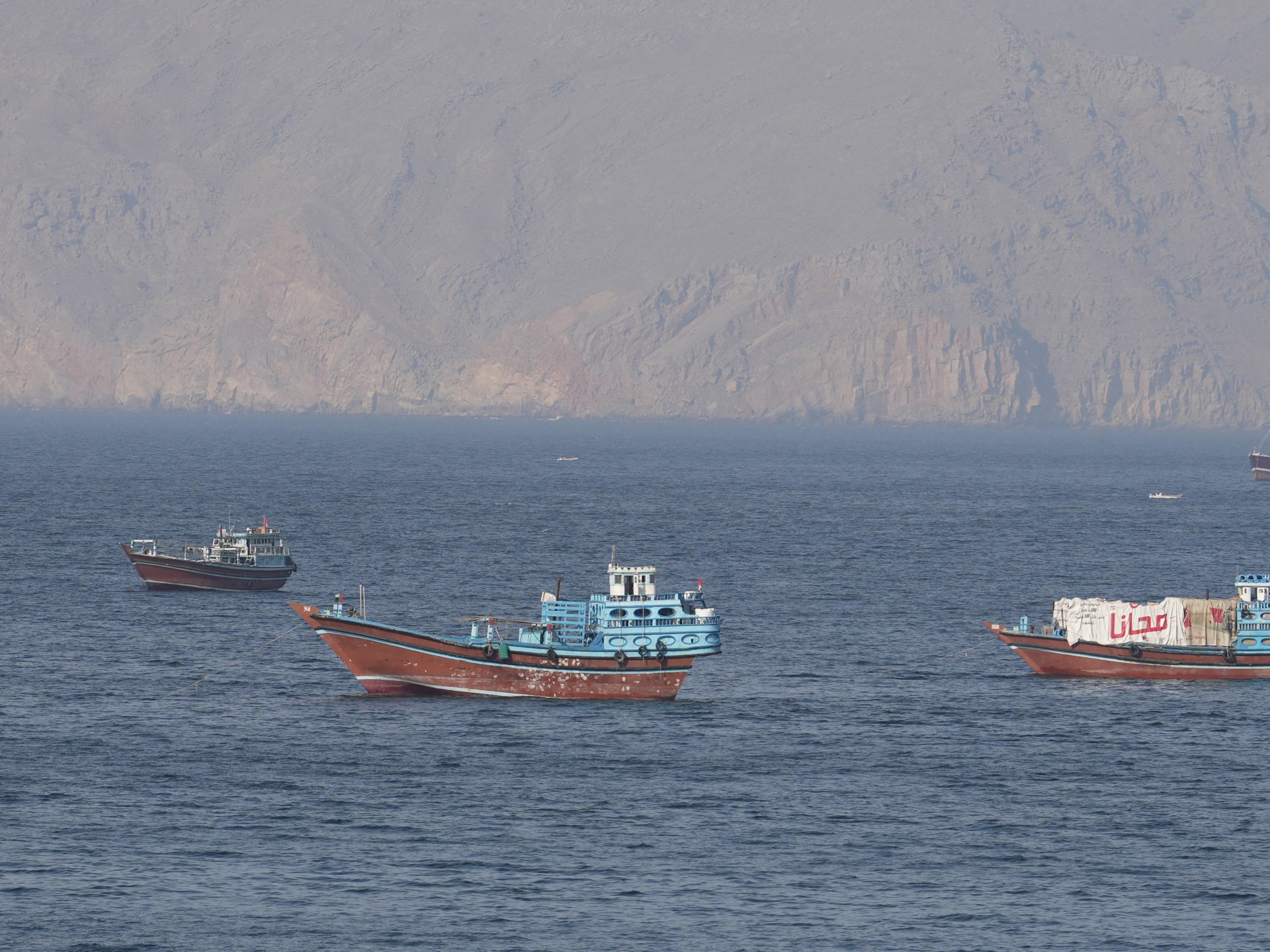
The Strait of Hormuz, a chokepoint for about a fifth of the world’s oil, has again become the chaotic centre of the United States-Israel war on Iran, as a standoff between Washington and Tehran is complicating efforts to end the war.

Iran on Saturday reversed its decision on reopening the strait, and its military opened fire at a ship trying to pass through the waterway after US President Donald Trump said Washington will continue its blockade on Iranian ports.

Trump has refused to end the blockade until a deal is finalised. On Saturday, he said that there have been “very good” discussions, but Washington won’t be “blackmailed”.

After a short-lived rise in transit attempts on Saturday, ships in the Persian Gulf once again stayed put, after reports of vessels coming under fire mid-passage and being forced to withdraw.

Their pullback restored the strait to its pre-ceasefire status, raising the risk of a worsening global energy crunch and increasing the likelihood of renewed fighting.

Iranian Foreign Minister Abbas Araghchi on Friday said the strait would be open for commercial vessels during the truce, which ends on April 22, in “line with the ceasefire in Lebanon”.

However, Iran’s Islamic Revolutionary Guard Corps (IRGC) announced a clear reversal in Iran’s position, saying the Strait of Hormuz would not return to its “previous state”, amid the blockade of Iranian ports.

The IRGC’s joint military command said the US has “continued acts of piracy and maritime theft under the guise of a so-called blockade”.

“For this reason, control of the Strait of Hormuz has returned to its previous state, and this strategic waterway is now under strict management and control by the armed forces,” said the statement, cited by Iranian broadcaster IRIB.

“Until the United States restores full freedom of navigation for vessels travelling from Iran to their destinations and back, the status of the Strait of Hormuz will remain tightly controlled and in its previous condition,” it added.

Iran’s Speaker of Parliament Mohammad Bagher Ghalibaf, who is Iran’s chief negotiator in talks with the US, said it was “impossible for others to pass” the strategic strait without Iran’s consent. He called Washington’s blockade “ignorant” and “foolish”, saying Tehran would not allow others to transit the strait if its own ships were blocked.

On Saturday, he said that major differences remain, despite some progress towards a deal.

In a Truth Social post on Sunday, the US president ‌accused Iran of violating the ceasefire agreement, but added that US negotiators will be heading to Islamabad, Pakistan on Monday to strike a deal.

“We’re offering a very fair and reasonable deal, and I hope they take it because, if they don’t, the United States is going to knock out every single power plant, and every single bridge, in Iran,” he said in the post.

Iran on Sunday said that it was tightening its control over the waterway once again in response to the US blockade of Iranian ports, which began on April 14. Tehran says the blockade violates the terms of the ceasefire.

Trump on Saturday said that the US was having “very good conversations” with Iran, but he noted that Tehran wanted to close the important oil corridor again and that it could not blackmail the US with such a move.

Lloyd’s List, a maritime firm, said traffic in the Straight of Hormuz had come to a halt after Iranian forces fired on several ships on Saturday.

The United ⁠⁠Kingdom ⁠⁠Maritime Trade Operations agency said it received a report ⁠⁠of a tanker being fired upon by what it ‌‌said were two gunboats linked to the IRGC.

Meanwhile, India summoned the Iranian ambassador in New Delhi and expressed deep concern that two Indian-flagged ships had come under fire in the strait, the government said.

Abas Aslani, a senior fellow at the Centre for Middle East Strategic Studies in Tehran, said the two sides are “engaging in war rhetoric ahead of any possible escalation and military conflict”.

“It seems that they are pressuring each other to win concessions – and we are not there yet,” Aslani told Al Jazeera.

“There are speculations that maybe the US is possibly planning to engage in limited strikes against Iran, but Iran has been saying that it will retaliate strongly,” he said. “This might end again in a wider conflict.”

The biggest contention is over hardening positions on Iran’s nuclear programme, chief among them being Tehran’s nuclear enrichment capability.

On Friday, Trump said Washington would obtain Iran’s enriched uranium, calling it “nuclear dust” and referring to the 440kg (970lbs) believed to be buried at sites hit by US strikes last year. He repeated on Truth Social that “the USA will get all Nuclear ‘Dust’”.

Speaking to Reuters news agency, Trump said the US would work with Iran “at a nice leisurely pace” and “start excavating with big machinery” to recover the material.

In a rebuke to Trump, Iran’s President Masoud Pezeshkian said Washington had no justification for depriving Iran of its nuclear rights.

“Trump says Iran cannot make use of its nuclear rights, but doesn’t say for what crime. Who is he to deprive a nation of its rights?” Pezeshkian asked, according to the Iranian Students’ News Agency.

Israel and the US have repeatedly accused Iran of enriching uranium to develop nuclear weapons. But Iran says its nuclear programme is for civilian purposes and that it has honoured its commitments under the Nuclear Non-Proliferation Treaty.

Tulsi Gabbard, the director of US National Intelligence, testified to Congress in March 2025 that the US “continues to assess that Iran is not building a nuclear weapon and Supreme Leader [Ayatollah Ali] Khamenei has not authorised the nuclear weapons programme he suspended in 2003.”

Khamenei was killed on February 28 in US and Israeli strikes. His son Mojtaba Khamenei has been named his successor.

A ceasefire in Lebanon had also been a key Iranian demand before it agreed to the two-week truce between the US-Israeli side and Iran.

While a 10-day ceasefire is technically in place between Israel and the Lebanese armed group Hezbollah, it remains fragile. Israel has carried out strikes despite the truce, and its forces have created a Gaza-like “yellow line” to create a buffer zone.

The truce was declared just days after Lebanon and Israel held their first face-to-face negotiations in decades in Washington. According to Iran’s FM Araghchi, the brief reopening of the Strait of Hormuz came in response to the ceasefire being extended to Lebanon.

Hezbollah has condemned the ceasefire agreement as “an insult to our country” and “a slippery slope with no end in sight”.

“A ceasefire means a complete cessation of all hostilities”, the Lebanon-based group said. “Because we do not trust this enemy, the resistance fighters will remain in the field, ready to respond to any violations of the aggression. A ceasefire cannot be unilateral; it must be mutual”.

Hezbollah is Tehran’s most powerful regional ally and a core pillar of the “axis of resistance” – a network of armed groups across the Middle East aligned with Iran against Israel, including Yemen’s Houthis and several factions in Iraq.

The group joined the fighting after the Israeli army killed Iran’s Supreme Leader Khamenei in its initial strikes on Tehran.

📰 மூல செய்தி (Source): https://www.aljazeera.com/news/2026/4/19/what-to-know-about-us-iran-standoff-over-the-strait-of-hormuz?traffic_source=rss

உலகம்

US Jewish leader, Israel advocate Abe Foxman dies at 86

Published

on

Israeli officials hail Foxman, who led the ADL advocacy group for nearly three decades, as warm and passionate.

Prominent Jewish American leader and Israel defender Abraham “Abe” Foxman has died at age 86.

The Anti-Defamation League, the advocacy group he led for 28 years, confirmed his death on Sunday, calling him an “outspoken, passionate, and tireless advocate for the Jewish people and Israel“.

A Holocaust survivor, Foxman helped shape the conversation around Israel and anti-Semitism in the US for decades.

ADL Board Chair Nicole Munchnik said Foxman helped build the “modern liberal era of America”, describing him as a “longtime adviser” to US presidents and world leaders.

“To those of us who knew him, Abe was a warm friend, adviser, spirited antagonist and hugger – all over lunch,” Munchnik said.

Foxman joined the ADL in 1965 and served as the group’s national director from 1987 to 2015.

Under his leadership, the group – which presents itself as an anti-hate watchdog – became one of the most influential advocacy organisations in the country.

Palestinian rights advocates have long condemned the ADL, accusing it of demonising pro-Palestine activists and conflating criticism of Israel with anti-Semitism.

Since the start of the genocidal war on Gaza, the ADL – under Foxman’s successor Jonathan Greenblatt – has intensified its campaign against Israel’s critics.

Greenblatt, who has supported laws to penalise boycotts of Israel, compared the Palestinian keffiyeh to the Nazi swastika last year.

Foxman also remained a staunch supporter of Israel and defended its conduct during the genocidal war on Gaza.

“What is happening in Gaza is tragic. But it is not Genocide. And it is not illegal,” he wrote on X in July 2025 as Israel imposed a hunger crisis on the territory.

“War is hell and inhumane, destructive and ugly. And nations must take all possible care to avoid civilian harm. And Israel has and is doing that. Having said this, Israel still needs to act with all deliberate speed and skill to provide maximum humanitarian aid to lessen the loss of innocent civilian lives.”

Weeks before his death, Foxman backed the US-Israel war on Iran, voicing gratitude to US President Donald Trump and Israeli Prime Minister Benjamin Netanyahu for attacking the country.

“Thank you President Trump and Prime Minister Netanyahu for standing up to evil and jihadist extremism. The world hopefully will be a better and safer place in the future,” he said in a social media post on February 28 after the war broke out.

In March, Foxman warned about what he described as the rise of anti-Semitism on the right and left of the political spectrum in the US, hitting out at liberal politicians publicly distancing themselves from the American Israel Public Affairs Committee (AIPAC).

“If a politician doesn’t want to take money from AIPAC, don’t take money from AIPAC, but don’t make taking money from AIPAC a morality test – because that continues to build the conspiracy theory that there is a Jewish lobby that controls America,” he told the Jewish Standard.

AIPAC, which backs the war on Iran, has been spending millions of dollars on ad campaigns to defeat Israel’s critics in US elections.

Last year, Foxman sounded the alarm about the dwindling support for Israel in the US, underscoring the importance of the alliance between the two countries for Israel.

“We’re in a propaganda war, and to an extent, we’re losing the propaganda war, and I worry about losing America,” Foxman told Times of Israel.

“It’s scary, looking at the polls, the Sunday television shows, the major newspapers – there is so much out there that is anti-Israel.”

Despite his assertion, rights advocates often decry the absence of Palestinian perspectives on TV shows in the US media.

In 2021, Foxman announced that he was cancelling his New York Times subscription after the newspaper published a front page featuring the photos of dozens of Palestinian children killed by Israel in Gaza.

“Today’s blood libel of Israel and the Jewish people on the front page is enough,” he said at that time.

Tributes in Israel and the US poured in for Foxman on Sunday.

Israeli Foreign Minister Gideon Saar said he was “deeply saddened” by the death of Foxman.

“A towering voice against antisemitism, Abe devoted his life to defending the Jewish people and strengthening the bond between Israel and Jewish communities worldwide,” Saar said on X.

Israel’s President Isaac Herzog also called Foxman a “legendary leader of the Jewish people”.

“He was a passionate Zionist, a humanist, and an outspoken, wise friend,” Herzog said.

📰 மூல செய்தி (Source): https://www.aljazeera.com/news/2026/5/10/us-jewish-leader-israel-advocate-abe-foxman-dies-at-86?traffic_source=rss

Continue Reading

உலகம்

Israeli weapon fires tiny metal cubes into people in Lebanon, like Gaza

Published

on

Israeli weapon fires tiny metal cubes into people in Lebanon, like Gaza

The same tiny tungsten cubes that spray out of Israeli bombs, causing devastating internal injuries to people in Gaza are being found in wounded civilians in Lebanon, war surgeon Dr Tahir Mohammed says. He draws parallels between what Israel is doing in both places and describes the weapons as “indiscriminate”.

📰 மூல செய்தி (Source): https://www.aljazeera.com/video/newsfeed/2026/5/10/israeli-weapon-fires-tiny-metal-cubes-into-people-in-lebanon-like-gaza?traffic_source=rss

Continue Reading

உலகம்

Trump to discuss Iran with Xi Jinping during China visit: Officials

Published

on

Official says US president will likely ‘apply pressure’ on China over Beijing’s purchase of Iranian oil amid war.

Donald Trump is set to arrive in Beijing on Wednesday evening to discuss the Iran war and other issues with his Chinese counterpart President Xi Jinping.

White House Principal Deputy Press Secretary Anna Kelly said an opening ceremony and meeting will be on Thursday morning, and the trip will conclude on Friday. The US plans to host the Chinese leader during a reciprocal visit later this year.

Kelly said that this week’s trip would be of “tremendous symbolic significance” and focus on “rebalancing the relationship with China and prioritising reciprocity and fairness to restore American economic independence”.

Trump’s visit, initially scheduled for earlier this year but postponed in March due to the US-Israel war on Iran, comes as the US president struggles to contain the fallout from the war, both at home and abroad.

A senior administration official told news outlets in an anonymous briefing on Sunday that Trump could “apply pressure” to China on Iran in areas such as oil sales and Tehran’s purchase of potential dual-role military-civilian goods.

US Treasury Secretary Scott Bessent last week accused China of “funding” Iran.

“Iran is the largest state sponsor of terrorism, and China has been buying 90 percent of their energy, so they are funding the largest state sponsor of terrorism,” Bessent told Fox News.

Iran closed the Strait of Hormuz in response to US-Israeli attacks, restricting passage through a key artery of global energy transport.

China has said that it wants to see the war end and hosted Iranian Foreign Minister Abbas Arraghchi last week. At the same time, Beijing has refused to recognise Washington’s “unilateral” sanctions on Iran’s oil sector.

Disruptions stemming from the war have disrupted the global economy, with Asian states that depend on imports from the Middle East especially hard hit.

Trump could also bring up China’s support for Russia during the talks, along with trade and rare earth minerals, a vital resource for the US tech sector. Business executives from aerospace manufacturer Boeing and a handful of agricultural companies are set to travel with the US delegation.

The anonymous administration official said that no change was expected regarding the US stance on Taiwan, a main sticking point in relations between Washington and Beijing. China considers the self-ruling island a part of its territory, but the US has deep security and economic commitments to Taiwan.

📰 மூல செய்தி (Source): https://www.aljazeera.com/news/2026/5/10/trump-to-discuss-iran-with-xi-jinping-during-china-visit-officials?traffic_source=rss

Continue Reading

Trending

Copyright © 2024 by 7Tamil Media, All rights reserved.