Connect with us

உலகம்

US military equipment worth billions of dollars destroyed in Iran war

Published

on

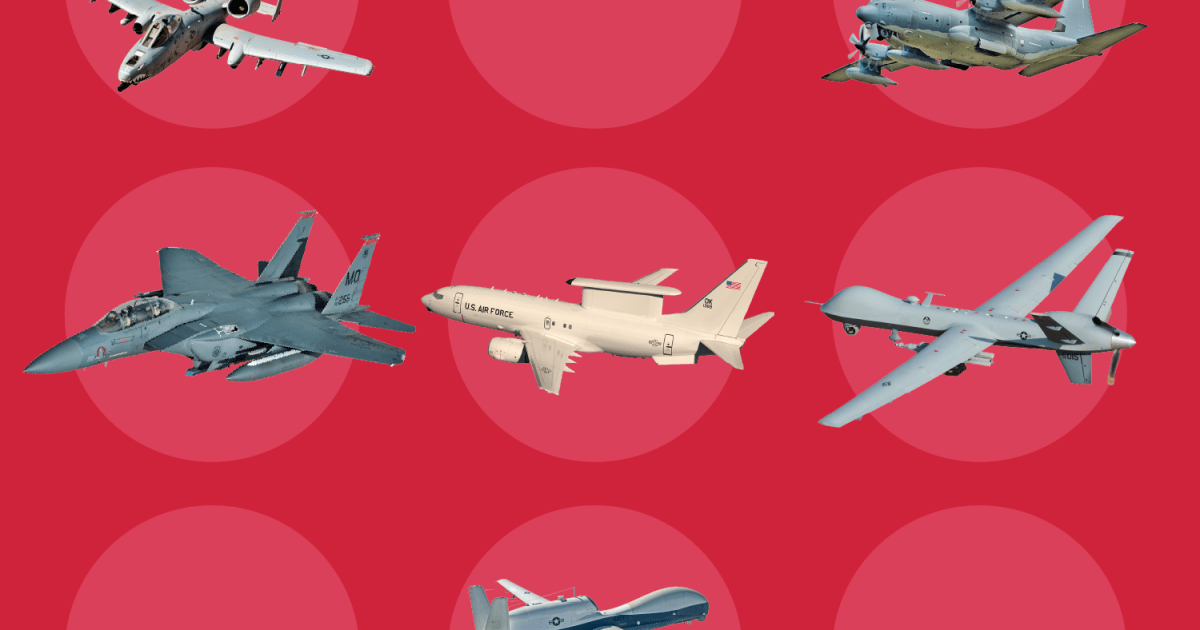
The United States lost aerial equipment worth up to $2.8bn, according to a US-based think tank.

Speaking at a televised Cabinet meeting on March 26, the US secretary of defense boasted of US military successes against Iran in the ongoing war. “Never in recorded history has a nation’s military been so quickly and so effectively neutralised,” he said, seated next to US President Donald Trump.

The very next day, Iran fired missiles and drones that struck a US base in Saudi Arabia, wounding several US soldiers and destroying a radar surveillance plane that cost $700m.

It was no one-off hit. Iran’s missiles and drones, and one devastating instance of so-called friendly fire, have destroyed US military equipment worth between $2.3bn and $2.8bn, the Washington, DC-based Center for Strategic and International Studies has calculated.

The CSIS estimate is the first detailed tabulation by a major international research group of US military losses in the war that began on February 28, and Al Jazeera is the first to report it.

This estimated costing does not include losses incurred at US bases in the region, or any of the specialised equipment or naval assets.

Mark Cancian, a senior adviser with the Defense and Security Department at CSIS, carried out the calculations. He said that he was also looking at damages to bases used by the US in the Gulf. But that exercise has been more challenging. Planet Labs, a global service provider for satellite imagery, has blocked all satellite images for public and media usage at the request of the US government since February 28. Iranian satellite imagery, however, has been available.

“We can see from the overhead photographs, you know, what, what buildings were struck,” said Cancian, of the bases used by the US. “It’s hard to know what was in the building.”

Some of the losses were the result of “friendly fire”. Three F-15 jets were shot down in one such incident in Kuwait in early March.

But most of the US aircraft and radar destroyed in the war were targeted by Iran. Two instances, in particular, stand out. On March 1, the US lost at least one powerful missile defence radar that uses the THAAD system to detect missiles and some hypersonic threats, and feeds targeting data to other defence systems. Some reports suggest two radars were destroyed. The total bill: Between $485m and $970m. The location has not been specified. The US armed forces are hosted by several Gulf nations where THAAD systems were implemented.

Read more here about the GCC military capabilities.

And on March 27, the attack on Prince Sultan airbase in eastern Saudi Arabia, fewer than 24 hours after Hegseth’s boast, destroyed the $700m E-3 AWACS/E7 radar detection aircraft. Essentially an airborne command centre, it can detect aircraft and missiles hundreds of kilometres away, and coordinate battles in the sky.

Omar Ashour, professor of security and military studies and founder of the Security Studies Programmes at the Doha Institute for Graduate Studies, said that while the US has disclosed some figures, it cannot afford full transparency for political reasons.

“At this point, I don’t think the Trump administration would want to be looking like losing equipment [and] personnel,” Ashour told Al Jazeera, adding that there might be a “price” to pay “at the [midterm] elections in November“.

The US, he said, had a history of achieving operational victories in conflicts around the world — only to then fail strategically.

“In Vietnam, they did a series of operational victories. In Afghanistan, they did. But then [they suffered] the strategic loss in the end. Because the operational victories did not serve the strategic ends,” he said.

“In this case, the strategic ends are very political,” Ashour added, referring to the proclaimed goals of regime change and denuclearising Iran.

He emphasised that at the moment, the US troops deployed to the region do not constitute even a 10th of the force used to invade Iraq in 2003. It also does not have the number of aircraft carriers used against Iraq.

Cancian said that he was surprised at Iran’s decision to strike Gulf nations — and not just the US bases they host.

“I think that was a strategic error on their part. They thought that that would split the Gulf states away from the United States, but it drove them closer to the United States,” he argued.

For the US, he said, the failure to keep the Strait of Hormuz open was a humbling reminder of what can happen when a navy is unprepared. Iran enforced restrictions on the passage of most vessels through the strait early in the war, and on April 13, the US launched its own naval blockade of Iranian ports and ships trying to transit through the waterway.

“It’s surprising because we’ve been thinking about this with the United States military for 45 years,” he said, before referring to his own time in the military. Cancian is a retired colonel from the US Marines, and his military career spanned over three decades. He served in multiple roles in Vietnam, the 1991 Gulf War – Desert Storm, and the Iraq war.

Cancian recalled participating in amphibious planning exercises to capture Qeshm Island, where Iran is believed to hold several of its missiles in an underground facility. “So it’s not that this just popped up unexpectedly.”

But when the US launched the current war, he said, “They didn’t have the forces in place.”

“They do now, but they did not initially. And then, you know, apparently for whatever reason, they don’t have the capability or are not willing to take the risk to open it,” he added.

Ashour said that Iran, too, has suffered severe damage to its military. He says the US-Israeli operation in this case has degraded the country’s conventional military architecture, but was unable to wipe out its missiles, munitions and drones.

“That claim that the [Iranian] navy got obliterated,” he said, was “far from the truth”.

“You can still fight in the sea without a conventional or without the blue water navy,” he said. “They were degraded. But it’s far from defeated, and they’re far from down.”

📰 மூல செய்தி (Source): https://www.aljazeera.com/news/2026/4/30/us-military-equipment-worth-billions-of-dollars-destroyed-in-iran-war?traffic_source=rss

உலகம்

US Jewish leader, Israel advocate Abe Foxman dies at 86

Published

on

Israeli officials hail Foxman, who led the ADL advocacy group for nearly three decades, as warm and passionate.

Prominent Jewish American leader and Israel defender Abraham “Abe” Foxman has died at age 86.

The Anti-Defamation League, the advocacy group he led for 28 years, confirmed his death on Sunday, calling him an “outspoken, passionate, and tireless advocate for the Jewish people and Israel“.

A Holocaust survivor, Foxman helped shape the conversation around Israel and anti-Semitism in the US for decades.

ADL Board Chair Nicole Munchnik said Foxman helped build the “modern liberal era of America”, describing him as a “longtime adviser” to US presidents and world leaders.

“To those of us who knew him, Abe was a warm friend, adviser, spirited antagonist and hugger – all over lunch,” Munchnik said.

Foxman joined the ADL in 1965 and served as the group’s national director from 1987 to 2015.

Under his leadership, the group – which presents itself as an anti-hate watchdog – became one of the most influential advocacy organisations in the country.

Palestinian rights advocates have long condemned the ADL, accusing it of demonising pro-Palestine activists and conflating criticism of Israel with anti-Semitism.

Since the start of the genocidal war on Gaza, the ADL – under Foxman’s successor Jonathan Greenblatt – has intensified its campaign against Israel’s critics.

Greenblatt, who has supported laws to penalise boycotts of Israel, compared the Palestinian keffiyeh to the Nazi swastika last year.

Foxman also remained a staunch supporter of Israel and defended its conduct during the genocidal war on Gaza.

“What is happening in Gaza is tragic. But it is not Genocide. And it is not illegal,” he wrote on X in July 2025 as Israel imposed a hunger crisis on the territory.

“War is hell and inhumane, destructive and ugly. And nations must take all possible care to avoid civilian harm. And Israel has and is doing that. Having said this, Israel still needs to act with all deliberate speed and skill to provide maximum humanitarian aid to lessen the loss of innocent civilian lives.”

Weeks before his death, Foxman backed the US-Israel war on Iran, voicing gratitude to US President Donald Trump and Israeli Prime Minister Benjamin Netanyahu for attacking the country.

“Thank you President Trump and Prime Minister Netanyahu for standing up to evil and jihadist extremism. The world hopefully will be a better and safer place in the future,” he said in a social media post on February 28 after the war broke out.

In March, Foxman warned about what he described as the rise of anti-Semitism on the right and left of the political spectrum in the US, hitting out at liberal politicians publicly distancing themselves from the American Israel Public Affairs Committee (AIPAC).

“If a politician doesn’t want to take money from AIPAC, don’t take money from AIPAC, but don’t make taking money from AIPAC a morality test – because that continues to build the conspiracy theory that there is a Jewish lobby that controls America,” he told the Jewish Standard.

AIPAC, which backs the war on Iran, has been spending millions of dollars on ad campaigns to defeat Israel’s critics in US elections.

Last year, Foxman sounded the alarm about the dwindling support for Israel in the US, underscoring the importance of the alliance between the two countries for Israel.

“We’re in a propaganda war, and to an extent, we’re losing the propaganda war, and I worry about losing America,” Foxman told Times of Israel.

“It’s scary, looking at the polls, the Sunday television shows, the major newspapers – there is so much out there that is anti-Israel.”

Despite his assertion, rights advocates often decry the absence of Palestinian perspectives on TV shows in the US media.

In 2021, Foxman announced that he was cancelling his New York Times subscription after the newspaper published a front page featuring the photos of dozens of Palestinian children killed by Israel in Gaza.

“Today’s blood libel of Israel and the Jewish people on the front page is enough,” he said at that time.

Tributes in Israel and the US poured in for Foxman on Sunday.

Israeli Foreign Minister Gideon Saar said he was “deeply saddened” by the death of Foxman.

“A towering voice against antisemitism, Abe devoted his life to defending the Jewish people and strengthening the bond between Israel and Jewish communities worldwide,” Saar said on X.

Israel’s President Isaac Herzog also called Foxman a “legendary leader of the Jewish people”.

“He was a passionate Zionist, a humanist, and an outspoken, wise friend,” Herzog said.

📰 மூல செய்தி (Source): https://www.aljazeera.com/news/2026/5/10/us-jewish-leader-israel-advocate-abe-foxman-dies-at-86?traffic_source=rss

Continue Reading

உலகம்

Israeli weapon fires tiny metal cubes into people in Lebanon, like Gaza

Published

on

Israeli weapon fires tiny metal cubes into people in Lebanon, like Gaza

The same tiny tungsten cubes that spray out of Israeli bombs, causing devastating internal injuries to people in Gaza are being found in wounded civilians in Lebanon, war surgeon Dr Tahir Mohammed says. He draws parallels between what Israel is doing in both places and describes the weapons as “indiscriminate”.

📰 மூல செய்தி (Source): https://www.aljazeera.com/video/newsfeed/2026/5/10/israeli-weapon-fires-tiny-metal-cubes-into-people-in-lebanon-like-gaza?traffic_source=rss

Continue Reading

உலகம்

Trump to discuss Iran with Xi Jinping during China visit: Officials

Published

on

Official says US president will likely ‘apply pressure’ on China over Beijing’s purchase of Iranian oil amid war.

Donald Trump is set to arrive in Beijing on Wednesday evening to discuss the Iran war and other issues with his Chinese counterpart President Xi Jinping.

White House Principal Deputy Press Secretary Anna Kelly said an opening ceremony and meeting will be on Thursday morning, and the trip will conclude on Friday. The US plans to host the Chinese leader during a reciprocal visit later this year.

Kelly said that this week’s trip would be of “tremendous symbolic significance” and focus on “rebalancing the relationship with China and prioritising reciprocity and fairness to restore American economic independence”.

Trump’s visit, initially scheduled for earlier this year but postponed in March due to the US-Israel war on Iran, comes as the US president struggles to contain the fallout from the war, both at home and abroad.

A senior administration official told news outlets in an anonymous briefing on Sunday that Trump could “apply pressure” to China on Iran in areas such as oil sales and Tehran’s purchase of potential dual-role military-civilian goods.

US Treasury Secretary Scott Bessent last week accused China of “funding” Iran.

“Iran is the largest state sponsor of terrorism, and China has been buying 90 percent of their energy, so they are funding the largest state sponsor of terrorism,” Bessent told Fox News.

Iran closed the Strait of Hormuz in response to US-Israeli attacks, restricting passage through a key artery of global energy transport.

China has said that it wants to see the war end and hosted Iranian Foreign Minister Abbas Arraghchi last week. At the same time, Beijing has refused to recognise Washington’s “unilateral” sanctions on Iran’s oil sector.

Disruptions stemming from the war have disrupted the global economy, with Asian states that depend on imports from the Middle East especially hard hit.

Trump could also bring up China’s support for Russia during the talks, along with trade and rare earth minerals, a vital resource for the US tech sector. Business executives from aerospace manufacturer Boeing and a handful of agricultural companies are set to travel with the US delegation.

The anonymous administration official said that no change was expected regarding the US stance on Taiwan, a main sticking point in relations between Washington and Beijing. China considers the self-ruling island a part of its territory, but the US has deep security and economic commitments to Taiwan.

📰 மூல செய்தி (Source): https://www.aljazeera.com/news/2026/5/10/trump-to-discuss-iran-with-xi-jinping-during-china-visit-officials?traffic_source=rss

Continue Reading

Trending

Copyright © 2024 by 7Tamil Media, All rights reserved.