Connect with us

முக்கியச் செய்திகள்

Ukrainian drone hits upmarket Moscow high-rise ahead of Victory Day celebrations

Published

on

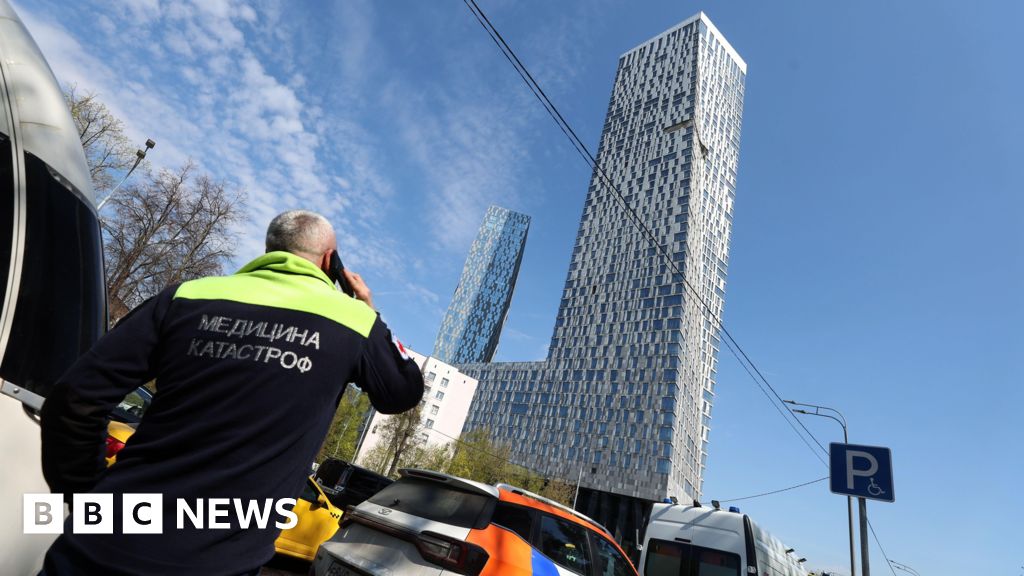
A Ukrainian drone hit an upmarket residential high-rise in Moscow in the early hours of Monday, resulting in no casualties but causing visible damage to the façade of the building.

It was the third night in a row that the Russian capital came under attack from drones, days before Russia holds a scaled-back 9 May parade to mark the Soviet Union's victory over Nazi Germany.

An unverified video circulating on social media showed firemen entering a heavily damaged flat covered in dust and rubble and with blown-out windows, while another showed drone debris strewn across the street below.

Two other drones were intercepted, Mayor Sergei Sobyanin said. Vnukovo and Domodedovo international airports suspended operations overnight.

A total of 117 were intercepted over several Russian regions between Sunday and Monday, the Russian defence ministry said. Sixty alone were aimed at the region of St Petersburg in what the regional governor Aleksandr Drodzhenko said had been a "massive" attack.

The residential building that was hit is located in an upscale neighbourhood in south-west Moscow, less than 10km (six miles) from the Kremlin and Red Square, where Saturday's parade will be held.

Ukrainian drones have attacked Moscow several times since Russia launched its invasion of Ukraine in February 2022.

Drone alerts regularly shut down airports on the outskirts of the capital and disrupt aerial traffic, but much of the capital is protected by the Pantsir-S surface-to-air missile system and successful strikes so close to the centre are relatively rare.

Betraying a sense of nervousness ahead of the 9 May celebrations, the Kremlin last week announced that due to a "terrorist threat" from Ukraine it would scale back the yearly grand military parade on Red Square. For the first time since 2008, no armoured vehicles or missile systems will feature.

Several local phone operators announced that mobile internet will be restricted in Moscow for much of the week ahead for "security reasons", Russian media reported on Monday.

Ukrainian President Volodymyr Zelensky said that the Kremlin was afraid that "drones will fly over Red Square. This is telling… We need to keep up the pressure."

Since the start of the war, Ukraine has developed an arsenal of long-range drones which are often able to hit targets many hundreds of miles from its borders.

Such drones now routinely hit energy infrastructure and refineries across Russia with the aim of slashing Russian oil production and revenue.

On Sunday Zelensky said three Russian oil tankers, a cruise-missile carrier warship and a patrol boat had been struck in separate attacks on two Russian ports.

The tankers were part of Russia's "shadow fleet" used to evade Western sanctions imposed over Moscow's full-scale invasion launched in 2022, Zelensky said.

For its part, Russia continues to launch deadly aerial attacks on Ukrainian cities on a daily basis.

On Monday Ukrainian authorities said four people were killed and 18 were injured in a missile strike near Kharkiv, close to the border with Russia.

📰 மூல செய்தி (Source): https://www.bbc.com/news/articles/cwy234llx3vo?at_medium=RSS&at_campaign=rss

முக்கியச் செய்திகள்

Davide Ancelotti: My dad, my tactics and Brazil's World Cup prospects

Published

on

Davide Ancelotti is Brazil's assistant manager for the World Cup, with his father, Carlo Ancelotti, the manager

Davide Ancelotti grew up immersed in football in a way few ever have.

Aged six, accompanying his father and then-Parma manager Carlo to the training ground, the first player he remembers meeting was Gianluigi Buffon.

The young boy would take shots against the Italian goalkeeper, who would go on to become one of the greatest in the game.

Turning his head, Davide would see defenders Lilian Thuram and Fabio Cannavaro, still early in their own journeys, honing the habits that would later make them World Cup winners with France and Italy.

A young Davide Ancelotti with his father, Carlo Ancelotti

This immersion came before the coaching badges, before he would accompany his father – a five-time Champions League-winning manager – as assistant boss of Bayern Munich, Napoli, Everton and Real Madrid.

I sat down with Davide, a tactics board on the table between us, looking to unpick the mind of a hardworking and curious coach following his first head coach role in charge of Botafogo and prior to this summer's World Cup – where he will accompany Carlo as assistant coach of the Brazilian national team.

Davide and I discuss his philosophy, the tactics used by Pep Guardiola's Manchester City and PSG's Luis Enrique, as well as possible future tactical trends

"In football, it is difficult to say that one manager inspires you," began the 36-year-old Davide. "You take things from different managers.

"Pep Guardiola was cutting edge, a pioneer. You cannot forget Jurgen Klopp in the high pressing, in the triggers. If we speak about superiority, you have to mention Roberto de Zerbi in how to find the third man, the small details that he discovered. I am fascinated by the defensive phase of Diego Simeone, by Unai Emery and, of course, my father.

"My father came from the school of Arrigo Sacchi, the zonal defence, the 4-4-2.

"And all of these ideas have influenced my own identity as a manager. This process of creating my own identity as a manager is always an ongoing one. For some people I am like my father, but in truth, I am not exactly like him. I have a similar character, but I am a different kind of manager.

"I don't think a manager has to be one thing or another. There is always a point in the middle. You adapt to the players, and sometimes to the opponent, but you also need clear ideas on what you like as a manager.

"In the end, the team will become what you emphasise and you emphasise the things you like."

"My dream is to have a team that can do different things at the highest level.

"If we take the example of the last Champions League winners, Paris St-Germain, they are able to do everything.

"They are able to find the spare man if they have superiority in the first build-up. They are able to have a positional possession, and also not have a positional possession [freedom] when they have the ball in the high build-up.

"Of course, they have great ability up front, but without the ball, if they have to press, they recognise when they have to press to be man-to-man. And they are really organised in the deep block.

"So what can you say about a team like this? This is a team that is complete."

Illustrating Davide's analysis on PSG. In 'high build-up', forward Ousmane Dembele has moved into a midfield position with central midfielder Dro Fernandez taking up his position in attack. The players marked in yellow stand in areas the manager has instructed, in a positional manner. The remaining unmarked players float in a non-positional manner, with freedom.

"Defensively, I believe in the zonal defence in your own half. The best way to defend is to defend with two lines of four and a line of two. It could be a 4-4-1-1 or a 4-4-2.

"But a shape is not enough, you need principles.

"Today it is difficult to defend the last line with four. The shape is 4-4-2, yes, but then it always changes.

"I believe, and this is from Jose Mourinho, Diego Simeone, Unai Emery, the great teachers of the defensive phase, that you have, at some point, to be five."

At this point we altered the tactics board, dragging one of the opposition midfielders forward in between the defending team's full-back and centre-back.

Davide continued: "For example, if this guy goes, you follow. It all depends on where the ball is, but you create a back five and that can be with your number six, or it can be with your winger.

"That is my belief. I still believe in zonal marking when you are defending the goal and when you are defending the box."

Ancelotti talks through the 4-4-2 when defending

"The skill you need to have today in the defensive phase as a manager is to make the players understand that the mid-block is disappearing.

"I made the coaching licence in Germany, and in Germany they draw two lines and they call it mittelfeldpressing [midfield pressing]. Here they keep the high line but don't press the ball.

"If you see Liverpool when they won the Champions League with Jurgen Klopp, it was like this. Against Barcelona away, there was no pressure on the ball, but the line was high.

"As a manager, you have to make your team understand that this block is now a transitory situation.

"Once we are here, we have to hold this position briefly, but we are looking for the next position, which is to drop deep or press high.

"Your players have to recognise the triggers and there are triggers to go high and there are triggers to go back.

"Following a passback or a trap you set, for example, your players can go man-for-man."

Liverpool's mittelfeldpressing in their first leg semi-final loss against Barcelona. Note Liverpool's high defensive line while their attackers fail to apply pressure to Barcelona's defenders, giving them time to pick passes.

Listening to Davide explain his defensive tactics, I then posed him a challenge.

In Manchester City's Premier League win at Liverpool in February, Arne Slot set his Reds side up in a 4-4-2. Guardiola countered that by placing Bernardo Silva between the two Liverpool central midfielders with attacking midfielders on the left and right of him.

The rationale was that if the central midfielders focused on Silva, the attacking midfielders would have space. If Liverpool's midfield two moved wider to address this, Silva would be free.

I asked how Davide would have addressed this tactic that appeared effective against the system he was describing.

Against Liverpool, Bernardo Silva positioned himself in the middle of the pitch with Nico O'Reilly to his left and Rayan Cherki to his right as attacking midfielders. Liverpool's midfield pairing in their 4-4-2 shape were torn between marking O'Reilly and Cherki or getting close to Silva with City having three players versus two in these situations

"Yes, the best way to attack against a 4-4-2 is to create an overload in the centre," said Davide.

"Guardiola did it a lot against us, even when we were at Everton. At Everton we defended in a 4-4-2, and we decided to mark their two midfielders with Abdoulaye Doucoure and Allan so he started to put a third player inside, and it was tough. We then moved our number 10 to follow this player.

"He did it again with John Stones in the Champions League, who started to go inside, I think in the game we drew 1-1 at the Bernabeu.

"We demand a lot from the four players in midfield. The way you cope with it is to close space with the wingers. They have to be really narrow.

"Every time the ball is on one side, the (far-side) winger controls one of their central midfielders, but at some point, because they are patient and they move from one side to another, you'll leave space in midfield.

"At that point, your number 10 dropping back helps.

"But sometimes you have [Kylian] Mbappe and Vinicius Jr as your two strikers, so what do you do when you need a player to drop back?"

"You have to find a way. At the highest level you have players that you cannot avoid playin

📰 மூல செய்தி (Source): https://www.bbc.com/sport/football/articles/clyp3y9lwjdo?at_medium=RSS&at_campaign=rss
Continue Reading

முக்கியச் செய்திகள்

BBC uncovers the Ugandan scammers abusing dogs to elicit donations from animal lovers

Published

on

A dog with rust-coloured fur lies at the side of a road. He looks peaceful, but as the TikTok video pans from his face to the rest of his body, severe injuries to his hind legs appear.

The dog is not resting. He is panting, presumably in pain.

Text on the 15-second clip tells viewers that this dog "got into an accident" and asks them "to save his life" by donating through an online link.

In the three weeks after the video was first posted on 8 January last year, this dog was featured in hundreds of other fundraising campaigns, by at least a dozen accounts.

A social media user from the UK named the dog Russet, which reflected the colour of his coat. Thousands of dollars were raised for his treatment. But he never got better.

BBC Africa Eye has discovered that this dog in Uganda was a prop in a scam that solicits donations for animals in distress, part of a hidden industry profiting from cruelty.

It is impossible to conclusively establish what caused Russet's injuries, but BBC World Service journalists managed to piece together parts of his story, which suggest he endured prolonged suffering, regardless of the cause.

The story connects a town in Uganda with animal lovers thousands of miles away. They are coaxed into parting with their money through emotional images, lies and the exploitation of Western stereotypes of Africa such as endemic poverty and widespread indifference towards animal welfare.

But it is dogs like Russet who pay the biggest price.

He was filmed in Mityana, a trading centre around 70km (43 miles) from Uganda's capital, Kampala.

The town has become infamous among online animal rescue activists around the world for one thing – sham dog rescue shelters.

Ugandan scammers have realised just how popular dogs are in Europe, North America and Australia, and how easily social media's obsession with dogs can be converted into cash.

"There are young men in the [Ugandan] countryside who are always looking for anything to do on the internet," Bart Kakooza, chairman of the Uganda Society for the Protection and Care of Animals, tells the BBC.

"On the other side, in the Western world, people are very passionate about animals. These young men realised they can make money if they can get a dog."

It is impossible to say how many social media accounts operate from Mityana. But collectively, they have flooded Instagram, TikTok, Facebook and YouTube with videos of pitiful-looking animals – mostly dogs and cats, but even rabbits – with commentary pleading for donations to shelter, feed and treat them.

A typical video involves a person showing some dogs in a makeshift structure coupled with messages like "our dogs are hungry" or "it's another day without food at the shelter" and "please help us".

The clips often exploit what content creators think will resonate with viewers' existing perceptions of Africa, depicting it as a place where food is scare and young dog lovers must fight against the odds to protect animals from societal hostility and neglect.

Data analysis by BBC Africa Eye suggests these videos have been effective in converting views into donations.

In the past five years, our research showed that more than $730,000 (£540,000) has been raised for animal shelters in Uganda by hundreds of fundraisers posted on the donation platform GoFundMe.

Nearly 40% of all the fundraisers analysed by the BBC were connected to Mityana.

In the town, the business of sham dog shelters is an open secret. Several residents tell the BBC it is easy to spot the con artists.

"When you see a young man driving a Subaru [a status symbol car in the area], you just know he is a scammer," says one.

Another says: "The scammers are the most respected here in Mityana".

But very few residents are willing to speak openly about specific shelter operations as they fear retaliation. The BBC decides to send an undercover team to Mityana.

The journalists pose as newcomers wanting to enter the business of online dog-shelter content.

They discover that some establishments in the area are rented out to multiple content creators.

The shelters charge an entrance fee to film with the owner's dogs. The videos are then posted on the scammer's social media accounts and affiliated online fundraisers, usually a GoFundMe or PayPal link.

This means the same physical shelter and the same dogs are used by several different accounts to solicit money.

The BBC team gains access to one of these shelters, run by a young man who introduces himself as Charles Lubajja.

At the shelter, the journalists find about 15 dogs kept in the same cage, lying in their own waste. Many appear severely underweight and lethargic.

Lubajja tells the undercover reporters that the shelter primarily exists to make money from social media viewers abroad under false pretences. He gives some advice on how to increase revenues, and shares some of the tricks, including:

"Once you receive the GoFundMe money, you use it to buy a car or build a house," Lubajja says while being secretly filmed.

"Once you get a white donor, don't treat them as a brother. You have to squeeze them [take their money]. Drain them."

But as fake operations like Lubajja's spread across the internet, a growing number of donors came to realise they had been deceived. Initiatives then sprang up to stop the scammers.

Campaigners' tactics include raising awareness among potential contributors, and naming and shaming the accounts believed to be the worst offenders.

Online activists also say that more than just neglect is taking place in Mityana's shelters, including deliberately harming the animals.

A campaign which gained ground due to its aggressive style is We Won't Be Scammed, which has an Instagram account with around 20,000 followers.

In the undercover filming, Lubajja himself mentions the campaign and describes it as the scammers' "biggest problem".

What Lubajja probably did not know is that the account is run by a 49-year-old woman who lives some 10,000km away in Yorkshire, in the north of England.

Nicola Baird, the founder of We Won't Be Scammed, is on the warpath.

"The scammers, I just have hatred for them," she tells the BBC. "They are the epitome of evil."

As with others in her network of 20 activists, Baird was once a victim. She sent money to a man in Mityana who said his dog needed surgery after a traffic accident.

When she received photos and videos of the dog's alleged surgery, Baird started to suspect something was wrong. Veterinary doctors she shared the images with confirmed that they looked more like abuse than veterinary care. "That's when I thought: 'Oh my goodness, I've enabled this abuse.'

"And that's when it became a real passion to stop the abuse because I felt like they were abusing [my dog] Sebi – they're abusing part of my family."

This experience shaped Baird's belief that animal injuries shown in social media videos – including burns, cuts and even missing limbs – have been deliberately inflicted, a view shared by other online activist groups monitoring accounts linked to Mityana.

Lubajja confirms to the undercover team that there have been instances where scammers have injured dogs on purpose.

"When they ran out of content, some people started cutting the dogs and asked for money," he says.

But he adds the escalation backfired when some donors started seeing through the abuse and warning others.

"[Scammers] no longer cut the dogs [because] they lost money when the white people realised."

Baird acknowledges that scammers' tactics have changed due to increased scrutiny, but maintains dogs are still being deliberately hurt and remain in danger.

"All that pain is just for a few donations," she says. "No animal should have to live like this."

We Won't Be Scammed and other online activists think that Russet, the dog who was filmed at the side of the road and featured in dozens of fundraising videos, had his legs deliberately broken.

During the undercover filming, Lubajja is shown a video o

📰 மூல செய்தி (Source): https://www.bbc.com/news/articles/c4g9l74wvd7o?at_medium=RSS&at_campaign=rss

Continue Reading

முக்கியச் செய்திகள்

Met Gala 2026: How to watch, the price of tickets and this year's theme

Published

on

The dresses have been sewn, the jewellery has been polished and New York's hairdressers and make-up artists have been fully booked ahead of the Met Gala 2026.

Around 450 A-list guests will begin arriving later for fashion's biggest night of the year, which raises money for the Metropolitan Museum of Art's Costume Institute.

Beyoncé, Nicole Kidman and Venus Williams are the co-chairs for this year's gala, which has the dress code: "Fashion is art."

Here's everything you need to know about this year's Super Bowl of fashion.

This year's theme is Costume Art, named after the museum's new exhibition, which will see 400 outfits and objects spanning 5,000 years go on display.

The dress code for the gala is Fashion Is Art, with guests invited to explore their relationship to fashion as an embodied art form and celebrate depictions of the dressed body throughout art history.

Some stars might reference famous artistic movements and styles from over the centuries, as Vogue pointed out with their helpful round-up of some runway looks that could appear on the night.

Outfits referencing the Baroque, Impressionist or Renaissance movements could show up, and there might even be direct references to specific individual paintings.

But, as is often the case with the Met Gala, the theme is suitably wide that it could be interpreted in countless ways, so we can expect to see a wide variety of looks on the red carpet.

Met Gala chair Anna Wintour has enlisted Beyoncé, Nicole Kidman and Venus Williams to serve as the evening's co-chairs this year.

It will mark Beyoncé's first Met Gala since 2016, when she attended wearing a futuristic outfit for the event's memorable technology-themed year.

Sabrina Carpenter, Doja Cat, Teyana Taylor, Lisa from Blackpink, Elizabeth Debicki and Lena Dunham are among the members of this year's host committee, which is headed up by Anthony Vaccarello and Zoë Kravitz.

The event formally opens the Costume Institute's spring exhibition, which serves as the department's primary source of funding and runs until January 2027.

Amazon founder Jeff Bezos and his wife Lauren Sanchez Bezos are co-chairs and sponsors of this year's event.

This has led to calls for a boycott in some quarters, with posters popping up near the New York museum alluding to issues like workers' rights.

Bezos stood down as Amazon's chief executive four years ago.

As is tradition, the Met Gala is taking place on the first Monday in May, with guests arriving from about 18:00 EST (23:00 BST).

The guest list isn't published in advance, but you can expect to see a huge number of A-listers on the night.

The public don't get to see inside the event itself, where the guests are treated to dinner, cocktails, live music and a look around the museum's new exhibition.

But despite the exclusivity of the event and the strict no-selfie rule inside, the lengthy red carpet event beforehand ensures acres of media coverage.

Publicity for other events is also often built around the Met Gala. It's no coincidence, for example, that this past weekend was chosen to release The Devil Wears Prada 2.

The beloved original film, which affectionately parodied the fashion industry two decades ago, was loosely based on Met Gala chair Anna Wintour's time as editor of Vogue.

Note: There was no Met Gala in 2020 due to Covid.

Vogue will once again host the livestream from the red carpet.

Ashley Graham, Cara Delevigne, and La La Anthony will host this year's coverage, with Emma Chamberlain returning as the magazine's red carpet correspondent.

The stream will be broadcast live across Vogue's digital platforms, as well as on YouTube and TikTok.

But countless news outlets will be live streaming their own coverage on social media platforms such as Instagram and TikTok.

The BBC News website will be covering the event, with a live page running while celebrities are arriving on the red carpet.

The Met Gala is a relatively small event, only open to a small number of invited guests – usually around 450.

Tables cost upwards of around $350,000 (£258,000), while individual tickets are reported to go for about $75,000 (£56,000).

Very few celebrities actually pay for their own tickets, however.

They instead receive invitations from fashion brands, many of whom host celebrities as their guests.

If an A-list star wears the brand's clothes and sits at their table, it generates publicity for the company that justifies the price of the table.

But despite picking up the bill, fashion houses still need to run every proposed guest past the queen of fashion herself.

Anna Wintour, chair of the Met Gala since 1995 and head of content at Vogue publisher Condé Nast, personally has to sign off on every invitation.

📰 மூல செய்தி (Source): https://www.bbc.com/news/articles/cdrm7gp5er3o?at_medium=RSS&at_campaign=rss
Continue Reading

Trending

Copyright © 2024 by 7Tamil Media, All rights reserved.