Connect with us

முக்கியச் செய்திகள்

UK seeks closer EU ties in volatile times – but at what cost?

Published

on

We live in hugely volatile times. In Ukraine, Europe is entering the fifth year of the worst conflict this continent has seen since World War Two, petrol prices are rising, and the global economy is under strain because of knock-on effects of the Iran war. Relations with the UK's former best friend, the United States are worsening.

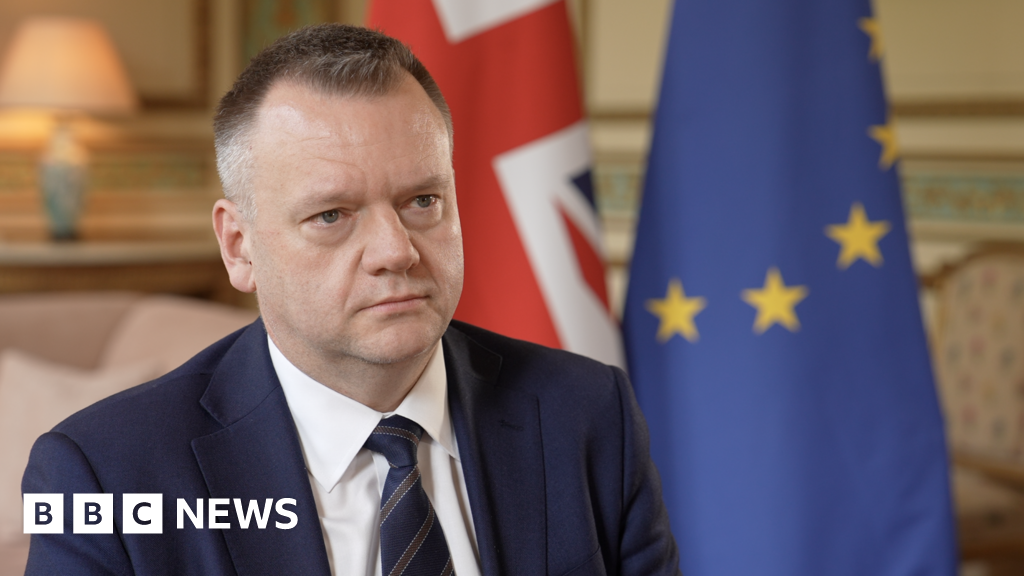
It's against this backdrop that the UK's minister for EU relations, Nick Thomas-Symonds, told the BBC that the UK is adopting an "ambitious" and "ruthlessly pragmatic" approach to becoming closer to its European neighbours – in sectors of UK national interest.

Speaking to me at the residence of the UK ambassador to the EU in Brussels, he told me he believes the UK public is more open to closer EU ties nowadays because of huge geopolitical instability: "I do find a support for closer UK–EU relations… I think there is a particular imperative at the moment… we find ourselves in a dangerous situation in the world."

The UK's increased cooperation with other European powers is already particularly evident when it comes to security and defence – take the common approach on Ukraine, for example, with the UK in a leadership role. Or the intention to work together on the joint procurement of armaments now European leaders have promised the US they'll do more for their own continental defence.

But Thomas-Symonds has his eye on economic ties.

Nearly ten years after the Brexit vote, Prime Minister Sir Keir Starmer has promised to reduce post-Brexit red tape and costs for UK companies doing business with the UK's biggest export market, the EU.

By this summer, and the second post-Brexit EU-UK summit (an exact date for that summit has yet to be announced), the UK says it will have concluded a food and agricultural safety agreement with Brussels to reduce the burden on businesses exporting sausages, for example, to Northern Ireland and the EU, as well as a deal on carbon emissions trading, and a deal on a youth "experience" programme, allowing youngsters from the EU and the UK to work or study in each others' countries for a limited time period.

On Wednesday this week, the two sides announced the UK was rejoining the EU's Erasmus+ scheme too, helping more young people from the UK to study across the bloc.

The government insists all this respects the Brexit-vote and the red lines in its manifesto: not to take the UK back into the EU or even into its single market or customs union.

But the leaders of Reform UK and the Conservative Party disagree. "Aligning" with the EU involves the UK following EU rules. It makes the UK a rule taker, not a rule maker. The main Leave campaign ahead of the Brexit vote, a decade ago now, promised the UK would "take back control" from Brussels.

The government insists that its decision to only make deals with the EU in sectors that benefit the UK, is in fact using post-Brexit national sovereignty in the UK's interest.

Starmer is planning new legislation, expected later this year, to give ministers a fast-track route for introducing draft laws to align with future European standards. It's designed to ensure a single market in the trade of certain goods and services.

Nigel Farage called the proposed bill "a backdoor attempt to drag Britain back under EU control". While Kemi Badenoch accused ministers of lacking bravery: "If you want to be in the EU, come out and say we want to go back into the EU," she said.

The government categorically denies that re-entry into the EU is its goal. And the Liberal Democrats and the UK's Green Party accuse the government of not going far enough in its attempts to get closer to the EU to help the UK economy.

Critics say Labour seems stuck between economic necessity and political constraints.

But all Labour's mini deals with the EU come at a cost anyway. Brussels – though it welcomes a closer relationship with the UK – only makes deals in its own interest, it says.

Erasmus+ will cost the British taxpayer £570m for the first year alone. The UK's participation in the EU's science programme Horizon, agreed under the previous UK government, costs £2.2bn a year. Backers point out though, that, two years on from rejoining the flagship EU research programme, the UK has emerged as a leading beneficiary.

Thomas-Symonds insists he won't make any deals with Brussels that go against UK national interest. On AI, he emphasises, it's better for the UK to take a different path to Brussels. He has also refused, to date, to join the EU defence loans scheme SAFE as long as the membership cost demanded by Brussels remains too high – a €2bn (£1.7bn) financial contribution. That's roughly 10% of the UK's annual defence budget.

French MEP Natalie Loiseau, who is a close ally of President Emmanuel Macron, told me that EU terms and conditions remain the same as they did 10 years ago, when the UK voted for Brexit. The closer the UK wants to get to the EU single market, she says, the more it will have to align with EU rules and regulations.

If the EU gets really close to the single market, Brussels could demand freedom of movement – another UK government red line.

Take a look at current UK efforts to gain access to the EU's internal electricity market. Thomas-Symonds points out that energy security is of paramount importance to the UK.

A lesson of soaring energy prices after Russia's full-scale invasion of Ukraine and now with the blocking of oil tankers in the Strait of Hormuz following US and Israeli attacks on Iran.

But Brussels says to get a deal on electricity, the UK will have to pay into the EU cohesion fund. That's a pot of money designed to help poorer EU regions to become more competitive. Would the UK accept that? I asked Thomas-Symonds.

That's just the EU's opening position at the start of negotiations, he retorted. An attempt, it seemed, to brush the subject away.

Thomas-Symonds won't be drawn into which other sectors the UK wants to align with the EU on in the future. The UK has, in the past, tried to get the EU to negotiate a deal on chemicals. Brussels demurred.

A criticism of a government focus to date on goods-based agreements with the EU is that they are insufficient to really shift the dial on the UK economy, as Chancellor Rachel Reeves says she wants. The UK economy is very much service-based.

Thomas-Symonds insists the food deal and the carbon emissions agreement alone will be worth £9bn to the UK economy by 2040. That's a long time in the future.

The European Commission – the bloc's executive arm that negotiates trade deals on behalf of EU member states, has also drawn criticism.

Countries that do a lot of trade and feel a particular affinity with the UK complain off the record that while it is important to safeguard EU interests, the commission is being "too rigid" and should be more imaginative and flexible when it comes to doing bespoke deals with the UK.

Especially, EU diplomats have told me, bearing in mind the threats to Europe economically and in security terms by China, Russia and of late, the US too.

I asked Thomas-Symonds whether this increasingly public drive by the government to break down barriers with the EU an admission that the "special relationship" with the US, that the UK has long cherished the idea of, is now over? President Donald Trump has repeatedly criticised and mocked the prime minister of late over his position on the Iran war.

"The special relationship [between the UK and the US] is deep and enduring," according to the Europe minister, adding that the UK doesn't choose between friends and allies.

Though the question remains – the more the UK aligns itself with EU rules in different sectors, the trickier it is likely to become to realise the Brexit aim of being free to close trade deals with other countries – including the United States.

Last May, Trump and Starmer announced a limited bilateral trade agreement that modestly expands agricultural access for both countries and lowers punitive US taxes on British car exports, leav

📰 மூல செய்தி (Source): https://www.bbc.com/news/articles/cqj8pg5yppwo?at_medium=RSS&at_campaign=rss

முக்கியச் செய்திகள்

Artemis II crew: 'We left as friends – we came back as best friends'

Published

on

The four astronauts of Artemis II say their mission gave the world a sense of hope and unity at a time when both feel in short supply.

At their first Nasa news conference since returning last Friday, Reid Wiseman, Victor Glover, Christina Koch and Jeremy Hansen said they left as friends and came back as something closer – bound by an experience that no earthly language can fully contain.

More than the technical milestones, the mission reminded them of what being human actually means: laughter, joy, tears, and an instinct toward one another that transcends borders.

And their message was clear: Landing on the Moon is not the distant dream it once seemed.

"We wanted to go out and try to do something that would bring the world together, to unite the world," Wiseman told reporters at Nasa's Johnson Space Center in Houston.

"We were certainly hooked on this mission, but when we came home, we were shocked at the global outpouring of support, of pride, of ownership of this mission… we want to thank the world. Thank you for tuning in."

He singled out the Orion spacecraft – named Integrity – and the Space Launch System as a symbol of what international partnership can still produce.

"Thank you to every single person that had a hand in building that machine," he said, "because it was a magnificent machine."

Artemis II carried its crew further from Earth than any humans have ever gone, swinging around the far side of the Moon in just over nine days. Victor Glover became the first black astronaut to reach deep space; Christina Koch the first woman; Jeremy Hansen the first Canadian.

For Koch, the scale of what they had done only became clear through others' eyes when her husband told her on a video call that the mission had cut through divisions and united people. She found herself undone.

"When my husband looked me in the eye on that video call and said, 'No, really, you've made a difference'," she told reporters, "it brought tears to my eyes, and I said, that's all we ever wanted."

Glover talked about it being an experience shared by the entire world.

"I think something that we all feel and we try to share is how much we want to reflect back to you all how we did this, not we as a crew, we as countries and as humans did this," he said.

Thinking about that, he said, brought to mind "the picture of the Earth as we started to go farther" as they traveled close to the moon and how they talked about "looking at you and how beautiful Earth is".

Hansen found that returning to Earth had deepened his faith in people.

"We don't always do great things. We're not always in our integrity, but our default is to be good and to be good to one another," he said. "What I've seen has brought me more joy, but more hope for our future."

Some experiences cannot be processed through rational thought. Wiseman described the moment the Sun passed behind the Moon – an eclipse seen from 250,000 miles away – as something that overwhelmed the capacity of the human mind.

Back on the recovery ship, he sought out the chaplain, needing a way to express what he had experienced that science had not given him.

"I'm not really a religious person," he said, "but there was just no other avenue for me to explain anything or to experience anything. So I asked for the chaplain on the Navy ship… and I broke down in tears.

"I don't think humanity has evolved to the point of being able to comprehend what we're looking at right now, because it was otherworldly."

Beyond the emotional weight, there was sheer visual wonder. Hansen found himself transfixed by the depth of space, as though seeing it for the first time. "We just saw so many amazing things," he said. "I kept seeing this depth to the galaxy that I just had never experienced before."

He described feeling "infinitesimally small, but yet this very powerful feeling as a human being, like as a group."

As the news conference wore on, the room filled with laughter. Koch described being so conditioned by weightlessness that back on Earth she had dropped a shirt expecting it to float – and was startled when it fell.

"I put a shirt in the air and it went – it actually surprised me," she said.

Not everything ran smoothly. The crew were candid about a persistent blockage in the toilet's primary vent line, saying it got "clogged up".

The Orion capsule, though, impressed its crew profoundly. And Wiseman, reflecting on how close they had come to the lunar surface, made a remark that will resonate in every Nasa planning room.

"If we had a first flight lander on board that thing," he said, "I know at least three of my crewmates would have been in it, trying to land on the Moon."

He chose his next words carefully, perhaps leaving out the word "giant" as a nod to the first words spoken on the lunar surface.

"It is not the leap I thought it was," he said. "Once we're around the Moon, in the vacuum of space, we've got a vehicle that's handling great. If you had given us two keys to the lander, we would have taken it down and landed on that Moon."

Time and again, the missions that matter most put a human face on the cosmos, allowing those watching from Earth to feel they too were along for the ride. Artemis II did that, through four people willing to cry in public, laugh about kicking each other in their sleep, and say that what they found out there was hope.

President John F Kennedy said America chose to go to the Moon "not because it was easy but because it was hard". This crew fits right in with the Apollo heritage.

"All of the what-ifs," said Koch, "all of the just coming up with every possible operational workaround for anything you might encounter – accomplishing the near impossible is exactly what we do, and what we just showed that we can do."

📰 மூல செய்தி (Source): https://www.bbc.com/news/articles/ce8jpz9rx2yo?at_medium=RSS&at_campaign=rss
Continue Reading

முக்கியச் செய்திகள்

Champions League in the Championship? Forest's juggling act goes on

Published

on

Morgan Gibbs-White scored the only goal on Thursday night against Porto

Championship game on a Saturday, Champions League match on a Tuesday?

While Nottingham Forest bask in the glory of Thursday's victory over Porto in the Europa League quarter-finals, their position in the Premier League means their short and medium-term future remains somewhat complicated.

Forest's battling 1-0 win to secure a 2-1 victory on aggregate means they will play Aston Villa in their first European semi-final for 42 years.

The winners of that all-English tie will head to Istanbul for the final on 20 May – against either Freiburg or Braga – as favourites.

And victory in Turkey will not only earn silverware but a spot in next season's Champions League.

Before that, however, they face crucial league fixtures against Burnley and Sunderland. If results in those games and elsewhere go against them, they could be in the relegation zone by the time that last-four tie with Villa arrives.

Despite being on their best unbeaten run of the season, could Forest really end up playing the likes of Bristol City and Real Madrid in the same week next season?

Villa & Forest progress – relive eight iconic all-English European ties

Winning the Europa League was a target for Forest at the start of the season, having spent around £180m on new players.

Owner Evangelos Marinakis was looking to build on last season's seventh-place finish, when Forest missed out on the Champions League on the final day.

Four managers – Nuno Espirito Santo, Ange Postecoglou, Sean Dyche and now Vitor Pereira – later and it remains realistic despite the self-inflicted chaos this season.

Postecoglou lifted the Europa League with Tottenham last May and told his Forest players he wanted to defend the trophy after he replaced Nuno in September.

During his 39 days in charge, Forest drew their opener 2-2 at Real Betis before a damaging 3-2 home defeat by Midtjylland saw fans turn on the Australian, who was sacked after seven winless games.

Dyche fared little better, although he at least guided Forest out of the Europa League group phase, but the turbulent nature of the season means Pereira must now balance domestic and European goals into May.

"They can do both [win the Europa League and stay up]," former England international Karen Carney told TNT Sports.

"The point against Aston Villa in the Premier League, this moment tonight finding themselves in the Europa League semi-finals, Burnley on Sunday… this could be a turning point for them this week."

Sunday's visit of Burnley remains key to Premier League safety with Forest having navigated three of their potentially season-defining games in the past seven days.

Pereira showed his hand both in his team selection and post-match comments after the first leg draw at Porto last week.

A much-changed side, including young defender Zach Abbott, Morato and Chris Wood's first appearance for six months after injury, underlined where the priorities were.

Sunday's 1-1 draw against Aston Villa, when Portuguese manager Pereira made nine changes to return to his strongest Premier League side, justified the minor gamble in Porto.

"The club said to me the priority is to keep the club in in the Premier League," said the former Wolves boss after the game in Portugal. "I agree. For the supporters, for everybody, for the club, for everybody. It's a disaster if we go to the Championship.

"We are competing with West Ham, Tottenham and Leeds and it's not easy to compete with these kind of clubs.

"If we are not in the Premier League, it will be a disaster and this is a disaster I don't want to have responsibility for.

"Of course, I want to win [the Europa League]. I had it as an assistant coach. We won the Europa League [with Porto in 2011] but I want to win it as a head coach.

"I want to keep my club in Premier League and to fight to achieve the final."

Forest have six games left as they look to beat the drop – potentially helping to relegate Tottenham for the first time since 1977 in the process.

Yet, if the worst happens, how will they juggle the relentless nature of the Championship with European football?

To give an idea of how the two schedules collide, Champions League teams played six fixtures in the league phase before Christmas, while there were five midweek Championship rounds during the same period.

All five of those Championship rounds coincided with Champions League games. There is no leeway.

Europe's elite competition expanded to 36 teams from last season. Add the Carabao Cup to that fixture list and it is a packed schedule that looks almost unmanageable.

League games – with English Football League clubs playing 46 in a campaign – would likely need to be postponed and moved. It would seem an impossible task.

Ipswich played in the Uefa Cup while competing in the second tier in 2002-03 having also played in the competition while in the Premier League the season before

Forest would not be a unique case of playing in Europe while in the second tier but they would certainly have more fixture congestion than previous teams, who faced fewer games in past versions of European competition.

In 2011, Birmingham stunned Arsenal to win the League Cup when Obafemi Martins' late goal earned the Blues their first major trophy.

Yet they were relegated from the Premier League three months later and faced the Europa League in the Championship.

The finished third in Group H, behind Club Brugge and Braga, to exit the competition despite losing just two of their six games and winning 10 points.

Their victory over Club Brugge in Belgium coming courtesy of a stoppage-time winner from current Forest striker Chris Wood.

Wigan Athletic followed two years later when they won the FA Cup and were relegated. They finished bottom of Group D which included Rubin Kazan, Maribor and Zulte Waregem.

Ipswich also reached the Uefa Cup despite being relegated from the Premier League in 2001-02 after they qualified via Uefa's Fair Play League.

All of the English teams above them in the Fair Play League had already made other European competitions.

While in the Championship they lost on penalties to Slovan Liberec in the second round, while Millwall – FA Cup runners up in 2004 – lost in the knockout stage to Ferencvaros in 2004-05.

📰 மூல செய்தி (Source): https://www.bbc.com/sport/football/articles/cm25p4ndmdyo?at_medium=RSS&at_campaign=rss

Continue Reading

முக்கியச் செய்திகள்

Why 'sensational' Palace & Conference League are good fit

Published

on

Crystal Palace are now three games away from European glory

Almost a year ago Crystal Palace fans experienced a day they will have felt could never be topped.

On Saturday, 17 May 2025, their side famously beat Manchester City to win the FA Cup – a first major trophy success in their 120-year history as a professional club.

It was a once-in-a-life-time moment for those connected with the Eagles – but they will now be pinching themselves once again as they find themselves just one step away from a first major European final appearance.

Making their debut in this competition, Palace booked a meeting with Shakhtar Donetsk in the Conference League semi-finals after overcoming Italians Fiorentina over two legs.

They lost the second leg on Thursday 2-1 but after winning the opener 3-0 at Selhurst Park, the fans who had travelled to Italy were determined not to let anything spoil their party.

Palace goalkeeper Dean Henderson summed up the feeling as he told TNT Sports: "This is unbelievable for this football club, sensational when you think of the FA Cup last season and then to keep going and create a new chapter in the book.

"The togetherness in the group is phenomenal and at the business end of the season, we come together.

"We've just got to keep pushing on and build momentum."

Palace hold off Fiorentina fightback to reach semis

How 10 Premier League teams could still qualify for Europe

Crystal Palace fans travelled in big numbers to Fiorentina

When the Conference League was first introduced back in 2021 there were some who questioned the value of the competition.

But it has offered many teams the chance to do something they had never done before – win a major European trophy.

There were wild scenes of celebration when Roma became the inaugural winners, while the following year West Ham claimed a dramatic last-minute success against Fiorentina to end their 43-year wait for a major trophy.

Thousands gathered in the streets of east London to welcome back the victorious Hammers, underlining how much the win meant to the club and their supporters.

Palace fans will no doubt feel the same should their side go all the way and claim yet more silverware in a memorable 12 months.

Former Crystal Palace defender James Tomkins said on TNT Sports: "The last couple of seasons have been incredible.

"They never expected to be in a European competition a couple of seasons ago but now they are going from strength to strength in this competition.

"They will feel they can go all the way."

Midway through this season, though, it looked like things were derailing for Palace.

The man who had led them to their FA Cup triumph, Oliver Glasner, seemed on the verge of leaving after criticising the club's ownership in January for "abandoning" the team.

Palace were on a poor run of form at the time which had seen them drop down the table, while they finished 10th in the Conference League group phase.

On 16 January Glasner stated he would leave at the end of the season when his contract expired – an announcement that left Palace fans concerned about the rest of the campaign.

But after that confirmation and Glasner remaining in the post, the club's form steadily improved. After beating Zrinjski Mostar over two legs in their Conference League play-off, they have since beaten AEK Larnaca and now Fiorentina to reach the last four.

Key to their form in Europe has been striker Ismaila Starr, who scored his seventh goal in the competition in Thursday's 2-1 loss.

Five of those seven goals have come since February, while he has scored 17 in all competitions.

"The variety of goals he scores are key," said ex-Manchester City defender Joleon Lescott.

"He has always scored good goals but the less glamorous ones that are equally important, he has added them to his game."

Ismaila Sarr has scored seven goals in 10 Conference League games this season

Despite being debutants, Palace were installed as favourites to win the Conference League at the start of the season.

It took a while for them to live up to that tag, with many of their performances in Europe looking somewhat turgid.

But their 3-0 win against Fiorentina – two-time finalists in the Conference League – showed what they are capable of.

Next up for Palace is a two-legged semi-final with Shakhtar, with Strasbourg facing Rayo Vallecano in the other tie.

"They made light work of them [Fiorentina] really, but from here on in they will expect some really tough games, there is some good quality in the competition," added Tomkins.

"The question is whether they can bring the positivity from the first leg. That was the best I've seen them for a while, the three-week break did them the world of good and they looked like the team we saw early this season and last season."

The season will end with Glasner's departure, but it could also end with a European prize.

"Of course, that is what we all want," said the Austrian.

"We want to enjoy our life together, not just the football. The more successful you are, the more you enjoy your life.

"When you play the semi-final, you want to get it all at the end and that's what we will go for."

Listen to the latest Football Daily podcast

Get football news sent straight to your phone

📰 மூல செய்தி (Source): https://www.bbc.com/sport/football/articles/cvg4z1pn7g4o?at_medium=RSS&at_campaign=rss
Continue Reading

Trending

Copyright © 2024 by 7Tamil Media, All rights reserved.