Connect with us

உலகம்

Two killed, including a doctor, in Israeli attacks on Gaza

Published

on

Several injured in Gaza, while Israeli settlers attack Palestinian homes and property across the occupied West Bank.

Two Palestinians have been killed and several others injured in Israeli attacks in Gaza, as Israeli settlers attacked Palestinian homes and property in northern and southern parts of the occupied West Bank.

The attacks across Palestine on Saturday, the fourth day of the Muslim holiday of Eid al-Adha, came amid continued Israeli violations of a United States-backed “ceasefire” implemented in October aimed at halting Israel’s genocidal war on Gaza.

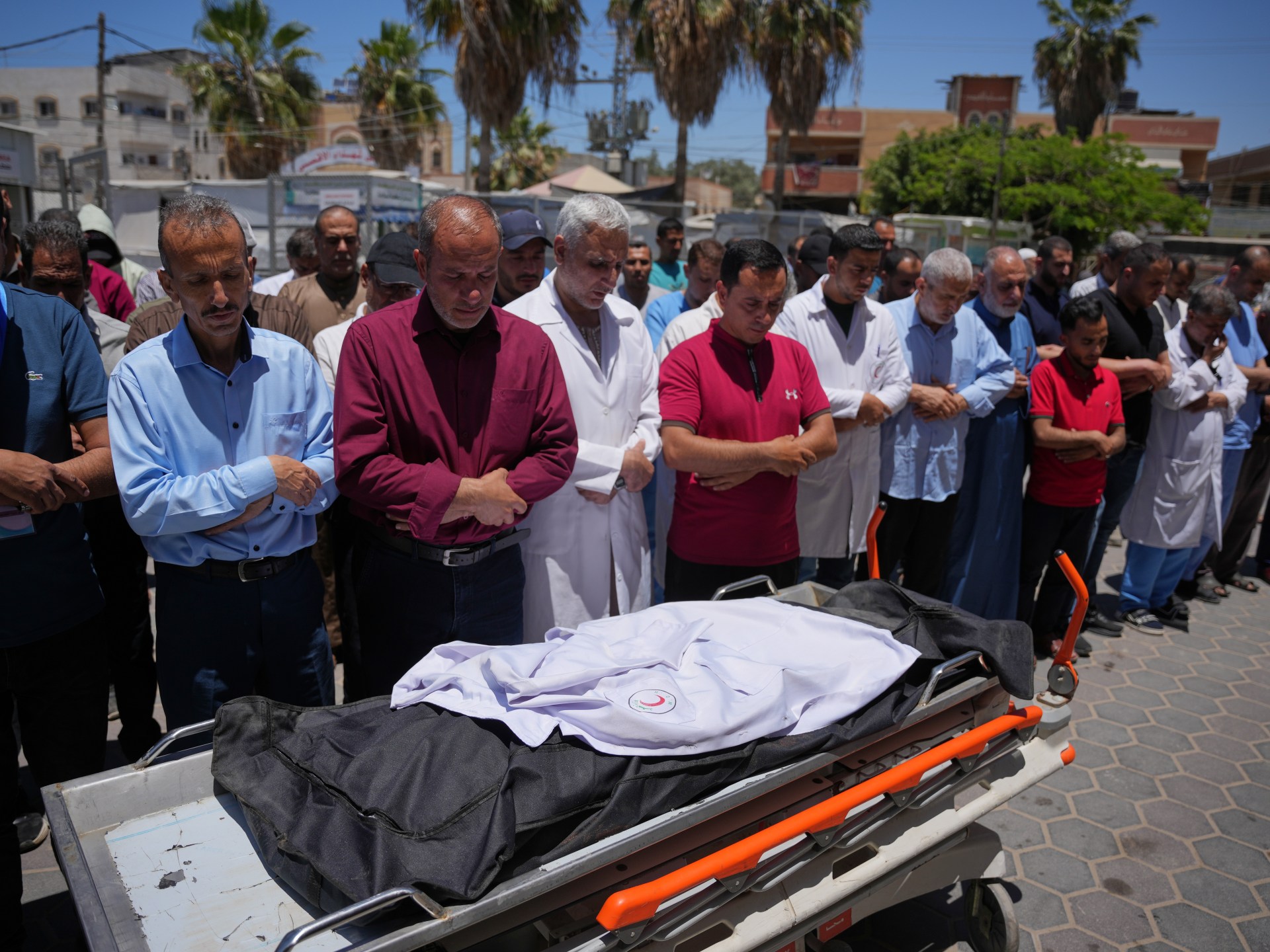
Dr Jamal Abu Aboun, head of the anaesthesia department at Al-Yafa Medical Hospital in central Gaza’s Deir al-Balah, was killed in an Israeli strike near the Al-Aqsa Martyrs Hospital, also in Deir al-Balah on Saturday.

“The body of Jamal Abu Aoun and three injured people, including a child, had arrived at the hospital following an Israeli drone strike that targeted a group of civilians near the hospital,” a medical source at Al-Aqsa hospital told the Anadolu news agency.

Earlier, Israeli artillery shelling targeted areas east and south of Khan Younis city in southern Gaza. Another artillery strike targeted al-Bureij refugee camp in central Gaza.

Later on Saturday, another Palestinian was killed and several others wounded in an Israeli drone strike near Firas Market, one of Gaza City’s busiest commercial areas, according to Palestinian news agency, Wafa.

Meanwhile, Israeli forces demolished homes east of Beit Lahiya in northern Gaza, further expanding the widespread destruction that has devastated residential neighbourhoods across the besieged enclave.

At least 922 Palestinians have been killed and 2,786 others injured in Israeli attacks since the October “ceasefire”, according to the Gaza Media Office.

Israel launched its genocidal war on Gaza in October 2023, killing at least 72,000 Palestinians and injuring over 172,000 others, according to Palestinian figures.

In testimonies to The Associated Press news agency, Israeli soldiers described a climate of dehumanisation, permissive rules of engagement and the routine killing of Palestinians during the “ceasefire”.

Reservists who served in Gaza between last October and January said Israeli troops frequently opened fire on Palestinians approaching or crossing the so-called “Yellow Line”, an often poorly marked boundary separating Israeli-occupied areas from the rest of the enclave.

One soldier said that fellow troops celebrated after a strike on a vehicle carrying Palestinians killed everyone inside. “It was a jungle,” the soldier told AP. “After the ceasefire, the order was: If someone crosses the line, you shoot them.”

Another reservist said commanders repeatedly emphasised holding territory at all costs. “There was a general feeling that human lives are not valuable,” he said.

Elsewhere in occupied Palestine, Israeli settlers attacked several homes early on Saturday in the town of Beita, south of the city of Nablus in the northern West Bank, according to Wafa.

They threw stones at houses and smashed several vehicles, Wafa reported.

State-run Voice of Palestine radio reported Israeli forces firing light bombs into the sky over the town.

In the southern West Bank, settlers attacked Palestinian farmland and damaged several trees in Khirbet el-Muraq in Masafer Yatta, activist Osama Makhamra, who follows Israeli violations south of Hebron, told reporters.

Israeli settlers carried out at least 540 attacks in April against Palestinians and their property in the occupied West Bank, including Jerusalem, according to a monthly report by the Palestinian state-run Wall and Settlement Resistance Commission.

The attacks ranged from “direct physical violence, uprooting trees, burning fields, preventing farmers from accessing their land, seizing property, as well as demolishing homes and agricultural structures”.

Israeli army raids, arrests and settler attacks have intensified across the West Bank since the start of the genocidal war in Gaza.

According to Palestinian figures, Israeli forces and settlers have killed 1,168 Palestinians, injured 12,666, displaced about 33,000, and detained nearly 23,000 in the West Bank since October 2023.

📰 மூல செய்தி (Source): https://www.aljazeera.com/news/2026/5/30/palestinian-doctor-killed-three-people-injured-in-israeli-attack-on-gaza?traffic_source=rss

உலகம்

Senior Sri Lankan monk suspended over child sex abuse allegation

Published

on

Pallegama Hemarathana is accused of abusing an 11-year-old girl in a Buddhist temple in 2022.

Sri Lanka’s Buddhist hierarchy has suspended a prominent senior monk accused of sexually abusing a child, in the religiously conservative nation’s highest-profile case involving a local clergyman.

In rare disciplinary action, 71-year-old Pallegama Hemarathana was stripped of his responsibilities on Saturday as the chief custodian of a highly venerated Ficus plant grown from a sapling of a tree believed to have sheltered the Buddha.

“The Council of Monks of the Malwatte Chapter decided today to suspend Ven. Hemarathana until the conclusion of the legal proceedings against him,” said a statement issued by the chief priests.

Police arrested Hemarathana on May 9 following allegations he sexually abused an 11-year-old girl in 2022 at the venerated Jaya Sri Maha Bodhi temple in Anuradhapura, 200km (125 miles) north of Colombo. Hemarathana was detained during his stay at a private hospital in the capital Colombo, where he had checked in for treatment as the criminal investigation progressed.

Authorities said the victim’s mother had also been arrested for aiding and abetting the monk.

Hemarathana has since been granted bail while a court has barred him from travelling abroad.

The temple draws thousands of people daily who pay homage at the tree Buddhists believe is closely connected to the same Ficus that sheltered the Buddha when he attained enlightenment.

Hemarathana’s suspension came on the same day Sri Lanka celebrated Vesak, the anniversary of the Buddha’s birth, enlightenment and death.

There have been several cases of clergy abusing children in Sri Lanka, but Hemarathana is the most senior monk to be accused of such a crime.

Last month, 22 monks were arrested at Colombo’s international airport after 110kg (242lbs) of cannabis was found hidden in their bags, in what was the biggest drug smuggling discovery ever in the facility. The monks have remained in custody pending prosecution, but have not been suspended from the priesthood.

📰 மூல செய்தி (Source): https://www.aljazeera.com/news/2026/5/30/senior-sri-lankan-monk-suspended-over-child-sex-abuse-allegation?traffic_source=rss

Continue Reading

உலகம்

Indonesia’s Mount Merapi volcano erupts, spewing ash into the sky

Published

on

Indonesia’s Mount Merapi volcano erupts, spewing ash into the sky

Videos show Indonesia’s Mount Merapi spewing a column of ash around 2 kilometres high in West Sumatra’s Tanh Datar District. Authorities have enforced an “exclusion zone” within a 3-kilometre radius around Mount Merapi since an eruption in 2023.

📰 மூல செய்தி (Source): https://www.aljazeera.com/video/newsfeed/2026/5/30/indonesias-mount-merapi-volcano-erupts-spewing-ash-into-the-sky?traffic_source=rss

Continue Reading

உலகம்

‘Opposite visions’: What to know about Colombia’s presidential election

Published

on

Senator Ivan Cepeda is leading two right-wing rivals in the first round of an election dominated by security and economic concerns.

On Sunday, voters in the South American country of Colombia are facing a choice.

Four years ago, they elected the first left-wing president in the country’s modern history, Gustavo Petro. Now, they must decide whether to continue with Petro’s leftist push — or restore the political right to power.

Fourteen candidates will be on the ballot for the first round of voting in Colombia’s presidential election.  The packed field includes contenders from the left, right and centre, who are slated to face off over issues like security and the cost of living.

But Petro will not be among them: Presidents in Colombia are limited to a single four-year term.

The right wing is expected to have the advantage, particularly if the race proceeds to a second round. Petro is struggling with low poll numbers, and voters have expressed frustration with crime and violence, driven in part by the country’s six-decade-long internal conflict.

But leftist candidate Ivan Cepeda has surprised observers, consistently placing at the top of the polls ahead of the first round.

When is the election, who are the candidates, and which issues are top of mind for voters? We look at those questions and more in this brief explainer.

The first round of voting is set to take place on May 31, 2026.

A candidate would need to win more than 50 percent of the vote in the first round to avoid a run-off.

If no single candidate meets that threshold, a run-off will be held between the top two finishers on June 21.

In recent years, across Latin America, long-entrenched left-wing governments have met defeat at the ballot box.

Last year alone, right-wing candidates have been elected to replace left-wing presidents in Bolivia, Chile and Honduras.

But Colombia does not have a long history of left-wing presidents. Petro was the first. That makes this race one to watch, according to Gimena Sanchez, a Colombia expert at the Washington Office on Latin America (WOLA), a human rights nonprofit.

“This is the first election to be held after the first-ever leftist administration in Colombia’s 200-year history,” Sanchez explained.

Colombia now stands at a fork in the road. One of the dominant issues in the election is how to resolve the country’s internal conflict, which forced more than 235,619 individuals from their homes in 2025.

Another 87,069 people were caught up in mass displacement events due to the fighting, according to the International Committee of the Red Cross.

Petro has embraced negotiation as a tool to end the conflict, which has seen government forces, criminal networks, left-wing rebels and right-wing paramilitaries all battling one another.

But the political right has advocated a return to the more militarised approach backed by the United States, according to Sanchez.

“The leading candidates fall into two camps: continuity with the leftist government of Petro and an approach to security that focuses on negotiations with armed groups, and right-wing candidates who very much want to go back to a hardline security model that Colombia had in the past,” Sanchez said.

“You have polar opposite visions for the country.”

Senator Ivan Cepeda has emerged as the primary candidate of the political left, running as the head of the governing coalition, known as Historic Pact.

Cepeda has largely pledged continuity with Petro’s platform, including social and economic policies meant to reduce inequality.

He has also embraced Petro’s “Total Peace” approach, which aims to resolve the country’s internal fighting by negotiating with armed groups and criminal networks, as opposed to solely relying on military force.

Confronting state-backed violence has become a hallmark of Cepeda’s life and career.

His father, who was also a senator, is believed to have been assassinated by a government-backed paramilitary. For years, Cepeda was also embroiled in a legal battle for accusing former President Alvaro Uribe of connections to right-wing paramilitaries.

While Cepeda has become the standard-bearer for the left, the political right has had to contend with a more fractured field of candidates.

Running on the far right is Abelardo de la Espriella, a lawyer for the Defenders of the Homeland Party who has generated comparisons with Salvadoran President Salvador Bukele and Argentina’s Javier Milei.

Like those leaders, de la Espriella has offered a hardline vision for his country’s security. If elected, he says he would end negotiations with armed groups, bomb rebel camps, and resume the aerial fumigation of coca ⁠crops, which produce the raw material for cocaine.

Senator Paloma Valencia, a candidate with the Democratic Centre Party, is running as a more moderate alternative to de la Espriella. She too has promised a stricter approach to crime. Her platform involves expanding the police and armed forces, while cutting taxes and promoting pro-business policies in the economic realm.

Their election-season competition has become a source of acrimony for Valencia and de la Espriella, who have accused each other of paving the way for a leftist election victory.

“There is a more familiar, establishment right, represented by Valencia, and a far right in the form of de la Espriella, who pitches himself as an outsider,” said Sanchez.

Valencia, for her part, has criticised de la Espriella as two-faced, defending criminals in his legal practice but advocating for tighter security on the campaign trail.

De la Espriella, meanwhile, has dismissed Valencia as a member of the country’s political establishment and chided her in a social media post, stating that the presidential election is “not for little games”.

Polls generally show Cepeda ahead of his rivals, with de la Espriella in second place and Valencia in third.

A May 24 poll from the National Consulting Centre (CNC) and the publication Cambio suggested that Cepeda had drawn 33.4 percent of voter support, the most of any candidate.

But de la Espriella was on the upswing with 30.9 percent. Valencia, meanwhile, trailed with 12.6 percent.

The same surveys, however, suggest that Cepeda would struggle to win a run-off against either of the two right-wing candidates, with de la Espriella eking out about three points in a head-to-head contest, and Valencia coming within a percentage point of victory.

Undecided voters could play a key role in deciding the outcome, though. An analysis cited by the Spanish paper El Pais estimates that undecided voters could account for as much as 28 percent of the electorate.

Concerns over crime, security and economic issues like unemployment and affordability have dominated the election.

In a poll from the firm Invamer, the highest proportion of voters — 37 percent — identified security as the top issue facing the country.

Basic needs and unemployment ranked second and third, with 17 percent and 16 percent, respectively. Eleven percent of voters, meanwhile, named corruption as a leading concern.

The threat of violence has lingered over the presidential campaign over the past year.

Two political staffers with de la Espriella’s campaign were killed by gunmen on motorbikes earlier this month. And in June 2025, presidential candidate Miguel Uribe Turbay was shot while leaving a campaign rally. The 39-year-old died two months later from his injuries.

Political violence is a serious concern in Colombia, and all of the frontrunners in the race travel with heavy security.

📰 மூல செய்தி (Source): https://www.aljazeera.com/news/2026/5/30/opposite-visions-what-to-know-about-colombias-presidential-election?traffic_source=rss

Continue Reading

Trending

Copyright © 2024 by 7Tamil Media, All rights reserved.