Connect with us

உலகம்

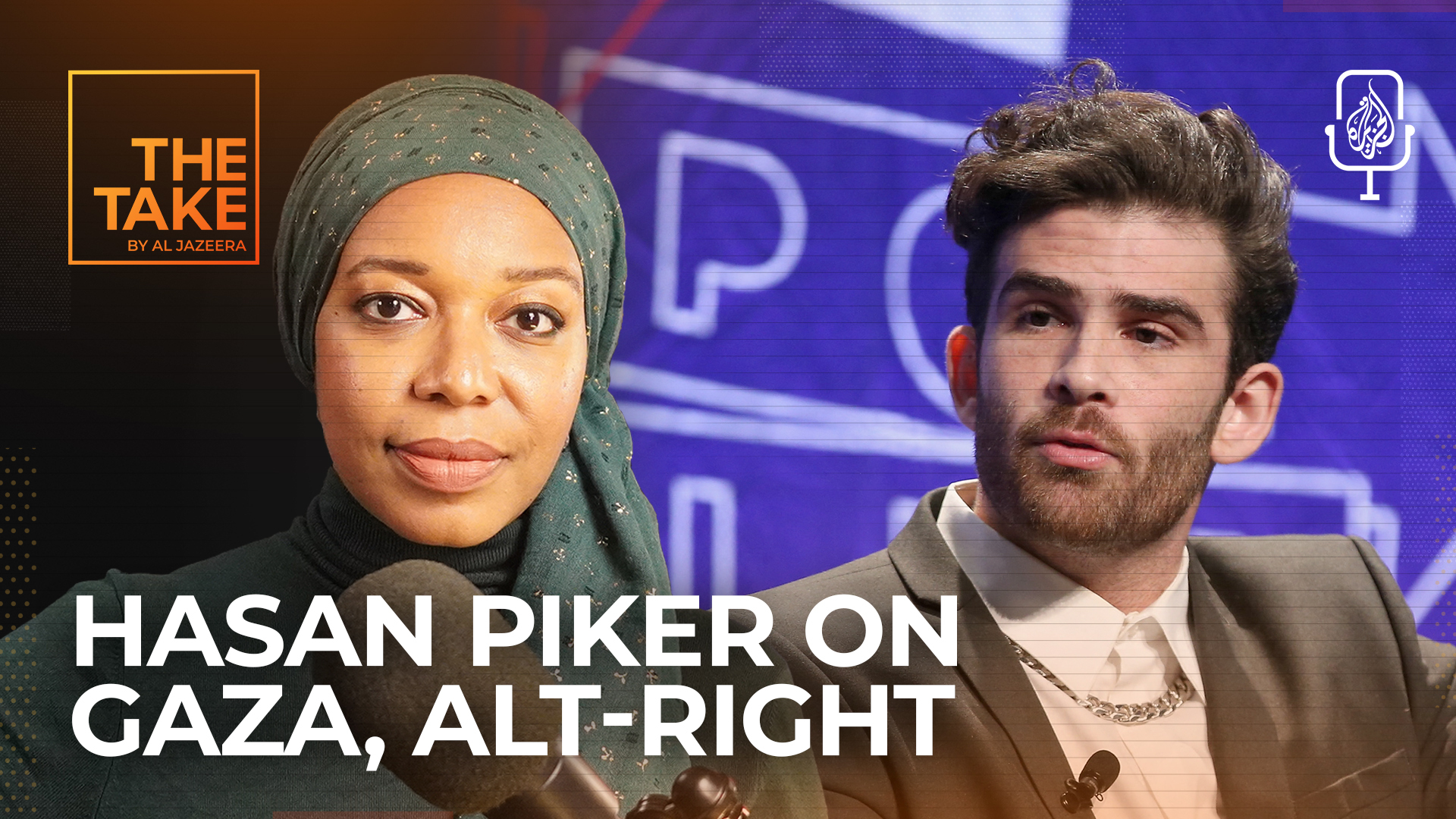
Twitch to politics: Hasan Piker on Gaza and the US right-wing

Published

on

Twitch streamer Hasan Piker tackles politics, Gaza, and culture for nearly 3M viewers.

With nearly three million Twitch followers, Hasan Piker is one of the internet’s biggest political streamers. He blends humor, culture, and masculinity talk with sharp political commentary, drawing young men away from the US alt-right. And on Gaza, he has become one of the loudest US voices for Palestine.

This is a story from the archives. This originally aired on August 19, 2025. None of the dates, titles or other references from that time have been changed. 

📰 மூல செய்தி (Source): https://www.aljazeera.com/video/the-take-2/2026/5/26/aje-onl-tt_rr_usa_piker_av_v1-250526?traffic_source=rss

உலகம்

Do we owe the world children?

Published

on

Is having children a choice or responsibility?

📰 மூல செய்தி (Source): https://www.aljazeera.com/video/doha-debates/2026/5/26/do-we-owe-the-world-children?traffic_source=rss

Continue Reading

உலகம்

US Supreme court rejects NFL attempt to move racism case to arbitration

Published

on

The league, plus New York Giants, Denver Broncos and Houston Texans, to move case to proceedings controlled by the NFL.

The US Supreme Court has turned away a ⁠bid by the National Football League to move a Black coach’s racial discrimination claims out of federal court and into arbitration proceedings controlled by the NFL.

The justices declined to hear an ⁠appeal by the league and three of its teams filed after a lower court ruled that the NFL cannot force Brian Flores, the former Miami Dolphins head coach and current Minnesota Vikings defensive coordinator, to arbitrate workplace bias ⁠claims through a process overseen by NFL Commissioner Roger Goodell.

The teams involved in the appeal were the New York Giants, Denver Broncos and Houston Texans.

Flores, 45, has accused the NFL, the most popular professional sport league in the United States, of systematic discrimination against Black coaches.

According to his 2022 lawsuit, the NFL and several teams discriminated against Black candidates for ‌coaching and management jobs in violation of federal and state laws. Flores filed the suit after being fired as head coach of the Miami Dolphins despite the team having a winning record for two consecutive seasons.

Flores alleged that during his career, he was asked to have “sham interviews” with the Giants and Broncos merely to satisfy a 2003 NFL policy called the Rooney Rule requiring that minorities be interviewed for coaching jobs. The NFL adopted the Rooney Rule in 2003 in light of the historically low number of minorities in NFL ⁠head coaching positions.

Two more Black coaches, former Arizona Cardinals head coach Steve Wilks and ⁠former longtime NFL assistant coach Ray Horton, later joined Flores as plaintiffs in the lawsuit.

The lawsuit seeks to force the NFL to make a series of changes, incentivise teams to hire Black coaches and general managers, and require teams to explain hiring and termination decisions in ⁠writing.

The NFL, which has denied claims of racial discrimination, responded to the lawsuit by arguing it should either be dismissed as lacking legal merit, or else sent to ⁠arbitration.

A New York-based federal judge in 2023 ruled that the NFL and ⁠the Giants, Broncos and Texans must face Flores’s claims of systematic discrimination against Black coaches in the league, while sending other aspects of the case to private arbitration.

On appeal, the New York-based 2nd US Circuit Court of Appeals in 2025 agreed that some of Flores’s claims belonged in ‌federal court. The 2nd Circuit ruled that a provision in the NFL constitution granting Goodell unilateral authority to arbitrate was “plainly unenforceable” because it would deny Flores arbitration “in any meaningful sense of the word”.

An arbitration agreement that “compels one ‌party ‌to submit its disputes to the substantive and procedural authority of the principal executive officer of one of their adverse parties, is an agreement for arbitration in name only,” Judge Jose Cabranes wrote for the 2nd Circuit.

📰 மூல செய்தி (Source): https://www.aljazeera.com/sports/2026/5/26/us-supreme-court-rejects-nfl-attempt-to-move-racism-case-to-arbitration?traffic_source=rss

Continue Reading

உலகம்

India, US strike critical minerals deal: What’s in it, why does it matter?

Published

on

The agreement is latest US has signed as it seeks to diversify its rare earths supply chain.

US Secretary of State Rubio in India to repair trade, energy and defence ties

India and the United States have signed a framework agreement to secure supplies of critical minerals and rare earths, including their mining and processing, according to the Indian Ministry of External Affairs and the US embassy in India.

Tuesday’s deal was finalised between Indian External Affairs Minister Subrahmanyam Jaishankar and US Secretary of State Marco Rubio in New Delhi during Rubio’s four-day trip to India.

Rubio spent a few days in India before a meeting of foreign ministers from the informal Quad security forum – comprising the US, Japan, Australia and India – in New Delhi on Tuesday, the final day of his trip. The Indian foreign ministry also on Tuesday separately announced a critical minerals framework among the Quad countries.

Here is more about the frameworks announced as well as more about India’s critical minerals stockpile.

Critical minerals are nonfuel minerals used to manufacture batteries, clocks, wiring, military hardware, semiconductors and other technological products. The US describes them as “essential to the economic or national security of the US” and having “a supply chain vulnerable to disruption”.

Nickel, cobalt, lithium, aluminium and zinc are among the best known critical minerals. For 12 critical minerals, the US relies entirely on imports. For 29 additional critical minerals, the US imports at least half of what it needs.

Critical minerals include 17 rare earth elements – 15 lanthanides (metallic elements) on the periodic table, scandium and yttrium. China has deposits of 12 of these. Rare earth metals have special magnetic properties and are necessary for the production of permanent magnets, used for industrial automation, electric vehicle motors, renewable energy generators, electronics and many medical devices. Rare earths are also used in key components of hardware that support semiconductors and artificial intelligence technologies.

The processing costs for rare earths are high, and mining them involves heavy use of chemicals that generate toxic waste.

Currently, China controls most of the world’s supply of rare earth minerals. China itself is home to 60 percent of these minerals and processes 90 percent of the world’s supply.

The US and other countries rely heavily on China for these minerals, and Washington, especially under President Donald Trump, has pushed to diversify US sourcing of these minerals to reduce reliance on China.

The Indian foreign ministry said the framework seeks to deepen New Delhi and Washington’s cooperation across the critical minerals and rare earths supply chain, including mining, processing, recycling and related investments.

An Indian statement referred to a critical minerals conference in Washington, DC, in February that Jaishankar attended. In the same month, India joined the US‑led Pax Silica initiative on secure semiconductor and AI supply chains.

The US embassy also said a bilateral deal was reached on Tuesday. “Through this framework, the United States and India will engage in international efforts to protect sensitive supply chains from coercive market practices and reduce our collective vulnerability to single-source monopolies,” an embassy statement said.

The statements do not expand on specific terms of the framework deal or how the cooperation would take place.

In July 2023, the Indian government released a list of 30 minerals that it described as critical: antimony, beryllium, bismuth, cobalt, copper, gallium, germanium, graphite, hafnium, indium, lithium, molybdenum, niobium, nickel, platinum group elements, phosphorous, potash, rare earth elements, rhenium, silicon, strontium, tantalum, tellurium, tin, titanium, tungsten, vanadium, zirconium, selenium and cadmium.

According to government sources, India has 13.15 million tonnes of monazite, a phosphate mineral that contains rare earth oxides, one of the main natural sources of rare earths. The Indian government estimated that the country’s monazite contains 7.23 million tonnes of rare earth oxides (REOs). By comparison, a US Geological Survey report estimated that China has an estimated 44 million tonnes of REOs in its reserves, almost half of the world’s known reserves.

The US International Trade Administration (ITA) said in a report this year that India currently produces only four critical minerals: copper, graphite, phosphorous and titanium. This is due to limited exploration and lack of proper infrastructure and processing technology, the ITA said.

In India’s national budget for the financial year 2026-2027, which began on April 1, the government introduced a new policy measure to create “rare earth corridors” in the states of Odisha, Kerala, Andhra Pradesh and Tamil Nadu. These would be hubs for mining and processing rare earth minerals, doing research and manufacturing high-performance rare earth magnets used in electric vehicles, wind turbines and other advanced technologies.

A multilateral document released by the Indian foreign ministry detailed a framework expanding on key areas for cooperation among the Quad countries on critical minerals supply chains.

The document said Quad governments and private companies intend to mobilise up to $20bn for the initiative, using a mix of loans, guarantees, subsidies and long-term purchase agreements. The countries aim to channel this funding into mining, processing and recycling projects to make their critical minerals supply chains more resilient and less dependent on a few suppliers.

The Quad countries have also agreed to share information on good practices and technical approaches for permitting, licensing and other regulatory processes.

They also agreed to cooperate on recycling and recovery of critical minerals, including during processing, to strengthen supply chains and promote the recycling of critical minerals among Quad partners and “like‑minded” countries.

In December, the US announced a $1.25bn investment in critical minerals mining at Reko Diq in Pakistan’s Balochistan province.

During the critical minerals meeting that the US hosted in February, it signed 11 critical minerals frameworks with Argentina, the Cook Islands, Ecuador, Guinea, Morocco, Paraguay, Peru, the Philippines, the United Arab Emirates, the United Kingdom and Uzbekistan, the State Department said.

In April, the US announced up to $50m in equity investment to back the Phalaborwa Rare Earths Project in South Africa.

📰 மூல செய்தி (Source): https://www.aljazeera.com/economy/2026/5/26/india-us-strike-critical-minerals-deal-whats-in-it-why-does-it-matter?traffic_source=rss

Continue Reading

Trending

Copyright © 2024 by 7Tamil Media, All rights reserved.