Connect with us

உலகம்

Turkiye woos investors amid Iran war fallout in Gulf economies

Published

on

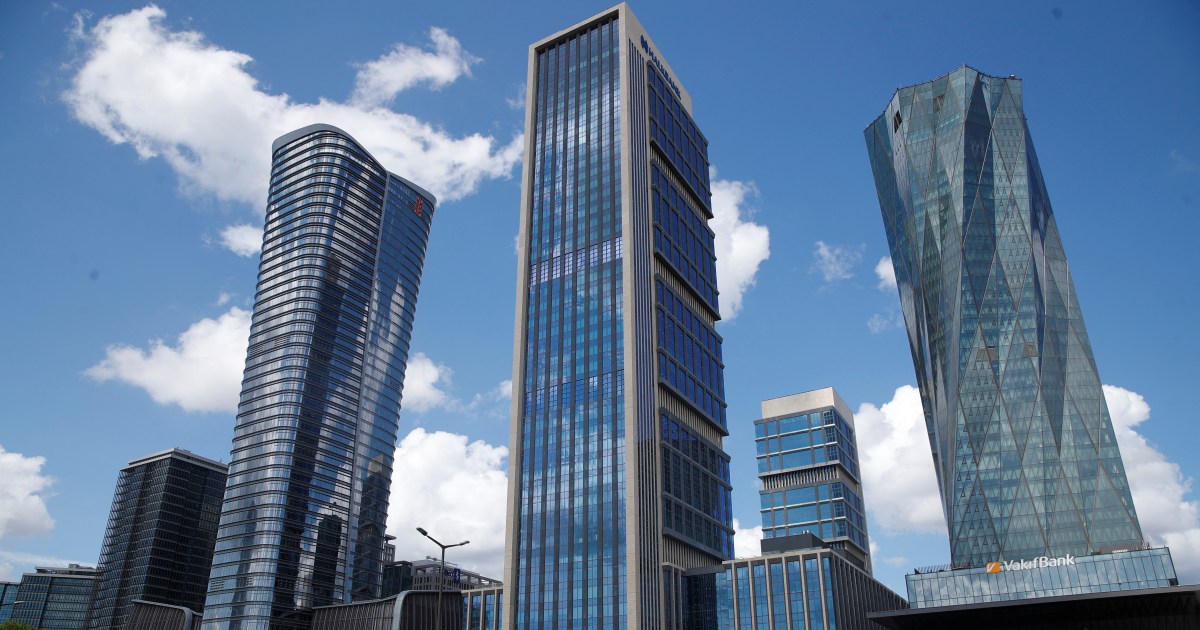
Turkish officials are promoting Istanbul as a regional financial hub amid the war’s fallout on the Gulf economies.

For Turkiye’s government, the Iran war has complicated efforts to turn around an economy still reeling from one of the worst financial crises in the country’s history.

But even as the conflict has driven up Turkiye’s fuel prices and forced authorities to dip into their precious foreign currency reserves to defend the lira, it has also presented an opportunity.

As the fallout of the war has reverberated across the Middle East, Ankara has jumped at the chance to promote Turkiye as a model of security and stability for businesses and investors.

While Iranian missiles and drones have inflicted significant damage on infrastructure in the United Arab Emirates, Saudi Arabia and Qatar, Turkiye, which is protected by NATO air defences, has emerged largely unscathed from aerial attacks blamed on Tehran.

Turkish officials have made little secret of their desire to capitalise on the shadow that the conflict – which is officially on pause until Wednesday under a two-week ceasefire between the United States and Iran – has cast over regional business hubs such as Dubai, Doha and Riyadh.

In remarks earlier this month, Turkish President Recep Tayyip Erdogan, who last month met with 40 global CEOs to discuss ways to boost his country’s competitiveness, cast the war as a boon to Ankara’s ambitions to transform Istanbul into one of the world’s leading financial centres.

“Just as in the pandemic period, we wholeheartedly believe that this global crisis, too, will open new doors before our country,” Erdogan said in a statement posted on social media.

Turkish Treasury and Finance Minister Mehmet Simsek confirmed soon afterwards that the government was preparing “radical” incentives to lure foreign capital.

Turkiye’s improving economic stability in the wake of its 2018 debt crisis and various financial incentives have helped to reposition the country as a regional hub and “safe haven”, said Bilal Bagis, head of the economics department at Fatih Sultan Mehmet Vakıf University in Istanbul.

“A liberal investment environment, ease of entry and new comprehensive incentive packages should help boost its position,” Bagis told Al Jazeera.

While Ankara has yet to confirm the measures in the pipeline, they are likely to involve tax breaks for companies that sell goods through Turkish entities without importing them into the country, said Guney Yildiz, a Turkish-born adviser at Anthesis Group who has clients in the Gulf.

“So you’d have a commodities trader or a logistics company booking transactions through Istanbul and getting a meaningful tax benefit for it,” Yildiz told Al Jazeera.

“That’s a direct play for the kind of intermediation business that Dubai has owned for two decades,” he said, adding that “the timing is obviously shaped by the war.”

Turkiye’s Ministry of Treasury and Finance did not respond to questions about the measures under consideration, but its plans follow a series of recent initiatives aimed at luring foreign investment, including the opening of the Istanbul Financial Center (IFC) in 2023.

The special economic zone offers tax incentives to financial institutions, including a 100 percent exemption from corporate tax on export earnings until 2031.

An IFC spokesperson said the district has recently seen “growing and concrete” engagement from both foreign governments and private institutions.

“There is a particularly strong strategic focus from Far Eastern institutions,” the spokesperson told Al Jazeera.

“This is not limited to private sector companies; we are also seeing engagement at the government level. We remain in close contact with Japan and South Korea, while our discussions with the United Kingdom continue,” the spokesperson said, adding that Istanbul has a “powerful triple advantage built on geography, innovation and economic depth.

“From Istanbul, institutions can reach around 1.3 billion people and a 30 trillion-dollar economy within a four-hour flight,” the spokesperson said.

Still, Istanbul faces a steep climb to seriously compete with hubs such as Dubai.

Istanbul currently ranks 101st on the latest Global Financial Centres Index, compiled by Z/Yen Partners in collaboration with the China Development Institute, far behind Dubai (7), Abu Dhabi (21), Doha (48) and Riyadh (61).

Turkiye’s economy has been plagued by double-digit inflation and a depreciating currency since the onset of the 2018 crisis. “The lira loses roughly a fifth of its value against the dollar every year,” Yildiz said.

“For a financial firm that earns in multiple currencies and pays staff in lira-denominated salaries, the math gets complicated fast. You’re constantly managing FX exposure in a way you simply don’t have to in a pegged-currency jurisdiction like the UAE or Singapore.”

Critics have also accused Erdogan’s administration of economic mismanagement by keeping interest rates low despite fears of inflation. But the government says the move is aimed at boosting the economy and ending foreign currency manipulation.

While the IFC has reported growing interest from firms, less than half of its office space has been filled, though officials say they expect occupancy to reach 75 percent by the end of this year.

“When we look at surveys of European firms with a subsidiary in Turkiye, their main complaints are unpredictability of economic policy, political instability, legal uncertainty, high bureaucracy, high inflation and imported inflation,” Meryem Gokten, an economist at The Vienna Institute for International Economic Studies, told Al Jazeera.

“None of these issues can be resolved in the short term … Turkiye has not been a financial hub so far, and I do not see it becoming one without addressing these structural issues,” Gokten added.

Selim Koru, a doctoral researcher who specialises in public policy at the University of Nottingham, expressed similar scepticism.

“Part of Dubai’s attractiveness was that it’s a tabula rasa of sorts. There is no firmly established cultural, legal, political climate, and foreign parties can have a say in what they want it to be,” Koru told Al Jazeera.

“That’s not the case with Istanbul, or anywhere else in Turkiye, really.”

For some analysts, whether Istanbul can directly challenge Dubai is not the right question.

Hasan Dincer, a finance professor at Istanbul Medipol University, said Turkiye’s bid to draw investment from overseas should be viewed as a “gradual positioning rather than direct short-term competition”.

“In emerging financial systems, investor confidence is primarily driven by predictability, transparency,” Dincer told Al Jazeera.

“And the credibility of long-term economic policies initiatives, such as the Istanbul Financial Center, represent important strategic steps whose long-term impact will depend on sustained implementation and institutional alignment,” he said.

📰 மூல செய்தி (Source): https://www.aljazeera.com/economy/2026/4/18/turkiye-woos-investors-amid-iran-war-fallout-in-gulf-economies?traffic_source=rss

உலகம்

US Jewish leader, Israel advocate Abe Foxman dies at 86

Published

on

Israeli officials hail Foxman, who led the ADL advocacy group for nearly three decades, as warm and passionate.

Prominent Jewish American leader and Israel defender Abraham “Abe” Foxman has died at age 86.

The Anti-Defamation League, the advocacy group he led for 28 years, confirmed his death on Sunday, calling him an “outspoken, passionate, and tireless advocate for the Jewish people and Israel“.

A Holocaust survivor, Foxman helped shape the conversation around Israel and anti-Semitism in the US for decades.

ADL Board Chair Nicole Munchnik said Foxman helped build the “modern liberal era of America”, describing him as a “longtime adviser” to US presidents and world leaders.

“To those of us who knew him, Abe was a warm friend, adviser, spirited antagonist and hugger – all over lunch,” Munchnik said.

Foxman joined the ADL in 1965 and served as the group’s national director from 1987 to 2015.

Under his leadership, the group – which presents itself as an anti-hate watchdog – became one of the most influential advocacy organisations in the country.

Palestinian rights advocates have long condemned the ADL, accusing it of demonising pro-Palestine activists and conflating criticism of Israel with anti-Semitism.

Since the start of the genocidal war on Gaza, the ADL – under Foxman’s successor Jonathan Greenblatt – has intensified its campaign against Israel’s critics.

Greenblatt, who has supported laws to penalise boycotts of Israel, compared the Palestinian keffiyeh to the Nazi swastika last year.

Foxman also remained a staunch supporter of Israel and defended its conduct during the genocidal war on Gaza.

“What is happening in Gaza is tragic. But it is not Genocide. And it is not illegal,” he wrote on X in July 2025 as Israel imposed a hunger crisis on the territory.

“War is hell and inhumane, destructive and ugly. And nations must take all possible care to avoid civilian harm. And Israel has and is doing that. Having said this, Israel still needs to act with all deliberate speed and skill to provide maximum humanitarian aid to lessen the loss of innocent civilian lives.”

Weeks before his death, Foxman backed the US-Israel war on Iran, voicing gratitude to US President Donald Trump and Israeli Prime Minister Benjamin Netanyahu for attacking the country.

“Thank you President Trump and Prime Minister Netanyahu for standing up to evil and jihadist extremism. The world hopefully will be a better and safer place in the future,” he said in a social media post on February 28 after the war broke out.

In March, Foxman warned about what he described as the rise of anti-Semitism on the right and left of the political spectrum in the US, hitting out at liberal politicians publicly distancing themselves from the American Israel Public Affairs Committee (AIPAC).

“If a politician doesn’t want to take money from AIPAC, don’t take money from AIPAC, but don’t make taking money from AIPAC a morality test – because that continues to build the conspiracy theory that there is a Jewish lobby that controls America,” he told the Jewish Standard.

AIPAC, which backs the war on Iran, has been spending millions of dollars on ad campaigns to defeat Israel’s critics in US elections.

Last year, Foxman sounded the alarm about the dwindling support for Israel in the US, underscoring the importance of the alliance between the two countries for Israel.

“We’re in a propaganda war, and to an extent, we’re losing the propaganda war, and I worry about losing America,” Foxman told Times of Israel.

“It’s scary, looking at the polls, the Sunday television shows, the major newspapers – there is so much out there that is anti-Israel.”

Despite his assertion, rights advocates often decry the absence of Palestinian perspectives on TV shows in the US media.

In 2021, Foxman announced that he was cancelling his New York Times subscription after the newspaper published a front page featuring the photos of dozens of Palestinian children killed by Israel in Gaza.

“Today’s blood libel of Israel and the Jewish people on the front page is enough,” he said at that time.

Tributes in Israel and the US poured in for Foxman on Sunday.

Israeli Foreign Minister Gideon Saar said he was “deeply saddened” by the death of Foxman.

“A towering voice against antisemitism, Abe devoted his life to defending the Jewish people and strengthening the bond between Israel and Jewish communities worldwide,” Saar said on X.

Israel’s President Isaac Herzog also called Foxman a “legendary leader of the Jewish people”.

“He was a passionate Zionist, a humanist, and an outspoken, wise friend,” Herzog said.

📰 மூல செய்தி (Source): https://www.aljazeera.com/news/2026/5/10/us-jewish-leader-israel-advocate-abe-foxman-dies-at-86?traffic_source=rss

Continue Reading

உலகம்

Israeli weapon fires tiny metal cubes into people in Lebanon, like Gaza

Published

on

Israeli weapon fires tiny metal cubes into people in Lebanon, like Gaza

The same tiny tungsten cubes that spray out of Israeli bombs, causing devastating internal injuries to people in Gaza are being found in wounded civilians in Lebanon, war surgeon Dr Tahir Mohammed says. He draws parallels between what Israel is doing in both places and describes the weapons as “indiscriminate”.

📰 மூல செய்தி (Source): https://www.aljazeera.com/video/newsfeed/2026/5/10/israeli-weapon-fires-tiny-metal-cubes-into-people-in-lebanon-like-gaza?traffic_source=rss

Continue Reading

உலகம்

Trump to discuss Iran with Xi Jinping during China visit: Officials

Published

on

Official says US president will likely ‘apply pressure’ on China over Beijing’s purchase of Iranian oil amid war.

Donald Trump is set to arrive in Beijing on Wednesday evening to discuss the Iran war and other issues with his Chinese counterpart President Xi Jinping.

White House Principal Deputy Press Secretary Anna Kelly said an opening ceremony and meeting will be on Thursday morning, and the trip will conclude on Friday. The US plans to host the Chinese leader during a reciprocal visit later this year.

Kelly said that this week’s trip would be of “tremendous symbolic significance” and focus on “rebalancing the relationship with China and prioritising reciprocity and fairness to restore American economic independence”.

Trump’s visit, initially scheduled for earlier this year but postponed in March due to the US-Israel war on Iran, comes as the US president struggles to contain the fallout from the war, both at home and abroad.

A senior administration official told news outlets in an anonymous briefing on Sunday that Trump could “apply pressure” to China on Iran in areas such as oil sales and Tehran’s purchase of potential dual-role military-civilian goods.

US Treasury Secretary Scott Bessent last week accused China of “funding” Iran.

“Iran is the largest state sponsor of terrorism, and China has been buying 90 percent of their energy, so they are funding the largest state sponsor of terrorism,” Bessent told Fox News.

Iran closed the Strait of Hormuz in response to US-Israeli attacks, restricting passage through a key artery of global energy transport.

China has said that it wants to see the war end and hosted Iranian Foreign Minister Abbas Arraghchi last week. At the same time, Beijing has refused to recognise Washington’s “unilateral” sanctions on Iran’s oil sector.

Disruptions stemming from the war have disrupted the global economy, with Asian states that depend on imports from the Middle East especially hard hit.

Trump could also bring up China’s support for Russia during the talks, along with trade and rare earth minerals, a vital resource for the US tech sector. Business executives from aerospace manufacturer Boeing and a handful of agricultural companies are set to travel with the US delegation.

The anonymous administration official said that no change was expected regarding the US stance on Taiwan, a main sticking point in relations between Washington and Beijing. China considers the self-ruling island a part of its territory, but the US has deep security and economic commitments to Taiwan.

📰 மூல செய்தி (Source): https://www.aljazeera.com/news/2026/5/10/trump-to-discuss-iran-with-xi-jinping-during-china-visit-officials?traffic_source=rss

Continue Reading

Trending

Copyright © 2024 by 7Tamil Media, All rights reserved.