Connect with us

உலகம்

Trump says US will ‘help free up’ ships stuck in Hormuz Strait

Published

on

US president says any interference with operation, which will start on Monday, will ‘have to be dealt with forcefully’.

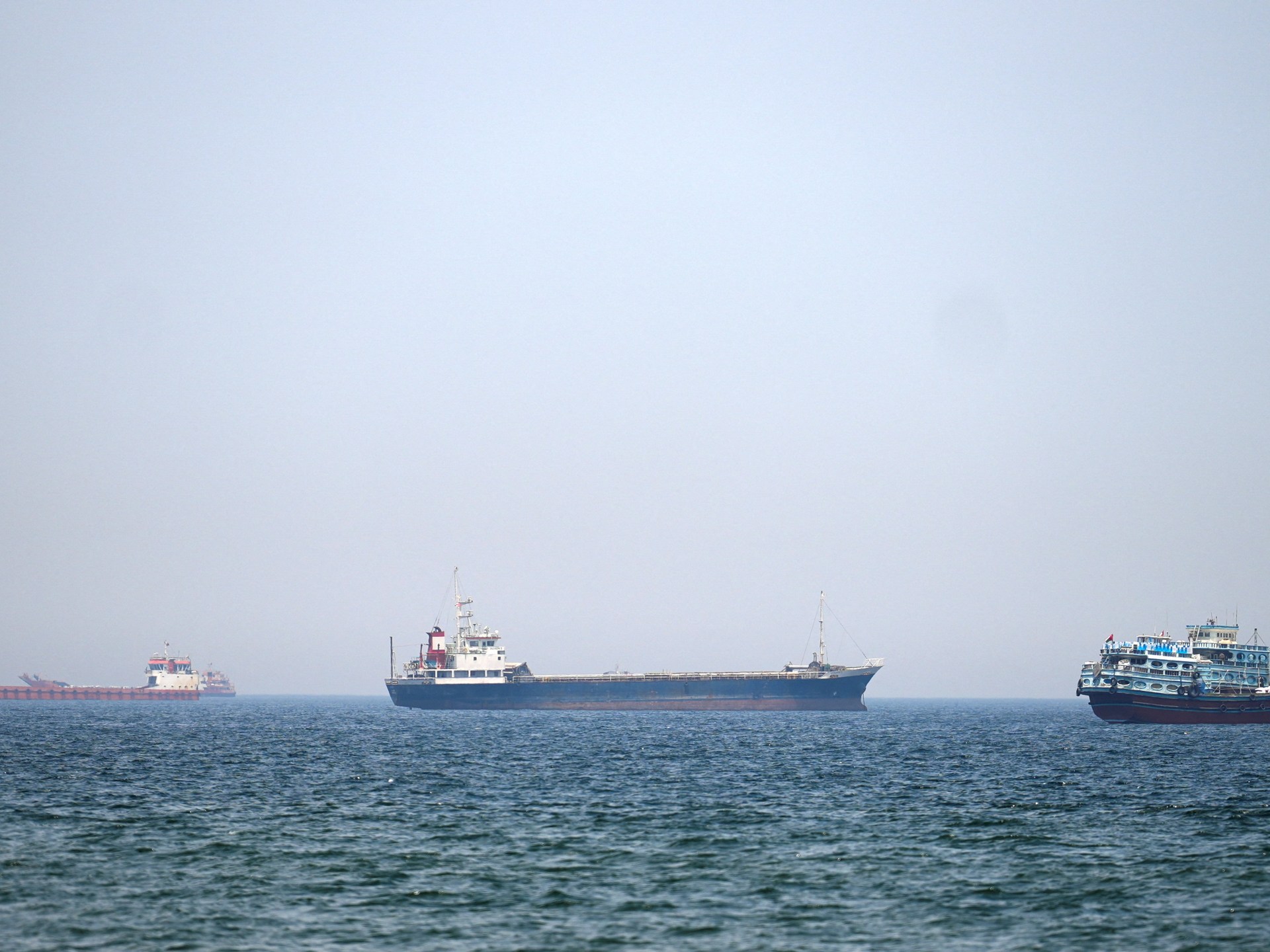
President Donald Trump has said that the United States will “free up” ships stuck in the Strait of Hormuz starting on Monday, suggesting that his administration will break the Iranian blockade on the strategic waterway.

Trump’s said on Sunday that the push – dubbed Project Freedom – would be a “humanitarian gesture”, warning Iran against interfering with the operation.

It’s unclear how the campaign will proceed or whether it will involve coordination with Tehran. If met with Iranian resistance, the move risks shattering the fragile ceasefire that came into effect in April.

“Many of these Ships are running low on food, and everything else necessary for largescale crews to stay on board in a healthy and sanitary manner,” the US president wrote in a social media post.

“I think it would go a long way in showing Goodwill on behalf of all of those who have been fighting so strenuously over the last number of months. If, in any way, this Humanitarian process is interfered with, that interference will, unfortunately, have to be dealt with forcefully.”

Trump said he told his representatives to inform Iranian officials that the US will “use best efforts to get their Ships and Crews safely out of the Strait”.

The US military has previously said that it is “not ready” to accompany vessels through the strait.

Although the truce has held for more than three weeks, Tehran’s blockade in Hormuz and Washington’s naval siege on Iranian ports have sent oil prices soaring.

In the US, petrol has risen $4.44 per gallon, up from less than $3 before the war started, fueling inflation. Energy costs are driving increasing public discontent with the war as Trump’s job approval ratings plummet, according to recent pubic opinion polls.

Trump had previously suggested that he is comfortable with the status quo of the competing blockades in the Gulf, arguing that the US siege “more effective than bombing”.

However, the move to forcibly re-open Hormuz could alter the relative calm that persisted against growing tensions in the past weeks.

Negar Mortazavi, a senior fellow at the Center for International Policy, said a US military push to re-open Hormuz certainly will not be seen as a humanitarian mission by Iran.

“This is also going to bring US forces and assets closer to the shooting range of Iran potentially if it’s going to be an escort,” Mortazavi told Al Jazeera in a TV interview.

“So I don’t know if this is a threat. Is this a negotiating tactic?… Or is this really the plan of the president? I mean, we know, and Tehran has suspected also that there would be a potential escalation in one form. I don’t know if this could be it.”

Trump suggested on Sunday that the path to a diplomatic resolution to the crisis remains open.

“I am fully aware that my Representatives are having very positive discussions with the Country of Iran, and that these discussions could lead to something very positive for all,” he said.

“The Ship movement is merely meant to free up people, companies, and Countries that have done absolutely nothing wrong — They are victims of circumstance.”

But hours earlier, the US president said he rejected Iran’s latest 14-point proposal for ending the war.

“It’s not acceptable to me. I’ve studied it, I’ve studied everything – it’s not acceptable,” Trump told KAN, Israel’s public broadcaster.

While details of the 14-point plan remain unclear, Iranian officials have said that Tehran is focused on permanently ending the war and lifting the blockade against its ports before talks to secure a broader nuclear deal.

Despite Trump’s comments, Iranian officials said on Sunday that Tehran received a formal response from Washington to its proposal, and it is currently studying it.

The US president had signalled earlier that he wants to inflict more damage on Iran before the war concludes.

“I will soon be reviewing the plan that Iran has just sent to us, but can’t imagine that it would be acceptable in that they have not yet paid a big enough price for what they have done to Humanity, and the World, over the last 47 years,” he wrote on Saturday.

Iran has projected defiance against Trump’s rhetoric, warning that it will defend itself against any attacks. Iran’s Islamic Revolutionary Guard Corps has said it is “fully prepared” to counter any “adventures or foolishness” from Washington.

📰 மூல செய்தி (Source): https://www.aljazeera.com/news/2026/5/3/trump-says-us-will-help-free-up-ships-stuck-in-hormuz-strait?traffic_source=rss

உலகம்

Israel’s strategy of ‘permanent war’: A race against time?

Published

on

Political analyst Daniel Levy says US policy is so ‘marinated’ in Israeli narratives, the two are indistinguishable.

Israel is in a race against time to “lock in its domination” across the Middle East, argues former Israeli negotiator Daniel Levy.

Levy, president of the US/Middle East Project, tells host Steve Clemons that Israel’s strategy of “permanent war” allows for only two types of countries in the region: either dependent, or “too collapsed, failed and fragile to pose any challenge”.

Israel can try to block a US-Iran deal by advocating for “just one more major military operation” against Iran, and “heating things up” with constant attacks on Lebanese and Palestinians despite ceasefires on paper, Levy says.

📰 மூல செய்தி (Source): https://www.aljazeera.com/video/the-bottom-line/2026/5/3/israels-strategy-of-permanent-war-a-race-against-time?traffic_source=rss

Continue Reading

உலகம்

Germany’s Merz downplays rift with Washington despite US troop drawdown

Published

on

German chancellor says criticism of Donald Trump’s strategy in Iran unrelated to troop withdrawal announcement.

German Chancellor Friedrich Merz has tried to downplay tensions with the United States after Washington announced plans to reduce the number of American troops in Germany.

Merz said on Sunday that US plans to withdraw troops have “no connection” to the rift with President Donald Trump over his strategy in Iran.

“I remain convinced that the Americans are the most important partner for us in the North Atlantic Alliance (NATO),” Merz told broadcaster ARD in an interview set to be fully aired later.

Trouble started last Monday when Merz appeared to criticise Trump’s actions in Iran, where the US and Israel started a war without consulting Washington’s NATO allies.

Iran was “humiliating” the US, Merz said, warning that Washington did not have a clear path out of the conflict. Foreign Affairs Minister Johann Wadephul later tried to walk back the comments, saying that Merz was referring to Iran’s “bad behaviour” in peace talks.

That did not appear to remove the sting for Washington. Trump scolded Merz over the remarks, saying the German leader “doesn’t know what he is talking about” and threatening to withdraw American soldiers.

On Friday, US Defence Secretary Pete Hegseth ordered the withdrawal of around 5,000 American soldiers over the next 12 months.

That’s expected to cut the number of US troops in the country by about 14 percent. Germany hosts the highest number of US troops in Europe—about 36,000 soldiers. Italy hosts about 12,000, with 10,000 in the UK.

Trump also announced on Friday increased tariffs on cars and trucks from the European Union, of which Germany produces the highest numbers.

Germany has been one of the most loyal allies of the US and Israel, with Berlin being one of Israel’s most important weapons suppliers.

Merz backed Israel’s attacks on Iran last year, saying that it was “doing the dirty work for all of us”.

Germany has also consistently backed Israel’s genocidal war on Gaza, while cracking down on pro-Palestine demonstrators at home through mass arrests, profiling and censorship.

With the sting of rising oil and commodity prices, however, Merz appeared to change his views on the US and Israel’s war in Iran.

Trump has long criticised Washington’s NATO allies in the EU for overly relying on the US, spurring governments such as Germany to begin boosting defence spending and upgrading weaponry.

Washington intensified those criticisms in recent weeks as EU countries refused to directly participate in the war against Iran or help to forcibly reopen the Strait of Hormuz.

Spain, in particular, has been publicly vocal in its criticism of the war and closed its airspace to the US military amid the bombing campaign on Iran.

On Sunday, Trump shared an article from the far-right news website Breitbart on social media reiterating his earlier comment, titled: “Trump Tells German Chancellor Merz ‘Fix Your Broken Country,’ Mulls Pulling U.S. Troops from Spain and Italy”.

About 4,000 US troops are based in Spain.

German Defence Minister Boris Pistorius said on Saturday that the US decision to draw down troops in Germany “was foreseeable”.

Speaking to the DPA news agency, Pistorius stressed the US-Europe relationship was important but also that “Europeans must assume more responsibility for our security”.

NATO spokeswoman Allison Hart posted on X that the alliance is “working with the US to understand the details of their decision”.

📰 மூல செய்தி (Source): https://www.aljazeera.com/economy/2026/5/3/germanys-merz-downplays-rift-with-washington-despite-us-troop-drawdown?traffic_source=rss

Continue Reading

உலகம்

Is Israel expanding into Gaza despite ceasefire?

Published

on

Redi Tlhabi speaks to Ray Adams Row Farr from Forensic Architecture on Israel’s expansion into Gaza post-ceasefire.

With the world focused on the war on Iran, Israel’s genocide in Gaza has slipped from the headlines. But despite a ceasefire, Israel has continued to expand its military control inside the enclave, raising fears of a more permanent occupation or even a renewed incursion.

Since the 2025 ceasefire, Israeli forces have pushed beyond the so-called ‘Yellow Line –  the boundary meant to separate areas under Israeli control from the rest of Gaza.

So what is actually happening on the ground? How far has Israel’s presence expanded? And what does it mean for Palestinians in Gaza?

This week on UpFront, Redi Tlhabi speaks with Ray Adams Row Farr, editor at Forensic Architecture, about how the organisation is documenting Israel’s expanding presence and what it means for Gaza.

📰 மூல செய்தி (Source): https://www.aljazeera.com/video/upfront/2026/5/3/is-israel-expanding-into-gaza-despite-ceasefire?traffic_source=rss

Continue Reading

Trending

Copyright © 2024 by 7Tamil Media, All rights reserved.