Connect with us

உலகம்

Sudan blames Ethiopia, UAE for recent drone attacks: What we know

Published

on

Sudan recalls its ambassador to Addis Ababa as drone attacks shatter sense of calm after years of civil war.

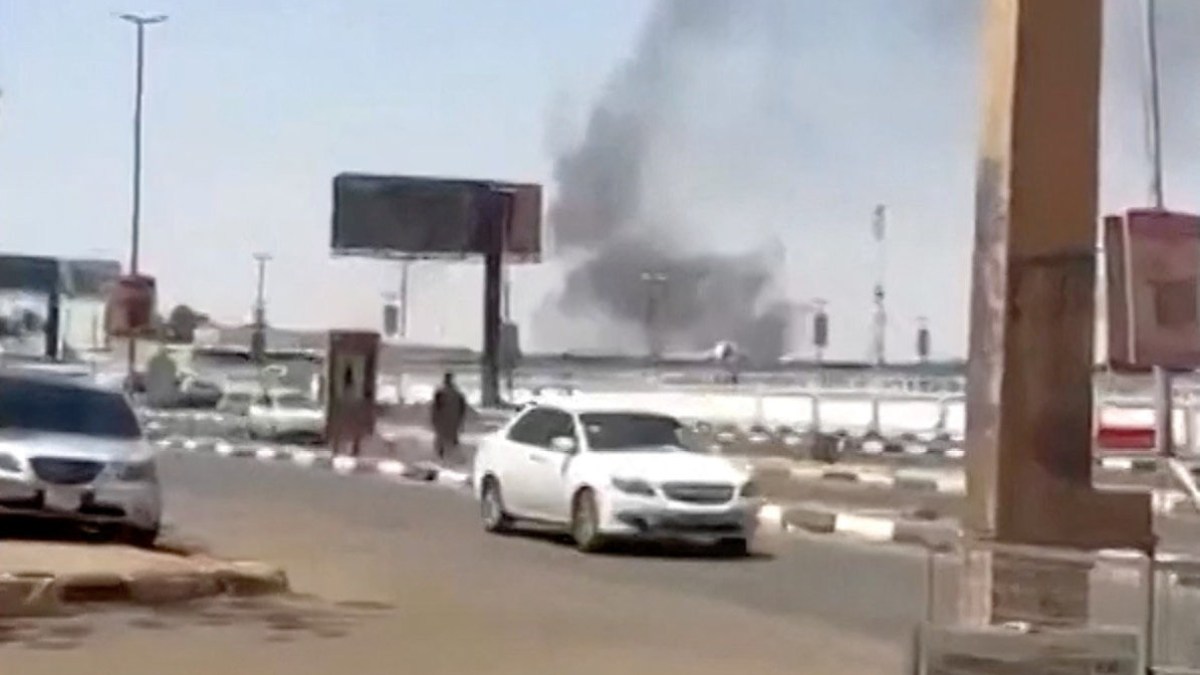
The Sudanese government has accused Ethiopia and the United Arab Emirates of being behind recent drone attacks, including at Khartoum airport.

Military spokesperson Brigadier General Asim Awad Abdelwahab told a news conference on Tuesday that Sudan’s government, which has recalled its ambassador from Ethiopia, had obtained evidence of four drone attacks since March 1 originating from neighbouring Ethiopia’s Bahir Dar airport. It claims the UAE provided the drones used in the attacks.

“What Ethiopia and the UAE have done is direct aggression against Sudan and won’t be met with silence,” Abdelwahab said.

Foreign Minister Mohieddin Salem said that while Khartoum will not initiate attacks against other countries, “whoever attacks us will be met with a response”, and that Sudan was ready to “enter into an open confrontation” with Ethiopia “if it becomes necessary”.

His comments came following a strike on Monday at the airport in Sudan’s capital, Khartoum. Previous attacks have been launched towards the Sudanese states of Kordofan, Blue Nile and White Nile.

A drone attack on Saturday on Omdurman, Sudan’s second-largest city, killed five people travelling on a civilian bus, while another attack the following day in the central Sudan state of Gezira killed relatives of Abu Agla Kaikal, a commander with the Sudan Shield Forces, a group allied with the Sudanese military, who defected from the rival Rapid Support Forces (RSF) earlier in the war.

Drone attacks have been frequent since Sudan descended into a bloody civil war on April 15, 2023, the result of a power struggle between the RSF, a powerful paramilitary force, and the Sudanese Armed Forces (SAF), but Khartoum was now considered largely safe.

Khartoum International Airport, where some of the early fighting between the RSF and Sudan’s army took place, received its first international flight in three years last ‌week, before the string of attacks shattered the sense of calm in the capital and in central Sudan.

Both countries are facing enormous internal challenges and have accused each other of supporting their armed opponents.

On Tuesday, Ethiopia’s Ministry of Foreign Affairs rejected Sudan’s “baseless accusations” and blamed its army for supporting “mercenaries” from the Tigray People’s Liberation Front (TPLF), whose armed wing fought a civil war against Ethiopia’s federal government from 2020 to 2022.

“Sudan is serving as a hub for various anti-Ethiopian forces,” the Foreign Ministry in Addis Ababa wrote on X.

“The Sudanese armed forces have also provided arms and financial support to these mercenaries, thereby facilitating their incursions along Ethiopia’s western frontier.”

The statement added it was “evident that these hostile actions, as well as the recent and earlier series of allegations by officials of Sudanese armed forces, are undertaken at the behest of external patrons seeking to advance their own nefarious agenda”.

Sudan and Ethiopia have long been embroiled in armed conflict over disputed strips of farmland along the frontier in the al-Fashaga region. Most recently, the construction by Ethiopia of Africa’s largest hydroelectric dam on the Blue Nile, the Grand Ethiopian Renaissance Dam (GERD), led to tensions with Sudan and Egypt, which rely heavily on the Nile for water supplies.

Alan Boswell, Horn of Africa director at the International Crisis Group, said Sudan and Ethiopia are becoming increasingly vocal in their reciprocal accusations. “That obviously creates a very dangerous dynamic between the two countries and risks making their own internal challenges much worse,” he told Al Jazeera.

Boswell added that this makes both conflicts more “regionalised”, requiring de-escalation efforts to come from abroad. “That has been a focus of US diplomacy, but that has yet to gain traction,” he said.

Sudan has accused the UAE of providing support to RSF paramilitaries during the civil war with the Sudanese army, a charge the Gulf state denies.

An unnamed UAE official told the AFP news agency: “These fabrications are part of a calculated pattern of deflection – shifting blame to others to evade responsibility for their own actions – and are intended to prolong the war and obstruct a genuine peace process.”

But Abdelwahab, Sudan’s military spokesperson, said the government had “conclusive evidence” from data recovered from a drone shot down in el-Obeid, the capital of North Kordofan state, that UAE-made drones had been launched from Ethiopia’s northeastern Bahir Dar airport region. These struck Sudanese army positions across several states on March 1 and 17, he said.

Unmanned vehicles also attacked sites in Khartoum since Friday, including Khartoum’s airport on Monday, he added.

Rights groups, including Amnesty International and Human Rights Watch, have also accused the UAE of providing arms to the RSF.

Several observers have argued the UAE’s alleged involvement in Sudan’s civil war could serve Abu Dhabi’s desire to expand its influence across the Red Sea and East Africa, especially since relations with Saudi Arabia – which supports Sudan’s army – have been increasingly tense. Abu Dhabi has sought to position itself as a global trading hub for gold as it seeks to diversify from its oil-dependent economy, and may view Sudan’s untapped mineral wealth, including gold, as an opportunity, experts say.

Boswell, at the International Crisis Group, said Sudan’s General Abdel Fattah al-Burhan and Ethiopia’s Prime Minister Abiy Ahmed were being “emboldened and encouraged on the path towards escalation by their outside backers”.

“But they have shown in the past that they’re able to meet together and de-escalate things,” he said. “Because really [it] benefits neither [to] get more deeply involved in the other’s civil war.”

📰 மூல செய்தி (Source): https://www.aljazeera.com/news/2026/5/6/sudan-blames-ethiopia-uae-for-recent-drone-attacks-what-we-know?traffic_source=rss

உலகம்

Madrid captain Carvajal in race against time for Spain’s World Cup squad

Published

on

Spain international Dani ⁠Carvajal injured his right foot during a training session for Real Madrid last week.

Spain manager ‌Luis de la Fuente says ⁠Dani ⁠Carvajal could still make his World Cup squad but the right back must prove his ⁠fitness and form after suffering a foot injury in training ⁠with his club Real Madrid last week.

“Carvajal is a very important figure in our dressing room,” de la Fuente said on Wednesday.

“I actually spoke with him yesterday, so I’m aware ‌of what’s going on. He doesn’t have a specific injury, nothing serious, but he needs time to get back to his usual level.

“We’ll see in the remaining matches whether he truly gets the opportunity and delivers the performances.”

De ⁠la Fuente added that Carvajal, ⁠who made just one appearance for Spain in 2025, would understand if he is left out of the squad for the ⁠World Cup, which is being held in the United States, Canada ⁠and Mexico from June 11 to ⁠July 19.

He joins a list of players who have sustained injuries in the weeks before the World Cup with Spanish teammate Lamine Yamal among them.

Carvajal, 34, is approaching the final weeks of his contract with Real and has struggled for game time this season ‌amid competition from Trent Alexander-Arnold.

Spain begin their World Cup campaign against Cape Verde on June 15 ‌and ‌also face Saudi Arabia and Uruguay in Group H.

📰 மூல செய்தி (Source): https://www.aljazeera.com/sports/2026/5/7/madrid-captain-carvajal-in-race-against-time-for-spains-world-cup-squad?traffic_source=rss

Continue Reading

உலகம்

US reinstates deportation proceedings against Mohsen Mahdawi

Published

on

Palestinian student Mohsen Mahdawi accuses government of weaponising the immigration system to silence his advocacy for Palestinian rights.

The United States Board of Immigration Appeals has reinstated ⁠deportation proceedings against Palestinian student Mohsen Mahdawi, according to a court filing from his lawyers.

Immigration judge Nina Froes in February had blocked the Trump administration’s efforts to deport the Columbia University student, who ⁠was arrested last year following his participation in pro-Palestinian protests.

Froes ruled that the Trump administration had failed to meet the burden of proof and dismissed its evidence as inadmissible. Last month, Froes was fired by the Trump administration.

The Board of Immigration Appeals, part of the Department of Justice’s Executive Office for Immigration Review, overturned Froes’s decision.

In a statement cited by the Reuters news agency on Wednesday, Mahdawi accused the Trump administration of weaponising the immigration system to silence his advocacy for Palestinian rights.

“The government is trying to punish and deport me, a stateless Palestinian refugee from the occupied West Bank, because it opposes my peaceful advocacy for human dignity and equal rights for Palestinians. But I remain unafraid and faithful that justice will prevail in America and in Palestine,” he said, in the statement shared by his legal team.

Mahdawi was arrested last year during an interview with Immigration and Customs Enforcement (ICE). He was detained for two weeks and not charged with a crime. His legal team said he was arrested under an obscure legal provision that allows Secretary of State Marco Rubio to seek the deportation of individuals deemed to pose “adverse foreign policy consequences” for the US.

Trump has cracked down on ⁠pro-Palestinian movements by attempting to deport foreign protesters, threatening to freeze funds for universities where protests were held and scrutinising immigrants’ online speech.

Experts and activists have accused his administration of stifling free speech ⁠and academic freedom. The crackdown also faced legal and judicial roadblocks.

In March, the Trump administration filed a lawsuit against Harvard University worth billions of dollars after accusing the institution of violating the civil rights of Jewish and Israeli students in the aftermath of Israel’s genocidal war on Gaza.

📰 மூல செய்தி (Source): https://www.aljazeera.com/news/2026/5/7/us-reinstates-deportation-proceedings-against-mohsen-mahdawi?traffic_source=rss

Continue Reading

உலகம்

What are US proposals to end war, and will Iran agree to them?

Published

on

Iran says it is reviewing a US proposal to end the US-Israel war on it that has caused a global energy crisis.

Iran says US proposal to end the war is still 'under review'

Iran has said that it was reviewing a United States peace proposal that sources said would formally end the war, while leaving unresolved the key US demands that Iran suspend its nuclear programme and reopen the Strait of Hormuz.

An Iranian Foreign Ministry spokesperson quoted by Iran’s ISNA news agency said on Wednesday that Tehran would convey its response. US President Donald Trump said he believed Iran wanted an agreement.

“They want to make a deal. We’ve had very good talks over the last 24 hours, and it’s very possible that we’ll make a deal,” Trump told reporters in the Oval Office on Wednesday.

A day before, Trump paused “Project Freedom” to reopen the blockaded strait, citing progress in peace talks. The de facto blockade of the waterway threatens to cause a global recession. Iran has been pressing to keep Hormuz under its control, through which a fifth of global oil and gas supply passes.

Here is more about the US proposal to end the war, and how experts think Iran would respond.

US media outlet Axios said the two sides were “getting close” to an agreement on a 14-point document. Under the memorandum, Iran would agree not to develop a nuclear weapon and halt enrichment of uranium for at least 12 years, it said.

The US would lift sanctions and release billions of dollars in frozen Iranian assets, and both sides, which have imposed competing blockades in the Strait of Hormuz, would reopen the critical waterway within 30 days of signing.

Iran has been under US sanctions for decades, and the lifting of some sanctions under the 2015 nuclear agreement was reversed after Trump walked out of the landmark deal signed under his predecessor, President Barack Obama. Billions of dollars of Iranian assets remain frozen in foreign banks due to the sanctions.

It is unclear how this memorandum differs from a 14-point plan proposed by Iran last week.

The Reuters news agency reported on Thursday, citing a source briefed on the mediation, that the US negotiations were being led by Trump’s envoy Steve Witkoff and son-in-law Jared Kushner. If both sides agreed on the preliminary deal, that would start the clock on 30 days of detailed negotiations to reach a full agreement.

The full agreement would end the competing US and Iranian blockades on the strait, lift US sanctions and release frozen Iranian funds. It would also include certain curbs on Iran’s nuclear programme, which was allowed by the United Nations nuclear watchdog.

While the sources said the memorandum would not initially require concessions from either side, they did not mention several key demands Washington has made in the past, which Iran has rejected, such as curbs on Iran’s missile programme and an end to its support for armed proxy groups in the Middle East.

The sources also made no mention of Iran’s existing stockpile of more than 400kg (900lb) of near-weapons-grade uranium.

Israeli Prime Minister Benjamin Netanyahu, Trump’s ally, said on Wednesday the two leaders agreed that all enriched uranium must be removed from Iran to prevent it from developing a nuclear bomb.

The US and Israel bombed Iranian nuclear sites last June during the 12-day war, after which Trump claimed that Tehran’s nuclear programme was obliterated. A significant portion of Iran’s enriched uranium stockpile remains buried inside the bombed nuclear sites.

Tehran denies wanting to acquire a nuclear weapon. It insists its programme is for civilian purposes as allowed within its position as a signatory to the non-proliferation treaty.

Iran has yet to formally respond to the latest US proposal. However, Iranian leaders have pushed back against it.

Iranian lawmaker Ebrahim Rezaee, a spokesperson for the parliament’s powerful foreign policy and national security committee, described the text as “more of an American wish-list than a reality”.

Iran’s Parliament Speaker Mohammad Bagher Ghalibaf appeared to mock reports that the two sides were close, writing on social media in English that “Operation Trust Me Bro failed.”

Al Jazeera’s Resul Serdar Atas, reporting from Tehran, said on Thursday that Iran is still reviewing the US proposal, after which a response is expected to be given to the Pakistani mediators later today.

The Pakistani Ministry of Foreign Affairs said on Thursday that it welcomes the news of a potential agreement between Iran and the US, adding that it will not disclose additional information at this stage.

“As mediators, we will not lose the trust of both parties by revealing details,” it said in a statement quoted by Al Jazeera Arabic.

Atas said, “Iranians are saying that, at this stage, they’re not negotiating their nuclear programme; it’s only about ending the war on all fronts.”

He added that Tehran wants direct guarantees from the UN Security Council, a lifting of sanctions and the reopening of the Strait of Hormuz.

“If that is achieved, in a second phase, they’re ready to discuss their nuclear programme.”

Al Jazeera’s Almigdad Alruhaid reported from Tehran on Tuesday that Iran has set “a very firm red line” on the nuclear file. “The nuclear enrichment programme is non-negotiable,” he said.

According to former US Assistant Secretary of State Mark Kimmitt, Trump’s reported demand that Iran halt all uranium enrichment is unrealistic and unlikely to be accepted by Tehran.

“If there is anything the Iranians are going to insist upon in these negotiations, it is their right to enrich uranium to the 3.67 percent level, which is allowed under nuclear non-proliferation treaties,” he told Al Jazeera.

Kimmitt added that even the 2015 nuclear deal permitted Iran to continue enrichment. Iran boosted its enrichment up to 60 percent after Trump withdrew from the deal in 2018, during his first term.

However, Kimmitt postulated that Trump might want Iran’s existing stockpile of enriched uranium outside of Iran. He added that Iran might either agree to move the enriched uranium outside the country or dilute it down to a non-enriched state.

Alruhaid, the Al Jazeera correspondent, however, said Iran is resisting handing over its existing stockpile of enriched uranium.

Iran is believed to have about 440kg (970lb) of uranium enriched to 60 percent. A 90 percent threshold of enriched uranium is needed to produce a nuclear weapon.

Al Jazeera’s Alruhaid said “the sovereignty on the Strait of Hormuz is becoming one of the main issues on the negotiating table.

“We are seeing the Iranians are tightening their control. They are setting new protocol, new mechanism for controlling that strategic chokepoint for each vessel that is to pass through.”

The US allies in the Gulf, who faced the brunt of Iranian retaliatory strikes, have been pushing for the restoration of navigation in the strait without any conditions. Iran carried out attacks on the Gulf nations, mainly targeting US military assets, after the US and Israel launched attacks on it on February 28.

Trump has repeatedly played up the prospect of an agreement that would end the war, so far without success. The two sides remain at odds over a variety of difficult issues, such as Iran’s nuclear ambitions and its control of the Strait of Hormuz.

A Pakistani source and another source briefed on the mediation told Reuters that an agreement was close on a one-page memorandum that would formally end the conflict, the agency reported on Thursday.

This agreement would kick off discussions to unblock shipping through the strait, lift US sanctions on Iran and set curbs on Iran’s nuclear programme, the sources said.

Al Jazeera, however, could not confirm the veracity of the reports.

📰 மூல செய்தி (Source): https://www.aljazeera.com/news/2026/5/7/what-are-us-proposals-to-end-war-and-will-iran-agree-to-them?traffic_source=rss

Continue Reading

Trending

Copyright © 2024 by 7Tamil Media, All rights reserved.