Connect with us

உலகம்

Russia pounds Kyiv as its advance in eastern Ukraine slows to a crawl

Published

on

Ukraine has prevented Russian arms and fuel from reaching the frontline in a successful interdiction campaign.

Russia launched more than 1,400 drones and 56 missiles into Ukraine on Wednesday and Thursday.

Much of the onslaught was aimed at the capital Kyiv, days after Russia threatened to do so only if Ukraine attacked its Victory Day parade in Moscow’s Red Square on May 9. It is a major Russian holiday commemorating the end of the Second World War.

Ukraine President Volodymyr Zelenskyy had proposed a ceasefire, beginning as early as May 5.

Moscow did not respond until May 7, and presented its peace proposal as a unilateral initiative, accompanied by threats to punish Kyiv if it did not respect its terms.

Moscow said Russian front line units would “launch a massive missile strike” on central Kyiv if attacked.

Forty-three Russian drones and a number of ballistic missiles were launched into Ukraine on May 9, and another 27 drones on May 10. It was not until May 11 that Ukraine had a day of peace.

Moscow justified these attacks as reciprocity for Ukrainian assaults. Kyiv accused Moscow of breaking its own ceasefire.

Once the ceasefire was over, on the night of May 11, Russia launched 216 drones and followed up with a massive strike involving 892 drones overnight on May 12 and during the day on May 13.

The night of May 13-14 was worse with 675 drones accompanied by 56 missiles.

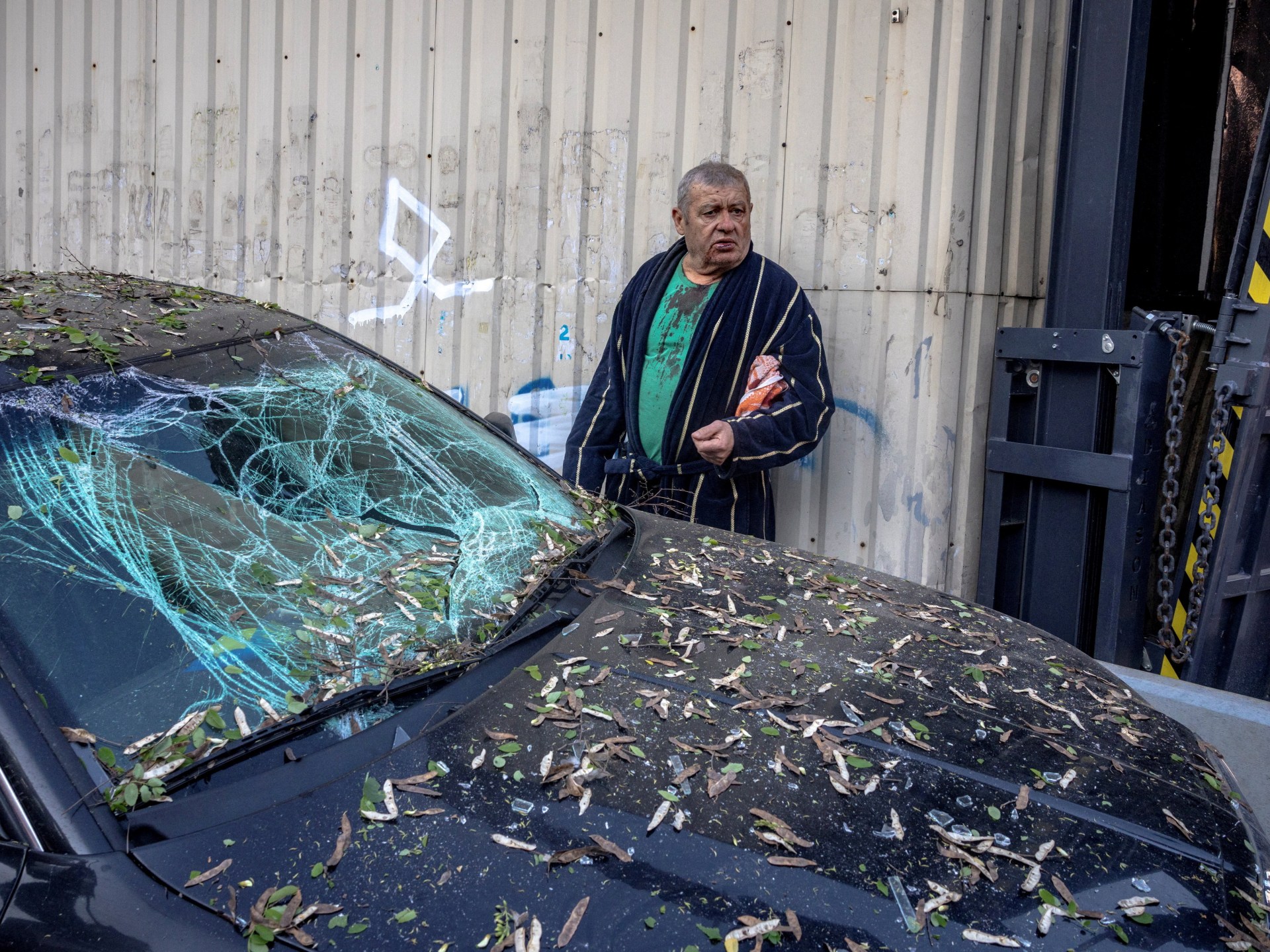
Official Ukrainian reports recorded strikes in at least 20 locations in the capital, including a nine-storey apartment building where 12 people were killed in the collapse.

“These are ordinary residential buildings, a school, a veterinary clinic, and other purely civilian infrastructure,” wrote Zelenskyy on his Telegram messaging channel. “These are definitely not the actions of those who believe that the war is coming to an end.”

Throughout the week, Ukraine said it shot down 92 percent of the 1,930 drones launched, close to Zelenskyy’s 95 percent kill target, with 41 out of 57 missiles downed.

Russia’s onslaught of came as its armies in eastern Ukraine slowed down.

The Institute for the Study of War, a Washington-based think tank, estimated they had advanced by an average of 2.9 sq km (1.1 sq miles) in the first four months of 2026, compared with 9.76 sq km (3.76 sq miles) a day in the first third of 2025 and 14.9 sq km (5.8 sq miles) a day between October 2024 and March 2025.

Two weeks into May, that daily average had already dropped to 2.63 sq km (1 sq mile), suggesting Russia’s advance is slowing almost daily.

The ISW recently estimated that Ukraine made net territorial gains of 116 sq km (45 sq miles) in April – its first such advance since a September 2023 counteroffensive.

Some of that success is attributed to Ukraine’s successful use of drones behind the front lines.

On May 8, the Azov Corps of Ukraine’s National Guard announced it had “returned to Mariupol”, four years almost to the day since it surrendered control of the city to Russian forces.

The Corps filmed drone strikes on Russian diesel tankers, army trucks and other logistics 160 km (99 miles) behind the front line along the T-0509 highway, which feeds the Russian war effort in the Donetsk region.

“The strike depth will increase,” said the Azov Corps.

Their strikes are part of a broader Ukrainian campaign to hit Russian logistics at middle ranges of about 120-150 km (75-90 miles) from the front line as announced by Zelenskyy at the end of April.

“This primarily involves military logistics, enemy warehouses and headquarters, air defence systems and other components,” he said, adding that Ukraine had increased its strikes at this depth five-fold during the past year.

“We’re already carrying out about five thousand successful strikes at a depth of 20 plus km (12 miles) every month,” said Ukrainian Defence Minister Mykhailo Fedorov this week.

Also this week, a Russian military reporter said Ukrainian Hornet drones were targeting Russian logistics on roads closer to the frontlines.

“Although the front line is more than 35 km away from the M-30, it is currently paralysed due to enemy [First Person View drone] surveillance,” wrote the Russian reporter.

“In 2014-2015 the front line was closer, but the M-30 was safer,” he added. “This is because many people think that if the front line moves away from large cities and logistics routes they become safer, but for some reason no one takes into account that the range of enemy drones, even FPV surveillance, increases more rapidly relative to the movement of the front line.”

Russia’s declining performance is not due to lack of effort.

“The enemy has intensified offensive actions along almost the entire front and is regrouping its troops,” said Ukrainian commander-in-chief Oleksandr Syrskii on May 8. “The most tense area is currently the Pokrovsk direction, where the Russian aggressor has concentrated about 106,000 personnel,” he said.

Since March, Ukraine has increased strikes against Russian oil infrastructure as many as 1,700 km (1,056 miles) inside Russia, in an effort to starve its war machine of diesel and export revenue.

Andriy Kovalenko, the head of Ukraine’s Center for Countering Disinformation, said the Ukraine Security Service (SBU) hit the Yaroslavl oil refinery and Perm oil pumping station on May 8 – Perm sends oil in four directions across Russia to refineries and export terminals.

Russian media reports said the fire from a previous strike on the pumping station was not put out until May 11.

The SBU also said it hit the Perm refinery that day.

During the week, Ukrainian forces struck drone bases and a radar research centre in Rostov-on-Don, the Bryansk chemical plant, an explosives warehouse in Nizhny Novgorod and other targets.

Fedorov on Monday thanked Germany for investing $1bn in Ukraine’s deep strike capabilities, when his German counterpart, Boris Pistorius, visited Kyiv.

“Overall, Ukraine’s positions right now – on the front line, in our long-range sanctions, and in our joint results with partners – are the strongest they have been in years,” said Zelenskyy.

📰 மூல செய்தி (Source): https://www.aljazeera.com/news/2026/5/15/russia-pounds-kyiv-as-its-war-machine-grinds-to-a-near-standstill?traffic_source=rss

உலகம்

FA Cup final: Chelsea vs Manchester City – teams, start, lineups

Published

on

Manchester City will continue their hunt for a domestic treble when they face Chelsea in Saturday’s FA Cup final.

Who: Chelsea vs Manchester City

What: English FA Cup final

Where: Wembley Stadium in London, United Kingdom

When: Saturday, May 16 at 3pm (14:00 GMT)

How to follow: We’ll have all the buildup on Al Jazeera Sport from 11 GMT in advance of our live text commentary stream.

History will be made on Saturday as Manchester City become the first side to line up in four consecutive finals as they take on Chelsea for the trophy.

Between them, the sides have won 15 FA Cup titles, but this is a first meeting between the clubs in the final itself – despite the teams between them appearing in five of the last six finals.

City, who have already claimed the League Cup, are still in with the chance of a domestic treble. Chelsea, however, have been engaged in a managerial merry-go-round – all off the back of beating Paris Saint-Germain to claim the expanded FIFA Club World Cup last year.

Al Jazeera Sport takes you through all the information you need to know in the run-up to the 145th FA Cup final.

Crystal Palace beat City 1-0 in last season’s final to lift the trophy for the first time in their history.

Eberechi Eze scored the only goal of the game after 16 minutes to sign off from the Eagles in style. The England forward joined Arsenal at the end of the season.

City had dominated the final with a staggering 78 percent of possession.

Chelsea overcame Leeds United 1-0 in their last four clash, with Enzo Fernandez scoring the only goal in the 23rd minute.

The Blues thumped Port Vale in the quarterfinals with a 7-0 win, while there was a more Hollywood feel to their clash with Wrexham in the prior round.

Extra time was required in their 4-2 win in Wales.

City were well tested in the semifinal by Championship side Southampton as Nico Gonzalez scored with three minutes remaining after Jeremy Doku’s 82nd-minute strike cancelled out Finn Azaz’s opener.

Liverpool were seen off in the quarterfinals with a 4-0 thumping at Etihad Stadium, while a 3-1 win was recorded at Newcastle United in the round prior to that.

Manchester City were 3-0 winners in the last meeting between the sides, which came in a Premier League fixture in west London on April 12.

All three goals came within 17 minutes of each other in the second half, with Nico O’Reilly, Marc Guehi and Jeremy Doku netting at Stamford Bridge.

City sit second in the English top flight, just two points behind leaders Arsenal with two games to play.

Club World Cup holders Chelsea have sacked both Enzo Maresca and Liam Rosenior this season and sit ninth in the league.

Calum McFarlane will be taking charge of his sixth game in his second spell as the club’s interim manager.

The teams last met in the FA Cup in a semifinal clash at Wembley Stadium in April, 2024.

Bernardo Silva scored the only goal of the game to send City through to the final, where they were beaten 2-1 by Erik ten Hag’s Manchester United.

Alejandro Garnacho, now of Chelsea, gave United the lead, which Kobbie Mainoo doubled before the break. Jeremy Doku netted an 87th-minute goal to set up a tense finale.

Chelsea have had their name etched on the trophy on eight occasions, with their first win coming in 1970 as they beat Leeds United 2-1 in a replay at Manchester United’s Old Trafford.

The first attempt ended in a 2-2 draw, leading to the first time a final would be replayed. Wembley hosted the opening match, but was unavailable for the replay due to the pitch being in unfit condition.

City have lifted the cup on seven occasions, with their first win coming in 1904 with a 1-0 win over Bolton Wanderers.

Chelsea’s last win came in 2022 and required penalties against Liverpool to seal the win.

The match ended 0-0 after extra time – the first final to end goalless since Sir Alex Ferguson’s Manchester United beat Arsene Wenger’s Arsenal on spot kicks in 2005.

City last lifted the trophy in 2023, beating Manchester United 2-1.

In a final that would see a rerun between the cross-city rivals the following year, Ilkay Gundogan opened the scoring in the first minute and later restored his side’s lead five minutes after the break, after a Bruno Fernandes penalty had levelled the tie at the break.

Arsenal are the record winners of the competition with 14 victories to their name. The first was in 1930 under the club’s famous manager, Herbert Chapman. The Gunners beat Huddersfield Town 2-0 in the final.

Their last win came in 2020 when they beat Chelsea 2-1. It was the first of three successive finals for the Blues, who tasted defeat the following year against Leicester City before the 2023 win against Liverpool.

Manchester United are the second-most successful side in the competition’s history with 13 wins. Chelsea’s eight victories are joint third on the list with Liverpool and Tottenham.

The first FA Cup final was staged in 1872 with Wanderers beating Royal Engineers 1-0 in a match staged at the Kennington Oval cricket ground, which remains the current home to the English county cricket club, Surrey.

This will be the 181st meeting between the teams, with Chelsea winning 99 of the meetings and Manchester City winning 68 of the encounters.

The first match was played in 1907 in the old Division One of English football (now the Premier League), with the match ending in a 2-2 draw in London.

This will be the 11th meeting between the sides in the FA Cup, with City winning six of the matches to Chelsea’s four wins.

The first cup meeting was in February, 1915, with Chelsea winning 2-1 in Manchester. City had to wait 33 years for a chance of cup revenge, which they took at first attempt with a 2-0 home win in January 1948.

This will be the side’s seventh meeting in the competition in the last 13 seasons.

Estevao Willian, Jamie Gittens and Jesse Derry are all out with injuries, but Robert Sanchez, Pedro Neto and Alejandro Garnacho have all trained in the build-up to the game as they attempt to shake off knocks.

Sanchez; Gusto, Fofana, Colwill, Hato; James, Caicedo; Palmer, Fernandez, Cucurella; Pedro

Guardiola made several changes to his starting lineup for their last outing in the Premier League game against Crystal Palace, ⁠with Erling Haaland playing no part.

The Norwegian will be leading City’s attack in Saturday’s showpiece, though, aiming to correct a remarkable statistic.

Haaland has scored 161 goals in 196 games for City in all competitions, yet has never found the net or made an assist in the 12 semifinals or finals in which he has ⁠featured.

Rodri remains an injury doubt with a groin issue.

Trafford; Nunes, Khusanov, Guehi, O’Reilly; Gonzalez, Bernardo; Semenyo, Cherki, Doku; Haaland

📰 மூல செய்தி (Source): https://www.aljazeera.com/sports/2026/5/15/fa-cup-final-chelsea-vs-manchester-city-teams-start-lineups?traffic_source=rss

Continue Reading

உலகம்

BRICS talks end without joint statement as divisions over Iran war deepen

Published

on

Iran’s foreign minister had urged member states to condemn ‘violations of international law by the United States and Israel’.

The BRICS alliance of major developing economies has failed to issue a joint statement after their two-day meeting in India, amid internal divisions over the Iran war which is affecting several members.

India hosted the foreign ministers’ meeting in New Delhi and currently chairs the alliance. BRICS brings together core members Brazil, Russia, India, China and South Africa, as well as newer members Ethiopia, Egypt, Iran, Indonesia and the UAE.

India said on Friday that “there were differing views among some members” regarding the conflict in the Middle East.

Iranian Foreign Minister Abbas Araghchi on Thursday urged BRICS member states to condemn what he described as “violations of international law by the United States and Israel”.

The war has intensified tensions between Iran and its Gulf neighbours, including Saudi Arabia and the United Arab Emirates, a fellow BRICS+ member. Riyadh has yet to formally join the bloc.

Without directly naming the UAE, Araghchi told a news conference that a BRICS member had blocked parts of India’s statement. Iran repeatedly targeted its Gulf neighbour following the outbreak of the war on February 28, reportedly striking the UAE more than any other country involved in the conflict, including Israel.

“We have no difficulty with that certain country, they have not been our target in the current war. We only hit American military bases and American military installations, which are unfortunately on their soil,” Araghchi said.

The UAE representative, Minister of State, Khalifa bin Shaheen Al Marar, rejected Araghchi’s remarks, accusing him of attempting to justify “terrorist attacks” against the UAE and other Gulf states. Al Marar said Iran had launched approximately 3,000 attacks on the UAE using ballistic missiles, cruise missiles and drones.

India’s statement highlighted areas of consensus among BRICS members, including calls for reforms to global governance institutions, such as the United Nations and the Security Council. The bloc reiterated its longstanding demand for greater representation of Global South countries within international institutions, reflecting its broader push for a multipolar world order.

The foreign ministers also discussed Israel’s genocidal war on Gaza. They agreed that Gaza was an “inseparable part” of any future independent Palestinian state, stressing the importance of unifying the enclave with the occupied West Bank under the governance of the Palestinian Authority. However, the statement noted that one unnamed country had expressed reservations about certain aspects of the section on Gaza.

The group further called on all parties to respect the ceasefire in Lebanon, which critics have denounced as a halt in hostilities in name only. Without singling out a specific country, the ministers condemned the use of economic sanctions as a form of coercion.

Sudan was also on the agenda. The African country remains in the grip of what the UN has described as the world’s worst humanitarian crisis. Ministers called for an immediate ceasefire, saying that only a peaceful solution through dialogue could bring a lasting end to the civil war, which began more than three years ago. They also warned that Sudan could become fertile ground for what ministers described as “extremism” and “terrorism”.

Also discussed was the situation in Syria, which is recovering from the civil war that effectively ended in December 2024 following the overthrow of longtime ruler Bashar al-Assad.

India’s statement called for a peaceful and inclusive political transition. The parties further stressed the importance of eliminating what they described as “foreign terrorist fighters” in Syria, saying they pose a security threat to both the country and the wider region.

📰 மூல செய்தி (Source): https://www.aljazeera.com/news/2026/5/15/brics-talks-end-without-joint-statement-as-divisions-over-iran-war-deepen?traffic_source=rss

Continue Reading

உலகம்

UAE to accelerate oil pipeline project to bypass Strait of Hormuz

Published

on

The crown prince of the UAE says the project would help ‘meet global demands’.

The United Arab Emirates is fast-tracking the construction of a new pipeline, which will double the export capacity through Fujairah, a port city in the country’s east, as Gulf nations seek to bypass the Strait of Hormuz.

Crown Prince Sheikh Khaled bin Mohamed bin Zayed announced the acceleration of the West-East Pipeline project to “meet global demands”, at an executive meeting held by the Abu Dhabi National Oil Company (ADNOC) on Friday.

The pipeline should be operational by 2027, the government’s Abu Dhabi Media Office said.

Sheikh Zayed said ADNOC is “well positioned as a responsible and reliable global energy producer, with the operational flexibility to responsibly increase production to meet market needs when export constraints allow”.

The United States and Israel’s war on Iran shook global energy supply chains across the world.

With the blockade on the Strait of Hormuz – through which previously about a fifth of the world’s oil passed – and Iran’s new maritime protocol in the waterway, as well as attacks on energy infrastructure, Gulf nations have been forced to find alternative trade routes to maintain oil and gas exports.

Currently, the UAE has the Abu Dhabi Crude Oil Pipeline (ADCOP), a 380km (235-mile) pipeline which runs from Habshan, an oil and gasfield in the southwestern area of Abu Dhabi, to the port of Fujairah – which has come under attack recently.

The pipeline, which started working in 2012, has the capacity of about 1.5 million barrels of oil per day (bpd). It is one of the key energy routes in the Middle East.

Saudi Arabia also has the East-West pipeline, designed to export the kingdom’s oil, concentrated in the country’s east, via the west coast, which has been less affected by the Iran war.

Saudi’s pipeline is 1,200km (745 miles) long, running from the Abqaiq oil processing centre to the Yanbu port on the Red Sea. State oil giant Aramco’s Chief Executive Amin Nasser has called it a “critical lifeline” for the kingdom.

Oman borders the Gulf of Oman with an extensive coastline outside the Strait of Hormuz, while Kuwait, Iraq, Qatar, and Bahrain depend almost entirely on the waterway for their trade shipments.

Last month, the UAE announced its departure from the Organization of the Petroleum Exporting Countries (OPEC) in order to focus on “national interests”. The UAE said this move was part of its “long-term strategic and economic vision and evolving energy profile”.

📰 மூல செய்தி (Source): https://www.aljazeera.com/news/2026/5/15/uae-to-accelerate-oil-pipeline-project-to-bypass-hormuz?traffic_source=rss

Continue Reading

Trending

Copyright © 2024 by 7Tamil Media, All rights reserved.