Connect with us

உலகம்

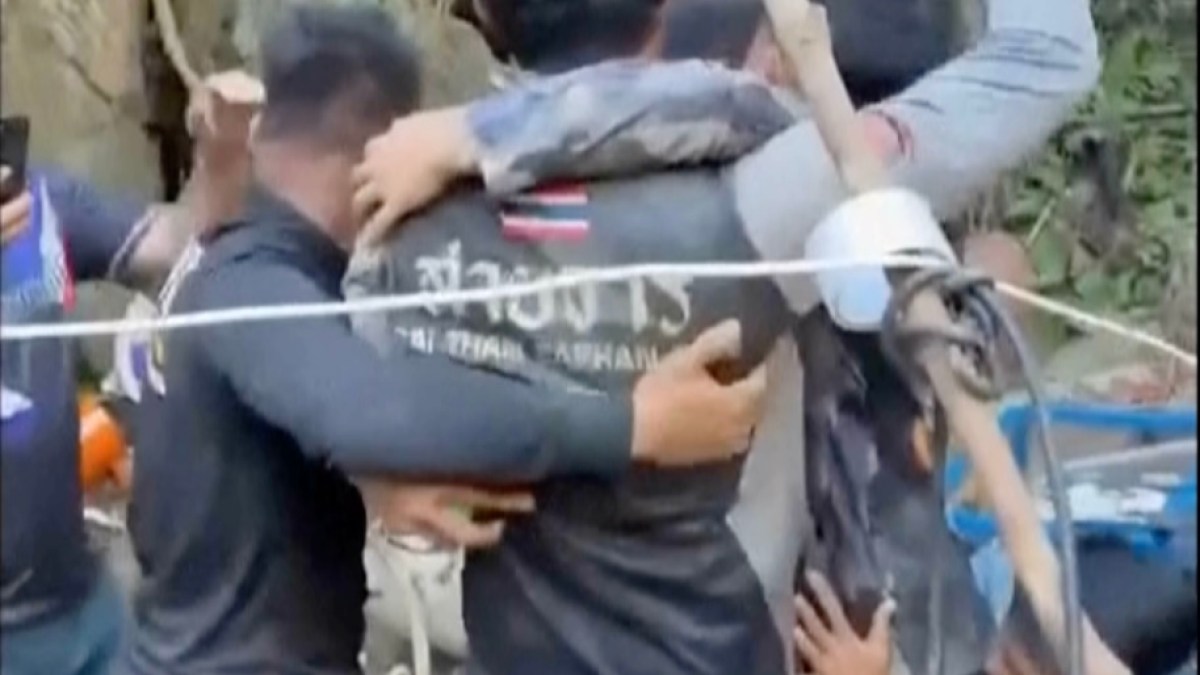
Rescue teams celebrate as survivors found in Laos cave

Published

on

உலகம்

Nigeria’s Eid Crisis: When a ram becomes a luxury

Published

on

At a Nigerian sheep market, entrepreneur and human rights advocate Sadaatu Madaki reveals how insecurity, violence, and rising prices are making Eid increasingly difficult for families. As the price of rams soars beyond the reach of ordinary citizens, traders fear kidnapping and attacks on routes once used to supply livestock.

📰 மூல செய்தி (Source): https://www.aljazeera.com/video/newsfeed/2026/5/27/nigerias-eid-crisis-when-a-ram-becomes-a-luxury?traffic_source=rss

Continue Reading

உலகம்

The Baltics urgently need a de-escalation mechanism; Belarus can help

Published

on

Amid a growing risk of a spillover from the Ukraine war, the Baltic states could use de-escalation channels through Minsk.

Recent weeks have seen a significant escalation of military tensions in and around the Baltics. Lithuania, Latvia and Estonia, which are all NATO members, now experience regular incursions into their airspace by Ukrainian drones. According to both Kyiv and the Baltic capitals, those drones, en route to hit targets in western Russia, get diverted by Russian electronic jamming and end up entering these countries’ territories.

In early May, several stray unmanned aircraft crashed in Latvia, one of them damaging an oil storage facility. Those developments triggered a political crisis in Latvia and led to the collapse of its government. Last week, a drone was shot down over Estonia, and another drone sighting forced Lithuania to suspend train and air traffic temporarily.

Days later, the Russian Foreign Intelligence Service (SVR) and Russia’s representative to the United Nations issued menacing warnings, accusing Baltic states of having greenlit air corridors for Ukrainian unmanned aircraft to attack infrastructure targets in Russia and even hosting Ukrainian drone operators.

The growing tensions in the region are raising the risk of miscalculation. This is why the Baltics urgently need de-escalation mechanisms and communication channels.

The increasing frequency of drone incidents in the region as well as Russia’s latest direct military warnings to the Baltic states indicate two highly dangerous developments.

First, the long-feared horizontal escalation of the Russian-Ukrainian war is already happening. The recent events marked the first time in many decades that air raid sirens have gone off in NATO member states. Even though Moscow and NATO’s Baltic and Nordic capitals have so far stayed out of a direct collision, its prospects appear imminent unless tensions de-escalate in the coming weeks. As Lithuanian Prime Minister Inga Ruginiene noted after the latest drone incident, “war is much closer than ever.”

All this looks particularly perilous as the Baltic region has long been seen as the most likely potential flashpoint between Russia and NATO. The Baltic states sit between the Russian mainland to their east and its exclave of Kaliningrad to their west. Moreover, Latvia and Lithuania also have Russia’s ally Belarus on their southeastern borders.

Besides geography, deeply held historical grievances further fuel confrontational perceptions and biases. It could take just one incident to get out of control for a cascading, deadly regional crisis to become a reality.

Second, this is not just a temporary outbreak of instability that the sides can simply wait out or reverse by minor adjustments of their actions and rhetoric. Instead, the situation amounts to the new normal in Eastern European security and reveals numerous complex geopolitical contradictions that have now surfaced as a systemic problem.

Importantly, neither side can control these action-reaction dynamics unilaterally, and therefore, the region’s new normal appears fraught with excessive risks of miscalculation and intended or unintended escalation.

In response to these highly hazardous developments, regional actors seem to offer only more of the same – that is, increasingly hawkish posturing and doubling down on the idea of deterring each other militarily, including by nuclear means.

The rhetoric on both sides says it all. While Moscow promises retaliation against decision-making centres in the Baltic countries, Lithuanian Foreign Minister Kestutis Budrys went on the record as saying that NATO must “show the Russians that we are capable of breaking through their little fortress in Kaliningrad”. He added that, if necessary, the alliance “has all the means to level the Russian air defence and missile bases there”.

Other Baltic leaders are repeating calls for their NATO allies to bolster cooperation against Moscow and demonstrate resolve from the position of strength. Similarly, Russia keeps to its own version of escalate-to-de-escalate signalling as the cornerstone of deterrence against NATO.

While such approaches might seem safe bets from the point of view of domestic and alliance politics, they can do little to reduce the dangerously increasing escalation risks between Russia and NATO. Simply doubling down on the rigid deterrence ideas and uncompromising rhetoric and political posturing that have essentially brought about the current situation will only continue making things worse for everyone.

To avert drifting into a major war, the Baltics and Eastern Europe urgently need a subregional mechanism for military risk reduction that can maintain de-escalation communication channels with Moscow. This mechanism must be fully depoliticised and managed exclusively by the military, not politicians.

A properly negotiated security arrangement involving NATO and Russia appears unfeasible at this point. Therefore, an interim de facto military-to-military communication and coordination mechanism could be established that would involve five countries on both sides of the division line. On the NATO side, these are the Baltic states of Lithuania, Latvia and Estonia as well as Poland. And on the other side, it is Belarus, which has a defence alliance with Moscow.

To make this mechanism work, no political or legal agreements are needed. Just an understanding that these countries want to avoid further escalation scenarios, especially ones that would likely emanate from mere miscommunication and misinterpretation.

Formally, the framework could rest on a rather unique network of advanced bilateral confidence- and security-building agreements that Belarus has had with all three Baltic states and Poland for more than 20 years. While Belarus’s NATO neighbours stopped implementing the agreements in late 2020, importantly, they have not withdrawn from them and can easily revive their application.

These agreements were concluded in a different technological era and, therefore, do not account for drones and other modern military challenges. Yet they could serve as an overall framework legitimising and facilitating regular military-to-military contacts to jointly counter the drone threat.

Arguably, initial moves in the direction of such a depoliticised, de facto mechanism have already taken place. Recently, the Belarusian military used respective communication channels to pass information about incoming third-country drones to their colleagues in Poland and the Baltic states. Polish and Baltic officials publicly acknowledged both the facts of information sharing and its practical utility. Now they can simply start reciprocating by also sharing similar information with Belarus.

This mechanism would not resolve fundamental disagreements between the region’s geopolitical antagonists. But it is badly needed for risk reduction at a time when any escalation could pull the region into war.

The views expressed in this article are the author’s own and do not necessarily reflect Al Jazeera’s editorial stance.

📰 மூல செய்தி (Source): https://www.aljazeera.com/opinions/2026/5/27/the-baltics-urgently-need-a-de-escalation-mechanism-belarus-can-help?traffic_source=rss

Continue Reading

உலகம்

Who is Moise Kouame, the youngest French Open match winner since 1991?

Published

on

World no 318’s victory over Marin Cilic also made him the youngest man to claim a Grand Slam victory in 17 years.

Roland Garros might have witnessed the birth of a new tennis megastar this week when local teenager Moise Kouame took a historic victory at the French Open to become the youngest man to win a major main-draw match in 17 years.

Aged 17 years and two months, Kouame defeated former US Open champion Marin Cilic 7-6(4) 6-2 6-1, raising his arms and throwing his head back as the home crowd on Court Simonne-Mathieu applauded his feat.

The victory made him the youngest male player ⁠to win a singles Grand Slam match since Australia’s Bernard Tomic reached the 2009 Australian Open second round at the age of 16. Kouame is the youngest player to register a first-round win at the French Open since Dinu Pescariu of Romania in 1991.

He also became the first teenager to defeat a major champion in his debut Grand Slam main draw match since Marat Safin defeated Andre Agassi at Roland Garros in 1998.

Here’s everything to know about the rising teen sensation.

Born in 2009 in the Parisian suburb of Sarcelles, Kouame is of Ivorian-Cameroonian descent. His mother, who has “always made a big impact”, was his first coach and now manages his career.

Kouame began playing tennis aged six, inspired by his older brother, Michael, and trained at the National Tennis Centre in Poitiers. He is now coached by former world no 7 and fellow countryman Richard Gasquet, with reports suggesting that he added Laurent Raymond to his team earlier this year.

The 6 feet 3 inches (1.91 metres) tall Frenchman has a strong serve and forehand and enjoys playing on every surface, which aligns with his nickname “KTT” –  which translates to “Kouame every surface”.

Yes, unless he wins his second-round matchup at Roland Garros against Paraguay’s Adolfo Daniel Vallejo on Thursday.

The Frenchman has won three ITF titles – the third tier of professional tennis – and received several wildcards on the main circuit, including at the 2026 Monte-Carlo ‌Masters and Miami Open, where he defeated Zachary Svajda of the US to become the youngest match winner in the event’s history.

“It’s a lot of emotion, it’s exceptional,” Kouame said. “Coming into this tournament, I didn’t really know what to ⁠expect. The team and I worked hard to be as ready ⁠as possible.”

The teenager cited his experience in Miami and Monte-Carlo as helping him in Tuesday’s win. “Technically, I felt pretty calm. I knew I was ready and I felt good mentally and physically.”

In a post on Instagram, Kouame thanked all those who have been part of his journey, adding that the win on home soil made it even more special.

The teen also brushed aside the age factor against Cilic, who is 20 years his senior. “I didn’t care about his age. I just wanted to give him shots that were as complicated to play as possible.

“So for some, the age factor may play a role, but as far as I’m concerned, I tried to focus, not to think about it, because in the end, when you’re on court, you don’t think about your age or what you’re going to eat. You think about what you have to do to win.”

While Kouame may not have expected his second French Open singles match against Vallejo, he played the men’s doubles with Giovanni Mpetshi Perrica against US duo Robert Cash and James Tracy, who defeated the Frenchmen 6-4 1-6 6-4.

Kouame and current French no 2 Elsa Jacquemot will pair up for the mixed doubles against Christian Harrison of the US and Hungary’s Fanny Stollar.

📰 மூல செய்தி (Source): https://www.aljazeera.com/sports/2026/5/27/who-is-moise-kouame-the-youngest-french-open-match-winner-since-1991?traffic_source=rss

Continue Reading

Trending

Copyright © 2024 by 7Tamil Media, All rights reserved.