Connect with us

உலகம்

Rabbi accused of war crimes selected for Israel’s national celebration

Published

on

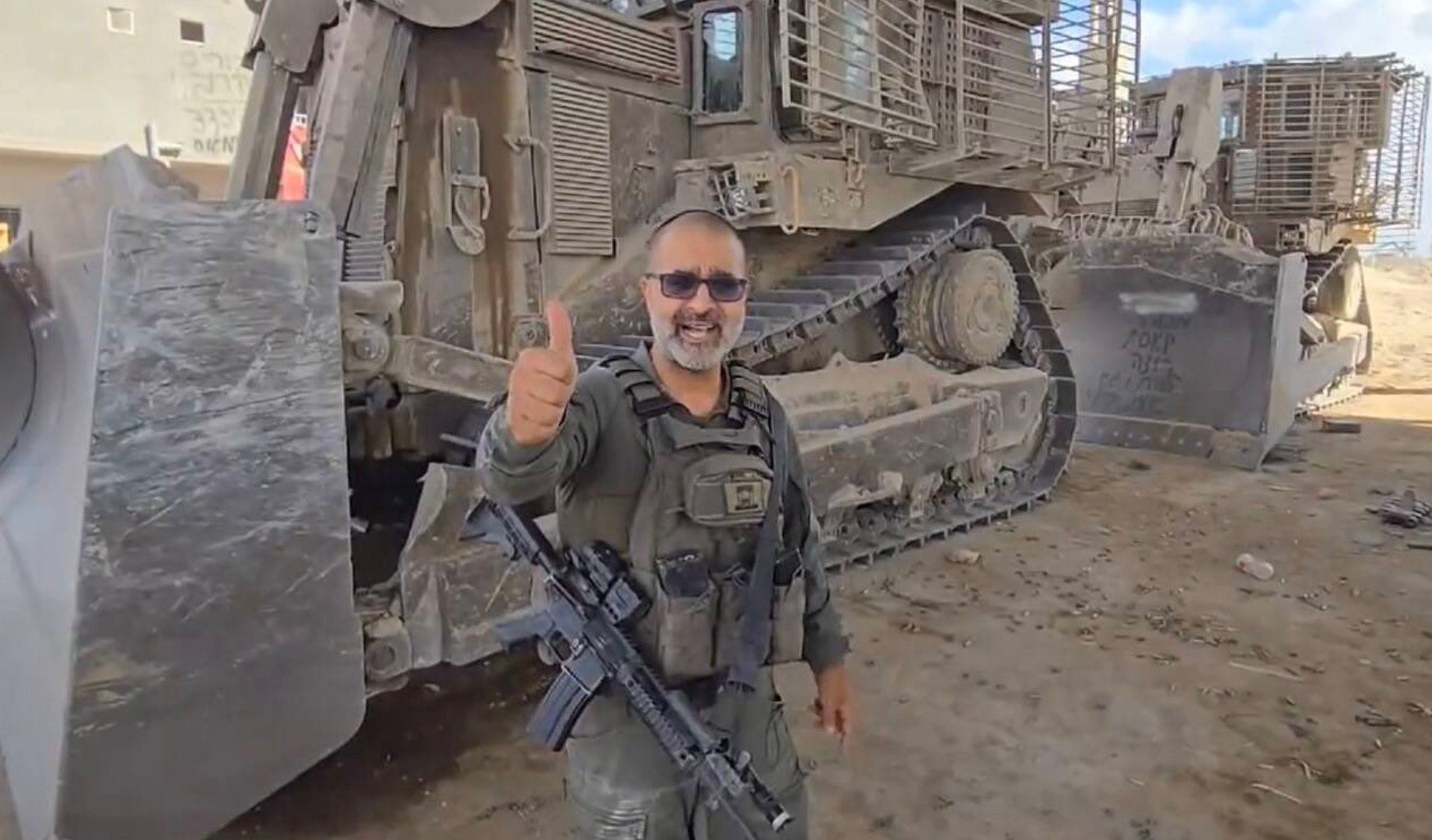
Rabbi Avraham Zarbiv has filmed himself demolishing Palestinian buildings in Gaza while reciting religious verses.

As the sun sets on Israel’s Memorial Day, 12 torches, together symbolising the spirit of the nation, are lit to mark the beginning of Independence Day, the anniversary of the country’s establishment in 1948 – which led to the ethnic cleansing of at least 750,000 Palestinians.

To be selected to light one of the torches over the resting place of Theodor Herzl, the man widely credited with the creation of modern Zionism, is regarded as one of the greatest honours in Israel.

This year, among those selected to light the torch on Tuesday evening is Avraham Zarbiv, a rabbi so controversial that even the Israeli military – an organisation that admits to having killed more than 70,000 Palestinians in Gaza – has publicly distanced itself from him. A military spokesperson said last week that Zarbiv “was not selected in coordination” with the military, and was not representing it at the ceremony, despite his being an army reservist.

Zarbiv first came to national prominence in Israel in the early months of 2024, when the 52-year-old rabbi and state rabbinical judge was filmed throwing grenades at Palestinians in Khan Younis during a firefight.

Since then, he has recorded himself gleefully demolishing Palestinian homes – his name even becoming a verb meaning to flatten or obliterate – and has delivered sermons from the ruins of Rafah promising “victory and settlement”. Zarbiv pairs it all with the traditional mannerisms of a religious leader, punctuating his threats and violence with footage of him blowing on a traditional ram’s horn, or shofar, as well as reciting prayers and parts of the Torah.

Zarbiv has also shared footage of himself taking part in the demolition of homes in southern Lebanon, where Israeli forces are accused of deploying the same scorched earth tactics as they did during Gaza’s genocide.

Speaking to Israel’s right-wing Channel 14 in January 2025, Zarbiv boasted of the destruction inflicted on Gaza.

“There are tens of thousands of dead. The dogs and the cats ate them because no one collected them,” he said. “Tens of thousands of families – they have not a piece of paper, no childhood photo, no IDs, they have nothing. No home, there is nothing. They come, they have no idea where their house is. It’s something unbelievable.”

While the army leadership itself might be seeking to distance itself from Zarbiv, the rabbi himself says that he represents his fellow soldiers.

“I am one soldier among many, I am a soldier of the Givati Brigade,” he said in an interview last week.

Last week, the Israeli organisation Kerem Navot, which monitors illegal settlement construction in the occupied West Bank, filed a complaint to Israel’s judicial watchdog after confirming that Zarbiv had built his home illegally on private Palestinian land in the Beit El settlement, accusing him of violating the ethics rules for both judges and rabbinic judges.

That had no bearing, however, on Transport Minister Miri Regev’s decision to nominate Zarbiv for the torch-bearing ceremony.

“Rabbi Zarbiv, a father of six, continues to serve in reserve duty and combines in his life in an inspiring way between the book and the sword – between Torah and the army, between study and action, and between spiritual leadership and security responsibility,” the right-wing minister said.

She continued, describing the man now accused of multiple war crimes as representative of a generation “that refuses to part with responsibility, that chooses to bear the burden and continue to build, out of great faith in the future”.

Nevertheless, in January 2025, The Hind Rajab Foundation, the Belgian-based NGO that seeks to prosecute Israeli soldiers on the basis of the video evidence they themselves frequently provide, filed an official complaint against Zarbiv with the International Criminal Court (ICC). According to the foundation’s lawyers, Zarbiv’s gleeful boast of destroying 50 buildings per week in Gaza, participating in the complete destruction of entire neighbourhoods, and having publicly incited violence and hatred through his appearances on Israeli media, were clear enough breaches of the Geneva Convention and Rome Statute to deserve prosecution.

Zarbiv was not a neutral public figure being honoured for civic virtue, Dyab Abou Jahjah, cofounder of The Hind Rajab Foundation, told Al Jazeera. Rather, “he is a notorious perpetrator of grave international crimes”, Abou Jahjah said.

“His selection [for the Independence Day ceremony] is therefore not incidental – it is revealing,” Abou Jahjah added. “When an individual implicated in acts that constitute genocide is elevated in this way, it reflects the underlying logic of a state project historically rooted in the dispossession and ethnic cleansing of Palestinians. From that perspective, his selection is entirely consistent.”

B’tselem, the Israeli rights group, is also

among those objecting to Zarbiv’s selection.

“The government’s decision to laud Zarbiv as an ‘exemplary citizen’, after more than two years of genocide in Gaza and amid a reality of unprecedented state and settler violence in the West Bank, represents a state-level endorsement of the complete dehumanization of Palestinians and the systematic destruction of Palestinian life,” B’tselem said in a statement.

“This selection sends a clear message to the citizens of Israel and the entire world: In Israel, genocide, ethnic cleansing, and war crimes are the ‘spirit of the nation’,” the group added.

📰 மூல செய்தி (Source): https://www.aljazeera.com/news/2026/4/21/rabbi-accused-of-war-crimes-selected-for-israels-national-celebration?traffic_source=rss

உலகம்

Nigeria charges six people with ‘terrorism’, treason over 2025 coup plot

Published

on

Nigerian authorities have charged six military officers over an alleged plot to overthrow President Bola Tinubu.

Nigerian authorities have charged six people, including a retired major-general and a serving police inspector, with “terrorism” and treason, over an alleged plot to overthrow President Bola Tinubu, according to documents filed at the Federal High Court in Abuja.

The six were all in custody on Tuesday while the seventh suspect, former Bayelsa State Governor Timipre Sylva, who is accused of helping to conceal the plot, is still at large.

The government had initially denied the existence of the alleged coup, before announcing in January that the military would try several officers for planning “to overthrow the government”.

They were part of a group of 16 military officers arrested in 2025 over what military authorities described as “acts of indiscipline and breaches of service regulations”, prompting rumours of a coup plot, which was initially denied by the government.

Shortly after denying the alleged coup plot, President Tinubu reshuffled the country’s top military generals.

In the 13-count charge sheet, authorities said suspects “conspired with one another to wage war against the state to overthrow the president of the Federal Republic”.

The charges named retired Major-General Mohammed Ibrahim Gana, retired Captain Erasmus Ochegobia Victor, Inspector Ahmed Ibrahim, Zekeri Umoru, Bukar Kashim Goni and Abdulkadir Sani.

The six were also accused of conspiring “with one another to commit an act of terrorism” and of “indirectly” but “knowingly” rendering “support” to Colonel Mohammed Alhassan Ma’aji and others “to commit an act of terrorism”.

Ma’aji has been named as the “mastermind” of the coup in previous Nigerian media reports.

Africa’s most populous nation experienced five coups in the 20th century but has not seen one since it became a formal democracy in 1999.

This alleged coup plot comes after a surge in coups and attempted coups in West and Central Africa in recent years, the latest in Benin and Guinea-Bissau late last year.

These military takeovers, experts say, follow a pattern marked by disputed elections, constitutional upheaval, security crises, and youth discontent.

📰 மூல செய்தி (Source): https://www.aljazeera.com/news/2026/4/21/nigeria-charges-six-people-with-terrorism-treason-over-2025-coup-plot?traffic_source=rss

Continue Reading

உலகம்

Why is the EU under pressure to suspend its trade agreement with Israel?

Published

on

Divided EU nations debate suspending Israel deal as pressure mounts over rights violations in Gaza and the occupied West Bank.

Germany and Italy blocked a bid to suspend a key European Union trade pact with Israel on Tuesday, as European Union foreign ministers met to discuss the bloc’s relationship with Israel.

Three member nations – Spain, Slovenia and Ireland – had requested that the Association Agreement between the European Union and Israel be reconsidered because of Israel’s actions in Gaza and the occupied West Bank.

While it has been blocked this week, the move is a reflection of growing unease across the continent over Israel’s conduct in the occupied Palestinian territories in recent years, as well as mounting calls for action from rights groups over Israel’s growing list of human rights abuses.

In Luxembourg on Tuesday, Spain’s Foreign Minister Jose Manuel Albares told reporters. “I expect every European country to uphold what the International Court of Justice and the UN say on human rights and the defence of international law,” he said. “Anything different would be a defeat for the European Union.”

The bloc remains divided on its ties to Israel, however. Countries such as Germany, Hungary and the Czech Republic, in particular, are reluctant to take any drastic steps, meaning any move towards full suspension of the agreement is unlikely in the near future.

German Foreign Minister Johann Wadephul called Spain’s request “inappropriate”, saying any issues had to be discussed in a “critical, constructive dialogue with Israel”.

So, what is the EU-Israel agreement, and why is it so controversial?

The agreement, which came into effect in 2000, grants Israel preferential access to EU markets and supports cooperation within key areas such as trade, research and diplomacy.

The European Union is Israel’s largest trading partner, making the agreement a major part of their relationship.

A central feature of the deal is its human rights clause, known as Article 2, which states that cooperation is “based on respect for human rights and democratic principles”.

This clause is at the heart of the current debate, as critics argue that violations by Israel could justify suspending the agreement, either fully or in part.

Calls to suspend the agreement have been made by several governments, rights groups and EU citizens, particularly those who have long condemned Israel’s decades-long occupation of Palestinian territory in the West Bank and Gaza.

Within the EU, Spain, Ireland and Slovenia are leading efforts to push for a review and suspension of the agreement, arguing that the bloc must act in line with its legal and human rights commitments.

“We need to act. We need to make sure that our fundamental values are protected,” Helen McEntee, Ireland’s foreign minister, said in Luxembourg.

Belgian Foreign Minister Maxime Prevot said while Brussels is calling for at least a partial suspension, a “full suspension is probably out of reach given the positions of the various European ⁠⁠countries”.

In a statement addressed to European Commission President Ursula Von Der Leyen on Thursday, more than 60 human rights organisations, including Amnesty International and Human Rights Watch, called on the EU and member states to “adopt long-overdue measures, including suspending the EU-Israel Association Agreement, banning trade with illegal Israeli settlements and suspending all transfers and transit of arms to Israel”.

Public pressure has also grown significantly. On April 15, The Justice for Palestine European Citizens’ Initiative (ECI) successfully gathered one million signatures, three months after it was launched, in support of its campaign demanding that Brussels halt the association agreement.

The campaign accuses Israel of committing genocide, maintaining an illegal occupation and enforcing an apartheid system against Palestinians in the occupied West Bank.

As a result of the number of signatures it has gathered, according to EU law, the European Commission is “required to react, and decide what, if any, action it will take in response to the initiative, justifying its decision”.

Mainly because of anger about Israel’s treatment of the Palestinians in Gaza, where more than 71,000 people have been killed in Israel’s war, and in the occupied West Bank, where Palestinian villages and communities have come under increased attacks by Israelis from illegal settlements and raids by Israeli forces.

Israel’s two-year genocide in Gaza has become the catalyst for growing calls to end the association agreement.

Since Israel’s war on the coastal enclave began on October 7, 2023, more than 71,000 Palestinians have been killed, most of them women and children, according to the Gaza Health Ministry. Many thousands of people more are missing, lost under the rubble and presumed dead.

Despite a US-led “ceasefire” agreement which was reached between Israel and Hamas last October, Israeli forces have continued to launch attacks and strikes on Gaza on a near-daily basis, killing more than 700 Palestinians since then, and continuing to severely restrict essential aid from entering the war-devastated coastal enclave.

A UN inquiry in September last year found genocidal intent in Israel’s war on Gaza, a landmark moment after nearly two years of war.

In December 2023, South Africa filed a case at the International Court of Justice (ICJ) in The Hague against Israel, accusing it of conduct amounting to genocide in Gaza. That case is ongoing.

And, in November 2024, the International Criminal Court (ICC) issued arrest warrants for Israeli Prime Minister Benjamin Netanyahu and former Israeli Defence Minister Yoav Gallant for alleged war crimes in Gaza.

There are “reasonable grounds” to believe that Gallant and Netanyahu “intentionally and knowingly deprived the civilian population in Gaza of objects indispensable to their survival, including food, water, and medicine and medical supplies, as well as fuel and electricity”, the ICC said.

The court also issued an arrest warrant for Hamas military commander Mohammed Deif for “crimes against humanity” in relation to the Hamas-led assault on army outposts and villages in southern Israel on October 8, 2023, when more than 1,000 Israelis were killed, and more than 200 were captured and taken to be held in Gaza. Deif’s death in an Israeli air strike on Gaza was confirmed in January 2025.

Concerns also extend to the occupied West Bank, where rising settler violence against Palestinians has received widespread condemnation by European governments. The violence, which Palestinians and activists say is ignored and often supported by the Israeli armed forces, has prompted discussions within the EU about possible sanctions targeting “extremist settlers“.

The continued building of illegal Israeli settlements has further intensified criticism, as it is seen by many European nations as undermining the prospects for a two-state solution.

A familiar pattern is that outposts are established at the edges of Palestinian villages, after which sustained and often violent harassment, including diverting water supplies, killing or stealing livestock and destroying solar panels, of the communities living there begins. Once the members of a community have been driven out, an illegal Israeli settlement is built on the site. These illegal settlements then gain retrospective approval from the Israeli authorities at some point later on.

In December last year, 14 countries, including the UK, Canada, Denmark and France, condemned Israel’s approval of 19 ⁠⁠settlements in the occupied West Bank, saying the move was illegal and jeopardised the Gaza ceasefire and “long-term peace and security across the region”.

In the same month, the United Nations said the expansion of Israeli settlements in the occupied Palestinian territory had reached its highest level since at least 2017.

International law stipulates that occupying powers like Israel must not move

📰 மூல செய்தி (Source): https://www.aljazeera.com/news/2026/4/21/why-is-the-eu-under-pressure-to-suspend-its-trade-agreement-with-israel?traffic_source=rss

Continue Reading

உலகம்

Trump says he opposes extending Iran ceasefire amid talks uncertainty

Published

on

US president says Iran has ‘no choice’ but to show up to the negotiations in Pakistan and accept a ‘great’ deal.

United States President Donald Trump says he opposes extending a ceasefire with Iran that will expire by the end of Wednesday to allow more time for negotiations.

Trump’s comment on Tuesday during an interview with CNBC raised the stakes for the round of talks set to take place this week in Pakistan, suggesting that the war could reignite if the parties fail to reach a deal.

Iran has not publicly committed to attending the negotiations as tensions over Tehran’s closure of the Hormuz Strait and the US blockade on Iranian ports intensify.

Asked by CNBC whether he would back prolonging the truce to buy more time for the talks to take place, Trump said, “Well, I don’t want to do that.”

The president said Iranian representatives will attend the talks, emphasising that the negotiators don’t have much time to reach an agreement.

“Iran can get themselves on a very good footing if they make a deal. They can make themselves into a strong nation again,” Trump said.

Despite the uncertainty over the talks, Trump predicted that Washington and Tehran would reach a “great deal”.

“I think they have no choice,” he said of the Iranians. “We’ve taken out their navy. We’ve taken out their air force. We’ve taken out their leaders.”

Trump, who has threatened to bomb Iran’s bridges and power and water stations, said the US military is “totally loaded up” to resume the war.

“It’s not my choice, but it would also hurt them. It would hurt them militarily,” he said of his threat to target civilian infrastructure in Iran. “They use the bridges for their weapons, for their missile movements.”

Iran has continued to voice defiance against Trump’s rhetoric, saying it will not negotiate under threat.

While the two-week ceasefire has succeeded in halting the fighting, it has been rocked by Israel’s assault on Lebanon and disagreements over the Strait of Hormuz.

Iran has insisted that Lebanon was part of the truce and kept the strait closed to pressure an end to the Israeli bombardment of the country.

Trump, in turn, ordered his own blockade of the waterway with the US military laying a naval siege on ships linked to Iran.

When a ceasefire was announced in Lebanon, Iran announced a reopening of the strait, but Trump said the US blockade would persist. So less than 24 hours later, Tehran said it was closing the strait again.

US forces have seized at least one Iranian-flagged vessel as part of the blockade in what Tehran decried as an act of piracy. On Tuesday, the US military said it has “directed 28 vessels to turn around or return to port” since the start of the blockade.

“The United States will bear full responsibility for the consequences of the dangerous escalation, and Iran will use all available means to defend its sovereignty and protect the rights of its citizens,” Iran’s Ministry of Foreign Affairs said on Monday.

The closure of the Strait of Hormuz has sent oil prices around the world soaring. The cost of petrol for US consumers has risen by more than 25 percent since the start of the war.

Trump stressed in his interview with CNBC that the US is “totally” in control of the strategic waterway.

📰 மூல செய்தி (Source): https://www.aljazeera.com/news/2026/4/21/trump-says-he-opposes-extending-iran-ceasefire-amid-talks-uncertainty?traffic_source=rss

Continue Reading

Trending

Copyright © 2024 by 7Tamil Media, All rights reserved.