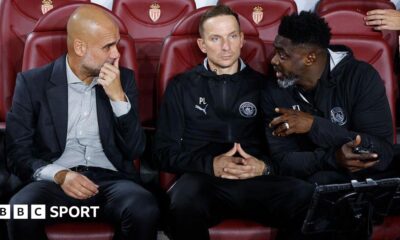
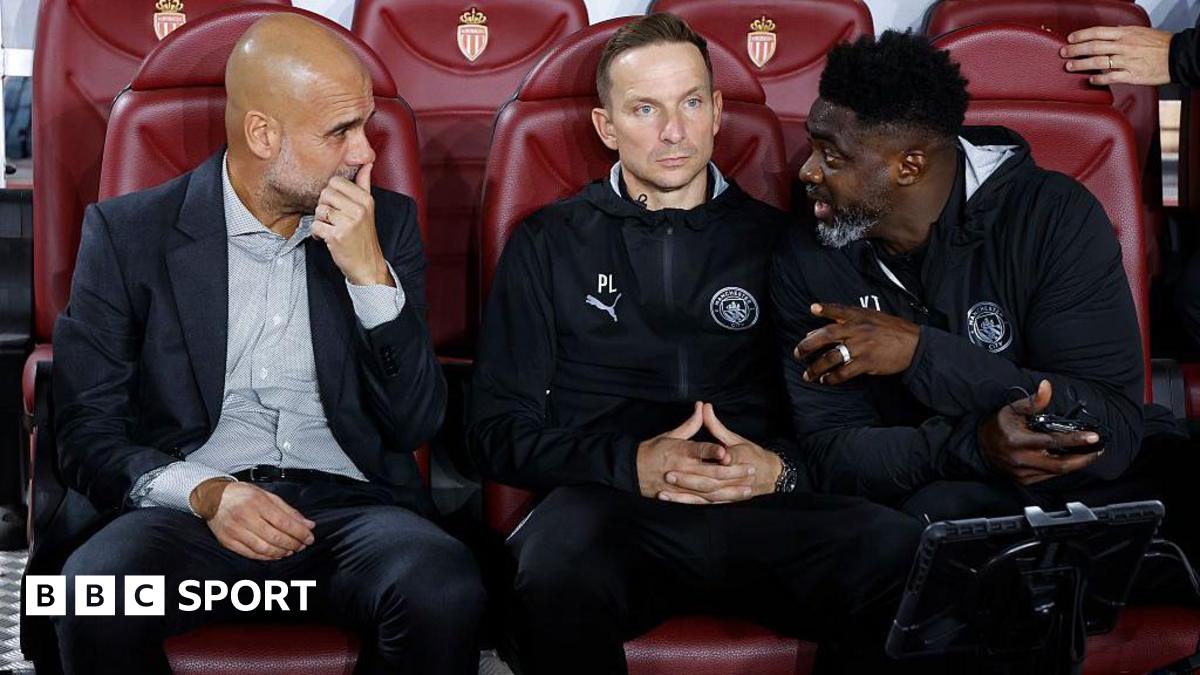
Pep Guardiola, Pep Lijnders and Kolo Toure have arrived at a system that suits Manchester City's players
Pep Guardiola has an uncanny ability to time his season right.
Like a long-standing sitcom, much of Guardiola's Manchester City career follows the same story arc: a bright September before his side begin to struggle.
As fans and pundits begin to predict City's downfall, Guardiola tinkers with his squad before a long winning streak results in his club being crowned Premier League champions.
Whether that storyline plays out at the end of this season is yet to be seen but Guardiola has finally landed on a system he trusts for the run-in.
Watch live on BBC One and BBC iPlayer and listen on BBC Radio 5 Sports Extra and BBC Sounds (both UK users only). Follow both and live text commentary on the BBC Sport website and app.
Manchester City started the season with a 4-0 win at Wolves
Of the team that started last Sunday's win over Arsenal, only three started their opening league match on 16 August – Erling Haaland, Jeremy Doku and captain Bernardo Silva.
City won 4-0 against now relegated Wolves.
The key differences then were that Rico Lewis and Rayan Ait-Nouri moved in-field from their full-back positions to support Nico Gonzalez while Silva moved into a more attacking midfield position alongside Tijjani Reijnders.
Out of possession, City pressed high. Doku and Oscar Bobb defended close to Haaland, but that often left Wolves' full-backs free.
That detail would become important. Across the season, City would repeatedly tweak their defensive structure as opponents found various ways to find the spare man.
Early on, City leaned into attacking transitions.
Inspired by assistant Pep Lijnders and signings like Reijnders, they attacked quicker than previous Guardiola sides, destroying Wolves on the counter. This also suited Haaland, who started the season in impressive scoring form but was something Guardiola later reeled in, preferring more measured games.
Rayan Ait-Nouri and Rico Lewis move into more narrow positions from full-back. Nico Gonzales anchors the midfield with Tijjani Reijnders and Bernardo Silva pushing on
On 23 August, City lost 2-0 at home to a Tottenham side who are now battling relegation.
Omar Marmoush replaced Doku, while Rayan Cherki came into midfield instead of Silva alongside Gonzalez and Reijnders.
The principles stayed the same – invite pressure before looking to release fast attackers into space.
As the season progressed, man-to-man pressure has been a key trend. Guardiola's early attempts to deal with this lay in drawing opponents on to City before launching the ball early, looking to find Haaland and Marmoush two against two in the opposing half.
City drew Spurs' players on to them from goal-kicks, leaving Marmoush and Haaland up top resulting in a two against two
City pressed in what looked like a 2-3 shape. Haaland jumped to the centre-back in possession while Bobb and Marmoush started narrow before being asked to press the full-backs. At times they were slow to get across, allowing Pedro Porro to play accurate long balls down the line.
Spurs vacated the centre and overloaded the flanks, resulting in Gonzalez often finding himself with nobody to mark while the defence played a high line and offside trap to minimal success.
For Spurs' first goal, Pedro Porro played long down the line. Pape Matar Sarr, Spurs' third midfielder, stepped into attack alongside Richarlison, attracting attention from Ruben Dias who had been dragged out of position. John Stones tried to apply an offside trap, slipping in the process.
Problems, particularly in defence, continued to grow as City lost to Brighton on 31 August.
City tweaked their press again. The wingers now pressed the centre-backs instead of the full-backs.
The left winger pressed Jan Paul van Hecke while left-back Ait-Nouri had to sprint long distances to reach Brighton's right-back Joel Veltman once Brighton progressed the ball.
A Rodri short of rhythm after injury returned but found himself on the same island Gonzalez did the week prior, disconnected from both defence and midfield, without a player to mark.
Brighton outnumbered City's defenders with their forward line, a damning indictment of the visitors' set-up.
Brighton progress the ball from centre-back to central midfielder before finding their right full-back. This triggers City's left-back to run but the distances are too large to cover
City responded with a 3-0 derby win over Manchester United on 14 September.
Reijnders started his fourth game in a row, this time alongside Phil Foden, both playing in front of Rodri. The pair would form a key partnership in the opening months.
Doku drifted inside from his left-wing position in build-up play, while Nico O'Reilly, starting at left-back for the first time that season, pinned Noussair Mazraoui back.
This worked remarkably well and Doku's narrow and roaming winger role became a key Guardiola weapon for the rest of the season.
It helped City create a four-man overload against United's midfield two and nudged Guardiola's men in the right direction.
Nico O'Reilly stands on the touchline, Jeremy Doku moves into midfield and City have an overload centrally
City beat Burnley 5-1 on 27 September with Gonzalez, Foden and Reijnders in midfield. O'Reilly kept his place at left-back with Josko Gvardiol, Dias and Matheus Nunes making up the back four.
Guardiola was beginning to identify pieces he liked.
Doku and Haaland were mainstays in the front three now. The right-wing position, subject to change, was filled by Savinho.
Pep's thinking at this point was to deploy traditional wingers – Doku and Savinho, who could get to the byline with Foden and Reijnders expected to arrive into the box to help Haaland score goals.
City's full-backs could rotate out wide but generally tucked into midfield aiming to support attacks and protect City from counters.
Protection centrally and late runs into the box have been key principles for Guardiola throughout his career.
As the season progressed, Guardiola altered his instructions hoping to find the right combination of players to carry out these tasks. O'Reilly, the manager realised with time, was far more valuable as a scorer than a player who prevented counter-attacks.
Jeremy Doku gets to the byline as Phil Foden and Tijjani Reijnders (white) attack the box. Full-backs Nico O'Reilly and Matheus Nunes (yellow) support centrally
In City's 1-0 loss to Villa on 26 October, Guardiola started with a midfield of Silva, Reijnders and Foden and an attack of Savinho, Haaland and Bobb.
Villa were able to pass around City's high press and it was telling that Guardiola changed things in the 61st minute with a triple substitution.
Gonzalez, Doku and O'Reilly came on together, a nod to what Guardiola now knew mattered more than ever. Given the current state of the Premier League, embodied by an imposing Villa side, City's had learned a valuable lesson around the value of physicality.
Guardiola outclassed Bournemouth 3-1 on 2 November and Doku again was given his free role in-field. O'Reilly and Doku were beginning to form an impressive and rotating partnership that Guardiola would rely on for the run-in.
Bournemouth pressed in a strict, aggressive man-to-man fashion and as they followed the winger into awkward positions, O'Reilly burst into the open space.
Cherki started on the right, moving in-field too. The Frenchman's influence gradually began to increase from this point on and in the small spaces, alongside Doku and Foden, Bournemouth struggled to find any reference against their fluidity.
With Andoni Iraola's men stepping up, City were able to find Haaland running in behind and won comfortably.
City persisted with this narrow front three against Liverpool on 9 November with the full-backs tracking Doku and Cherki into their own half before O'Reilly again showcased his dynamic running ability with Guardiola taking note o
📰 மூல செய்தி (Source): https://www.bbc.com/sport/football/articles/cy419pnepwpo?at_medium=RSS&at_campaign=rss












 உலகம்9 years ago