Connect with us

உலகம்

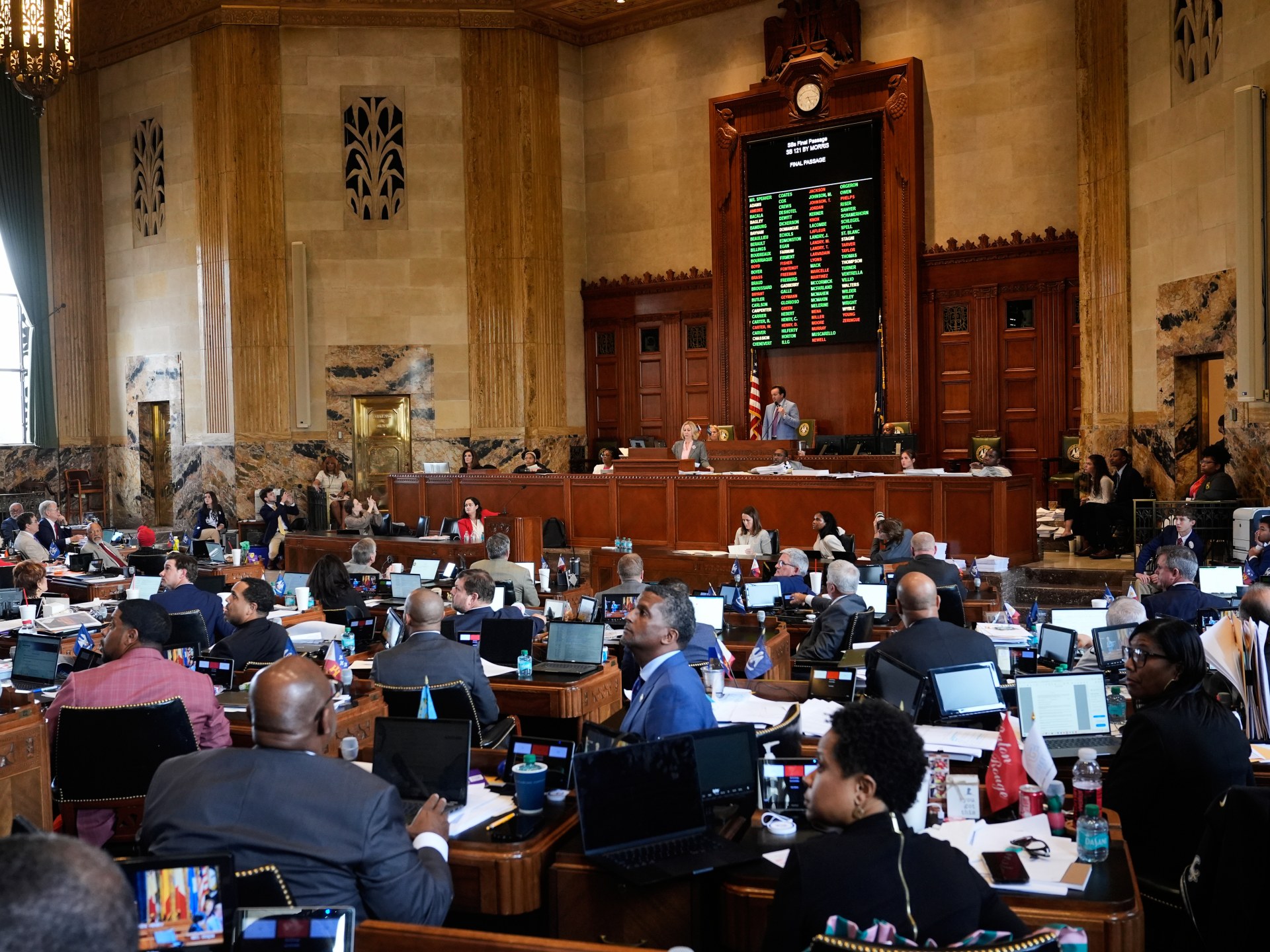
Louisiana lawmakers pass congressional map favouring Republicans

Published

on

Louisiana approves new congressional map eliminating a majority-Black district after an April Supreme Court ruling.

Louisiana lawmakers have passed a new map of congressional districts designed to help Republicans pick up a seat in the United States House of Representatives.

But to do so, the map eliminates one of the state’s two majority-Black districts, both of which are represented by Democrats.

Approval in Louisiana’s legislature came on Friday. It follows an April decision from the US Supreme Court striking down Louisiana’s current map as an illegal racial gerrymander because it was drawn to include two majority-Black districts.

That ruling, in the case Louisiana v Callais, weakened the landmark 1965 federal Voting Rights Act, meant to prevent discrimination against minorities at the ballot box.

It also intensified a national redistricting battle fuelled by President Donald Trump’s efforts to protect the Republicans’ slim House majority in the midterm elections. Louisiana is one of several Southern states now redrawing their maps to help Republicans.

Louisiana Republicans had considered drawing a map giving the party a shot at winning all six of the state’s US House seats. But that would have required adding more registered Democrats to Republican-held districts, which could have potentially backfired with Republican losses.

Republicans currently hold four of Louisiana’s six congressional seats, and they are slated to pick up a fifth with the newly passed map.

It was approved on Friday by the Louisiana state Senate in a 28-to-10 vote.

Republican Governor Jeff Landry is expected to sign the new map into law, even as threats of more litigation emerged Friday.

A half-hour Senate floor debate revolved around Democrats contending that the proposed map is racially gerrymandered to squeeze more Black voters, who tend to be registered Democrats, into a single district.

Democratic state Senator Royce Duplessis pointed out that some fellow Southern states, such as South Carolina, had refused to redraw their maps in the middle of an election year.

He warned that Louisiana is participating in a “vicious, vicious race to the bottom” by participating in the redistricting push.

The bill’s sponsor, Republican state Senator Jay Morris, repeatedly insisted that party affiliation, not race, drove the new district boundaries.

“I purposely put more Democrats into District 2 to make the remaining districts better performing for Republicans,” Morris said at one point.

Morris said he instructed the map demographers to avoid including any data on race or including those statistics in information shared with lawmakers before the vote.

Democratic state Senator Sam Jenkins told Morris, “I think it’s a racially gerrymandered district that’s going to get us into a lot of trouble here.”

“Agree to disagree,” Morris told Jenkins.

Louisiana is currently using a map ordered by a lower court in 2024 to comply with the Voting Rights Act. It includes a second district with a majority-Black population.

That map, however, was challenged in court, and the Supreme Court responded on April 30 by striking it down as an illegal racial gerrymander.

Landry has postponed the state’s closed US House primary slated for May 16 to allow for the new congressional map to be implemented.

He later signed a law making the US primary open and shifted the date to November 3 to allow time for Republican lawmakers to draw and pass a new map. All candidates, regardless of party affiliation, will be on the ballot for voters in their district.

The proposed map redraws a district currently represented by Democratic Representative Cleo Fields, clustering it around predominantly white communities in the Baton Rouge area and southern Louisiana.

It also adds part of Baton Rouge to a heavily Democratic, majority-Black district based in New Orleans, represented by Democratic Representative Troy Carter.

More lawsuits are expected over the new map.

Democrats say the proposed map could draw a legal challenge over racial gerrymandering, and the American Civil Liberties Union (ACLU) of Louisiana suggested Friday that it could sue, calling the map a “racial gerrymander hiding behind the thin veneer of partisanship”.

“This fight is just beginning,” the ACLU branch added.

Meanwhile, the victorious plaintiffs in the US Supreme Court’s decision criticised the legislature’s map for leaving a majority-Black district in place.

In the weeks following the Supreme Court’s decision, other Republican-controlled Southern states have seized upon the weakened federal Voting Rights Act to redraw their own congressional districts.

So far, Republicans are winning the nationwide redistricting contest, passing more partisan maps to gain House seats than Democrats.

But that doesn’t necessarily mean they will win in the narrowly divided US House in November.

Republicans think they could gain as many as 15 seats from their redistricting efforts so far, while Democrats think they could gain six seats from new districts in California and Utah.

Meanwhile, a court decision in Wisconsin on Friday could give Democrats a new avenue to pick up seats in 2028.

The liberal-controlled Wisconsin Supreme Court said it would hear an appeal of a case filed by a bipartisan coalition of business executives that seeks to redraw the state’s Republican-friendly congressional districts. Republicans hold six of the state’s eight House seats, but only two are considered competitive.

A three-judge panel dismissed the case in April. Those who filed the lawsuit weren’t seeking a ruling in time for the 2026 election. Instead, they asked the state Supreme Court to send the case back to the lower court for a trial on their claims, which would likely not take place until 2027.

📰 மூல செய்தி (Source): https://www.aljazeera.com/news/2026/5/30/louisiana-lawmakers-pass-congressional-map-favouring-republicans?traffic_source=rss

உலகம்

Ebola treatment centre rebuilt after being torched by protesters in DRC

Published

on

Ebola treatment centre rebuilt after being torched by protesters in DR Congo

Workers in eastern DR Congo are rebuilding an Ebola treatment centre that was burned by protesters earlier this month, as health officials warn misinformation is driving families to hide sick relatives. The Congolese government confirmed over 1,000 suspected cases and at least 220 deaths since the outbreak was declared.

📰 மூல செய்தி (Source): https://www.aljazeera.com/video/newsfeed/2026/5/29/ebola-treatment-centre-rebuilt-after-being-torched-by-protesters-in-drc?traffic_source=rss

Continue Reading

உலகம்

‘Arbitrary measures’: Lula slams US ‘terror’ designation for Brazil gangs

Published

on

Lula warned that labelling Brazil’s criminal networks as ‘terrorists’ could ‘undermine’ local law enforcement efforts.

The president of Brazil, left-wing leader Luiz Inacio Lula da Silva, has denounced a decision by the United States to designate two of the South American country’s criminal networks as “terrorists”, warning that the label could be a “setback” for local law enforcement efforts.

The condemnation came in a 435-word message posted to Lula’s social media platforms on Friday.

In it, Lula drew a line between criminal activities and international terrorism, which is often understood to use violence for political or social aims.

“The terror inflicted by these organisations upon communities seeks to generate profit through crime — specifically through drug and arms trafficking,” Lula wrote.

Those activities, however violent, “must not be conflated with the ideologically, politically, or religiously motivated actions characteristic of international terrorism”, he added.

Lula’s statements came in response to an announcement a day earlier from the administration of US President Donald Trump.

On Thursday, US Secretary of State Marco Rubio revealed that he had designated Brazil’s two largest criminal groups — the Primeiro Comando da Capital (PCC) and the Comando Vermelho (CV) — “specially designated global terrorists”.

He also outlined plans to add the two groups to the list of “foreign terrorist organisations”, effective June 5.

Rumours had swirled for months that the Trump administration would apply the “terrorist” label to the two groups. But Lula and his ministers had pushed back, calling on Trump to hold off.

“Terrorist” designations freeze all US-based assets connected to the targeted groups, but they can also be used to penalise anyone who offers “material support or resources” to them.

Experts warn that such restrictions could potentially affect financial institutions and even the victims of such groups, including businesses and individuals who might be forced to pay extortion.

Lula has also expressed concern that the “terrorist” label could pave the way for US military intervention, a fear he reiterated in Friday’s statement, though he never named Trump outright.

“We remain fully prepared to develop joint solutions that yield mutual benefits for all nations involved,” Lula wrote.

“However, we will not tolerate the imposition of arbitrary measures from abroad, nor will we accept their use as a pretext to undermine our sovereignty or our economy. Unilateral, non-negotiated measures can undermine the fight against criminals and trigger actions that endanger the lives of people who have absolutely no connection to crime.”

A prominent left-wing leader in Latin America, Lula is in the midst of a heated election season, as he seeks a fourth nonconsecutive term as Brazil’s president.

Previously, he served as president from 2003 to 2011, before being re-elected to a third term in 2022.

In that race, he defeated the right-wing incumbent, Jair Bolsonaro, who would later be convicted of attempting to overturn the results of the race. Bolsonaro is currently serving a 27-year prison sentence.

His eldest son, Senator Flavio Bolsonaro, is thought to have been instrumental in Trump’s decision to issue the “terrorist” designations. The senator is currently running against Lula in the 2026 presidential election, and the two have been locked in a tight race.

This week, as he visited the White House, Senator Bolsonaro confirmed to reporters that he intended to seek “terrorist” designations for both the Primeiro Comando da Capital and the Comando Vermelho.

Trump has close ties to the Bolsonaro family, and he has previously intervened in elections around the world on behalf of right-wing candidates.

In Friday’s post, Lula accused Senator Bolsonaro of leveraging his family connections to “petition foreign authorities” for favour.

“It is deplorable that, once again, members of the Bolsonaro family have travelled to the United States to advocate for foreign intervention in Brazil,” Lula wrote.

He pointed to alleged efforts to stop the criminal prosecution of Jair Bolsonaro. Currently, one of the ex-president’s sons, Eduardo Bolsonaro, is facing obstruction charges related to efforts to lobby Trump to intervene in the case.

Trump ultimately did impose steep sanctions against Brazilian products in August 2025, citing the Bolsonaro trial as a reason.

Under Trump, the US has taken an increasingly expansionist view towards the Western Hemisphere, reviving the 19th-century Monroe Doctrine, which described the Americas as Washington’s sphere of influence.

Trump himself has used crime as justification for taking unilateral military action in the region. Since September, his administration has conducted 59 strikes against alleged drug-trafficking boats in the Caribbean Sea and eastern Pacific Ocean, killing at least 196 people.

And on January 3, he launched an early-morning military operation against Venezuela, culminating in the abduction and imprisonment of then-President Nicolas Maduro on drug-trafficking charges.

While the Bolsonaro family has courted Trump in recent months, Lula has criticised those military-led actions as unjustified.

But security is expected to be a dominant issue in October’s presidential race. This week’s “terrorist” designations are likely to put Lula in an awkward position, forcing him to condemn the label without downplaying the extent of the violence.

Lula has attempted to brush off right-wing criticism that he has been lax on crime, pointing to his government’s recent $11bn investment in the “Brazil Against Organized Crime” programme.

That follows a separate $2bn programme in March to bolster the country’s prisons, improve homicide investigations and disrupt arms trafficking and other financial transactions carried out by criminal groups.

Still, Lula and Bolsonaro remain neck and neck in the lead-up to October’s election.

On May 16, the polling firm Datafolha found that both candidates would receive 45 percent of voter support in a one-on-one race, with 9 percent of voters indicating they would cast a null vote.

Another 1 percent identified as undecided.

📰 மூல செய்தி (Source): https://www.aljazeera.com/news/2026/5/29/arbitrary-measures-lula-slams-us-terror-designation-for-brazil-gangs?traffic_source=rss

Continue Reading

உலகம்

ICE agent arrested over shooting of Venezuelan man in US immigration raid

Published

on

The charges stem from the January 14 shooting of Julio Cesar Sosa-Celis in Minneapolis during Operation Metro Surge.

An Immigration and Customs Enforcement (ICE) agent charged with shooting a Venezuelan man during a controversial immigration raid in Minnesota has been arrested in Texas, according to United States authorities.

Agent Christian Castro, 52, was taken into custody on Friday after investigators from Minnesota tracked him down in the southern state, where he was arrested with assistance from the Texas Rangers and the Department of Homeland Security’s (DHS) inspector general’s office. He faces four counts of second-degree assault and one count of falsely reporting a crime.

The charges stem from the non-fatal shooting on January 14 of Julio Cesar Sosa-Celis in Minneapolis during Operation Metro Surge, a large-scale immigration enforcement campaign that drew widespread criticism for its aggressive tactics.

Prosecutors allege Castro fired through the front door of a residence, striking Sosa-Celis in the leg.

“Mr Castro was charged earlier this month with four counts of second-degree assault and one count of falsely reporting a crime for an incident on January 14, 2026, when he discharged his weapon through the front door of a home knowing there were people who had just run inside,” the Hennepin County Attorney’s Office said in a statement.

“The bullet travelled through the door and struck one victim in the leg before making its final impact in the wall of a child’s room.”

Minnesota officials welcomed Castro’s arrest, saying federal agents should be held to the same legal standards as everyone else.

“In Minnesota, we believe in equal justice under the law. That means nobody is above the law, including agents of the federal government,” said Minnesota Attorney General Keith Ellison. “I am pleased to hear Christian Castro has been taken into custody and will stand trial for the crimes he allegedly committed in Minnesota.”

The case became a flashpoint after federal authorities initially claimed Sosa-Celis and another man had assaulted ICE officers.

Those allegations later unravelled when video and other evidence emerged that contradicted agents’ accounts, prompting prosecutors to drop charges against Sosa-Celis and his housemate, Alfredo Aljorna.

The DHS later acknowledged that officers involved in the incident had provided false information about the shooting.

The outgoing director of ICE, Todd Lyons, also indicated a federal investigation was under way. “Lying under oath is a serious federal offense,” he said.

But through a spokesperson, ICE rejected Minnesota’s effort to prosecute the agent involved, calling the case “unlawful” and “a political stunt”.

Castro is the second federal officer charged this year in connection with Operation Metro Surge, an unusual step that reflects growing scrutiny of federal agents’ conduct during the immigration crackdown.

Hennepin County Attorney Mary Moriarty is also pursuing investigations into other incidents linked to the operation.

Operation Metro Surge began in Minnesota in December 2025. By the time Sosa-Celis was shot on January 14, hundreds of federal agents had been deployed across the Minneapolis-St Paul area in what officials described as the largest DHS operation in US history.

The crackdown ultimately prompted intense controversy, particularly after the fatal shootings of two US citizens: Renee Good on January 7 and Alex Pretti on January 24.

Against that backdrop, the investigation into the Sosa-Celis shooting further intensified scrutiny of federal agents’ tactics and conduct during the operation.

📰 மூல செய்தி (Source): https://www.aljazeera.com/news/2026/5/29/ice-agent-arrested-over-shooting-of-venezuelan-man-in-us-immigration-raid?traffic_source=rss

Continue Reading

Trending

Copyright © 2024 by 7Tamil Media, All rights reserved.