Connect with us

முக்கியச் செய்திகள்

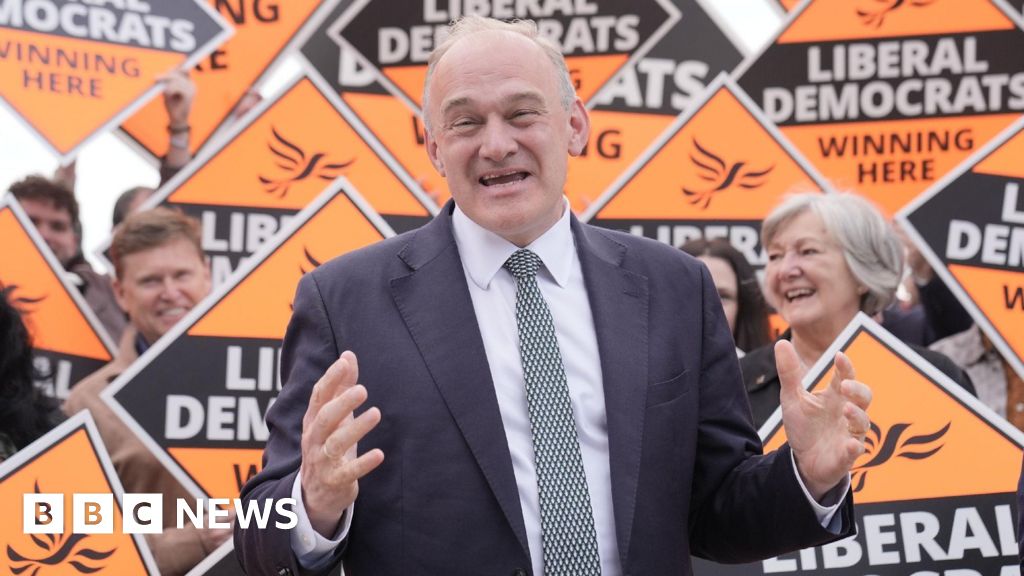
Lib Dems offer alternative to extremes of Reform and Greens, Davey says

Published

on

Liberal Democrat leader Sir Ed Davey has said his party offers an alternative to the "extremes" of Reform UK and the Greens, as he hailed gains across England and Scotland.

The Lib Dems gained 153 councillors in England, winning control of Stockport and Portsmouth council, and six seats in the Scottish Parliament.

However, the party's gains were more modest than those of Reform UK and the Green Party of England and Wales, with the Lib Dems primarily benefitting from a slump in support for Labour and the Conservatives.

In Hull, a Reform UK surge saw the Lib Dems lose control of the council, while Nigel Farage's party thwarted their hopes of winning in Tory-run Hampshire.

Speaking on a visit to Edinburgh on Saturday, Sir Ed said: "There's no doubt that British politics is in flux, the old two parties have failed, people looking for change.

"I think the option for British people is the change of the populist parties on the extremes of left and right – Reform and the Greens – or change that is true to British values from the Liberal Democrats.

"Many people voted for that type of change and I'm going to champion that."

Challenged over whether his party was losing momentum, Sir Ed it was the eighth consecutive year of net gains for the Lib Dems in English council elections, while the party had its best result for nearly 20 years in Scotland.

He added: "Clearly, the populist parties on the extremes of left and right have also done well.

"But I think the more that they are exposed and the more people see their policies, they will realise they are either pipe dreams or the politics of division."

In Stockport and Portsmouth, where the Liberal Democrats were already the largest party, Labour losses saw the Lib Dems win control of the council, despite a challenge from Reform UK.

The Lib Dems also cemented their dominance in Sutton and Richmond-upon-Thames, south-west London, where they now hold every seat on the council.

In south-east England, the party profited from a drop in support for the Conservatives, winning the two new councils of East and West Surrey.

However, despite winning nine more seats on Hampshire Council, bigger gains for Reform UK left no party in overall control.

In the Scottish Parliament election, the Lib Dems increased their number of seats to 10, winning Edinburgh Northern and Strathkelvin and Bearsden off the SNP.

The Lib Dems also overturned a large SNP majority in Sky, Lochaber and Badenoch.

However, there was a shock loss for the party to the SNP in their traditional stronghold seat of Shetland.

In Wales, the party's leader Jane Dodds returned to the Senedd but remains the only Lib Dem in the Welsh parliament.

Sign up for our Politics Essential newsletter to keep up with the inner workings of Westminster and beyond.

📰 மூல செய்தி (Source): https://www.bbc.com/news/articles/c2029ljyq25o?at_medium=RSS&at_campaign=rss

முக்கியச் செய்திகள்

Putin denounces Nato at scaled back Victory Day parade

Published

on

Vladimir Putin has used his annual Victory Day speech in Moscow's Red Square to justify his war in Ukraine and denounce Nato.

Speaking in front of hundreds of military personnel, the Russian president said he was fighting a "just" war and called Ukraine an "aggressive force" that is being "armed and supported by the whole bloc of Nato".

His remarks come amid muted celebrations across Russia to mark the nation's biggest national holiday, commemorating the Soviet Union's victory over Nazi Germany.

Ahead of the celebrations, curtailed for security reasons amid fears of Ukrainian attack, Russia and Ukraine agreed to observe a three-day ceasefire, announced by US President Donald Trump on Friday.

Following the parade, Russia's defence ministry accused Ukraine of breaking the ceasefire, without providing details. Ukraine did not immediately comment.

For the first time in years, no armoured vehicles or ballistic missiles featured in Moscow's Victory Day parade.

But under tightened security, military personnel marched in droves across Red Square.

Addressing the crowd, Putin started his speech by commemorating the sacrifices of Soviet soldiers during World War Two.

"The great feat of the generation of victors inspires the soldiers carrying out the goals of the special military operation today," he said, referring to the war in Ukraine which has been going on for more than four years.

"They are confronting an aggressive force armed and supported by the whole bloc of Nato. And despite this, our heroes move forward."

The Russian leader went on to celebrate the citizens of Russia, making reference to the contributions of workers to its war effort, including scientists, inventors, military correspondents, doctors and teachers.

"No matter how military tactics change, the future of the country is being provided for by the people," he said.

Immediately after the speech, cannons fired successive rounds before music was played by a military brass band.

Foreign guests in attendance included Belarus's leader Alexander Lukashenko, Malaysia's King Sultan Ibrahim and Uzbekistan's President Shavkat Mirziyoyev.

Slovak Prime Minister Robert Fico, the only representative of the EU to attend, was also pictured meeting Putin at the Kremlin ahead of the parade.

Markedly fewer world leaders turned up compared to last year's 80th anniversary parade, which featured 27 leaders including China's President Xi Jinping and Brazil's Luiz Inácio Lula da Silva.

Russian TV viewers were shown a broadcast of soldiers on the front lines after Putin's speech.

Following the ceremony in Red Square, Putin laid flowers at the Tomb of the Unknown Soldier before attending a reception at the Kremlin.

Victory Day celebrations took place in other parts of Russia, though in fewer numbers than previous years.

In far-eastern Vladivostok, a parade and an Immortal Regiment march honoured war veterans.

Marches also took place in a number of other cities including Krasnoyarsk, in Siberia, and St Petersburg, state media reported.

Other parades were called off altogether.

Some virtual events were scheduled to take place instead, though internet outages were expected to disrupt them.

Under Putin, Victory Day has been used a propaganda tool to show off Russia's military might.

But it is also seen as a moment to remember the sacrifices made in World War Two – or the Great Patriotic War as it is called in Russia – in which 27 million Soviet citizens died.

Russia's full-scale invasion of Ukraine was launched in 2022.

Despite the movement of troops and military equipment to the front lines, Russia had continued to feature military hardware such as tanks, missiles and other weapons in its annual Moscow parade up until now.

But last week officials announced this year's parade would be scaled back, citing the "current operational situation".

"Our tanks are busy right now," Russian MP Yevgeny Popov told the BBC earlier this week. "They are fighting. We need them more on the battlefield than on Red Square."

Security measures have also been tightened, with threats of Ukrainian drones used to justify the paring back of this year's parade.

A three-day ceasefire between Russia and Ukraine appeared to hold as the parade took place in Moscow.

But afterwards, Russia's defence ministry claimed Ukraine had violated the truce. It added that Russia would continue to observe the ceasefire.

Earlier in the week, Putin had announced a ceasefire for 8-9 May, while Kyiv had called for an indefinite truce, starting 6 May.

Since those announcements, the two countries have accused each other of extensive battlefield ceasefire violations.

📰 மூல செய்தி (Source): https://www.bbc.com/news/articles/c626xjq0q0vo?at_medium=RSS&at_campaign=rss
Continue Reading

முக்கியச் செய்திகள்

Man critically injured after car hits pedestrians in Nottinghamshire town

Published

on

One person has suffered life-threatening injuries after a car crashed into five pedestrians in a town centre.

Nottinghamshire Police said an "argument" is believed to have taken place before a red Vauxhall Astra struck a group in Market Place, Arnold, at about 01:10 BST on Saturday.

The driver, believed to be a white man, abandoned the car and left the scene. Police added counter terrorism officers were not involved in their investigations and there was "no indication" of "any ongoing threat to the wider public".

Market Place and the junctions from Gedling Road to Derby Street, Hallams Lane and Central Avenue were cordoned off as investigations continued.

Police said the closures were expected to remain in place "for some time" and advised people to avoid the area.

Det Ch Insp Ruby Burrow said there was no indication at this stage of any ongoing threat to the wider public and asked for witnesses to come forward.

"This was a serious incident which will have caused concern in the community," she said.

"We believe an argument has taken place in Arnold town centre and this has resulted in a car being driven at a group of people.

"We know five people were injured but we'd still like to hear from anyone else involved.

"Any witnesses who were in Arnold Market Place, or the wider town centre area around this time, should also get in touch."

She added: "A number of roads are closed while investigations continue and we'd thank people for their understanding."

Michael Payne, MP for Gedling, told the BBC at the scene: "We're a tight-knit community in Arnold.

"This has been my home my entire life. I live in Arnold and we'll respond in the usual way as a community and will support the police in the important work they're doing.

"My best wishes go to the individuals who've been hurt in the incident and I seriously hope that the said individual who's got life-threatening injuries makes a recovery. My thoughts are with them and their family."

Payne attended the scene alongside Gedling Borough Council leader John Clarke.

Clarke spoke of a need for barriers along the road, adding that the borough council had called for the road to be blocked off to traffic.

He added: "There need to be barriers, there needs to be prevention, and we need to look at it seriously to make people feel safe, to make the businesses stay here so they'll prosper."

Listen to BBC Radio Nottingham on Sounds and follow BBC Nottingham on Facebook, on X, or on Instagram. Send your story ideas to eastmidsnews@bbc.co.uk or via WhatsApp on 0808 100 2210.

📰 மூல செய்தி (Source): https://www.bbc.com/news/articles/cgrpgp91rwwo?at_medium=RSS&at_campaign=rss

Continue Reading

முக்கியச் செய்திகள்

Labour MPs have put Starmer on notice after election battering. Can he turn it around?

Published

on

"Over to you Keir," says a senior minister, not mincing his words.

Not everyone in the Labour Party wants there to be a challenge to the leadership, but even Sir Keir Starmer's most loyal ministers are pushing him to change – and fast.

The prime minister is nothing if not a determined man. But can he show he can turn it round?

Millions of voters have told him they aren't impressed with what he's been doing in 22 months of government – and, as each hour passes, more of his colleagues are going public to say, neither are they.

The powerful unions, who still pay the party's bills, have put the prime minister on notice, too. One of their leaders told me: "It's been a slow motion car crash – we need a concrete promise that things will change."

Labour has been battered at these elections – and it being expected makes it no less painful.

At count after count, seat after seat, the party lost to Nigel Farage, a man many in Labour deride as a vaudeville performer who harbours offensive views.

In other parts of the country, Labour gave ground to another leader, Zack Polanski, who used to be an actual performer, a hypnotist, and a Lib Dem.

The success of Reform UK under Farage is extraordinary, and the progress of the Greens under Polanski is impressive too.

But for some in Labour the grating thing about their dismal position now is it's different to losing to the Conservatives – that feeling is familiar, it's in their DNA.

So how can Labour escape this new bewildering world of pain?

Starmer's allies say the best thing to do is to be better, move faster, govern more effectively, and to show voters "the change" – the most overused, ill-defined couple of words in politics.

What they really mean is they want to appear like a group of people who know what they're doing, and will make a meaningful improvement to your life. "We made unnecessary mistakes," Starmer said on Saturday, including not doing "enough to convince [the public] about the change that would impact them, how their lives would be better".

"The hope wasn't there enough in the first two years of this government," Starmer added.

Downing Street is already trying to show he is cracking on – surprising Westminster by bringing in Gordon Brown and Harriet Harman as unpaid advisers on global finance and women and girls (although precisely how Harman's new job differs to the appointment she was given last year is not clear).

Global finance and women and girls are, of course, important issues. It's hard not to conclude those decisions are also to beef up the prime minister's political security – one of Brown's nicknames was the "clunking fist", after all.

You might wonder if the best way of showing you're all about "change" is by bringing back faces from the past. One Labour source joked, "there are rumours that they've brought an ouija board through the green baize door to consult Clem Atlee and Harold Wilson".

The prime minister's next move is a big speech on Monday – billed as him promising closer ties with the European Union, a drum Starmer's been banging since our interview at the start of the year.

Then there's the King's Speech on Wednesday, when the monarch will set out the new laws that the government wants to pass. It's a big fancy occasion, with the trappings of power on full display – but all the gleaming horses and trumpets in the world won't give the government the veneer of authority without credible and coherent plans.

The Labour Party and its MPs are desperately hoping for something to catch voters' imagination. One source involved in preparing for the speech told me there'd be plenty of Labour-friendly measures on offer. But would there be anything dramatic or dazzling to change the conversation? They weren't so sure.

Another cabinet minister told me in recent weeks Starmer has been "bluntly self critical" and has recognised privately that he has to step up. The minister told me a leadership contest now would be a mistake, adding "he is the most astonishing adaptor and survivor".

The trouble is, Starmer has already had several resets and reboots to his still young government.

There's plenty of evidence from his own track record that he won't give up – but history is less on his side when it comes to governments in predicaments like this. That's why some ministers have already concluded "it's terminal – I just can't see a way through", as one told me.

As for a solid, better offer than Starmer? Well, the evidence for that is patchy too.

I don't expect we'll hear anything from Andy Burnham this weekend. He isn't even an MP, and after Labour took a pasting across his backyard in the North West, perhaps it looks harder for him this weekend too.

I also don't expect Angela Rayner to say she'd take a tilt at the job this weekend, though she'll make plain her concerns about the direction of the party.

And some allies of the PM insist "there is a quiet majority in the PLP [Parliamentary Labour Party] who think, 'Oh my god, what are we doing?'"

Without a clear contender, ready to go, the prospect of forcing Starmer to lay out a timetable now for leaving No 10 would, these allies say, look crackers to already-fed-up voters. They feel it would send the message: "Dear country, we can't make a decision, so we want a bit more time 'til we do."

And if the prime minister accepted calls for him to set out this timetable for his departure, another minister warns the game would effectively be over straight away. "If you say you're going, you're done as soon as you've said it."

Labour still has a huge majority and we are living through a time of huge international turmoil. Loyalists point to the government's achievements like increasing the minimum wage, or improving NHS waiting lists. Getting rid of leaders, as the Tories discovered during their 14 years of power, can end in disaster too.

But the truth this weekend? "We just can't seem to stop talking about the leadership," as one cabinet minister, who wants "resilient" Starmer to stay, puts it. That conversation simply is not going to go away.

Support for the prime minister across the country has dramatically fallen, as this week's hard evidence has shown. With the growing tally of MPs calling for his exit, support for Starmer within the party is ebbing away.

It feels increasingly like the prime minister is on borrowed time. This weekend, Labour's stuck in an unhappy, angry stasis – no one ready to move; fewer and fewer happy for Starmer to stay.

BBC InDepth is the home on the website and app for the best analysis, with fresh perspectives that challenge assumptions and deep reporting on the biggest issues of the day. Emma Barnett and John Simpson bring their pick of the most thought-provoking deep reads and analysis, every Saturday. Sign up for the newsletter here

📰 மூல செய்தி (Source): https://www.bbc.com/news/articles/cx21e79qqlgo?at_medium=RSS&at_campaign=rss
Continue Reading

Trending

Copyright © 2024 by 7Tamil Media, All rights reserved.