Connect with us

முக்கியச் செய்திகள்

Joy and tears as brothers complete 33-day marathon challenge and raise £1.5m

Published

on

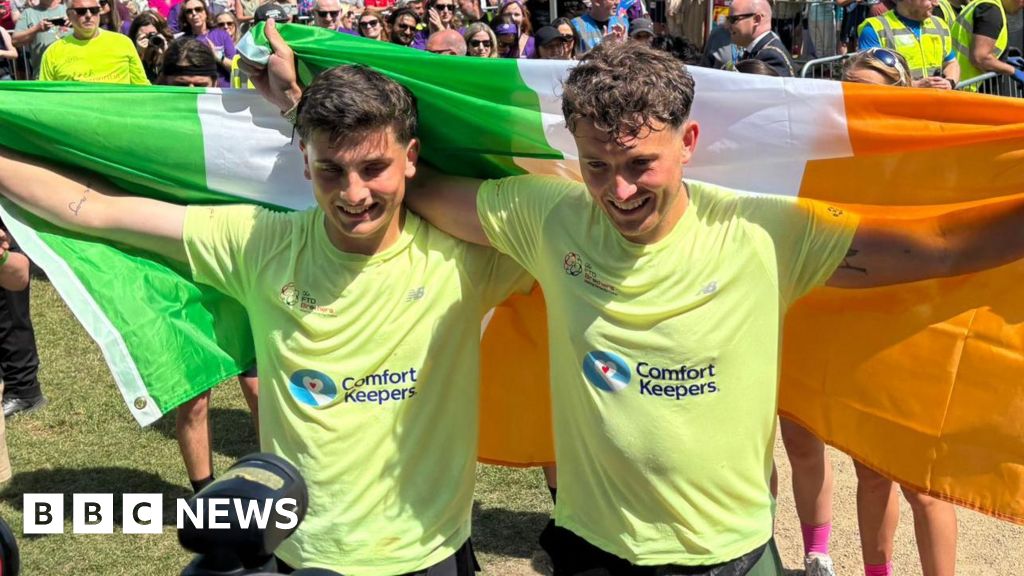
There were hugs, cheers and tears as two brothers crossed the finish line to complete a mammoth challenge of running 33 marathons in 33 days, raising £1.5m for dementia research in the process.

Jordan and Cian Adams, from Redditch, Worcestershire, were roared on by hundreds of supporters in central Dublin as they completed their final marathon.

Their mother Geraldine died at 52 after being diagnosed with frontotemporal dementia (FTD).

They also have a rare gene that causes the condition, meaning they are likely to develop it in their 40s.

The pair, known as the FTD Brothers, started their challenge by running the London Marathon before then completing a marathon in all 32 counties on the island of Ireland in the following 32 days.

Speaking at the finish line, Jordan said he walked out of hospital the day he found out that he carried the gene knowing he "wanted to make an impact on the world".

He described his mother as "beautiful, vivacious, a cool mum – you couldn't have wished for a better mum".

Jordan later told the crowd that he will lose his life "starting more than likely in my mid to late 40s".

"That hand you get dealt can consume you or you can walk through a door where you can use it as a powerful message to the world," he said.

"To show that no matter the time you have here or the cards you've been dealt, you have a choice of how to play your hand."

After leaving the finish line, they met Tánaiste (Irish deputy prime minister) Simon Harris, and other ministers, and were thanked for their work raising awareness of FTD.

An Irish government spokesperson said the ministers committed to looking at further support for people with dementia in Ireland, including exploring the potential for a National Expert Centre focused on early detection, research, and therapies.

The brothers set off on their final marathon at about 09:30 local time in north Dublin, before crossing the finish line in Merrion Square at about 14:30.

They were cheered on by hundreds of spectators in the park, and crossed the finish line accompanied by friends and family including sister Kennedy Frampton, while dad John and grandfather Glenn also watched on.

Their challenge began with the London Marathon where Jordan ran with a fridge strapped to his back.

Ahead of that feat, he told the BBC he wanted to do something different and "get other people who don't know about our story asking questions".

They then travelled to Ireland to start their marathon odyssey across the island the next day.

The brothers also received a letter of congratulations from the Prince of Wales, who wrote that he was "incredibly impressed with your inspiring journey and ambitious challenge to undertake 32 consecutive marathons across Ireland".

While the brothers grew up in England, their mother's roots are in Ireland where a number of her family members have also been affected by FTD.

Cian said the multiple marathons had given the two brothers the opportunity to connect again with relatives in Ireland, where their mother had taken them "numerous times as a child".

"It is really good to go back to Longford and Leitrim, go back to where our granddad went to school, where our nan grew up, it was very special."

Speaking to BBC Radio Ulster's Good Morning Ulster programme before setting off, Cian said they were "shattered" while Jordan said it had been a "tough 33 days".

Sunny weather accompanied them in Dublin, as did supporters, with people encouraged to join the run, in limited numbers to manage safety, in its early stages.

For the final 10km, only friends and family were permitted to join Jordan and Cian as they raced to the finish.

Glenn Adams, their dad, was among those at the finish line – he said his sons were "not anything really other than normal working-class boys from a small town in the Midlands".

Their grandfather John said: "It's hard to put into words how proud I am of them. They are wonderful."

He said the gene of grit and determination is a gene that is inherited "right through the family".

John accompanied his grandchildren during most of their marathon challenge across the island of Ireland, while also going back to England to look after his partner who has dementia.

When describing the people of Ireland he said they "were so generous, every person I've spoke to had been so kind".

Kennedy Frampton, the brothers' sister, said she was "so grateful they haven't let this [the diagnosis] overcome them".

"They actually make every day count and I'm so proud of them."

📰 மூல செய்தி (Source): https://www.bbc.com/news/articles/c4g4yn2rpyjo?at_medium=RSS&at_campaign=rss

முக்கியச் செய்திகள்

Covid era gave Arteta space to revive Arsenal, says Kroenke

Published

on

Stan and Josh Kroenke have had majority control of Arsenal since 2018

Arsenal co-chair Josh Kroenke says behind-closed-doors football during the Covid-19 pandemic allowed manager Mikel Arteta "space" to help revive the "sleeping giant".

The Kroenke Sports and Entertainment (KSE) group took full control of Arsenal in 2018 but it has not always been easy, with fan protests at how the club was being run taking place during their tenure.

The Kroenkes hired Arteta in 2019, giving the former Arsenal player his first senior managerial role after a period of uncertainty at the club.

It took time for that vision to take hold with two eighth-placed finishes, despite a 2020 FA Cup win, leading to some questioning whether Arteta was the right man for the job.

But now the Spaniard has transformed the club after six-and-a-half years in charge and has led the Gunners to their first Premier League title in 22 years.

And in a wide-ranging interview, Kroenke talked about:

How the pandemic meant that Arteta had time without fan pressure

The Gunners' summer plans to strengthen to "stay top of the mountain"

Being on his hands and knees watching the video assistant referee decision against West Ham

And how the culture has changed at the club

Giving a manager their first senior job in football is always a risk, but Kroenke says Arteta's character made it clear that he was the right candidate to succeed Unai Emery in December 2019.

"Anybody that gets a chance to be around Mikel, you can buy into what he's selling pretty easily," Kroenke said.

"So I don't want to give myself or my father [Stan Kroenke, founder and chairman of KSE and co-chair of Arsenal] any credit.

"I think Mikel and his staff and our players are the ones that earned those rights to have the patience in those moments by the amount of work and energy they were putting in behind the scenes."

Arteta won the 2020 FA Cup but finished eighth in a league affected by the Covid-19 pandemic, which meant games were played behind closed doors.

"I don't know if I would ever acknowledge it, or Mikel or anybody – there was something about Mikel having a little bit of what I would say 'space' during Covid when there weren't fans around." Kroenke said.

"There were some growing pains that went on during matches, different moments, and obviously we won the FA Cup, but to not have that extra pressure of fans being on top of you at different points in time when we were going through different growth phases was probably something I don't think any of us would acknowledge in the moment.

"But, looking back I think we can say 'maybe that was a little bit of a benefit'."

'It's been written' – Arsenal players look ahead to UCL final

It has not always been an easy transition for the Kroenkes, who took full ownership of the club in 2018 after being shareholders since 2007.

There was a "We Care, Do You?" movement from supporters who called into question the owners' commitment to the club.

"There was a lot of heavy lifting going on behind the scenes at the club at that point in time," Kroenke said.

"We went through a big transition from Arsene [Wenger], obviously a legendary person and manager.

"Transitioning to a new era after 22 years was going to be difficult.

"One: it was taking the club private that summer.

"Two: You had a legendary manager moving along, us trying to reinvent ourselves.

"Third: An underestimated thing for me on the back end was [chief executive] Ivan Gazidis' departure.

"For a club of our stature, change is going to be healthy but that was way too much change in way too short of a period of time."

In the early period of running the club, Arsenal found themselves – in Kroenke's own words – "straddling strategies" as they chased Champions League qualification and trophies.

Kroenke flew to Baku and saw Arsenal lose 4-0 to Chelsea in the 2019 Europa League final which was the moment when he says he and his father had to "accept" where the club was after watching the "worst 45 minutes of the season".

"Seeing that happen was the first time where I came back from that trip and I told my dad that I think we need to really embrace where we are," Kroenke said.

"Now that we have 100% of the club, we might need to take a step back to go forward at some point."

But, in that low moment, one of the bright lights of Arsenal's next generation emerged in a conversation with soon to be departing academy manager, and former player, Per Mertesacker.

"After the final in Baku, I made a comment about Virgil van Dijk, who had arrived at Liverpool a year or two before," Kroenke said.

"I said 'how do we get one of these guys into our system'. [Mertesacker replied] 'Well unless you've got 100 million quid, you better not be thinking about him'.

"I said 'who's the best young defender in Europe?'. He turned without hesitation and said 'William Saliba'."

Saliba joined Arsenal aged 18 in July 2019 for £27m from Saint-Etienne, going on to become a key member of their title-winning side.

Kroenke spends a lot of time flying to and from the United States, which can mean some early rises to watch the Gunners play.

"If there's any way they could do away with the 12.30, 12.45 kick-off… the 4am wake-up is not fun in the United States." Kroenke joked.

"There were some big highs and some tough ones as well. That's when you wish you were with someone else, at least to talk to."

Another big moment Kroenke experienced in the US was the season-defining video assistant referee (VAR) decision that saw West Ham's late goal ruled out, three games from the end of the season, as Arsenal moved closer to the title.

"I was on my hands and knees in my living room. It was a moment where I think every Arsenal supporter worldwide held their breath," said Kroenke.

After Arsenal's first league title for more than two decades was confirmed, tens of thousands of supporters rushed to Emirates Stadium to celebrate.

"I knew we were a sleeping giant that we needed to awaken in some way." Kroenke said.

"We haven't had a team, a squad like this in the social media age. Social media evolved and the Twittersphere and everything else around it.

"The instantaneous information, the 'Banter Era' – I'm aware of all this. I turned 46 last week.

"I've grown up around this and I've seen it all from my own perspective. I think that's what I'm so proud to see. There was almost a time when you were a closeted Arsenal fan."

But this success does not mean the end of the journey for Kroenke and his vision for the club, with the Gunners playing Paris-St Germain in the Champions League final on Saturday.

"I think I can think back and say that our stated goal was winning the Premier League, because if you can put yourself in contention for the Premier League, you're in contention for everything else." Kroenke said.

"Should we get a great result on Saturday, it's not going to change or affect who we are. When you win something, the sun's still going to come up the next day.

"You've got to get back to work and there are many teams trying to gain on you, including some historically great ones around the Premier League.

"So, we're going to look to strengthen because we know that teams around us are going to get better. If you're not trying to continually evolve and improve, you're standing still."

Latest Arsenal news, analysis and fan views

Ask about Arsenal – what do you want to know?

📰 மூல செய்தி (Source): https://www.bbc.com/sport/football/articles/c62e157w9kro?at_medium=RSS&at_campaign=rss

Continue Reading

முக்கியச் செய்திகள்

Gaza City hospitals say several killed in strike, as Israel targets Hamas leaders

Published

on

At least 10 people, including five children, were killed in an Israeli strike on a building in Gaza City late on Wednesday, according to local hospitals.

The target of the attack appeared to have been a local Hamas battalion commander Imad Asleem, who was killed alongside his teenage daughter Israa and buried on Thursday.

The Israeli military has released a short statement saying it struck "two central Hamas terrorists in the northern Gaza Strip", without disclosing their identities.

It is the latest Israeli strike targeting senior Hamas figures in Gaza in recent days.

Footage from Thursday's attack showed a badly damaged residential building in central Gaza City and destroyed tents in a neighbouring displaced people's camp.

Around 20 people were reportedly injured.

Raslan Bajou, who was asleep in his tent at the time of the latest strike, said: "This is a sin, I swear it's a sin."

He told BBC News his "neighbours were in pieces" as he described the chaotic aftermath of the attack in which his wife was injured.

"We didn't know what was going on," said Um Azzam al-Zaim, whose relative was visiting her for the Muslim Eid al-Adha holiday.

She continued: "We were soaked when a water tank on the roof above was hit.

"Our tent broke and rubble fell on me from outside. It was difficult for us to get out of the tent."

Um Azzam said that she had seen the bodies of children who had been blown off the top of the neighbouring building after gathering there to share their Eid chocolates.

Pictures from Gaza City on Thursday showed a large funeral procession taking place, with a body wrapped in the flag of Hamas carried on a stretcher through the crowds with a gun placed on top of it.

Several people were seen waving green flags, the colour associated with Hamas.

The Gaza City attack came a day after the newly chosen head of the Hamas military wing, Mohammed Odeh, was killed along with his wife and two sons in an Israeli strike. One other woman was reportedly killed.

On 15 May, Israel killed Odeh's predecessor, Izz al-Din al-Haddad.

Israel has targeted a long list of Hamas leaders since the start of the Israel-Gaza war.

On Wednesday, Israeli Defence Minister Israel Katz wrote on X that his country had "pledged to eliminated everyone who led the October 7 massacre" in 2023, adding: "We pledged that Hamas will not rule Gaza civilly or militarily."

The Israeli military has also said a strike on a car in Khan Younis on Tuesday killed Ihab Khrizim, the head of a Hamas funds transfer network, and Mohammed al-Habash, a unit commander in Hamas's production headquarters who was said to have been involved in weapons manufacturing.

Another Israeli attack on the same day killed at least five Palestinians in al-Meghazi refugee camp in central Gaza, according to a local hospital.

The strikes come at a critical time when Israel and Hamas remain deadlocked in indirect, US-brokered talks to advance President Donald Trump's peace plan for Gaza.

The next steps involve the Palestinian armed group giving up its weapons and Israeli troop withdrawals.

About 1,200 people were killed in the 2023 Hamas-led attack which triggered the Gaza war and 251 others were taken hostage.

Israel responded by launching a massive military campaign in Gaza, which reduced much of the Palestinian territory to ruins and left many of its 2.1 million residents displaced.

Israeli forces have killed more than 72,800 people in Gaza, according to its Hamas-run health ministry, whose figures the UN considers reliable.

📰 மூல செய்தி (Source): https://www.bbc.com/news/articles/cn9p40en4ngo?at_medium=RSS&at_campaign=rss

Continue Reading

முக்கியச் செய்திகள்

Learning from Ukraine, Hezbollah is now using fibre-optic drones to hit Israel

Published

on

Fibre-optic drones have become Hezbollah's primary weapon against Israeli soldiers and civilians, along both sides of the Lebanese border, and are now seen as the biggest threat there, as fighting continues six weeks into a supposed ceasefire.

One Israeli soldier was killed and two others injured in a drone attack near the Israeli border community of Shomera on Wednesday.

Of the 11 Israeli soldiers and one civilian defence contractor killed since the ceasefire came into force, eight have been killed by fibre-optic drones.

Most of the attacks have targeted Israeli forces, which are currently occupying a large area of southern Lebanon, but Hezbollah is also increasingly attacking Israeli communities across the border, according to the Alma Research Center, an Israeli think tank which monitors the conflict.

It has recorded more than 100 drone attacks against communities inside Israel since the ceasefire began in April.

In Shomera, a leafy town at the western end of the border, drone attacks have left trails of fibre-optic wires along the roads – and a new sense of fear in this battle-hardened community.

"The problem is you don't feel them coming. You're sitting there, and suddenly it arrives," said Shomera's council chief, Sami Zanetti. "And if you run away, it follows you."

He showed me a bus-stop, scarred by a recent drone attack this week that struck minutes after a school bus had left.

The fibre-optic drones used by Hezbollah – also known as First-Person View or FPVs – are much harder to detect than the rockets and mortars this town is used to. The drones are loaded with explosives and fly low, without a radio signal that can be jammed by Israel's military. They are connected to their operators by a thin optical wire, which allow them to see and chase targets on the ground. It's a tactic learned from the war in Ukraine.

Several times a day, sirens sound in these frontier communities, warning of a drone crossing the border from Lebanon. Here, the warnings and the weapons come seconds apart; sometimes there's no warning at all.

"With rockets, I've got 15 seconds to go into a bomb shelter. With drones, you have no way of knowing when it will fall," Sami Zanetti said.

The alerts on our phones said a drone had been spotted, heading straight for Shomera.

From inside the public bomb shelter, we scan the sky.

Israel's army sometimes intercepts drones that cross the border, but also often loses contact with the small, low-flying devices.

This time in Shomera, the attack never arrives.

But the road we're standing in is strewn with the fine silvery filaments left from previous drone strikes.

Just the day before, members of the community's security team were filmed chasing and firing at a drone flying along this street, right next to the house of Amichai Ben David, a peach and nectarine farmer with seven children.

"[The drone] came and we rushed into the house," he told me. "The soldiers outside shot at it, and managed to knock it out of the air. They saved us, thank god."

Amichai has lived here all his life. His home has a large hole in the roof where a rocket hit the family home last year. But the drones are a new and different threat, he says.

"The missiles stopped because of the ceasefire – and the drones started coming instead. They have cameras attached – if there's a soldier in uniform, or they don't like the look of someone, it simply drops and explodes."

The Alma Research Center says Israel's military assessment is that Hezbollah has dozens of trained drone operators and that it has accumulated a significant stockpile of the small, cheaply-made drones, which cost around $300-$400 each.

"They intensified the amount of attacks across the border inside Israel," said Sarit Zehavi, who heads the center. "And I think that's a direct order from Iran, against the background of what is happening with the [US] deal. Iran wants to see a situation where Israel is attacking Hezbollah, and everything explodes, and goes back to the beginning."

"[Hezbollah's] goal is to harm as many lives as possible, and when they see that Israeli soldiers are finding more ways to protect themselves physically, then they try to harm civilians in civilian communities," said Capt Adi Stoler, a spokesperson for Israel's military. "They go outside more, they live their life, take their children to school, and if [Hezbollah] can harm them while they're doing that, that's what they'll do."

Israel's military chief of staff has reportedly called for attacks on "buildings in Beirut", in response to Hezbollah's growing use of explosive drones.

"For every drone that harms one of our soldiers," the far-right Finance Minister, Bezalel Smotrich said, Israeli forces should "bring down 100 buildings" in Hezbollah's southern Beirut stronghold.

Earlier this week, Israel's Prime Minister Benjamin Netanyahu vowed to deal Hezbollah "a crushing blow".

"It is true they are launching drones at us," he said. "We have a special team working on this, and we will solve this."

Israeli forces have been criticized for being slow to learn from the experience of troops in Ukraine, who have battled the threat of fibre-optic drones launched by Russia for the past two years.

Sarit Zehavi said Alma's researchers had warned in 2024 about fibre-optic drones becoming the next threat from Hezbollah.

"We knew this was coming because it was obvious Hezbollah would adopt the methods from Ukraine and that as we had success at intercepting rockets and became better in intercepting UAVs [unmanned aerial vehicles], that FPVs were next."

"It's a tactical problem that Israel is dealing with, it's not something we see as an existential threat," said the IDF's Adi Stoler. "But yes, these type of drones are a challenge for us. It is something we're trying to solve as soon as possible."

An Israeli military official admitted that the primary bottleneck in combatting the threat came from "gaps in weapons development".

"The response is not hermetic, and capabilities for detection and interception must continue to be developed," the official said, adding that countering drones was now a "central mission" for the Israel Defense Forces' Northern Command, with significant resources being invested.

Learning from troops in Ukraine, Israeli forces have begun covering their positions with netting to entrap and tangle the tiny drones.

And several Israeli defence companies are working on new ways to defeat Hezbollah's drone warfare.

According to the Alma Research Center, they include an advanced interceptor drone, specialist fragmenting anti-drone ammunition, and automatic firing systems with electro-optical sensors.

In one project being developed by the Israeli company, Smart Shooter, a sensor continuously scans the environment, sending information to a computer mounted on a soldier's personal weapon, which can then analyse the threat, lock onto a target, and give the soldier a firing window.

But Israel's widely-read daily newspaper, Israel Hayom, says the defensive systems developed so far are falling short, and that Israel's preferred military option for now, the paper says, is to destroy the drones in warehouses or eliminate operators before launch.

Earlier this week, the IDF put out a video showing what it says is a strike on an operator retrieving a drone in southern Lebanon.

The race to adapt on the battlefield has been sharpened by a parallel public relations war.

Hezbollah regularly releases edited footage of what it says are drone attacks on Israeli targets, underlaid with doom-laden music.

One video released this week was apparently filmed from a Hezbollah drone as it flew towards a military vehicle full of Israeli troops in the Lebanese village of Bint Jbeil. It ends with two soldiers leaping from the truck as the drone flies straight into it.

On Wednesday, the IDF issued more evacuation notices for villages, towns and cities in southern Lebanon, culminating in a sweeping evacuation or

📰 மூல செய்தி (Source): https://www.bbc.com/news/articles/c0r2ydlvk41o?at_medium=RSS&at_campaign=rss
Continue Reading

Trending

Copyright © 2024 by 7Tamil Media, All rights reserved.