Connect with us

முக்கியச் செய்திகள்

Japan defence minister denies militarism and criticises China's 'huge arsenal'

Published

on

Japan's defence minister has rebutted Beijing's claim that his country is engaging in a "new militarism" – criticising China for its military expansion and lack of transparency.

Speaking on the last day of a defence summit in Singapore, Shinjiro Koizumi argued it was actually China and its "huge arsenal" of weapons that was of "serious concern" to the international community.

His remarks were some of the most pointed yet from Tokyo in response to China's repeated criticism of Japan's military build-up under Prime Minister Sanae Takaichi.

The two countries have a long history of tensions stemming from Japan's invasion of China during World War Two.

Last week, a day before the Singapore summit began, China's national defence ministry spokesperson Jiang Bin warned "the grey rhino of a remilitarised Japan is gathering speed" and called on the international community to "work together to contain Japan's neo-militarism".

Japan has been steadily increasing its defence budget, setting spending records for 12 consecutive years. Its latest budget, approved in December by its cabinet, is for more than 9 trillion yen ($57bn, £42bn) – moving the country closer to its target of spending 2% of its GDP on the military.

The Japanese government has previously insisted it does not seek war and only wants to bolster its defences.

In his speech on Sunday at the Shangri-la Dialogue, Koizumi said it was "only natural" that every country, including Japan, updates its defences to meet new challenges and to contribute to peace in the region.

He sought to reassure the roomful of officials from Asian countries, including several that were invaded by Japan in WW2, by promising Japan would proceed "with a high degree of transparency" and engage in constant dialogue with other countries.

"What are we developing these capabilities for? And based on what thinking? Japan will move forward while making a clear explanation to the international community," he said.

Koizumi refuted the idea that Japan was engaged in "new militarism" saying it was "nothing further from the truth".

"There's a country that has a huge arsenal of nuclear weapons and strategic bombers," he said, in a veiled reference to China. "Japan has neither of these weapons. And yet Japan is labelled [with] 'new militarism'. Isn't it strange?"

Following his speech, a representative of the Chinese military asked if Japan would issue an apology to China, South Korea and South East Asian victims in WW2.

Shinjiro Koizumi sidestepped the dialogue participant's question while taking aim at China.

"China continues to increase its defence spending at a high level and is rapidly expanding its military capabilities across a wide range of areas without sufficient transparency. China's external approach and military activities are matters of serious concern for Japan and the international community," he said.

He added that "Japan's door is always open" for communication with China.

The issue of Japan apologising for wartime atrocities has long been a sticking point in the two countries' relations, with China in the past criticising some of the apologies as insufficient. Koizumi's father, Junichiro Koizumi, issued several apologies when he was prime minister.

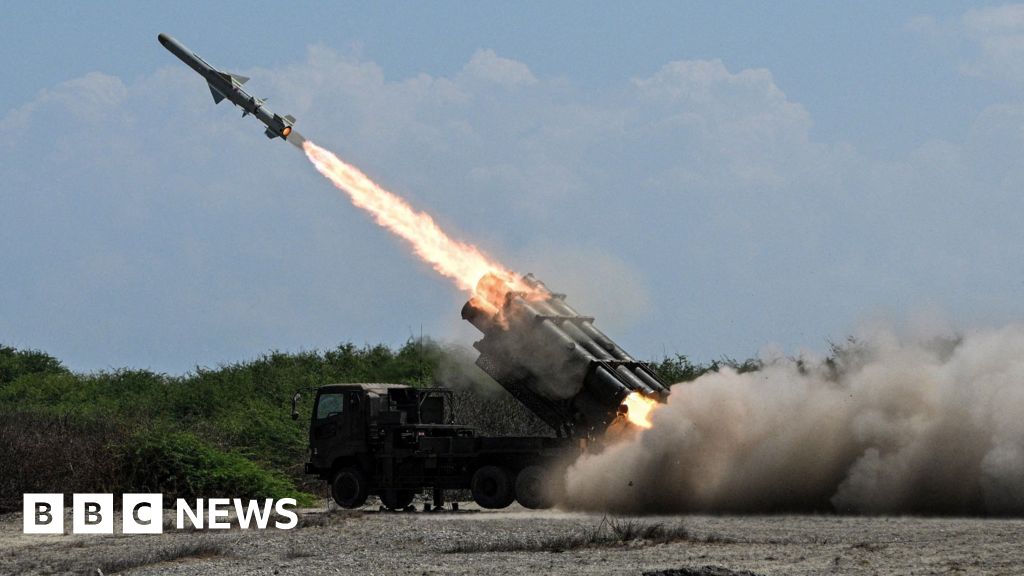
Japan's PM Takaichi has taken major steps to boost defence since taking power in October 2025. With its increased military budget, Japan plans to invest in new surface-to-ship missiles and unmanned drones deployed on land and underwater.

Japan has also recently relaxed rules that will allow it to sell lethal weapons to other countries in a move that will help build up its defence industrial base. It will also be revising key security documents by the end of this year.

Takaichi has also pushed for revising Article 9 of Japan's constitution – a pacifist clause that renounces war.

Tensions with China have escalated, peaking in November when Beijing took issue with Takaichi's suggestion that Japan could respond with its own self-defence force if China attacked Taiwan.

Takaichi's moves have also deeply divided Japan.

Some support increased defence against potential threats such as China, while others fear it could escalate the possibility of confrontation.

There has also been fierce debate over whether Japan is moving away from its post-war pacifism, a core part of the national identity.

In recent months, anti-war protests have been held across the country, with some swelling to become Japan's largest in decades.

📰 மூல செய்தி (Source): https://www.bbc.com/news/articles/cp8p4ejy8ppo?at_medium=RSS&at_campaign=rss

முக்கியச் செய்திகள்

How Putin became master of the image

Published

on

Throughout his time as Russian President, Vladimir Putin has been alert to the power of visual imagery.

The first time I interviewed him in 2001, an aide swooped in just before the cameras went live and snatched away the small water glasses on the table in front of us.

"We wouldn't want anyone to think they were for vodka," came the reply. "And anyway, we can't risk a glass spilling live on TV. Television is a nuclear bomb when it comes to publicity."

"Everybody in Russia, but especially Putin, realised that TV was the key to the consolidation of power," says the author and political analyst Peter Pomerantsev.

Over the years, Putin has transformed Russia from a fragile emerging democracy into a largely authoritarian state revolving around himself as president. He has also dramatically transformed himself.

Early photos show him as a slight, reticent figure who seemed wary of the camera. So how did this seemingly quiet, retiring child and self-effacing bureaucrat turn into a president who so avidly embraced the limelight?

His keen interest in the power of image far predated his rise to power. Like most youngsters growing up in the 1960s and 70s, Putin was a child of the television age. His role models were the spy heroes of popular Soviet TV series and movies. By his own admission, these strong, silent double agents battling against enemies of the Soviet state were what inspired him to seek a career in the KGB, the Soviet Union's intelligence agency.

As a KGB operative and then an assiduous apparatchik, he avoided attention. But when in 1999 he was catapulted into the role of acting president and a few months later elected president, he and his PR advisers showed themselves acutely aware of the importance of visual imagery in shaping his presidential persona.

Part of the image-making process was to edit out what was unhelpful. So Putin came across as a virtual teetotaller. At annual meetings with foreign policy experts at the Valdai Discussion Club, he would stick to a cup of tea with honey while they were served fine wines.

On occasions when he did have a drink, his minders tried to keep it under wraps. I once met the custodian of a local museum who told me how he had sat down with the president to enjoy some Russian pancakes smeared with vodka to give them an extra kick. "But don't tell anyone," he implored me. "They were very strict about it. I might get into terrible trouble."

Another part of the plan was to drum home the message that he was nothing like his predecessor, Boris Yeltsin, whose public displays of inebriation had dismayed and embarrassed many Russians.

Putin donned a pilot's helmet to fly a fighter jet. His prowess at judo was displayed. All to communicate that this was a vigorous, healthy man of action, not an ailing drunkard.

Most notorious of all, perhaps, were the series of photos starting in 2007 showing him bare-chested, riding a horse like a Russian Marlboro Man, or fly fishing in a river, or flexing his muscles in a vigorous butterfly stroke.

Was this for real? Or was there a kind of knowing humour to the images? Pomerantsev thinks the people in charge of his PR knew exactly what they were doing.

"For one audience, this is very crass, but we're going to do it in an ironic way, so that it's kind of cool. For another audience, it was that Russia should be led by a traditional hardman hero."

He adds: "Putin was playing this sort of very, very, I suppose, traditional Soviet leadership role, but he was doing it in an era of the reality show, MTV and sugar daddies."

"Putin is the trendsetter," says Fiona Hill, a Russia specialist and adviser to US presidents. "He has shaped the image of the first populist president, the first acclaimed strongman of the 21st Century."

Certainly, Putin was sending different messages to different audiences. To the outside world, it was to signal that Russia was no longer weak but a power to be reckoned with. A bear with teeth and claws, as he once put it.

Other extravagant displays were even more incongruous, perhaps reflecting something of the Leningrad schoolboy who was at last able to live out childhood fantasies: scuba diving to "discover" carefully placed relics at the bottom of the Black Sea; being harnessed into a motorised hang glider to soar high in the sky flanked by endangered cranes; and petting a Siberian tiger cub.

Putin himself claimed that the point of all this was to raise environmental and scientific awareness. But did he realise that these stunts verged on self-parody? Or did none of his aides by now dare tell him so? Or did he simply not care anymore what others thought?

Early photos of Putin, like the one in his ID card from 1985 for the Stasi (the East German secret police), suggest a steely resolve behind the mask – a deliberate reticence no doubt well suited for a KGB role and further honed by KGB training.

After the USSR collapsed at the end of 1991, he recast himself as a government official with a reputation for loyalty and efficiency, initially serving the mayor of St Petersburg, then – after a move to Moscow – Yeltsin's presidential administration. In photos of that period, he is usually at the back or side of the picture, never looking into the camera, never centre stage.

Nina Khrushcheva, the great-granddaughter of the Soviet leader, Nikita Khrushchev, said she was told in the 1990s that in KGB circles, he was known as "the moth", a man who could hide anywhere he wanted, a man in the shadows.

But when he became president, it was a different story. He seemed to welcome the opportunity to don different roles.

A few years later, when he was photographed for Time magazine's Person of the Year award in 2007, he instinctively settled back in his chair and looked down the lens of the camera, like a tsar on a throne or a menacing mafia boss.

"He was performing power for me," says Platon, the Time photographer who took the picture. "As far as I know, Putin loves these images. Many of his supporters love the pictures. They show him as a tough nationalist."

It was what Pomerantsev calls "a postmodern version of authoritarian propaganda," with Putin playing out all the roles like a performance artist.

And the various guises of a strongman which he adopted were reflected in his policies. To make Russia strong again, Putin argued there needed to be more order, more oversight from above. So, step by step he tightened control over Russian society, reducing the space for free expression and criticism, turning the Duma into a rubber-stamp parliament, marginalising or eliminating political opponents and lashing out at Western powers for failing to show Russia enough respect.

His hyper-macho topless photoshoots have been picked over endlessly as a reflection of his confidence. But maybe these images also tell us something about his insecurities: his desire to reassure everyone, including himself, that he was still the main man, as fit as he'd ever been.

After 2008 when he stepped back from the presidency to become prime minister for four years, attention-grabbing photos such as these also signalled that he, rather than President Dmitry Medvedev, was the real power in the land.

In 2011 came a dramatic visual change that also marked a pivotal point on his political journey. He suddenly appeared in public with a new fuller, puffier face, more immobile and inexpressive. It was mystifying. Was this a sign of steroid treatment for some illness? Or had he resorted to Botox in his quest to stave off signs of decline and old age?

A few months later he ran for the presidency again. The outcome was never in doubt, but at the open-air rally to declare his victory, his new face could be seen streaked with tears.

I concluded the weeping was genuine. His voice was also hoarse with emotion. It looked like relief that all had gone according to plan, despite widespread protests ahead of the election, when – astonishingly – some protestors had dared raise slogans calling for h

📰 மூல செய்தி (Source): https://www.bbc.com/news/articles/cddpl33v247o?at_medium=RSS&at_campaign=rss
Continue Reading

முக்கியச் செய்திகள்

The Papers: 'Agony for Arsenal' and '5 cops axed' at Kensington Palace

Published

on

The Sunday Times says US court documents show a man suspected of planning attacks against the Jewish community in London met Iran's supreme leader, three days before the Ayatollah was killed. Mohammad Baqer Saad Dawood al-Saadi is alleged to have directed attacks "in real time", through a smartphone app, from a bunker in Iraq, according to the paper. It says the documents described al-Saadi and Ali Khamenei's relationship as "close".

Sir Keir Starmer has been accused of "going easy" on benefit fraud to prevent the system from collapse, according to the Sunday Telegraph. The paper says the number of Personal Independence Payment claimants has risen to record levels and new rules will soon allow people aged over 25 to receive support for four years after an initial assessment. The Telegraph has seen minutes from a government meeting, in which officials warn the system will "fall over" if capacity pressures are not addressed. A government spokesperson tells the paper the changes are helping health professionals spend more of their time where it's needed.

The Sunday Mirror says Technology Secretary Liz Kendall, has given the strongest hint yet that a social media ban for under-16s could be introduced within weeks. She has told the paper that nine out of 10 parents who responded to a government consultation called for tougher age limits. Kendall is quoted as saying "a ban is definitely on the table".

The Sunday Express says food and drink manufacturers have warned a soon-to-be-announced trade deal with the European Union would make rising prices at the checkouts worse. The Food & Drink Federation claims that while it would lower prices in the long run, costly short-term changes would be needed to line up with the new rules. A government spokesperson tells the Express its food and drink deal could bring more than £5bn into the economy.

A report in the Mail on Sunday says an upcoming biography of the Reform UK leader, Nigel Farage, claims he was "banned" from appearing on BBC Radio 4's Desert Island Discs. The book – by the Conservative peer Lord Ashcroft – quotes an unnamed BBC source as saying Farage has "effectively been blacklisted" and is "instinctively regarded as unacceptable" by many staff. The Reform leader tells the Mail he expects "nothing less". The BBC says it does not ban any individuals from the programme.

The leader of the Conservatives Kemi Badenoch has written in the Sunday Telegraph to say future party MPs would not be, as she puts it, "glorified social workers". Badenoch says politics has become a stage, when it needs to be a workshop. She adds that future candidate selection for her party will focus on the five Cs – cleverness, charisma, communication skills, conviction and Conservatism.

Sign up for our morning newsletter and get BBC News in your inbox.

📰 மூல செய்தி (Source): https://www.bbc.com/news/articles/cjdpvz55lx2o?at_medium=RSS&at_campaign=rss

Continue Reading

முக்கியச் செய்திகள்

Streeting suggests NI cut and North Sea drilling

Published

on

Former Health Secretary Wes Streeting has suggested cutting employers' National Insurance (NI) could be a way to incentivise businesses to hire more young people.

In an interview with the Sunday Times, he also said some new North Sea drilling for oil and gas should be allowed as it would raise more tax.

Since quitting the cabinet just over a fortnight ago, Streeting has been distancing himself from policies pursued by Sir Keir Starmer's government.

The former minister, who says he will challenge Sir Keir in any Labour leadership contest, has already said the UK's future lies "one day back in the European Union", and called for what he described as a "wealth tax".

Now Streeting has floated the idea of a "targeted" cut to National Insurance to tackle youth joblessness.

It follows the publication this week of the review by Alan Milburn into the rising number of young people not in education, employment or training, known as NEETS.

"We have to make it easier for business to employ young people and for businesses to take that risk on someone," Streeting told the Sunday Times.

"I think we should be thinking actively about how to incentivise, whether that's through targeted reduction in employers' National Insurance or other kinds of recruitment and retention incentives," he said.

Labour's first budget after winning the 2024 election hiked taxes with the specific aim of investing in public services.

The rate of National Insurance paid by employers was increased from 13.8% on each employee's salary to 15%. The starting threshold it applies to was lowered from £9,100 to £5,000.

The measure aimed to raise £25 billion a year. The National Health Service, which Streeting oversaw until he quit earlier this month, was one of the principal beneficiaries.

But while Streeting has floated lowering employers' NI he did not, in his remarks to the newspaper, suggest any cuts to NHS spending.

During his review, Milburn said employers had told him Labour's policies of increasing NI and the minimum wage had disincentivised them from hiring young people.

But, he said, the Low Pay Commission which has been monitoring the situation "has concluded that there isn't one straightforward impact" on youth employment rates from the tax and wage increases.

The NEET problem was not triggered two years ago, Milburn said. "It's been going on since time immemorial."

Sir Keir's government points out that many young people are already exempt from NI, as employers do not pay NI if their workers are under 21 years old unless that person earns more than £50,000 a year.

And it says it has made it a priority of implementing the "biggest youth employment reforms in a generation" to help half a million young people find work.

New measures such as a "youth jobs grants" will give £3,000 to employers for every person aged 18 to 24 that they take on who has been on benefits and looking for a job for six months or more.

Streeting, meanwhile, has also sought to differentiate himself from Sir Keir over the issue of whether new drilling for oil and gas should be allowed in the North Sea.

Labour's 2024 manifesto said "we will not issue new licences to explore new fields because they will not take a penny off bills, cannot make us energy secure, and will only accelerate the worsening climate crisis".

The Conservatives and Reform UK have been pressuring Sir Keir to approve more drilling, saying it is "reckless" that the country is not making use of its own resources at a time when the Iran war has sent energy prices higher.

The Energy Secretary Ed Miliband has been considering whether to allow drilling in two fields, Jackdaw and Rosebank, where applications had already been submitted before Labour took office and so, it could be argued, are not 'new' projects.

Streeting indicated to the Sunday Times he is in favour of new licences and the government should approve them. "Yes. I think that's probably where Ed will get to. When he makes a decision, I'd be surprised if that wasn't the case".

"The granting of those licences will not necessarily translate into cheaper bills, but it will translate into higher tax receipts," he added.

Sir Keir's clear view is that oil and gas will continue to be extracted from the North Sea and used in the UK whatever happens with these licences.

But, to have cheaper bills and secure energy supplies in future, he says the country needs to transition towards renewable sources including solar and wind power backed by nuclear generation.

📰 மூல செய்தி (Source): https://www.bbc.com/news/articles/cy42z03r18xo?at_medium=RSS&at_campaign=rss
Continue Reading

Trending

Copyright © 2024 by 7Tamil Media, All rights reserved.