Connect with us

உலகம்

Israel’s war creating a ‘lost generation’ of Lebanese students

Published

on

Israel’s war on Lebanon has displaced hundreds of thousands of students and teachers, and is the latest crisis facing the country’s education system.

Beirut, Lebanon – Israel’s war has created a lost generation of Lebanese students, widening societal disparities and, in turn, damaging national unity, experts have told Al Jazeera.

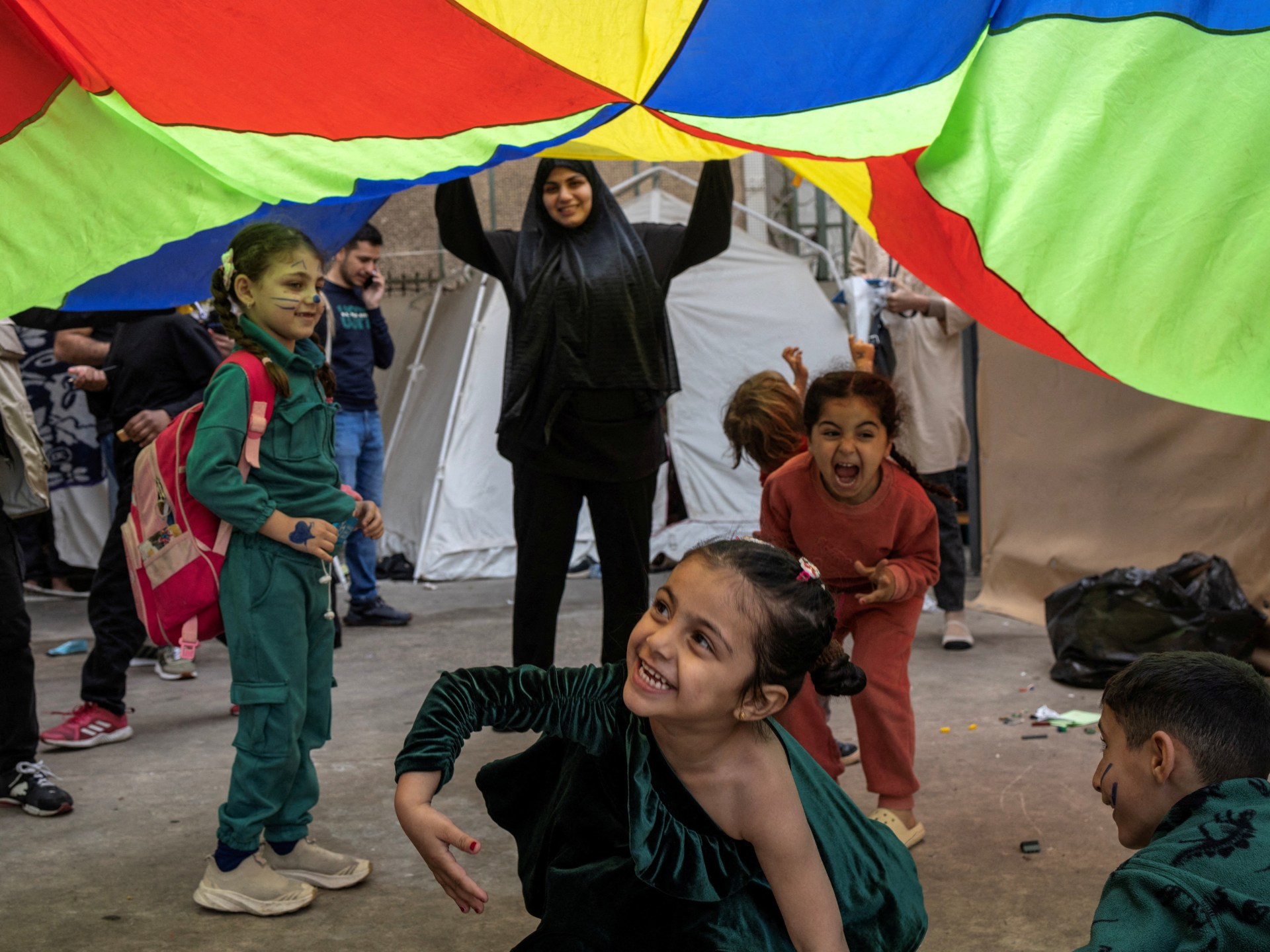
Israel has destroyed schools across southern Lebanon and displaced hundreds of thousands of students. Hundreds of educational institutions have turned into makeshift shelters for thousands of displaced people, causing a compounding series of disruptions to an education system that was already struggling as a result of a debilitating economic crisis.

Schools in Lebanon have responded by using online learning and other programs to reach students, but education experts in the country said many were still falling through the gaps. And in an effort to catch up on all the lost schooling, the focus has been on subjects such as the sciences and mathematics, with topics such as citizenship ignored.

In a country like Lebanon, with its numerous religious sects, that could lead to a dangerous future.

“The mission of an education system is to build citizens,” Carlos Naffah, an academic researcher, told Al Jazeera.

“We don’t want to face the fact that we lost a generation,” said Naffah.

On March 2, Israel intensified its war on Lebanon for the second time in under two years. It came on the back of Hezbollah’s first response to months of unanswered Israeli attacks on Lebanon, including more than 10,000 violations of the November 2024 ceasefire between the two sides.

Since March, Israeli attacks have displaced more than 1.2 million people in Lebanon, among them 500,000 school-aged children, according to UNESCO. Not only are hundreds of thousands of students displaced, but many of the schools they learned in are no longer accessible.

According to UNESCO, 339 schools are located in warzones in Lebanon, while hundreds more are now acting as collective shelters to the displaced, affecting access to education for another 250,000 children. Another 100 schools are in high-risk areas, meaning they could soon become inaccessible to students.

With so many students out of school, some learning institutions have turned to online learning. But education experts said this had its drawbacks, particularly for students from lower-income families, and that a series of compounding crises has meant that every year of schooling since 2019 has been interrupted for one reason or another.

“Hybrid learning has become the de facto norm in Lebanon over the past several years due to continuous instability, from the October 2019 revolution to COVID-19, the economic crisis, and now the ongoing war,” Tala Abdulghani, a senior researcher at the Asfari Institute for Civil Society and Citizenship, told Al Jazeera. “However, it has often proven ineffective, particularly for vulnerable students, due to limited internet access, electricity shortages, lack of devices, and unstable living conditions, leaving many children unable to consistently access education.”

Other solutions have also been put forward by the Ministry of Higher Education, in coordination with UNESCO, including opening multiple shifts to public schools and setting up temporary learning centres. They have also worked on integrating psychosocial and mental health services for students.

“Children are losing routine, stability, friendships and normal life,” Maysoun Chehab, senior education programme specialist at UNESCO, told Al Jazeera. “Many are carrying trauma, anxiety, fear, uncertainty over repeated displacement, exposure to violence, being around violence and listening to the news, and prolonged instability.”

Experts said the Ministry of Education and other NGOs are providing support to students where they can, but Lebanon’s economic crisis and a global reduction in humanitarian support have made it more difficult for families to find solutions.

“Poverty has dramatically increased, placing additional pressure on families already struggling to survive,” Chehab said. “Families face impossible choices between paying for transportation, food, heating or keeping kids connected to their education by the internet.”

Chehab said that those choices lead to some students dropping out, which in turn increases cases of child labour and child marriage. “All this is happening when humanitarian funding is under immense strain and educational emergencies are one of the most underfunded worldwide,” she added.

Even before the start of hostilities with Israel in October 2023, Lebanon’s education system was in bad shape. The economic crisis in particular has seen an erosion of the country’s once thriving middle class, with Lebanon’s Gini coefficient, which measures income inequality, rising from 0.32 in 2011 to 0.61 in 2023, according to the Lebanese Center for Policy Studies. According to a 2024 study by ESCWA (PDF), Lebanon was in the top 1 percent of most unequal countries in the world, and that is all before the latest Israeli attacks.

“The war has had an uneven impact across the country, in which we’re seeing a growing educational inequality where geography and socioeconomic status increasingly determine whether a child can access learning at all,” Abdulghani said. “In the south, many students have stopped going to school entirely because of displacement, insecurity, and schools being located in active conflict zones.”

While students and school-age children are among the primary victims of the war, the education system is also being deeply affected by the pain being suffered by teachers as a result of the fighting.

“What we are witnessing is the emergence of a deeply unequal education where some children are continuing their education while others are experiencing prolonged interruptions, learning loss, trauma, and isolation,” Abdulghani said. “This is on top of economic barriers, the collapse of infrastructure, limited access to remote learning, and the immense psychological toll the war has had on children and teachers alike.”

Lebanon’s public sector teachers have fought for livable wages for years. With low salaries, many take on additional workloads, such as tutoring. Recent years have been particularly brutal on teachers as the economic crisis and currency devaluation meant their already meagre salaries decreased by about 80 percent.

“Teachers are the backbone of any education system, and they are paying a tremendous price,” Chehab said. “From 2019 onwards, 30 percent of the sector left the country or changed professions entirely.”

Among those displaced by the war are many teachers, who, in addition to facing economic difficulties, are facing threats to their lives.

“Education systems may survive one shock, but these are overlapping shocks ongoing for years,” Chehab said.

Most experts believe the current minister of education, Rima Karami, is competent, but said that numerous structural factors, including the ongoing economic crisis, political corruption, and the shortage of humanitarian aid, mean that a lot more needs to be done, requiring what one researcher called “out-of-the-box thinking”.

“The fear is that without serious nationwide intervention, these disparities will have long-term consequences and leave an entire generation further behind,” Abdulghani said.

📰 மூல செய்தி (Source): https://www.aljazeera.com/features/2026/5/12/israels-war-creating-a-lost-generation-of-lebanese-students?traffic_source=rss

உலகம்

Protesters torch cars, buildings in Belfast after knife attack

Published

on

Unrest comes after a Sudanese man was arrested over a stabbing attack in north Belfast, UK.

Belfast plunged into chaos as vehicles set ablaze following stabbing attack

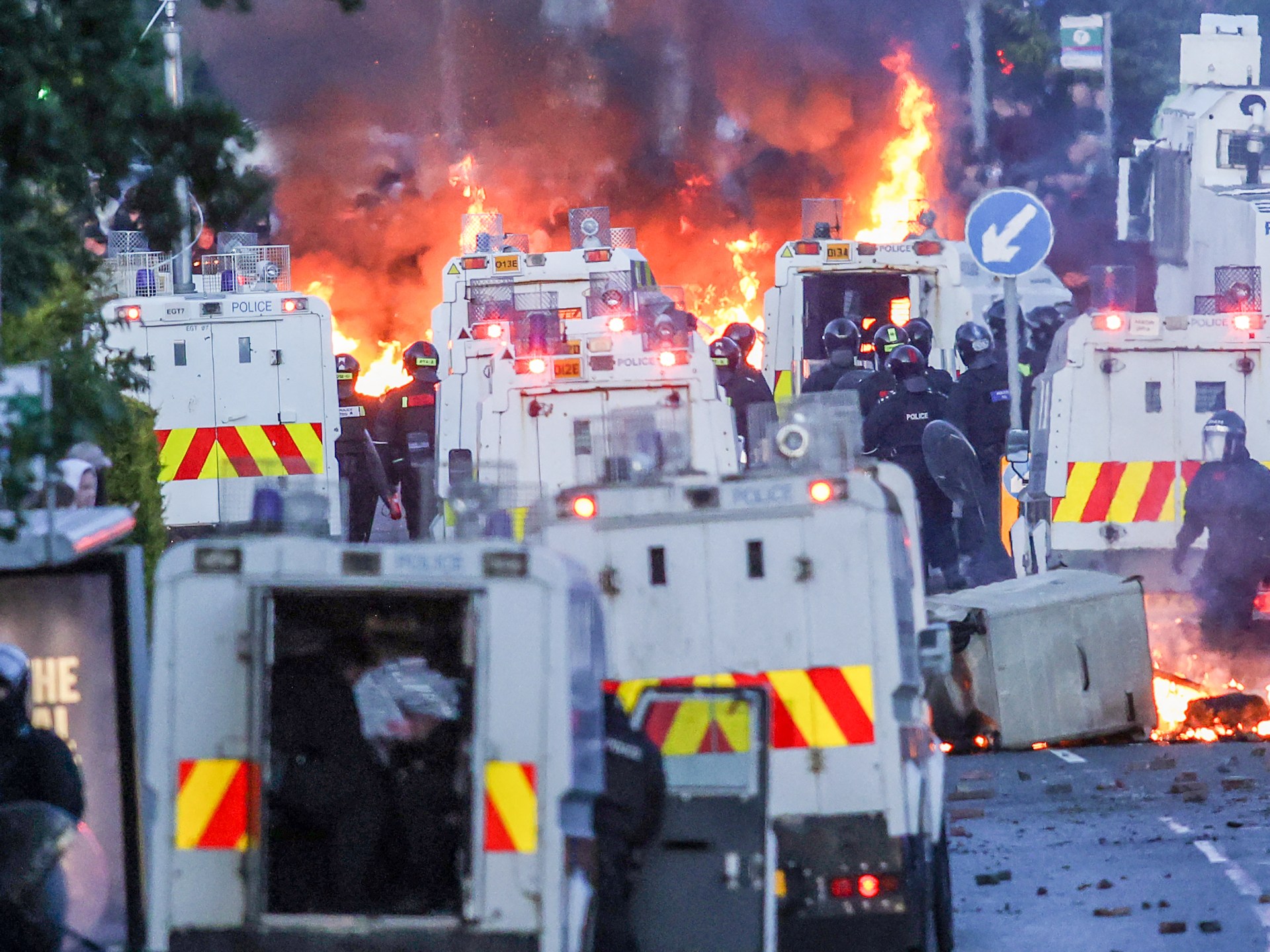
Anti-immigrant protesters in the city of Belfast in the United Kingdom have torched vehicles and buildings after a Sudanese man was arrested over a knife attack that left one person with serious injuries.

Hundreds of protesters, many of them masked, gathered at several locations across the city on Tuesday, setting fire to a bus and several cars.

A building near the city centre was also set alight, with residents telling the AFP news agency that the protesters started a fire in the bins and went on to throw petrol bombs.

Crowds also gathered in Antrim, about 25km (15 miles) west of Belfast.

Michelle O’Neill, the first minister of Northern Ireland, slammed the protests and urged calm.

“Groups of masked men burning families out of their homes is nothing less than disgusting cowardice,” she wrote on X.

“Racism, intimidation and violence are wrong wherever they occur. There can be no excuse and no justification for these attacks tonight. No one wants to see this on our streets and I again appeal for calm”.

The suspect in the knife attack, which took place in north Belfast late on Monday, was charged late on Tuesday with attempted murder, possession of a bladed weapon in a public place, and making threats to kill.

The 30-year-old man, whose name has not been released, is due to appear in court on Wednesday.

The victim, a man in his 40s, suffered significant injuries to his eyes and slash wounds to his face and back during the attack with a kitchen knife found at the scene, police said.

“I understand that last night’s attempted murder will leave people feeling a range of emotions, from fear to anger,” Northern Ireland’s Assistant Chief Constable Ryan Henderson told ⁠a news conference, as he declared the unrest a “critical incident”.

“I appeal for calm and the safety of all of our communities in ⁠response to this”, he said.

Footage of the knife attack in north Belfast showed several members of the public trying to fight off the ⁠attacker before police arrived, and they were credited by senior officers with saving the man’s life.

UK Prime Minister Keir Starmer called the attack “horrific” and “sickening” on X. “I have absolutely no tolerance for abhorrent scenes of violence like this on our streets,” he said.

His office said that “it is time for calm”, adding: “It’s important that police have the time and space to investigate appropriately.”

The attack, which is ⁠not being treated as terrorism, comes at a time of heightened tensions in the UK following the murder of a student in Southampton who was handcuffed by police as he lay dying from stab wounds after his killer, a Sikh man, had falsely alleged a racist attack.

Although the victim and convicted killer were both British, protesters on Tuesday stood outside a Southampton hotel that had housed asylum seekers, holding signs that read, “Illegal Migration Is Destroying Our Civilisation”.

The attack in Belfast, meanwhile, sparked immediate questions about the suspect’s immigration status, including from some politicians.

Gavin Robinson, the leader of the Democratic Unionist Party, urged authorities to curb “uncontrolled immigration”, while anti-immigration figures, including Reform UK party leader Nigel Farage and Restore Britain leader Rupert Lowe, demanded details about the attacker.

Northern Ireland’s chief constable, Jon Boutcher, told reporters that the suspect was living in the UK on a five-year visa granted in September 2023.

Boutcher said he was believed to have travelled from Sudan to Paris and Dublin before claiming asylum in Belfast.

“There is no trace of this suspect on any of our national security databases, and he was not known to the Police Service of Northern Ireland,” he added.

Northern ‌Ireland’s ‌main political party leaders jointly condemned the knife attack, calling it “horrific” and saying that “there is no place in our society for this kind of brutality”.

They also called for calm, saying that disturbances would only damage their communities.

📰 மூல செய்தி (Source): https://www.aljazeera.com/news/2026/6/10/protesters-torch-cars-buildings-in-belfast-after-knife-attack?traffic_source=rss

Continue Reading

உலகம்

Iran attacks Bahrain, Kuwait, Jordan in retaliation for US strikes

Published

on

Strikes come after US attacked Iranian ports and islands in the Strait of Hormuz over the downing of a helicopter.

Iran’s Islamic Revolutionary Guard Corps (IRGC) has claimed attacks on United States military bases in Bahrain, Kuwait and Jordan in retaliation for US strikes on Iranian ports and islands in the Strait of Hormuz.

In a statement carried by state media on Wednesday, the IRGC said it launched drone attacks on the US Fifth Fleet in Bahrain and the Ali Al Salem airbase in Kuwait, as well as a long-range missile strike on an airbase in Azraq, Jordan.

It said it attacked 21 US targets and destroyed four of them, including an F-35 fighter jet hangar at the base in Jordan.

It also claimed to have shot down a US MQ-9 drone in the skies over the Iranian city of Jam.

The latest flare-up comes after the US military attacked Qeshm Island and ports along the Iranian coast in the Strait of Hormuz after blaming Iran for downing a US Apache helicopter earlier on Tuesday.

The IRGC said the US’s attacks had caused damage to a telecommunications tower in the town of Sirik and destroyed two water tanks there.

It warned that its forces remain fully prepared to deliver a “crushing and decisive” response to any US military actions and that Washington would bear full responsibility for the consequences of further escalation.

There was no immediate comment from the US.

In Jordan, the military said it intercepted and shot down five missiles launched from Iran towards Azraq, adding that the operation “resulted in the fall of shrapnel without any human injuries or material damage”.

The attacks prompted air raid alarms in Bahrain and Kuwait.

The Kuwaiti military said earlier that it was intercepting “hostile aerial targets” in the country’s airspace, without elaborating further.

Trita Parsi, executive vice president of the Quincy Institute for Responsible Statecraft in the US, said Iran’s swift response to Washington’s attacks signalled a new doctrine.

“They believe they have to respond proportionately, but very harshly and swiftly, against any American attack. Because otherwise, a new normal is established, one in which the United States can strike at Iran with more or less impunity,” he said.

The Iranians, he said, were making clear that any attack on them would be responded to, regardless of the size and the scope.

“But at the end of the day, every time these different types of events have occurred, the sense I have gotten from both sides is that their confidence and their trust in the ability of reaching a deal is starting to diminish,” he added.

This new round of strikes came a day after Iran and Israel exchanged fire in their most serious escalation since a ceasefire took effect in April. The war began with US and Israeli strikes on Iran on February 28, and has shaken the global economy and driven up the cost of fuel and food.

Progress towards a peace deal remains slow, complicated further by Israel’s intensifying campaign in Lebanon against the Iranian-backed Hezbollah.

Al Jazeera’s Mohamed Vall, reporting from Tehran, said that despite the latest strikes, neither side wanted a return to full-scale war.

“Whether the Americans are going to absorb this latest retaliation from the Iranians and end their operation or whether there will be new attacks will become clear in the next few hours,” he said.

“But the understanding is that both sides would like to go back to negotiations, even though the Iranians say they don’t trust any American initiative with regards to peace.”

📰 மூல செய்தி (Source): https://www.aljazeera.com/news/2026/6/10/iran-strikes-bahrain-and-jordan-in-retaliation-for-us-attacks-in-hormuz?traffic_source=rss

Continue Reading

உலகம்

Bolivia approves military measures against nationwide protests

Published

on

Bolivia approves military measures against nationwide protests

Bolivian President Rodrigo Paz has authorised military force against protesters amid the country’s worst economic crisis in 40 years, after roadblocks paralysed the nation. At least 10 people have been killed since the unrest began.

📰 மூல செய்தி (Source): https://www.aljazeera.com/video/newsfeed/2026/6/10/bolivia-approves-military-measures-against-nationwide-protests?traffic_source=rss

Continue Reading

Trending

Copyright © 2024 by 7Tamil Media, All rights reserved.