Connect with us

உலகம்

Israel’s invasion of southern Lebanon devastates centuries of history

Published

on

From Phoenician temples to Crusader castles, heritage sites bear the brunt of Israel’s expanding military offensive.

Lebanon’s landscape is layered with thousands of years of history, but many of its most treasured archaeological and cultural sites now lie in the path of Israel’s expanding military offensive.

Despite a so-called ceasefire, on Saturday, Israeli forces captured Beaufort Castle, a 900-year-old fortress located on a rocky hilltop near the city of Nabatieh, one of the largest cities in southern Lebanon.

The capture followed days of fierce fighting and forms part of Israel’s deepest military incursion into Lebanon in 26 years. Israeli troops have crossed north of the Litani River and advanced towards the Zahrani River.

Lebanon currently has six UNESCO World Heritage Sites.

UNESCO World Heritage Sites are landmarks or areas judged to have exceptional cultural or natural importance to humanity and are designated for international protection and preservation.

Lebanon’s Culture Minister Ghassan Salame told the AFP news agency that Israeli attacks on the country’s south are putting heritage sites, including in the ancient city of Tyre, in “serious danger”.

Tyre, located some 83km (52 miles) south of Beirut, contains the remains of one of the most important cities of the ancient Phoenician world, including extensive Roman-era ruins and one of the largest hippodromes of the Roman Empire.

Israeli forced displacement orders and bombardments have pushed tens of thousands of people to flee Tyre, with some estimates putting displacement from the city and surrounding area at about 200,000. Across Lebanon, the wider war has uprooted more than one million people.

Dated to the third millennium BC, Tyre grew into one of the Mediterranean’s leading maritime powers. After Alexander the Great’s siege in 332 BC linked the island city to the mainland, Tyre flourished under Greek, Roman and Byzantine rule before gradually declining in the centuries after the Crusades.

“Bombings fell very close to the ruins of Tyre,” Minister Salame said, adding that the medieval Beaufort Castle overlooking Nabatieh was “directly hit”.

Lebanon is home to at least 39 cultural sites that have been granted provisional enhanced protection. Several of them are in the south, in areas affected by the ongoing Israeli military operations.

The designation provides the highest level of legal protection for cultural heritage under international law, with any noncompliance constituting a serious breach of the 1954 Hague Convention and its 1999 Second Protocol and potentially giving rise to criminal responsibility.

In a news release on April 1, Lazare Eloundou Assomo, the assistant director-general for culture at UNESCO, emphasised the protection of cultural heritage and how it serves as a backbone of people’s identity.

“When heritage is destroyed anywhere, moral standards are undermined, social cohesion is eroded, and trust and resilience are jeopardised,” he stated.

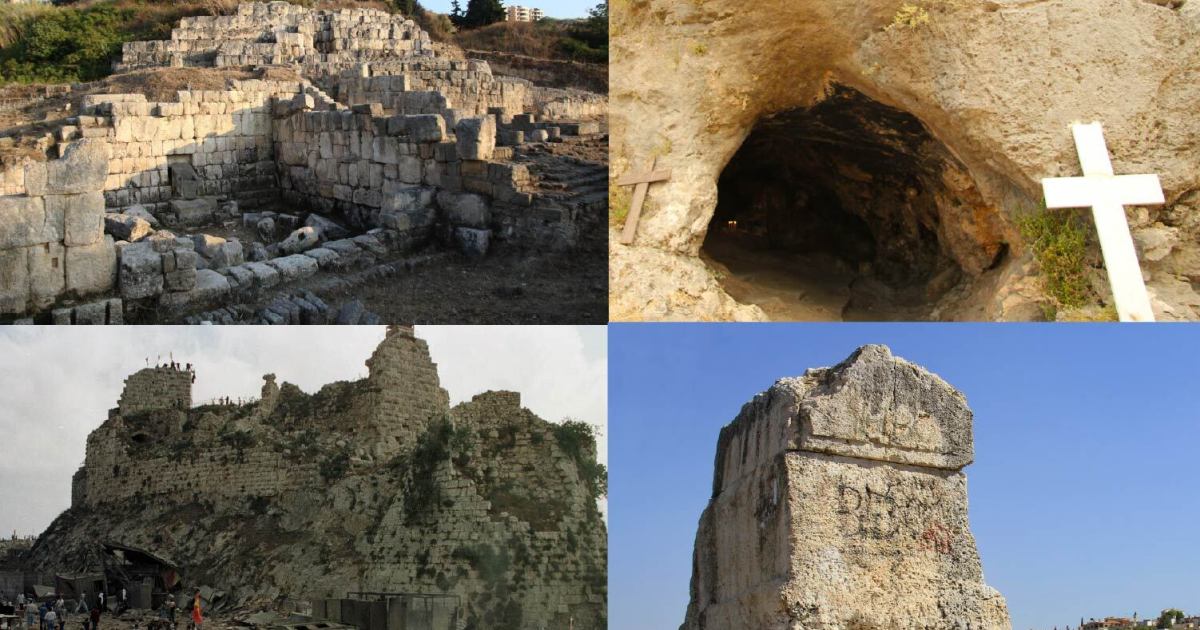
Some of the most notable protected sites include:

Known in Arabic as Qalaat al-Shaqif, the 12th-century Crusader fortress is perched 700 metres (2,300ft) above southern Lebanon. Overlooking the Litani River, its commanding position made it one of the region’s most strategic strongholds.

Control of the castle passed from the Crusaders to successive regional powers, including the Ottomans. Palestinian fighters later used it as a base before Israel captured it during its 1982 invasion and occupied it until it withdrew from southern Lebanon in 2000.

There are four other medieval castles in the Mount Amel region reflecting centuries of Crusader, Ayyubid, Mamluk and local influence, documenting the evolution of military architecture in southern Lebanon.

Qalaat Tibnin (Toron), Qalaat Chakra (Dubieh), Qalaat Deir Kifa (Maron) and Qalaat Chamaa began as Crusader strongholds in the 12th century and were repeatedly rebuilt and reused over the centuries.

The sites preserve archaeological layers spanning from the Roman era and earlier, with evidence of Bronze Age settlement at Tibnin and Chamaa.

The Eshmun sanctuary near Sidon spans 3.6 hectares (almost 9 acres) on the banks of the Awali River. Dedicated to the Phoenician healing god Eshmun, it is one of the region’s most important healing sites.

About 40km (25 miles) south of Beirut, Sidon grew into one of Phoenicia’s leading ports, building its wealth on Mediterranean trade, purple dye, glassmaking and metalwork. Its historic core includes an ancient tell, a fishing harbour, as well as sea and land castles.

The Historic Centre of Saida is among the sites granted enhanced protection, a designation that covers both World Heritage properties and sites still under consideration for inscription.

Lebanon’s Chouf region preserves the remains of a Roman and Byzantine village, including houses, a temple dedicated to the sun god Helios, and a Byzantine basilica. The site offers a rare glimpse into rural life and worship in late antiquity.

The site overlooks Hasbaiyya in southern Lebanon. Originally a Crusader stronghold, it was taken by the Chehab emirs in the 12th century and later became their seat of power. Parts of the fortress remain occupied by the family today.

Near Tyre, it is a monumental stone tomb traditionally associated with Hiram, the Phoenician king of Tyre. Its massive limestone sarcophagus reflects Phoenician burial traditions and the enduring legacy of the ancient kingdom.

Located in the hills between Salfit and Qalqilya, it contains archaeological remains dating from the Chalcolithic and Early Bronze Age. Christian tradition holds that Jesus and his disciples prayed there around the time of the wedding at Cana, where he is said to have turned water into wine.

In the south of Tyre, it preserves evidence of human activity dating back to the Lower Palaeolithic period. Archaeologists also found traces of stone-tool production from the Chalcolithic and Early Bronze Age I.

📰 மூல செய்தி (Source): https://www.aljazeera.com/news/2026/6/3/israels-invasion-of-southern-lebanon-devastates-centuries-of-history?traffic_source=rss

உலகம்

UK-China ‘ice age’ thaws: Why the West needs Beijing

Published

on

British Foreign Secretary Yvette Cooper hails ‘candour and respect’ in new ties with Beijing, despite differences.

Eight years after a British prime minister and foreign secretary made back-to-back visits to China, the Keir Starmer government is once again trying to reset relations with Beijing after a long period of what Starmer had in January described as an “ice age” in relations.

Prime Minister Starmer went to Beijing in January, and Foreign Secretary Yvette Cooper is currently visiting on a three-day trip, as the United Kingdom and China try to revive economic and diplomatic ties despite lingering differences over security, human rights and the Russian war on Ukraine. Former PM Theresa May and her Foreign Secretary Jeremy Hunt made similar visits to China soon after each other in 2018.

The UK isn’t alone. Cooper’s visit to Beijing this week is the latest in a string of visits by global leaders and officials seemingly eager to engage with the second-largest economy in the world at a time of heightened global instability.

During her trip so far, Cooper has called for the two nations to work together to confront a host of global challenges, including conflicts in Iran and Ukraine and the Ebola outbreak in the Democratic Republic of the Congo.

“It is in our shared interest to have a rules-based international order and to find ways to reduce rising geoeconomic tensions,” the foreign secretary said on Tuesday as she met Chinese Vice President Han Zheng at Beijing’s Great Hall of the People at the start of her visit.

While acknowledging “areas of disagreement” between London and Beijing, Cooper insisted that approaching discussions with “candour and respect” would help to increase mutual understanding.

“Those frank and constructive discussions can help us make meaningful progress for the benefit of our two countries and the wider world,” she said.

The rhetoric about a “rules-based order” comes at a time when, under President Donald Trump, the United States – the country that led the creation of the post-World War II global architecture – increasingly faces accusations of ripping apart the international laws that were its foundation. China has in recent years positioned itself as a grown-up, responsible and stable global power, in contrast to the US.

But behind Cooper’s comments, say analysts, is also a deeper, more pragmatic acknowledgement: Western nations like the UK need China now more than ever.

The West has come to rely heavily on China, especially when it comes to the production of advanced goods – like semiconductors, medical instruments and aerospace components – as well as its stranglehold on many of the earth’s critical natural resources required to manufacture them all, said John Minnich, assistant professor in the Department of International Relations at the London School of Economics.

“This dependence is growing by the day,” Minnich told Al Jazeera. “Whether this is a good thing for the West or this trajectory is politically sustainable is another matter.”

Getting on a better footing with Beijing is a priority now, say observers. “The UK cannot afford a purely adversarial relationship with China,” Jing Gu, director of the Centre for Rising Powers and Global Development at the Institute of Development Studies in the UK, said.

“It’s a pragmatic response to the UK’s own global economic position and needs, and to the changing winds of US-China relations under the second Trump administration,” Minnich said.

This rapprochement has been in the works since the UK’s governing Labour party swept to power in July 2024. Former Foreign Secretary David Lammy travelled to China for a two-day diplomatic trip in October that year, as part of initial efforts to thaw what Starmer would dub a diplomatic “ice age” between the two countries. Starmer’s own trip in January, to meet President Xi Jinping, laid the groundwork for deeper economic engagement, including a $15bn investment by British pharmaceutical company AstraZeneca and visa-free travel for Britons.

On Tuesday, China’s Vice President Han gave Cooper a warm welcome, along with a cultural visit to the Forbidden City, where she was shown around the world’s largest imperial palace complex by a tour guide before meeting her counterpart, Wang Yi, for talks at Diaoyutai State Guesthouse.

In his address at Beijing’s Great Hall of the People, Han stressed the need to “intensify interactions and strengthen dialogue and cooperation for the sake of world peace and stability and for the growth of our respective economies”.

“Currently, the ongoing geopolitical conflicts are dealing a heavy blow to world peace and stability and affecting the prospect of the world economy,” he continued. Addressing Cooper, he said her visit would help “move our relations steadily forward along the strategic direction established by the leaders of our two countries”.

It’s not just the UK. A growing number of Western countries are seeking to reset ties with China at a time when global geopolitical tensions are causing havoc with supply chains and huge market volatility. This year, leaders and officials from the US, Ireland, Spain, Germany, Canada and Finland are just a number of those who have travelled to China in a flurry of diplomatic engagement.

US President Donald Trump’s trip to China last month signalled a shift in direction after last year’s “trade war”, in which the two sides slapped each other with tit-for-tat tariffs and China threatened to restrict exports of most of its rare-earth metals. Those tensions had been rising since Trump’s first term as president until he and Xi called a temporary truce late last year to allow for trade talks.

Also notable, however, was that Washington’s rapprochement with Beijing coincided with a tense period in US-UK relations.

Trump publicly took Starmer to task over his refusal to assist in the US-Israel war on Iran or to send naval backup to help the US reopen the strategic Strait of Hormuz. Similarly, Trump’s outbursts over the Western response to the war generally have depicted the EU as a foe and NATO as obsolete.

For the UK, Trump’s unpredictability is what has tipped the balance in favour of reinforcing bilateral cooperation with Beijing, as Britain struggles with sluggish economic growth and global energy price shocks triggered by the war on Iran.

And there is “plenty of room for mutual beneficial economic cooperation” between the two countries, Minnich said. “The UK is unusual among major Western countries in that its economic strengths complement rather than compete with China’s.

“Unlike Germany, the UK is not heavily dependent on high-value-added manufacturing, where China is increasingly competitive. Instead, it specialises in things like high-value financial and other services in which China remains relatively weak,” he added.

Cooper is expected to fly to Shenzhen, a major technology hub, to discuss trade links as well as “the challenges of the future of AI as it rapidly changes our world”. This is significant because China is outpacing almost every country in the world in producing ideas and innovation in areas that matter to the UK, including renewable energy.

Last year, the UK and China signed a partnership agreement on clean energy covering academic, regulatory, industrial and commercial partnerships. During Starmer’s visit to China earlier this year, the prime minister announced that Octopus Energy, the UK’s largest electricity supplier by market share, had formed a joint venture with China’s PCG Power to trade renewable energy in the Asian country.

Access to affordable, clean technology – which China has bundles of – could help the UK reduce the cost of decarbonisation and accelerate the energy transition. “But this cannot mean passive dependence,” Gu, at the Institute of Development Studies, said. “Middle powers such as the UK are not simply choosing sides; they are trying to buy time – time to support growth, accelerate the green transition, re

📰 மூல செய்தி (Source): https://www.aljazeera.com/news/2026/6/3/uk-china-ice-age-thaws-why-the-west-needs-beijing?traffic_source=rss

Continue Reading

உலகம்

Hezbollah video shows attack on Israeli troops at Lebanon’s Beaufort Castle

Published

on

Hezbollah video shows attack on Israeli troops at Lebanon’s Beaufort Castle

Hezbollah has released drone video showing attacks targeting Israeli forces occupying Beaufort Castle in southern Lebanon. Israeli troops seized the medieval fortress on May 31.

📰 மூல செய்தி (Source): https://www.aljazeera.com/video/newsfeed/2026/6/3/hezbollah-video-shows-attack-on-israeli-troops-at-lebanons-beaufort-castle?traffic_source=rss

Continue Reading

உலகம்

How social media changes the way we see war

Published

on

We see war now as we see everything else – through a screen. Genocide, displacement and mass violence are livestreamed to our phones, tucked between cat videos and advertisements for products designed to distract us.

We don’t choose to be spectators, we become them almost unconsciously – scrolling, watching and moving on. In the age of digital spectatorship, the key question is no longer whether we see human suffering, but what, if anything, we choose to do once we have.

Join Ali Rae in Episode Five of All Hail The Military – a five-part series that reveals the systems, power and hidden complicities that sustain global militarism – and the profound impact it has on us all.

📰 மூல செய்தி (Source): https://www.aljazeera.com/video/all-hail/2026/6/3/how-social-media-changes-the-way-we-see-war?traffic_source=rss

Continue Reading

Trending

Copyright © 2024 by 7Tamil Media, All rights reserved.