Connect with us

உலகம்

Iran war effect: Why is Modi asking Indians to avoid foreign trips, gold?

Published

on

PM urges Indians to work from home and avoid foreign trips during the global energy crisis due to the Iran war.

Narendra Modi urges Indians to conserve fuel amid war on Iran

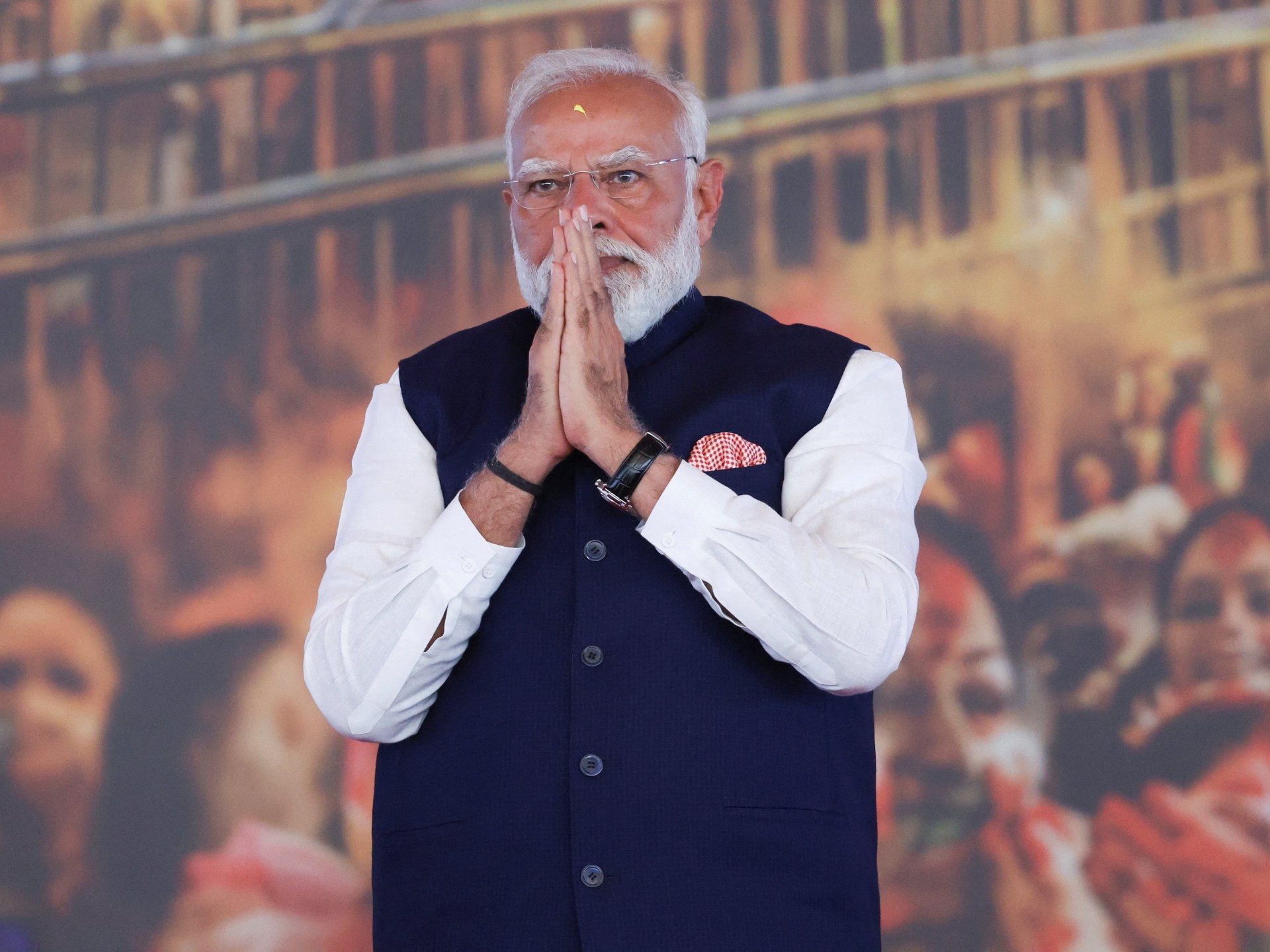
Prime Minister Narendra Modi has urged Indians to work from home, avoid international trips and not buy gold during the United States-Israeli war on Iran, which has caused global energy prices to surge, adding pressure on India’s foreign exchange reserves.

Modi made his plea during a public event in the southern city of Hyderabad on Sunday.

Here is more about what Modi said, what’s behind the Indian government’s concerns and how they’re linked to the war on Iran.

Modi said people should move to online meetings instead of physical gatherings and use the work-from-home model that was adopted globally during the COVID-19 pandemic. He explained that such practices would cut down the use of fuel.

Additionally, Modi urged people to use public transport and carpooling to save fuel. He called on families to reduce their cooking oil consumption, describing that move as both healthy and patriotic.

Modi also asked Indians to avoid buying gold and to cut nonessential overseas travel for at least a year. The prime minister asked farmers to cut their fertiliser use by as much as half.

And he explained his justification for asking the people of India to make these changes in their lifestyles and plans: “In the current situation, we must place great emphasis on saving foreign exchange.”

Simply put, Modi was referring to the war on Iran and its far-reaching economic consequences, especially for India.

Early in the war too, Modi had compared the economic crisis spawned by the conflict to the situation during the COVID-19 pandemic. On Sunday, he extended that parallel to also ask Indians to adopt some of the restrictive measures forced upon the world by the coronavirus crisis.

Oil prices have climbed due to the war on Iran, which started on February 28. A barrel of Brent crude, the international benchmark, was worth $72.87 on February 27. As of Monday, a barrel of Brent crude was worth $105.45, an almost 50 percent increase.

Iranian attacks on oil and gas facilities in the Gulf in the early weeks of the war impacted energy supplies. Since early March, Iran has also restricted passage through the Strait of Hormuz, the narrow waterway through which 20 percent of the world’s oil and liquefied natural gas supplies passed before the war. Iran has allowed passage by vessels from select countries that need to negotiate their transit with the Islamic Revolutionary Guard Corps.

In April, the US announced a naval blockade on ships entering or leaving Iranian ports, further adding to the disruption of global oil and gas supplies.

With rising fuel costs, airlines have hiked ticket prices. According to the travel search site Kayak, the average international airfare from the US to all destinations was $1,101 in the last week of April, a 16 percent increase from the same period a year earlier.

Nearly half of the world’s traded urea, the most widely used fertiliser, and large volumes of other fertilisers are exported from Gulf countries through the Strait of Hormuz. Those supplies have now been dramatically disrupted.

“Patriotism is not only about the willingness to sacrifice one’s life on the border. In these times, it is about living responsibly and fulfilling our duties to the nation in our daily lives,” Modi said.

And those duties and responsibilities, per Modi’s comments, centre on India’s foreign exchange reserves.

India’s foreign exchange reserves as of May 1 were $690.69bn, down $7.79bn, or about 1.12 percent, from the end of March, according to the Reserve Bank of India, the central bank.

Compared with where India’s reserves stood before the war, the fall is more precipitous. As of February 27, India’s foreign exchange reserves stood at $728.5bn.

The International Monetary Fund projected that India’s current account deficit (CAD) will be $84bn in 2026. A negative CAD means that it is effectively overdrawn – it has spent more money than it has.

India is the world’s third largest oil importer after China and the US.

From April 2025 to March, the last Indian financial year, the country imported crude oil worth $123bn. That is the single largest contributor to India’s import budget.

At second spot? Gold. Indians imported gold worth $72bn in the 2025-2026 fiscal year, second in the world only to China.

According to the travel insurance firm ACKO, Indians travelling abroad spent $31.7bn in 2023-2024. In 2024, about 30.9 million Indian nationals departed India, according to data from the Bureau of Immigration. This was up from about 27.9 million Indian nationals in 2023.

India is also the world’s largest importer of urea – it imported about 10 million tonnes of the fertiliser last year, according to analysis from S&P Global.

India’s foreign exchange reserves are depleted by large volumes of imports of oil, gold, fertilisers and by Indians spending abroad.

However, of these expenses, oil and fertilisers are hard for India to cut back on. Energy imports are essential to drive India’s economy, and fertilisers are critical both for the country’s agrarian economy – more than half of the country’s families depend on agriculture – and for food supplies.

That leaves gold and foreign travel. Whether Indians will take up Modi’s call, though, is unclear.

📰 மூல செய்தி (Source): https://www.aljazeera.com/news/2026/5/11/iran-war-effect-why-is-modi-asking-indians-to-avoid-foreign-trips-gold?traffic_source=rss

உலகம்

Cole Allen pleads not guilty to attempted Trump assassination

Published

on

Allen’s legal team challenges involvement of US Attorney Pirro, citing her friendship with Trump and role at the gala where shots were fired.

The man accused of trying to assassinate United States ⁠President Donald Trump at a White House reporters gala last month has pleaded not guilty to all charges.

Cole Allen, 31, of California did not speak in court as ⁠his attorney Tezira Abe entered the plea on his behalf. The charges include attempted assassination of the president, assault on a federal officer and firearms offences.

Prosecutors alleged Allen fired a shotgun at a US Secret Service agent and stormed a security checkpoint in a foiled attack on Trump ‌and other members of his administration at the White House correspondents dinner.

Allen’s lawyers asked US District Judge Trevor McFadden to disqualify at least two top Department of Justice officials from direct involvement in prosecuting him because they could be considered victims or witnesses in the case, creating a potential conflict of interest.

Acting Attorney General Todd Blanche and US Attorney Jeanine Pirro were attending the event when Allen ran through a security checkpoint and fired a shotgun at a Secret Service officer, authorities said. Defence attorney Eugene Ohm said the defence likely would seek to disqualify Pirro’s entire office from involvement in the case.

McFadden didn’t rule from the bench on that question but asked Allen’s attorneys to elaborate on the possible scope of their recusal request.

Allen allegedly travelled to Washington by train, carrying a shotgun, pistol and knives, and booked a room in the Washington Hilton, where the April 25 dinner took place.

On Monday, Allen wore an orange jumpsuit and was shackled at the waist during the brief court proceeding. It was his first appearance in the Washington, DC, federal court before McFadden, who will preside over ⁠the remainder of the case.

A different ⁠judge last week apologised to Allen for his treatment in a Washington, DC, jail, which included being placed on suicide precautions and isolated from other inmates.

Allen’s other lawyer, Eugene Ohm, said the defence is likely to seek the recusal of the entire US Attorney’s Office in Washington, DC, which Pirro leads, because of her friendship with Trump and her status as a potential victim.

“It is wholly inappropriate ‌for victims of an alleged event like this to be individually prosecuting the case,” Ohm said.

Prosecutors are set to respond to the defence’s legal filing by May 22. Pirro previously ‌told ‌CNN in an interview that “my ability to prosecute this case has nothing to do with my being there [at the Hilton gala].”

Allen is scheduled to return to court on June 29.

Besides the attempted assassination count, Allen is also charged with assaulting a federal officer with a deadly weapon and two additional firearms counts. He faces a maximum sentence of life in prison if convicted of the attempted assassination charge alone.

Allen was placed on suicide watch after his arrest, but jail officials removed him from that status after several days. Allen’s attorneys complained that he had been unnecessarily confined in a padded room with constant lighting, repeatedly strip-searched and placed in restraints outside his cell.

Allen told FBI agents that he didn’t expect to survive the attack, which could help explain why he was deemed to be a possible suicide risk, a Justice Department prosecutor said.

📰 மூல செய்தி (Source): https://www.aljazeera.com/news/2026/5/11/suspect-pleads-not-guilty-to-attempted-assassination-of-us-president?traffic_source=rss

Continue Reading

உலகம்

Israel pushes for hangings and ‘show trials’ for ‘October 7 detainees’

Published

on

A new legal framework would allow special tribunals to admit evidence obtained through torture and broadcast proceedings, raising alarms among rights groups.

Legal experts have warned that legislation being pushed through the Israeli parliament could result in Palestinians detained around the time of the October 7, 2023, attacks face publicly broadcast “show trials” and the death penalty.

The proposed bill, which has gained rare bipartisan support from both the governing coalition and the opposition, recently entered the parliament, known as the Knesset, for its final readings and would create a special military tribunal to try Palestinians accused of playing a role in the 7 October attacks, when Hamas-led fighters stormed communities along southern Israel’s fence with Gaza.

Co-sponsored by Simcha Rothman of the far-right Religious Zionism Party and Yulia Malinovsky of Yisrael Beytenu, and strongly backed by Justice Minister Yariv Levin, the legislation proposes a dedicated military headquarters and court in Jerusalem to handle the mass prosecution of Palestinians seized by Israeli forces on or around October 7.

At least 1,139 people, mostly civilians, were killed in the attacks, according to an Al Jazeera tally based on official Israeli statistics. About 240 others were seized as captives. Israel’s subsequent war on Gaza killed at least 72,500 Palestinians and destroyed the territory.

Crucially, the bill authorises the court to deviate from standard rules around evidence, legal procedures and detention, as well as granting judges the full authority to issue the death penalty against Palestinians implicated by prosecutors in the attacks.

While some members of the Knesset have championed the bill, the international community and rights groups argue the law could become a political weapon designed to strip detainees of fundamental legal protections.

It follows the Knesset’s approval of a one-sided bill that will instruct military courts to impose the death penalty on Palestinians convicted of killing Israelis in acts of “terror”, but will not impose the same penalty on Jewish Israelis convicted of killing Palestinians.

To handle the scale of the mass arrests following October 7, the legislation permits sweeping exemptions in standard legal procedures during the trials of Palestinian suspects.

Muna Haddad, an attorney with Adalah, the Legal Center for Arab Minority Rights in Israel, has submitted a formal objection to the bill. She told Al Jazeera it intentionally lowers legal protections to guarantee fair trials in order to secure the mass conviction of Palestinians.

“The bill explicitly permits mass trials that deviate from standard rules of evidence, including broad judicial discretion to admit evidence obtained under coercive conditions that may amount to torture or ill-treatment,” Haddad said. “This constitutes a severe violation of fair trial guarantees that falls well short of international law requirements.”

In a departure from standard Israeli judicial practice, which typically prohibits courtroom cameras, the bill mandates the filming and public broadcasting of key moments in the trials on a dedicated website, including opening hearings, verdicts and sentencing.

Malinovsky, one of the bill’s sponsors, said that “the entire world will witness” the proceedings.

Haddad warned that this provision effectively “transforms proceedings into show trials at the expense of the accused’s rights.”

“The provisions governing public hearings… violate the presumption of innocence, the right to a fair trial, and the right to dignity,” Haddad explained. “The framework effectively treats indictment as a finding of guilt, before any judicial examination has begun.”

Because newly passed capital punishment laws cannot be applied retroactively, the new framework seeks to transplant existing Israeli criminal codes – such as treason, assisting an enemy in wartime and the 1950 Law for Preventing and Punishing the Crime of Genocide – into an entirely new legal construct with substantially lower standards of due process.

Israeli legislators have repeatedly compared the upcoming proceedings to the 1961 trial of Adolf Eichmann, a chief architect of the Nazi Holocaust, however, Haddad pointed out glaring historical and legal discrepancies in drawing parallels.

“Adolf Eichmann was not, in fact, tried under the Genocide Law but the Nazi and Nazi Collaborators (Punishment) Law,” she clarified.

Haddad warned that the bill seeks to apply the crime of genocide in an “expansive and exceptional manner, despite it being one of the most serious, complex and narrowly defined offences in international law, one whose adjudication demands particularly rigorous evidentiary and legal scrutiny”.

Israel strictly limits the death penalty under civil law and has only carried out executions twice in its history. However, the domestic political climate has shifted drastically in recent years. The internal security agency, the Shin Bet, has publicly supported the potential use of the death penalty for October 7 attackers in what it describes as an act of deterrence.

When asked if the push for executions was merely domestic political theatre, Haddad was unequivocal.

“This is not political theatre,” she told Al Jazeera. “Lawmakers have clearly and explicitly stated their expectation that the death penalty will be applied. Taken together with the recent passage of the March 2026 death penalty law, we are witnessing a deliberate move toward ending Israel’s long-standing moratorium on the death penalty and operationalising it in practice.”

Under international law, imposing the death penalty through a compromised judicial process is illegal. “Any death sentence imposed in the absence of strict fair trial guarantees constitutes an arbitrary deprivation of life and is absolutely prohibited under international law,” Haddad said, citing the International Covenant on Civil and Political Rights (ICCPR).

The risk of unchecked judicial authority is compounded by the fact that the minister of defence – a political actor – would be granted overarching authority over the law’s implementation, requiring only periodic written reports to a Knesset committee rather than independent civilian or judicial oversight.

Historically, Israel has operated two parallel legal systems in the occupied territories: civil law for Israeli settlers and military law for Palestinians.

According to data cited by Israeli rights groups, Palestinians tried in Israeli military courts face a conviction rate of 99.74 percent. In contrast, the conviction rate for Israelis tried in civilian courts for crimes committed against Palestinians is just around three percent.

Prominent international rights organisations, including Amnesty International and Human Rights Watch (HRW), have previously described Israel’s legislative manoeuvres regarding the death penalty for Palestinians as a “discriminatory tool” that entrenches a “system of apartheid“.

📰 மூல செய்தி (Source): https://www.aljazeera.com/news/2026/5/11/israel-pushes-for-death-penalty-and-show-trials-for-oct-7-detainees?traffic_source=rss

Continue Reading

உலகம்

Lebanese civil defence worker captures moment of Israeli strike

Published

on

Lebanese civil defence worker captures moment of Israeli strike

A Lebanese civil defence worker captured the moment an Israeli strike hit an active rescue operation in Toul, southern Lebanon. Emergency crews had entered a damaged building to search for survivors when it was hit.

📰 மூல செய்தி (Source): https://www.aljazeera.com/video/newsfeed/2026/5/11/lebanese-civil-defence-worker-captures-moment-of-israeli-strike?traffic_source=rss

Continue Reading

Trending

Copyright © 2024 by 7Tamil Media, All rights reserved.