Connect with us

உலகம்

India is being left to die in the heat

Published

on

Modi has denied climate change for years. Now, as the death toll climbs uncounted, his government offers branding instead of protection.

India is experiencing an extraordinary summer.

Across the country, temperatures have crossed 45 degrees Celsius (113 degrees Fahrenheit), inching towards 46, with Akola in Maharashtra’s Vidarbha region recording the country’s highest temperature of 46.9C on April 26. Census workers have died, as have voters who stepped out in the recently concluded West Bengal election. A man who boarded a bus to attend a wedding died before he reached his destination. On a single day in late April, all of the top 50 hottest cities in the world were located in India.

There is a violence to the light, the kind that makes you shield your eyes – even at 7am. With farmers unable to work outside, livestock under heat stress and crops failing, the United Nations is concerned that the heatwaves are pushing food supply “to the brink”. Even more alarming is that the extreme heat is causing not just heart attacks, but also kidney injury, affecting sleep quality and exacerbating numerous chronic conditions, including diabetes, respiratory illnesses and mental health conditions.

While the newspapers record a few deaths here and there, the majority of heat-related deaths go unrecorded in India. I know, from my decades as a health reporter, that those who die early in any catastrophe – like the HIV patients of the 1980s, or COVID-19 more recently – become numbers. Only after we have a mountain of bodies do we think to raise a flag and give it a name, perhaps even its own day.

In fact, the 16th Finance Commission has recommended that heatwaves be notified as national disasters, but getting funds out of this government to mitigate these deaths, or compensation for the families of victims, comes with red tape that can reduce hardened warriors to tears.

As the climate heats up, the rest of the world looks at green cover – trees, wetlands and biodiversity hotspots – as central to mitigating a warming planet. Not in India. Here, between the government, the courts and private developers, there is an orgy of tree-felling across the worst-affected cities. In Nashik, despite protests, heritage banyan trees that have stood for decades, if not centuries, are being cut down. In Pune, too, old trees are making way for a four-lane highway. In Bengaluru, trees are making way for a metro train and in Kashmir, which has never experienced such heat, mulberry, walnut and chinar trees have to go for wider roads and “smarter” cities.

Back when he came to power in 2014, Prime Minister Narendra Modi alarmed many Indian scientists and researchers by denying climate change. “Climate has not changed. We have changed. Our habits have changed,” he told students.

The heat pummelling India’s megacities is reinforcing longstanding inequalities of caste, class and gender in poor and marginalised communities. Our treeless streets are abandoned, save for the homeless and the street hawkers. The rich travel from their air-conditioned houses in their air-conditioned cars to their air-conditioned offices, malls and schools. The poor are being left to die in a country that keeps inventing new ways of neglecting its most vulnerable populations. Watching this heat, Harvard’s South Asia Institute released a white paper asking an innocuous question: how hot is too hot? Researchers say the human body can only handle so much heat before it can no longer cool itself, and that limit is below a wet-bulb temperature of 35C. Above this limit, even a young, healthy person resting in the shade with access to ample drinking water and skin fully coated in sweat would experience a continual rise in core temperature, leading to death from heatstroke within hours.

The paper grimly adds that nearly 380 million Indians are living in conditions that exceed the capabilities of human physiology.

After making living conditions worse, the Modi administration, characteristically, has done nothing to transparently record annual heat-related deaths. There is growing criticism from scientists, journalists and public health experts that India’s heat data systems are fragmented, inconsistent, slow and opaque. The India Meteorological Department (IMD) is also facing criticism about transparency in temperature readings. In 2024, the IMD blamed a “faulty sensor” for an erroneous recording of 52.9C on May 29.

Each year, the excruciating summer marks a new level of public scrutiny of the IMD system that is long overdue.

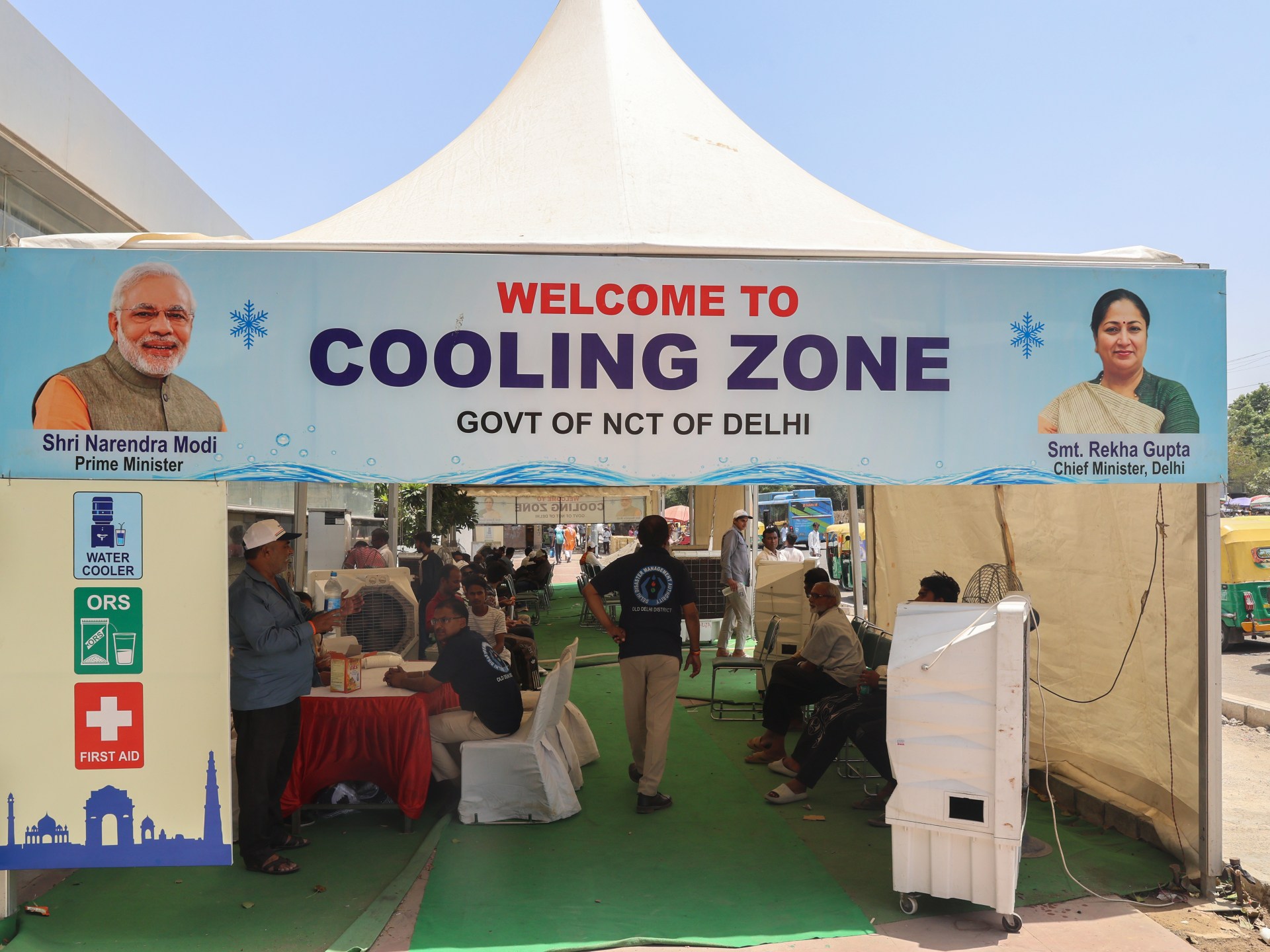
The impacts of this year’s heatwave are still being analysed. But for everyone who lived through it, this was a relentless two-month emergency, with no respite. Well into the heatwave – after temperatures remained above 40C for 40 consecutive days – the Modi government implemented its much-awaited Heat Wave Action Plan. As with every crisis, Modi had turned this deadly heatwave into a branding opportunity. With cameras rolling and citizens queueing up, government officials were seen forcefully wiping faces with towels whose origins were unknown. Much like COVID certificates that carried his photo, India’s newly rolled-out “cooling points” – unveiled across the national capital – were plastered with the prime minister’s face, and the taxpayer-funded heatwave action plan is the latest in a series of loyalty programmes that expect the public to remain indebted to the ruling party.

Meanwhile, the country now has collective wisdom from having survived nationally traumatic events such as demonetisation, the abrogation of Article 370 and COVID-19 lockdowns: we are on our own. If you are looking for some profound meditation on the catastrophe caused by global heating, it will not be found now. That is for the people who come after us. For now, we grapple with this on our own. Just us and these terrible men – for it is mostly men – who fell trees and spend other people’s lives as pocket change.

What I know for certain is that a prime minister who does not believe in climate change will not be an ally in the fight against extreme weather events.

The views expressed in this article are the author’s own and do not necessarily reflect Al Jazeera’s editorial stance.

📰 மூல செய்தி (Source): https://www.aljazeera.com/opinions/2026/5/22/india-is-being-left-to-die-in-the-heat?traffic_source=rss

உலகம்

Protesters torch cars, buildings in Belfast after knife attack

Published

on

Unrest comes after a Sudanese man was arrested over a stabbing attack in north Belfast, UK.

Belfast plunged into chaos as vehicles set ablaze following stabbing attack

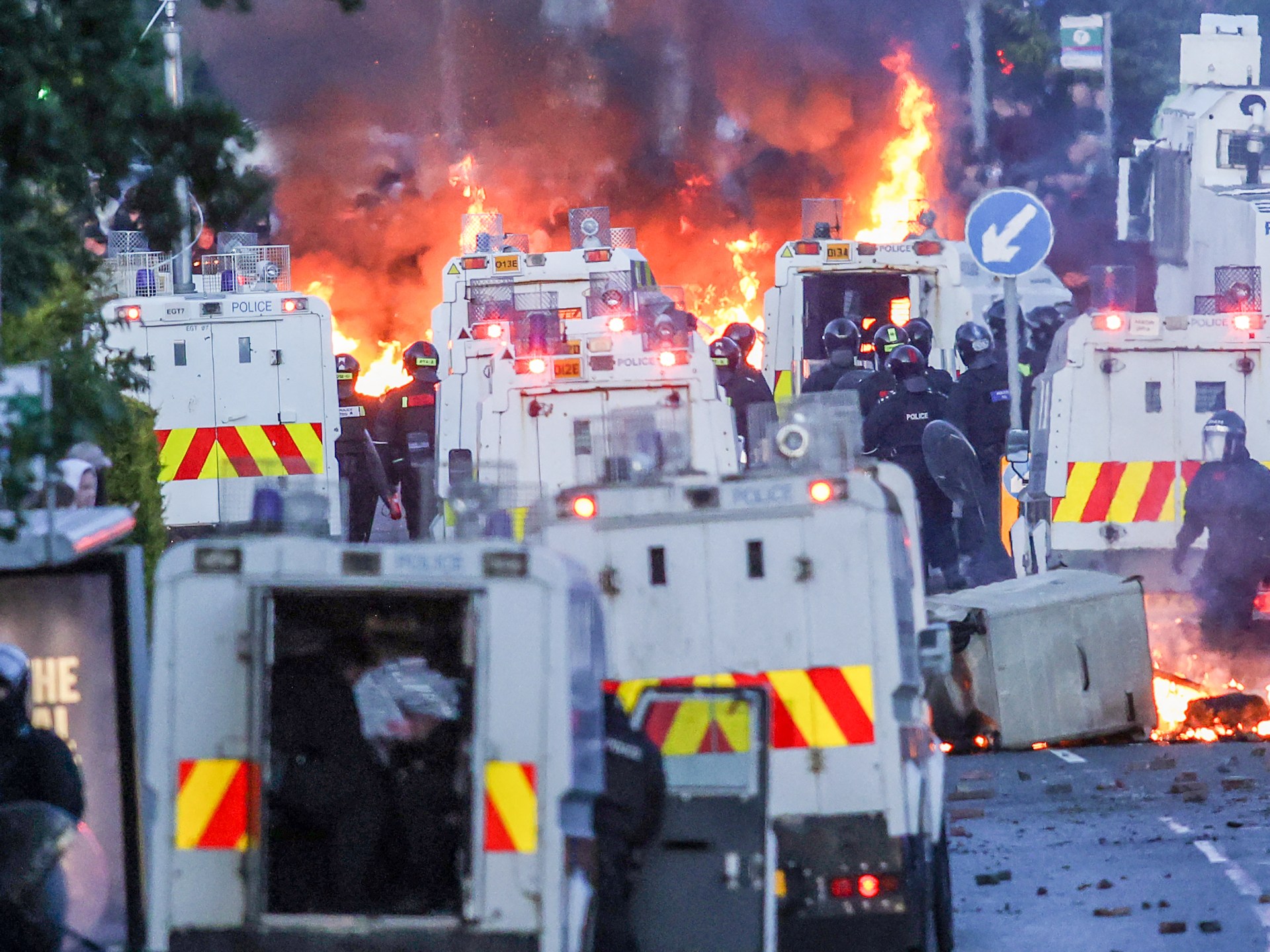
Anti-immigrant protesters in the city of Belfast in the United Kingdom have torched vehicles and buildings after a Sudanese man was arrested over a knife attack that left one person with serious injuries.

Hundreds of protesters, many of them masked, gathered at several locations across the city on Tuesday, setting fire to a bus and several cars.

A building near the city centre was also set alight, with residents telling the AFP news agency that the protesters started a fire in the bins and went on to throw petrol bombs.

Crowds also gathered in Antrim, about 25km (15 miles) west of Belfast.

Michelle O’Neill, the first minister of Northern Ireland, slammed the protests and urged calm.

“Groups of masked men burning families out of their homes is nothing less than disgusting cowardice,” she wrote on X.

“Racism, intimidation and violence are wrong wherever they occur. There can be no excuse and no justification for these attacks tonight. No one wants to see this on our streets and I again appeal for calm”.

The suspect in the knife attack, which took place in north Belfast late on Monday, was charged late on Tuesday with attempted murder, possession of a bladed weapon in a public place, and making threats to kill.

The 30-year-old man, whose name has not been released, is due to appear in court on Wednesday.

The victim, a man in his 40s, suffered significant injuries to his eyes and slash wounds to his face and back during the attack with a kitchen knife found at the scene, police said.

“I understand that last night’s attempted murder will leave people feeling a range of emotions, from fear to anger,” Northern Ireland’s Assistant Chief Constable Ryan Henderson told ⁠a news conference, as he declared the unrest a “critical incident”.

“I appeal for calm and the safety of all of our communities in ⁠response to this”, he said.

Footage of the knife attack in north Belfast showed several members of the public trying to fight off the ⁠attacker before police arrived, and they were credited by senior officers with saving the man’s life.

UK Prime Minister Keir Starmer called the attack “horrific” and “sickening” on X. “I have absolutely no tolerance for abhorrent scenes of violence like this on our streets,” he said.

His office said that “it is time for calm”, adding: “It’s important that police have the time and space to investigate appropriately.”

The attack, which is ⁠not being treated as terrorism, comes at a time of heightened tensions in the UK following the murder of a student in Southampton who was handcuffed by police as he lay dying from stab wounds after his killer, a Sikh man, had falsely alleged a racist attack.

Although the victim and convicted killer were both British, protesters on Tuesday stood outside a Southampton hotel that had housed asylum seekers, holding signs that read, “Illegal Migration Is Destroying Our Civilisation”.

The attack in Belfast, meanwhile, sparked immediate questions about the suspect’s immigration status, including from some politicians.

Gavin Robinson, the leader of the Democratic Unionist Party, urged authorities to curb “uncontrolled immigration”, while anti-immigration figures, including Reform UK party leader Nigel Farage and Restore Britain leader Rupert Lowe, demanded details about the attacker.

Northern Ireland’s chief constable, Jon Boutcher, told reporters that the suspect was living in the UK on a five-year visa granted in September 2023.

Boutcher said he was believed to have travelled from Sudan to Paris and Dublin before claiming asylum in Belfast.

“There is no trace of this suspect on any of our national security databases, and he was not known to the Police Service of Northern Ireland,” he added.

Northern ‌Ireland’s ‌main political party leaders jointly condemned the knife attack, calling it “horrific” and saying that “there is no place in our society for this kind of brutality”.

They also called for calm, saying that disturbances would only damage their communities.

📰 மூல செய்தி (Source): https://www.aljazeera.com/news/2026/6/10/protesters-torch-cars-buildings-in-belfast-after-knife-attack?traffic_source=rss

Continue Reading

உலகம்

Iran attacks Bahrain, Kuwait, Jordan in retaliation for US strikes

Published

on

Strikes come after US attacked Iranian ports and islands in the Strait of Hormuz over the downing of a helicopter.

Iran’s Islamic Revolutionary Guard Corps (IRGC) has claimed attacks on United States military bases in Bahrain, Kuwait and Jordan in retaliation for US strikes on Iranian ports and islands in the Strait of Hormuz.

In a statement carried by state media on Wednesday, the IRGC said it launched drone attacks on the US Fifth Fleet in Bahrain and the Ali Al Salem airbase in Kuwait, as well as a long-range missile strike on an airbase in Azraq, Jordan.

It said it attacked 21 US targets and destroyed four of them, including an F-35 fighter jet hangar at the base in Jordan.

It also claimed to have shot down a US MQ-9 drone in the skies over the Iranian city of Jam.

The latest flare-up comes after the US military attacked Qeshm Island and ports along the Iranian coast in the Strait of Hormuz after blaming Iran for downing a US Apache helicopter earlier on Tuesday.

The IRGC said the US’s attacks had caused damage to a telecommunications tower in the town of Sirik and destroyed two water tanks there.

It warned that its forces remain fully prepared to deliver a “crushing and decisive” response to any US military actions and that Washington would bear full responsibility for the consequences of further escalation.

There was no immediate comment from the US.

In Jordan, the military said it intercepted and shot down five missiles launched from Iran towards Azraq, adding that the operation “resulted in the fall of shrapnel without any human injuries or material damage”.

The attacks prompted air raid alarms in Bahrain and Kuwait.

The Kuwaiti military said earlier that it was intercepting “hostile aerial targets” in the country’s airspace, without elaborating further.

Trita Parsi, executive vice president of the Quincy Institute for Responsible Statecraft in the US, said Iran’s swift response to Washington’s attacks signalled a new doctrine.

“They believe they have to respond proportionately, but very harshly and swiftly, against any American attack. Because otherwise, a new normal is established, one in which the United States can strike at Iran with more or less impunity,” he said.

The Iranians, he said, were making clear that any attack on them would be responded to, regardless of the size and the scope.

“But at the end of the day, every time these different types of events have occurred, the sense I have gotten from both sides is that their confidence and their trust in the ability of reaching a deal is starting to diminish,” he added.

This new round of strikes came a day after Iran and Israel exchanged fire in their most serious escalation since a ceasefire took effect in April. The war began with US and Israeli strikes on Iran on February 28, and has shaken the global economy and driven up the cost of fuel and food.

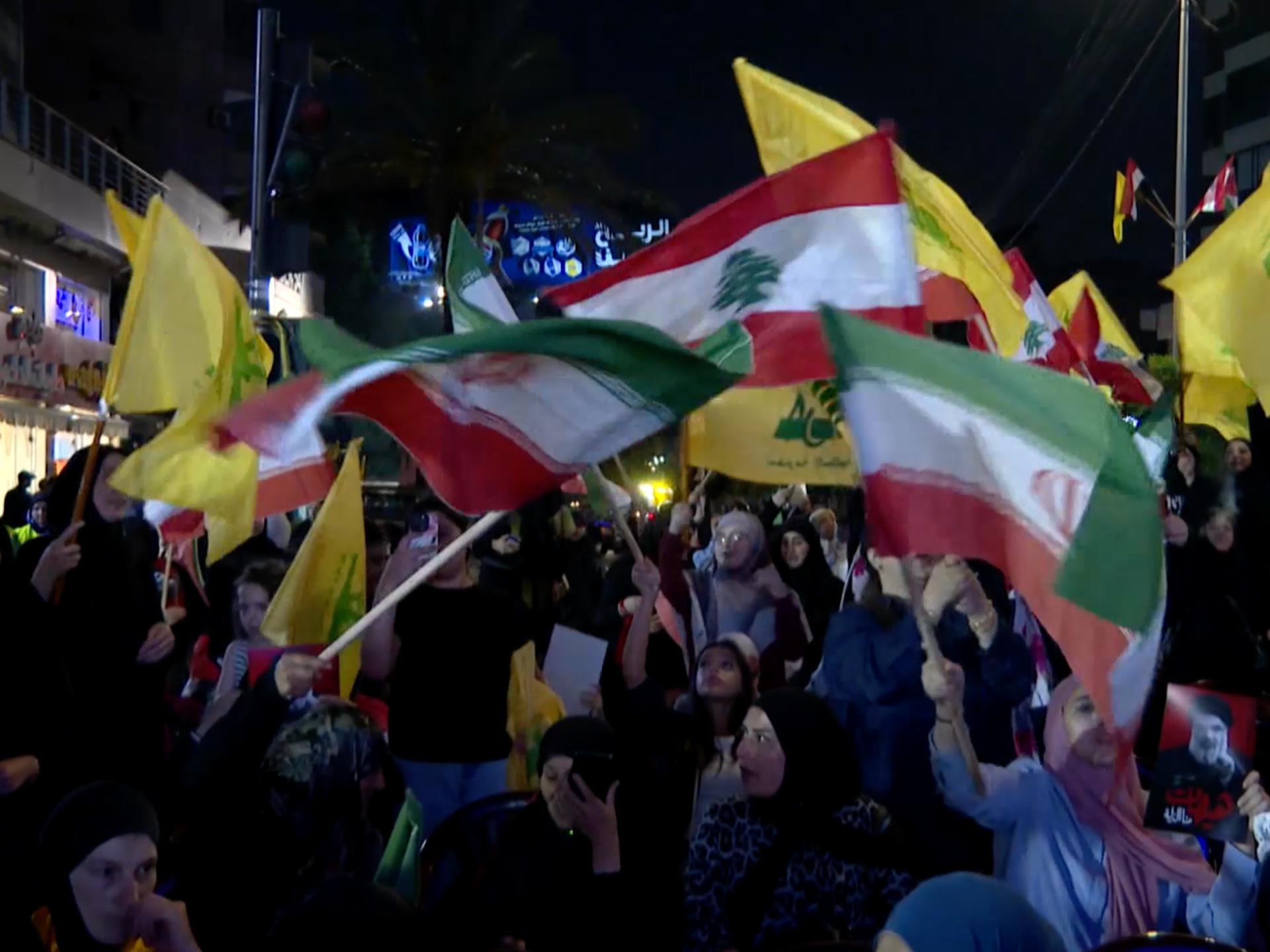
Progress towards a peace deal remains slow, complicated further by Israel’s intensifying campaign in Lebanon against the Iranian-backed Hezbollah.

Al Jazeera’s Mohamed Vall, reporting from Tehran, said that despite the latest strikes, neither side wanted a return to full-scale war.

“Whether the Americans are going to absorb this latest retaliation from the Iranians and end their operation or whether there will be new attacks will become clear in the next few hours,” he said.

“But the understanding is that both sides would like to go back to negotiations, even though the Iranians say they don’t trust any American initiative with regards to peace.”

📰 மூல செய்தி (Source): https://www.aljazeera.com/news/2026/6/10/iran-strikes-bahrain-and-jordan-in-retaliation-for-us-attacks-in-hormuz?traffic_source=rss

Continue Reading

உலகம்

Bolivia approves military measures against nationwide protests

Published

on

Bolivia approves military measures against nationwide protests

Bolivian President Rodrigo Paz has authorised military force against protesters amid the country’s worst economic crisis in 40 years, after roadblocks paralysed the nation. At least 10 people have been killed since the unrest began.

📰 மூல செய்தி (Source): https://www.aljazeera.com/video/newsfeed/2026/6/10/bolivia-approves-military-measures-against-nationwide-protests?traffic_source=rss

Continue Reading

Trending

Copyright © 2024 by 7Tamil Media, All rights reserved.