Connect with us

உலகம்

‘I can’t feel my leg’: Israeli gunfire disables teenagers in West Bank

Published

on

Al Jazeera visits a refugee camp in the West Bank where Israeli soldiers have killed or maimed numerous young people.

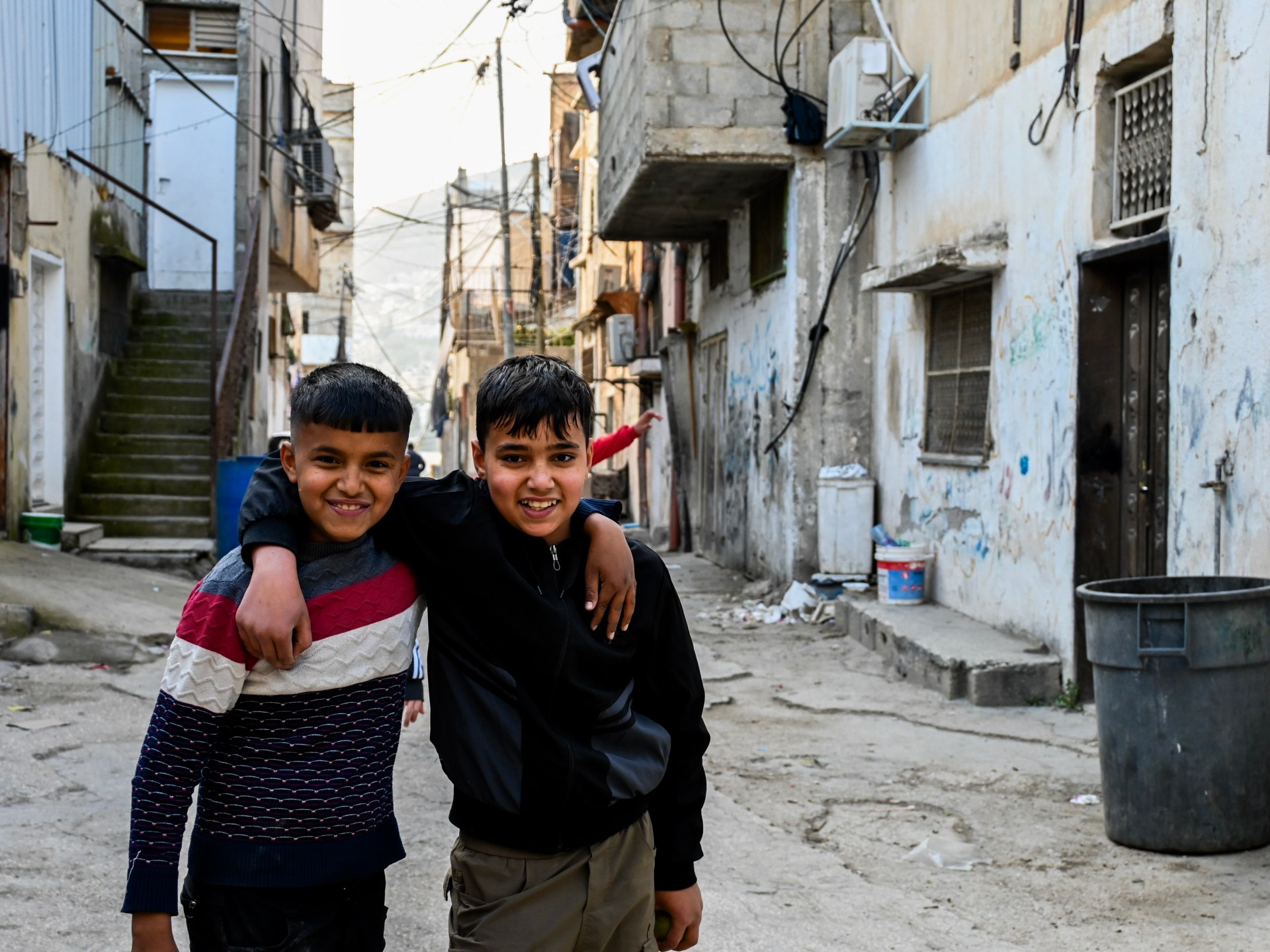
Nablus, occupied West Bank – Islam Madani says families and young people from the Askar refugee camp would once congregate beneath the olive trees on the slopes of Tel Askar, a hilly area in the north of the occupied West Bank which is home to the camp.

“But most won’t go anymore because soldiers shoot so many people there,” the 32-year-old father of two told Al Jazeera.

Amjad Refaee, director of the Askar Social Development Centre, says memories of those killed by Israeli soldiers haunt one of the only green spaces in the camp where children can play.

The military has killed three teenagers there, and maimed many more since October 7, 2023, when Hamas led an attack on Israel, and Israel began its genocidal war on Gaza.

The soldiers no longer fire rubber bullets or aim below the waist, “they shoot to kill, or cause disability”, Refaee told Al Jazeera.

“We are animals to them,” he added. “They terrorise us, kill our young people in cold blood, and keep us here in a prison.”

People from the camp say Tel Askar has become the entrance point used by invading Israeli soldiers as they infiltrate the narrow and dilapidated streets of the camp, often via the illegal settlement of Elon Moreh that looms over the east of Nablus.

It was on the hill where soldiers shot 18-year-old Amir Othman last January, leaving him with a disability. The shooting was almost at the exact spot where his childhood friend Mohammed Abu Haneen was killed by the army just over a year before. He was 18.

Amir was a promising footballer and dancer until Israeli soldiers shot him in the leg last January as a convoy of jeeps drove through Tel Askar.

He had travelled extensively performing Dabke, a traditional Palestinian line dance.

Amir, now an aspiring nurse, was hauling his wounded friend – also shot by soldiers – to safety when he was hit by a bullet.

“My kneecap and my thighbone were shattered,” he told Al Jazeera.

“I couldn’t feel my leg anymore, so I thought I had lost it.

“The blood felt like boiling water spilling out of my leg.”

Soldiers blocked ambulances from reaching Amir as he lay bleeding. Healthcare officials and international organisations say that has happened hundreds of times since October 7, when Israel intensified raids on Palestinian communities in the occupied West Bank, particularly refugee camps.

Amir eventually underwent four operations to help him walk again. He spent four months bed-bound, doctors tell him his mobility will never return to normal.

“When I woke up from the first surgery, I asked my uncle to shoot me, because I thought it’d be better,” he added.

“But I’m learning to accept the situation and keep living.”

Amir said he still dreams of touring, dancing Dabke and running with his friends. “But none of that is possible now,” he said.

At least 13 Palestinians have been killed in Askar since Israel’s assault on the occupied West Bank intensified after October 7, according to Palestinian monitoring groups. Many others have been shot during the military’s incessant raids.

At least 157 children have been killed by soldiers or Israeli settlers in the West Bank and occupied East Jerusalem since 2024, according to data compiled by Defense for Children International – Palestine.

Israel denies targeting children, saying its military raids are necessary for security reasons, and to clamp down on Palestinian fighters.

Askar is among the most densely populated of the 19 refugee camps in the occupied West Bank. It is home to 24,000 people, packed into an area about the size of 17 football fields.

It is plagued by unemployment, and many residents live in poverty and suffer “cramped living conditions,” according to the United Nations Relief and Works Agency (UNRWA).

Refugee camps originally were makeshift tented communities intended to provide temporary sanctuary to hundreds of thousands of refugees forcibly expelled from historic Palestine in the Nakba of 1948, when the state of Israel was established.

But as the decades passed, and hopes faded for the refugees to return to their homes faded, the camps became overcrowded, built-up areas.

Amir sat in the camp’s newly established emergency health centre with his friend Yamen Habron, aged 17, and Islam Madani, aged 32. They were also shot by the Israeli military in the last three years, leading to disabilities.

The trio were insistent that no one, no matter their age, is safe when the military storms the camps. They noted the case of 14-year-old Iyad Shalakhti, who was shot dead by soldiers on July 9, 2025, in Tel Askar.

Islam Madani said he forbids his children – as do many other parents – to play outside in the refugee camp. His four-year-old son energetically patrolled the meeting room where Al Jazeera spoke with his father.

The young boy cries uncontrollably every time the military enters the camp because he knows what soldiers did to his father.

He was shot by a sniper at 7:30 am on January 9, 2024 as he rushed to clock in at the factory where he worked.

“I lost so much blood,” he said. “The paramedic did everything he could to keep me conscious, in case I didn’t wake up.”

He recovered from multiple major surgeries. The shot, he says, went in the back of his knee and out the front, leaving gruesome scars.

He said the army now invades at any time of day and doesn’t distinguish between those fighting against the Israeli occupation and peaceful, unarmed residents.

“Anyone can get shot,” he said. “There is no safety. I was just walking to work.”

Islam is no longer employed at the factory, and cannot stand for long before pain overwhelms him.

He’s been seeing a psychologist to help him process what he sees as the shame of not being able to provide for his family since he was shot and left jobless.

“I became more aggressive, angry and impulsive since being shot,” he said. “I pray to God that better is to come.”

Yamen dropped out of school very young to support his family through hardship.

The timid teenager was shot twice in the side by soldiers who surrounded him as he reached his front door after returning from the gym. One bullet became lodged in his hip, and the other sliced through his side.

He told Al Jazeera that all he could remember was his father and brother desperately trying to keep him conscious while he waited for the ambulance, which was being blocked by army jeeps.

“All I could remember were my mother’s cries,” he said.

He spent 14 days in intensive care, and doctors spent two days removing the bullet shrapnel. He now walks with a limp.

Centre director Amjad Refaee has known Islam, Amir, and Yamen their entire lives. He says none of them has ever been active in Palestinian fighting groups, as many are in refugee camps.

As they discussed their futures, the young men questioned whether the soldiers had intended to kill them, or whether they aimed to deliberately leave them disabled – to deepen the misery of their lives in the camp.

“Kids in Askar wake up to the occupation,” Refaee said. “They don’t have playgrounds. They can only play football in the streets. Many are forced to work from a very early age.”

Refaee said that his purpose is to keep young people alive by giving them hope, because they are “the future of the country”. “Otherwise we will disappear,” he added. “Which is what Israel wants.”

📰 மூல செய்தி (Source): https://www.aljazeera.com/news/2026/5/4/i-cant-feel-my-leg-israeli-gunfire-disables-teenagers-in-west-bank?traffic_source=rss

உலகம்

How to escape Russia’s army: Soldiers serving in Ukraine seek a way out

Published

on

Russia’s army faces a desertion crisis as it continues to use waves of soldiers to attack Ukraine’s defensive positions.

Warning: This story contains references to suicide and self harm, which some may find distressing.

Oleg, a 24-year-old who grew up in the western Russian city of Ufa, thought he was signing up to work as a security guard at the Zaporizhzhia nuclear power plant in the occupied part of southeastern Ukraine.

To secure the job, with a salary of 200,000 rubles ($2,660), he took a train in December from Moscow to a conscription office in the city of Ryazan, 200 kilometres (125 miles) southeast.

He knew the job was being arranged through the army, but did not imagine having to serve on the frontlines.

He arrived at the office on a gloomy evening, sleepy and with a splitting headache.

And he then signed away his civilian life “in a hurry, without reading, without comprehending, and that was it”, he told Al Jazeera.

The officer who handed him the contract at 11pm had asked Oleg to sign an “appendix” that turned out to be an agreement to become a drone pilot, he said.

Oleg withheld his last name and current location for security reasons, as he has since deserted the army and fled Russia.

The Kremlin does not release data on the number of soldiers who have deserted or gone absent without official leave.

Last June, the independent Mediazona publication claimed that almost 21,000 Russian servicemen were convicted for refusing to serve, adding that even more deserters were taken back to their military units without being prosecuted.

The United Nations’ special rapporteur on human rights said in September that at least 50,000 Russian soldiers, or about one in 10 servicemen fighting in Ukraine, had deserted since 2022.

At least 3,000, including Oleg, did so with the help of a group aptly named “Idite Lesom”. The phrase means “go through the forest,” but is used idiomatically for “get lost!”

Oleg travelled by bus to a military unit in the western town of Kovrov, where, he said, a drill sergeant bellowed to him and other future soldiers, mostly men below 35: “You’re nobody now, you belong to the army”.

Each of them had signed up because of the salary.

“Patriotism ends with money,” Oleg quipped.

No drill sergeant listened to his complaints about the allegedly forced enlistment, even though Oleg had been diagnosed with schizophrenia and was therefore barred from handling weapons.

“I was told, ‘To hell with you, no one will find out [about the diagnosis] stop squealing’.”

After failing a drone pilot’s test, he was told he would become a driver. But his three-month training was mostly “sitting on a stool,” he said.

Desperate and traumatised by thoughts about ending his life, by March he was taken to the western region of Voronezh that borders Ukraine and serves as a springboard for Russian forces.

“I lost myself emotionally and physically, and began cutting my hands,” Oleg said.

At the time of publication, Russian authorities had not responded to Al Jazeera’s request for comment.

Idite Lesom’s spokesman, Ivan Chuvilyaev, said Russia’s mobilisation effort “keeps mutating”.

In 2022, Moscow began an unpopular “partial” mobilisation, while large numbers of prisoners were promised pardons and died in droves during attempted assaults on Ukrainian positions.

Volunteers were offered signup bonuses of tens of thousands of dollars – and their families received sizeable “coffin” payments.

Most recently, economic migrants, university students and arrested men awaiting trial have become a new source of soldiers.

Some new soldiers, such as Oleg, are recruited through false promises of “safe” civilian jobs behind the frontline, or are duped into signing up, said Chuvilyaev, a former film critic who left Russia in 2022 because of his anti-war stance.

“This meat grinder keeps rolling non-stop,” he said.

His group operates online, receiving requests and vetting people who want to leave the army by checking their documents and details of service.

Sixty percent of deserters remain in Russia, living off the grid. The group instructs them to stop using their bank cards and SIM cards, and rent apartments.

In late March, he fled to Moscow, then to the western city of Belgorod, and then went south to cross into Georgia only to find out that he was barred from leaving Russia.

He felt fortunate not to have been detained at the border checkpoint.

Friends told him that police visited the apartment in Ufa where he was registered.

Idite Lesom instructed Oleg to follow a tried-and-tested evacuation route – travel by land to Minsk, the capital of former Soviet state Belarus, whose border with Russia is barely guarded, and then fly to Armenia.

He spent a whole day at Minsk airport thinking he had to be apprehended. It was only after landing in the Armenian capital, Yerevan, that his anxiety “went away”.

Oleg relocated to another country and awaits a humanitarian visa to a country in the European Union.

In Ukraine, the desertion crisis is even more severe.

Defence Minister Mykhailo Fyodorov said in January that more than 200,000 soldiers, or more than 20 percent of active servicemen, have gone AWOL or deserted, and more than two million are evading the draft.

“For Ukrainian forces, this is a real crisis, and for the Russian army, it isn’t,” Nikolay Mitrokhin of Germany’s Bremen University told Al Jazeera.

Ukrainian conscription officers often resort to violence to round up men of fighting age – and have been implicated dozens of times in corruption schemes.

Ukrainians may remember their President Volodymyr Zelenskyy mostly in connection with the “clumsy and corrupt conscription system that became one of his biggest and most obvious failures”, Mitrokhin said.

Deserters cite mistreatment by officers, bad conditions and slow rotation of servicemen.

In mid-April, officers of the 14th Special Mechanised Brigade were fired after the publication of photos of emaciated soldiers who had not left their isolated frontline positions near the eastern town of Kupiansk for a year, drank melted snow, and nearly starved because food was infrequently delivered by drones.

For some servicemen, it is a case of desertion over likely death.

Olena, a 29-year-old mother of two, said her 31-year-old husband Arseny fled the army in February after eight months of service.

She said his friend was killed after receiving a “suicidal” mission order from a commanding officer he had argued with.

“He didn’t want to be the next to die for nothing.”

📰 மூல செய்தி (Source): https://www.aljazeera.com/news/2026/5/4/how-to-escape-russias-army-soldiers-serving-in-ukraine-seek-a-way-out?traffic_source=rss

Continue Reading

உலகம்

All-round hero Hardie helps Babar Azam’s Peshawar Zalmi win PSL 2026

Published

on

Hardie’s 4 wickets and 56 runs help secure Peshawar’s second PSL title with a five-wicket win over Hyderabad Kingsmen.

Aaron Hardie’s brilliant all-round performance ensured Peshawar Zalmi clinched their second Pakistan Super League cricket title with a five-wicket win over newcomers Hyderabad Kingsmen, despite an early wobble in the run chase in the final.

Hardie grabbed 4-27 to bowl out Hyderabad for a below-par 129 all out in 18 overs and then hit a fluent 56 not out off 39 balls to anchor Peshawar to 130-5 in 15.2 overs, in front of a packed crowd at the Gaddafi Stadium in Lahore on Sunday.

It completed a redemption arc for Peshawar’s captain Babar Azam, who finished the franchise-based T20 tournament as its leading run-scorer after finding himself in and out of Pakistan’s T20 squad in recent years.

“It’s a very big achievement for me, for Peshawar Zalmi and all the fans,” Babar said after winning his first PSL title as skipper.

“Throughout the tournament, we’ve performed really well as a team … Every player executed the plans they were given in batting, bowling, and fielding. Our plan was to go match by match.”

The crowd at the Gaddafi Stadium in Babar’s hometown chanted his name and erupted in joy when Hardie scored the winning runs for the team in yellow and pink kits.

Peshawar, who won the toss and chose to chase, had slumped to 40-4 inside the first five overs after losing Babar for a golden duck, while Mohammad Haris, Kusal Mendis, and Michael Bracewell also fell for single-digit scores.

But Hardie, who smashed nine fours, then combined in a match-winning stand of 85 runs with Abdul Samad (48), who missed out on his half-century before holing out in the deep when Peshawar needed only five runs for victory.

“It was just a great game of cricket,” Hardie said. “Kingsmen came out of the blocks really hard. They’ve certainly had a lot of momentum from the last couple of games and they carried that in, but I’m really proud of the way the boys were able to fight back.”

Peshawar were favourites for the title after losing only one game in the tournament, with Babar, who scored two centuries, equalling Fakhar Zaman’s PSL record of 588 runs in one edition of the tournament.

Earlier, Saim Ayub (54) scored a fighting half-century to help Hyderabad post 129.

Hyderabad had a productive power play of 69-2, despite Hardie having captain Marnus Labuschagne (20) caught behind off a rising delivery, and Maaz Sadaqat’s early aggression was cut short to just 11 runs when he half-heartedly pulled pace bowler Mohammad Basit to deep backward square leg in the first over.

However, Hyderabad lost momentum and crashed to 73-6 in the space of nine balls after the power play for just two runs.

The slide began when Usman Khan, coming into the final with half-centuries in the last three successive games, was trapped leg before wicket by the tournament’s leading wicket-taker Sufyan Moqim (1-23).

Irfan Khan and Kusal Perera were run out due to some sharp fielding by Bracewell, and between those dismissals, Glenn Maxwell was undone by Nahid Rana’s (2-22) pace and got caught first ball while going for a pull against the Bangladesh fast bowler.

Ayub stretched the total beyond the 100-run mark with a knock of 54 off 50 balls before he fell in Hardie’s last over as he top-edged a pull to mid-on, before the fast bowler wrapped up the innings by having No 11 batter Akif Javed caught behind.

The Australian batter, who was visibly moved to tears after leading Hyderabad into the final in a dramatic last-over win over Islamabad United in the second qualifier on Friday, admitted that his team did not post an imposing target.

“As a batting group, we probably left a few runs out there,” Labuschagne said. “We showed once again that belief in the side and what we can do, putting them four for 40, but just not enough runs on the board tonight.”

Hyderabad had a fairytale run in the tournament when they came back strongly after losing their first four league games, and also knocked out both former champions Multan Sultans and Islamabad United in the playoffs.

“Tonight hurts,” Labuschagne said. “But reflecting on what an amazing tournament we’ve put together, coming from four losses to winning four in a row, getting bowled out for 80 then winning by 100, and then winning two games to get into the final, we’ve made so many great memories and I’m just so proud of the team, it’s been an awesome effort.”

📰 மூல செய்தி (Source): https://www.aljazeera.com/sports/2026/5/4/all-round-hero-hardie-helps-babar-azams-peshawar-zalmi-win-psl-2026?traffic_source=rss

Continue Reading

உலகம்

North Korean women’s club to play rare football match in the South

Published

on

Naegohyang FC will play the South’s Suwon FC on May 20 in the semifinal of the Women’s Asian Champions League.

A North Korean women’s football club will become the first sports team from the country to play in South Korea since 2018 when they visit this month, Seoul’s Ministry of Unification has confirmed.

The neighbours remain technically at war after their 1950-53 conflict ended in an armistice rather than a peace treaty, and sporting and cultural exchanges between them are very rare.

Naegohyang Women’s FC will play the South’s Suwon FC Women on May 20 in the semifinals of the Asian Champions League.

The visiting delegation will include 27 players and 12 club staff, the ministry said on Monday. South Korea’s football association told the AFP news agency that the team would arrive on May 17.

They will fly into Incheon airport on an Air China flight from Beijing, a Unification Ministry official said.

The winner of the match at Suwon Sports Complex, south of the capital Seoul, will play the final of Asia’s top women’s club competition against either Australia’s Melbourne City or Japan’s Tokyo Verdy Beleza on May 23.

“The losing team in the semifinal will return home on Thursday, May 21, with no third-place playoff scheduled,” the ministry statement added.

The match will be the first time a North Korean sports team has played in the South since shooting, youth football and table tennis delegations travelled there in 2018.

The last time Pyongyang sent a women’s football team to the South was in 2014, when the North Korean national team took part in the Asian Games in Incheon.

Founded in 2012 and based in the North Korean capital, much of Naegohyang’s squad is “made up of national team-level players”, the ministry said.

North Korea’s national team is one of the dominant forces in Asian women’s football, winning multiple international titles in recent years, especially at the youth level.

The most recent one came in November last year, when they defeated the Netherlands 3-0 in the final of the U-17 Women’s World Cup.

📰 மூல செய்தி (Source): https://www.aljazeera.com/sports/2026/5/4/north-korean-womens-club-to-play-rare-football-match-in-the-south?traffic_source=rss

Continue Reading

Trending

Copyright © 2024 by 7Tamil Media, All rights reserved.