Connect with us

முக்கியச் செய்திகள்

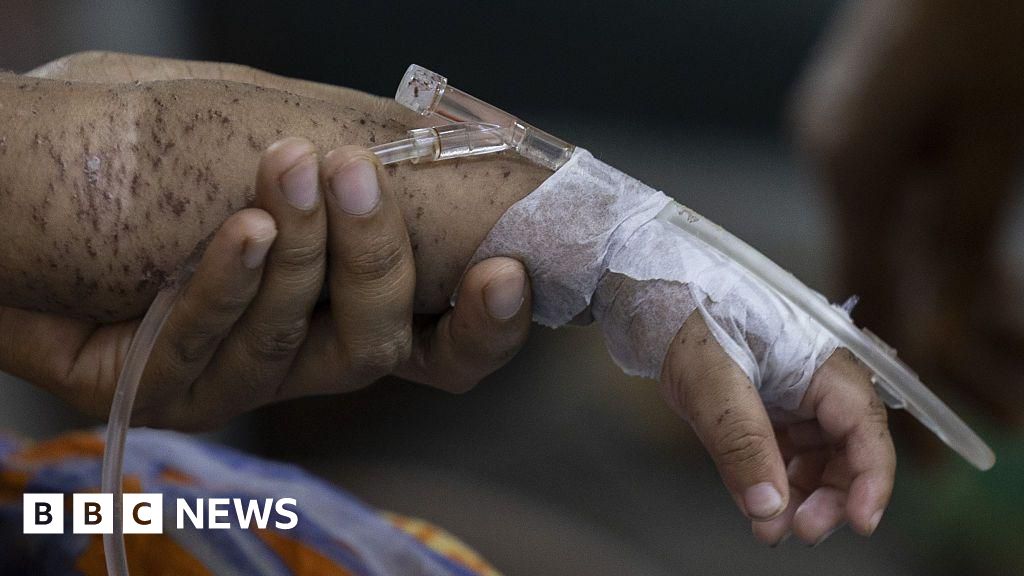
Hundreds of children die within months as measles cases soar in Bangladesh

Published

on

Akira was always a fast learner, her father Al Amin says with pride.

At 6 months she was already saying her first words. At just over 4 years old, she had started to say some words in English.

"She was never short of love from both families. She was the crown of all."

Al Amin, who lives with with his family in the Bangladeshi capital of Dhaka, says his daughter had all her vaccines, apart from measles.

They took her four times to get it; twice she was turned away because she had a cold. "Don't stress," he says the health care worker told them, "the vaccine can be administered up until she reaches 5." The third and fourth time, he says, they were told the vaccine was unavailable.

On 8 March Al Amin took Akira to hospital, suffering with what he thought was a normal fever. She improved, went home, then started developing a rash, a high fever and sores in her mouth. She was discharged and readmitted to hospital a total of five times, Al Amin says; only on the fifth occasion did a doctor tell him she was suffering from measles.

Akira was put on life support. She died 27 days after she was first admitted.

Over 500 children with suspected and confirmed cases of measles have died in Bangladesh since March, according to the country's health ministry.

The health minister said last week that doctors and nurses treating those with the virus have had their Eid holiday leave cancelled and the government has been running a mass vaccination campaign to slow the spread and save lives.

Al Amin says he and his wife still torture themselves, thinking that their daughter may have picked up the virus in the hospital.

"From the ticket counter line to the x-ray room, there was a measles patient everywhere," he says.

He is angry; that his child couldn't get a vaccine, that her symptoms were missed, that he feels the hospitals failed to keep patients with measles apart from others.

In just over two months, the number of suspected cases of measles have reached over 60,000 in Bangladesh, according to the health ministry. The exact number has not been confirmed, as many are waiting for results from the laboratory.

Highly contagious, measles spreads quickly through coughs and sneezes and is particularly dangerous for unvaccinated young children under the age of 5.

There are multiple reports of parents struggling to find space for their sick children in Bangladesh's hospitals.

UNICEF told the BBC that during field visits the hospitals they went to were overwhelmed. They say that their staff are helping to isolate and triage children arriving at hospitals where such measures are lacking.

Where local health clinics can't help, many people are travelling to the cities, hoping the hospitals there will be able to.

"Poor people do not usually come to government hospitals until the last moment, as they have to buy medicine and tests," Dr Mushtaq Husain, former Principal Scientific Officer at the Institute of Epidemiology Disease Control and Research says.

If healthcare were better resourced at a local level, he adds, fewer would need emergency hospitalisation.

"It feels like a bit of a perfect storm," Rana Flowers, Bangladesh country head for UNICEF said during a press conference.

Flowers explained that the agency had identified several factors which increased the risk of infection, including pockets of cases since 2023 where children were missing out on routine vaccination, high population density in certain areas – especially Dhaka or Cox's Bazar – and big population movements for holidays.

But one element in particular has stood out: delays ordering vaccines.

In 2024 Bangladesh's long-term ruler, Sheikh Hassina, fled from the country after mass protests against her rule. An interim government was appointed, and elections were held in February 2026.

UNICEF says that the interim government decided to change the way Bangladesh bought vaccines, which led to delays in placing orders. Flowers said they had 10 separate meetings with the interim government where UNICEF flagged risks associated with delays to vaccine procurement.

"I can tell you I sat with the interim advisor and staff on at least ten occasions," she said. "Saying we are worried, look at my face, I am worried you are going to face an outage."

In a post on social media, Md Sayedur Rahman, former Special Assistant to interim chief advisor for the health ministry, said that "no change was implemented in the vaccine procurement process during the tenure of the interim government".

"A regular and consistent collaborative relationship regarding vaccine matters was maintained with UNICEF," he added.

Others also say that gaps in vaccination which opened during the Covid pandemic were never closed.

"Previously health workers went from door to door to convince parents to get their children vaccinated," Husain says. "But during Covid they were discouraged from doing that to avoid transmission. Some parents were afraid that they could contract Covid if they took their child to hospital to receive the vaccine too."

Bangladesh launched an emergency vaccination campaign at the start of April, assisted by international aid agencies. UNICEF says this has helped numbers start to plateau in some badly affected areas – which were the first to be the focus of the vaccination campaign – and that the number of new infections has declined.

Building immunity from the jab is not immediate, so it will take time for the impact of the vaccine to start to take full effect nationwide.

Bangladesh's Minister of Health and Family Welfare, Sardar  Sakhawat  Hossain, tells the BBC he is expecting the number of infections to start dropping soon.

"It takes three to four weeks after the vaccination to create antibodies in the babies. We expect by next week, Inshallah, it will come down."

Others are concerned about the potential spread during this Eid holiday, as families travel to see friends and relatives.

"Thousands of children will travel with their parents from town to village, village to town," Husain warns. "There will be mixing of children with a fever, with the virus."

Hossain dismissed calls for Bangladesh to declare an emergency, saying district level hospitals are "ready" and are helping to supply ICUs in more remote areas.

"I don't think at all about the emergency," he says. "Bangladesh is able to handle."

Meanwhile, Al Amin still counts the number of days since Akira passed away.

"Today I cried for over an hour beside her graveyard," he says, and points out that he has been prescribed sleeping pills by his doctor.

📰 மூல செய்தி (Source): https://www.bbc.com/news/articles/cwy2d5d7wn5o?at_medium=RSS&at_campaign=rss

முக்கியச் செய்திகள்

Prosecution opens case against ex-DUP leader Sir Jeffrey Donaldson in sex abuse trial

Published

on

The prosecution has begun opening its case against former Democratic Unionist Party (DUP) leader Sir Jeffrey Donaldson on 18 sex abuse charges.

Crown barrister Rosemary Walsh KC told the jury there are two alleged victims who stepped forward two-and-a-half years ago and told police "about difficult and traumatic incidents they say happened when they were children".

Sir Jeffrey, 63, has pleaded not guilty to all charges, including one count of rape.

His wife, Lady Eleanor Donaldson, faces a trial of the facts on five related charges of aiding and abetting, which she has denied.

The Donaldsons were arrested in their County Down home and charged on 28 March 2024.

He resigned as DUP leader the next day and did not contest his Lagan Valley seat in the general election four months later.

He is accused of rape, four counts of gross indecency and 13 counts of indecent assault.

The offences allegedly occurred between 1985 and 2008.

At Newry Crown Court on Wednesday, the Crown barrister outlined a summary of the case she said the court could expect to hear from Complainant B – the eldest of the two women.

She described an incident in which the complainant alleged Sir Jeffrey "put his hands down her underwear".

Rosemary Walsh KC said the complainant recalled that Sir Jeffrey had put his feet between her feet, pulled her legs apart and sexually assaulted her.

The barrister then outlined a second alleged incident in which Sir Jeffrey followed Complainant B into a room, approached her and "lifted her top up and her bra and started to touch her exposed breasts".

The complainant was said to have remembered Sir Jeffrey "putting his hands down her pants a lot".

The court also heard he would touch her breasts under her top.

Walsh said Complainant B later disclosed to individuals linked to a church that she had been sexually abused as a child.

A meeting was facilitated between Sir Jeffrey and Complainant B who described the meeting as "a bit weird and surreal".

The court heard Sir Jeffrey told her he wanted to apologise for what had been done in the past.

The barrister also gave a summary of the account of Complainant A – the younger of the two women.

Walsh said this complainant had alleged Sir Jeffrey would have been physical with her, putting his hands up her top and touching her chest area.

The court heard that the complainant recalled the accused commenting on the size of her breasts.

This complainant was also said to have reported being kissed inappropriately by Sir Jeffrey – by putting his tongue into her mouth.

When she pushed away, the accused was said to have laughed and said it was a joke.

It wasn't until she was older, the court heard, when she realised it was not normal.

Lady Donaldson will face a trial of the facts after being found unfit for a conventional trial under the Mental Health (Northern Ireland) Order.

Under a trial of the facts, she will not participate in proceedings.

The trial will continue on Thursday when the first witness will be called. That is due to be Complainant A.

Her police interview will be shown to the jury beforehand.

📰 மூல செய்தி (Source): https://www.bbc.com/news/articles/cz922zpe3p9o?at_medium=RSS&at_campaign=rss
Continue Reading

முக்கியச் செய்திகள்

How you can save money on your energy bill

Published

on

During a heatwave the last thing you'll be thinking about is your heating and energy bill.

But energy prices will rise in July and analysts predict bills – driven by the increase in the cost of gas – are likely to remain elevated into the winter.

Experts say action now can save money when the pinch comes, even though people may feel they have already made every saving possible.

Some 22 million people – about 40% of billpayers – have the certainty of fixed tariffs.

In these deals, the cost per unit does not change for the term of the tariff, which is usually a year. The total bill still depends on the amount of energy used.

Options on the market are cheaper than the price cap level. However, if international events do change and prices fall sharply, savings might not be so clear-cut.

Receiving your bill every quarter, rather paying a monthly direct debit, is typically about £140 a year more expensive, says regulator Ofgem.

There are still about seven million of these so-called standard credit accounts. Although some people like the quarterly payment of bills, it is a more expensive option.

The record-breaking May heatwave is not necessarily the time you think about getting your home winter-ready.

But experts say it is the perfect time to check if you can do more to block draughts, change cooking habits, bleed radiators and generally be more energy efficient.

Short shower times can also make a difference, albeit small. There are egg timers and even four-minute songs that can keep time for you.

Millions of pounds goes unclaimed in the benefits system. Pension credit, in particular, is underclaimed and yet it can help older people with financial support as a gateway to other benefits.

Grants for energy efficiency improvements may also available through schemes organised by local councils.

Eligibility criteria, such as income and location, varies. Charities such as Citizens Advice can help people see if they can get assistance.

Collectively people owe £4.5bn in unpaid bills and charges.

Suppliers say they may write off some of that debt, provide payment plans, or help with the cost of white goods – but only if you tell them you're in trouble.

You can check what your supplier offers through various support measures.

📰 மூல செய்தி (Source): https://www.bbc.com/news/articles/cwy2e3wx7xwo?at_medium=RSS&at_campaign=rss

Continue Reading

முக்கியச் செய்திகள்

Fifa ordered to explain World Cup ticket pricing

Published

on

The attorneys general of New York and New Jersey have been at loggerheads with Fifa over ticket pricing and transport costs

Fifa must answer questions after allegations of "artificially inflating prices" and "misleading fans" over the sale of tickets for the 2026 World Cup.

It comes as the attorneys general of New York and New Jersey officially launched an investigation into Fifa's practices.

New Jersey attorney general Jennifer Davenport called the process a "gauntlet of confusion, fake scarcity and impossibly high prices".

She added there would be a "thorough investigation of Fifa's conduct" with world football's governing body subpoenaed to provide information.

A subpoena compels a party to release specified internal documents or information.

Davenport made a joint announcement alongside New York attorney general Letitia James and the New York City department of consumer and worker protection (DCWP).

DCWP commissioner Samuel AA Levine said the body would be taking "allegations of blatantly deceptive conduct very seriously" and would look into allegations of "artificially inflating prices".

In particular, Fifa has been asked to explain why tickets have "exceeded the prices for any previous World Cup tournament".

Fans have reported they were "misled" about the location of seats, including through the creation of more expensive 'front' category tickets released after the initial sales.

It is also alleged variable pricing through various phases had allowed Fifa to raise prices for about 90 of the 104 fixtures by an average of 34%.

The investigation will consider how the ticket release schedule and public statements may have impacted prices.

World Cup transport prices cut after fan backlash

Empty rooms and Fifa cancellations – US hotels fear World Cup washout

'I wouldn't pay it' – Trump on USA ticket price

Fifa has regularly talked up the demand for tickets, with Fifa president Gianni Infantino defending the cost by saying they reflect the public's "absolutely crazy" appetite for the summer tournament.

But as of Wednesday, there were face-value tickets available for 86 of the 104 matches and all but 10 of the group-stage matches, for which the fixtures have long been known.

The attorneys general in particular highlighted the cost of tickets for eight matches, including the final, at the MetLife Stadium in New Jersey.

"Being honest about ticket sales is not complicated," Davenport said. "It's an honour to host the World Cup but the event is not an invitation to exploit our residents and visitors."

James said local residents "deserve a fair shot at affordable tickets".

"No-one should be manipulated into paying sky-high prices for seats and fans should be able to trust that the tickets they purchase will be the ones they receive," James added.

Levine said supporters should expect "transparency and fairness" when buying tickets for the World Cup.

"Reports of Fifa conduct in violation of the city's consumer protection law, including misleading fans about seat locations and artificially inflating prices, are deeply troubling," Levine said.

The investigation comes after California attorney general Rob Bonta sent a letter to Fifa, external raising concerns about "potentially misleading ticketing practices" earlier this month.

Local organisers have been at loggerheads with Fifa for the past few months over high costs.

New Jersey governor Mikie Sherrill previously criticised Fifa's refusal to subsidise transport at the event and insisted local taxpayers would not foot the bill.

After initially announcing a train ticket would cost $150 (£111), earlier this month NJ Transit backtracked and reduced the fare to $98 (£73).

Rail journeys from Penn Station in Manhattan to the venue – a distance of about 18 miles – are normally $12.90 (£9.50) for a return fare.

Everything you need to know about the World Cup

📰 மூல செய்தி (Source): https://www.bbc.com/sport/football/articles/c5yrzl46d4ro?at_medium=RSS&at_campaign=rss
Continue Reading

Trending

Copyright © 2024 by 7Tamil Media, All rights reserved.