Connect with us

முக்கியச் செய்திகள்

How Saudi Arabia's spending spree reached the end of the line

Published

on

Autocratic monarchs once left an echo of their glory in the ruins of the megaprojects they commanded at the peak of their unchallenged power. Those monumental physical traces are to be found in the fertile plains, mountainsides and deserts of the Middle East. But one of their most prominent modern counterparts may only have a digital footprint to leave behind for some of his most ambitious concepts.

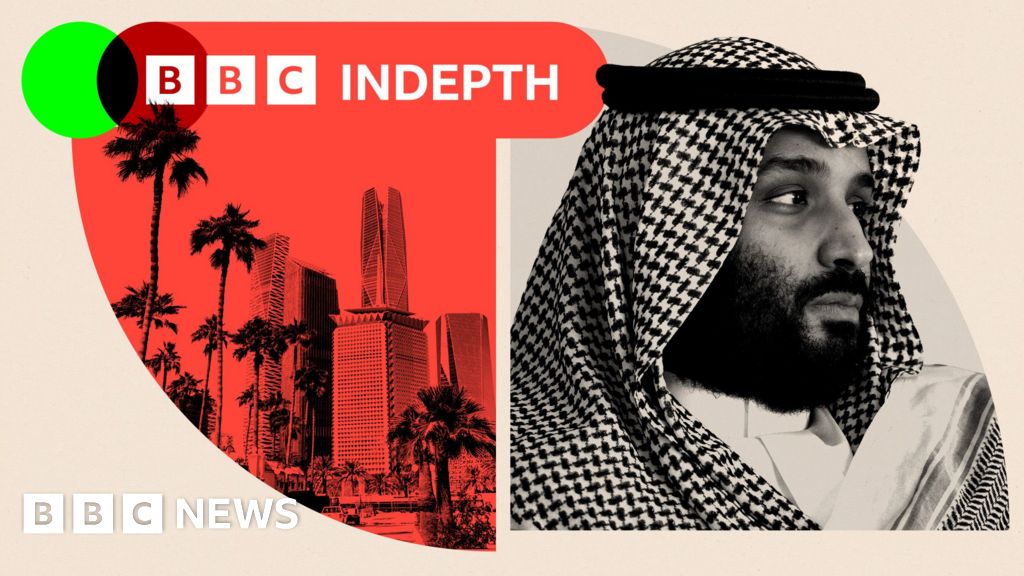
A decade ago, the Crown Prince of Saudi Arabia Mohammed bin Salman – or MBS as he is widely known – decreed a revisioning of his country that leapt from the realm of science fiction. It was called Vision 2030. Extraordinary monolithic structures were to help bring forth new technological marvels not just for the Kingdom but for the world.

Those ideas were made manifest in lavish PR material conjuring up fantastical landscapes that attracted reams of coverage that mingled awe and derision. It was made possible by the near $1trn (£744bn) sovereign wealth fund of Saudi Arabia (PIF) whose riches, so dependent on oil, were to be used to create the foundation for a future without oil.

Four years from 2030, there has now been, perhaps predictably, a retrenchment. Part of that is down to financial imperatives, as a big fall in oil prices before the current war in the Middle East meant that even Saudi Arabia's extraordinary wealth took a hit.

Even though those prices have now shot up because of the war, the uncertainty created by the conflict will continue to put constraints on Saudi revenue and spending. And the influx of foreign investment in these hyper-expensive visionary projects has never materialised to the degree on which the Saudis had been banking.

Some of the most striking projects are now being watered down, put on hold or even abandoned. Several come under the once all-embracing umbrella of the $500bn Neom mega-project.

It looks like The Line, which was meant to redefine the concept of a city as it stretched ramrod straight across more than 100 miles (161km) of untapped land in the north west of Saudi Arabia, looming taller than The Shard, is being turned into something considerably more prosaic.

The winter resort of Trojena in the mountains of the north west has also been reined in. There is snow up there, belying the image of Saudi Arabia as an unyielding desert, but it doesn't last very long. The concept of a year-round mountain resort took the area into a realm of artificiality that is no longer seen as viable. There were to have been miles of ski slopes and a full-on ski village with a man-made lake and luxury hotels and shops – a mini St Moritz in the mountains of Arabia. It was meant to have been ready in time to host the Asian Winter Games in 2029, but that has now been cancelled, with the Games to be held in Kazakhstan instead.

The Cube – a massive structure of flats and offices that could have contained the Empire State Building 20 times over – has been jettisoned entirely. It was set to cost an estimated $50bn.

Most recently, one of the apparent crown jewels of the Kingdom's vaulting ambition to become a world powerhouse of sport from a standing start, the LIV Golf tour, has been reassessed as a hugely expensive dud that's cost some $5bn to date and brought neither a financial nor a reputational return.

Some longtime observers of Saudi Arabia, such as Ellen R Wald, the author of Saudi, Inc., feel like they've seen it all before.

"This is the same playbook, the same thing again with The Line. You know, 'We're going to build this huge thing. Oh wait, well now we're going to significantly downscale it.' And it's the same thing over and over again, and it's been that way even since before Mohammed bin Salman. They make these big announcements, they're very splashy, and then it either doesn't get built or it gets built in a significantly scaled down or [in a] 'not what it was' way."

Wald recalls the new cities that were to be built in the 2000s under a previous monarch, King Abdullah.

The "Economic Cities" programme was also aimed at diversifying the Saudi economy away from oil, which has been a perennial imperative in the Kingdom for decades. Relying almost entirely on one natural resource that will not last for ever has long been seen as an obstacle to the development of a much more well-rounded and resilient economy.

The results were largely underwhelming even as billions of dollars were expended. Several of the proposed cities never got off the ground, others were recast as more modest enterprises. The biggest, the $100bn King Abdullah Economic City on the Red Sea coast north of Jeddah, did come to fruition, but the goal of it becoming a business and tourism hub hasn't materialised.

The hope had been to bring in major new foreign investment and create jobs – real ones, away from the calcified state sector – for Saudi Arabia's large and ever-growing young population. But by 2016, the rate of unemployment still stood at around 12%.

Wald thinks there is a fundamental failure to take a realistic view of the potential of such projects by the officials behind them. "Where did they think the market was? Who told them that this was a possibility? There's a big 'yes man' mentality. You get people telling the king what he wants to hear. And that goes for consultants too, because they want the big contracts. So, they'll say what they think their Saudi clients want to hear – and then these things fall short."

That pattern goes back decades, with foreign companies often not wishing to risk the highly lucrative contracts they've secured by asking questions.

Some believe that when MBS became de facto ruler of the Kingdom in 2017, he inherited a system that badly needed overhauling.

Ghanem Nuseibeh, an economic analyst who's followed the shifts in Saudi Arabia for years, says MBS inherited "a social economic system that was very much out of touch with the modern world" that was "heading towards total stagnation."

Vision 2030 was designed to change Saudi Arabia in three ways: economically, politically, but also socially. "The very, very tricky thing for them was that they needed to implement those in concert."

The social control exerted by the powerful and very conservative Islamic leadership of the country was seen by MBS and his advisors as a major obstacle in the ability of Saudi Arabia to achieve its full economic potential. Political change under MBS was presented as the handing over for the first time of the reins of power to a more dynamic, younger generation. But this did not mean that any new space for political discourse was allowed.

Indeed – as Nuseibeh acknowledges – MBS himself was responsible for some of the issues that have impeded the scope and rate of change – as well as casting a long shadow over his rule.

Just as he became de facto ruler in 2017, he ordered the mass detention of Saudi Arabia's elite officials and businessmen in the Ritz-Carlton hotel in Riyadh, which the Saudi government portrayed as a crackdown on corruption, but others saw as a shakedown. And the savage killing of the Saudi journalist Jamal Khashoggi in the country's consulate in Istanbul in 2018 left a stain on the Crown Prince's reputation, which may have faded but remains indelible.

One Saudi who has direct experience of how the authorities there deal with dissent is Abdullah al-Ouda, an academic and human rights activist based in the US. His father, Salman al-Ouda, a prominent Saudi Islamic scholar, has been detained in prison since 2017 on charges including "stirring up unrest".

Abdullah believes that episodes like the Ritz-Carlton purge have been counterproductive to the aim of funding Vision 2030, even if those held in that gilded cage did cough up an estimated $100bn.

"Long term, it's actually scared away investors, he said. "And all the oppression also affected how investors see Saudi Arabia as a government, as a country, that lacks what investors want, which is predictability. When you have no predictability, you can simply be an in

📰 மூல செய்தி (Source): https://www.bbc.com/news/articles/cx21g0828reo?at_medium=RSS&at_campaign=rss

முக்கியச் செய்திகள்

UK braces for hottest May day on record as 30C heat continues

Published

on

Heatwave conditions were reached in several parts of the UK on Sunday

The UK is likely to experience its hottest May day on record on Monday as searing heat continues.

Temperatures are forecast to reach as high as 34C, breaking the previous May record of 32.8C set more than 80 years ago. The 32.3C recorded at Kew Gardens in south-west London on Sunday was the highest of the year so far, the Met Office said.

It comes as eight regions in southern and eastern England officially entered heatwave conditions on Sunday, after three days at or above the temperature threshold.

Amber heat health alerts are in place in parts of the Midlands and eastern England until at least Wednesday.

Monday is forecast to bring the most widespread heat of the week with all nations set for their hottest day so far this year

Monday and Tuesday are forecast to be the hottest days of the week with temperatures on both days reaching the mid-30s in southern Britain.

However, Monday will bring the most widespread heat with all nations set for their hottest weather so far this year.

Wales could also set a new May heat record in the next few days, surpassing the 30.6C recorded in Newport in 1944.

But it is not just daytime heat records at risk.

It is possible on Monday or Tuesday night that somewhere stays warmer than the May record of 18.9C set in Folkestone in 1947.

What are UV levels and how can you protect yourself?

The hot weather may spark a few thunderstorms in central England and Wales on Tuesday. However, they are likely to be very localised and not enough to cause a significant break from the heat.

On Wednesday, a break in the heat is expected widely across much of eastern and southeastern England. Cooler air will temporarily spread off the North Sea as some locations experience a five to 10-degree drop.

However, Wales and southwestern England will remain fairly hot, sheltered from the North Sea breeze. Highs, here, could still reach 30C.

By Thursday, the supply of cooler air will be cut off as hot air resurges from France once again. This means that temperatures will increase, with 30C back on the cards.

Most weather forecast models show that respite will begin next weekend and more starkly into next week.

The jet stream, to the north of us this week, will wobble back southwards, meaning areas of low pressure, occasional rain, stronger winds, and a drop in temperature as we head into the first week of June.

The heatwave that began early last week across southwestern Europe is consistent with what we would expect in a changing, hotter climate.

Even by mid-summer standards, the current hot spell would be significant – let alone for May.

According to the latest European State of the Climate report, Europe is the fastest warming continent in the world with heatwaves becoming more frequent and more intense.

Since record-keeping began in the UK, there have only been a handful of years when temperatures reached or exceeded 30C in May.

Values in the mid-30s were once uncommon in the British Isles even at the height of summer, yet we are now on course to reach those levels before June has even begun.

Statistically, the UK experiences its highest temperatures at the end of July or the beginning of August, so it's likely we'll see even higher temperatures during the summer.

How to keep cool at your summer festivals

Six ways to keep your home and yourself cool in hot weather

📰 மூல செய்தி (Source): https://www.bbc.com/weather/articles/c794j5zwppno?at_medium=RSS&at_campaign=rss

Continue Reading

முக்கியச் செய்திகள்

Beer boom goes flat as breweries call last orders

Published

on

Walking down the streets of Burton-upon-Trent 30 years ago, Al Wall could smell different aspects of the beer brewing process through the day – but those moments are now few and far between.

He is the head brewer at the oldest and largest independent brewery remaining in the town that once produced a quarter of British beer, with more than 30 breweries at its peak.

These days the brewing scene in Burton is a shadow of its former self, and the town is not alone.

Across the UK 320 businesses shut last year, Companies House data shows. Yet only 170 opened, resulting in a net loss of 150.

In addition, the beer industry estimates that around two pubs closed a day in the first quarter of 2026.

The net loss has continued this year. As of April, the number of UK beer brewing companies fell to 2,320. It peaked at 2,594 in 2022.

Tim Webb, from the Campaign for Real Ale (CAMRA), explained the domination of big brands is one of the main issues.

"The big problem that breweries have got, and it is getting worse, is access to market," he said.

"The problem, which is really happening everywhere across Europe, is large brewery companies owning the draught lines in pubs."

Smaller breweries are also blocked from supermarket sales due to price undercutting.

Webb said some closures are due to the lingering impacts of Covid, but consumer habits are also key.

Less than a decade ago, England's beer businesses were booming. In 2017 alone, 317 breweries were incorporated – more than double last year's figure.

While England still accounts for the vast majority of the UK's beer-brewing businesses, its total has fallen below 2,000 this year for the first time since 2018.

Of the 1,965 remaining, 95 are in the process of administration, insolvency or liquidation.

The South East's oldest brewery, based on the year of incorporation, is Oxfordshire's Hook Norton.

James Clarke is the fifth generation of his family to run the company and has been brewing for over 30 years.

He has seen a large change in "consumption, attitudes and lifestyle".

"Back in the early nineties, we brewed three beers, a mild, a bitter and Old Hooky," he said.

"I think beer consumption in the UK was about double the volume that it is now."

Hook Norton is brewing half the amount of beer it was 15 years ago, but a wider variety, and Clarke believes there is a "small renaissance in the traditional styles of beer".

Webb added: "The part of the beer market that's holding up or growing is the interesting part.

"So you've got heritage beers, craft beers, in some cases very strange wacky new types of beer – those are all doing fine."

"What is slowly but surely contracting, and has been for decades now, is the bright, shiny, frothy top, see-through lager market."

A crucial part of continued success for Hook Norton has been finding ways to diversify.

Clarke said: "We were probably the first with a visitor centre of any scale and we were one of the first with a microbrewery within the main brewery."

Andy Slee, chief executive of the Society of Independent Brewers and Associates (Siba), said many of its members are looking to diversify, with some opening taprooms that allow breweries to serve beer directly to customers.

"In order to survive, you just can't stay doing what you were doing before," he added.

"Although the beer market has been in consistent decline, demand for independent beer is relatively strong."

However, breweries are facing a "suffocating level of taxation" and Siba wants to see a tax reduction on draught beer in pubs.

"When a brewery or a pub dies, something in that community dies," Slee said. "A place to meet, a place of employment, a place that pays local tax."

London is the only English region which didn't see a net loss of companies last year.

In the West Midlands, the home to the former capital of beer brewing, nine companies were started up but 21 were dissolved – a loss of 12.

Back in Burton, Al Wall and Emma Cole, brewery manager at Burton Bridge and Heritage Brewing Company, hope to preserve their history and be a "bastion of independence".

"It is about hope," Cole said. "People see us carrying on and it gives hope that beer isn't going to die in Burton."

The breweries rely on selling beers through its taproom. Cole added: "There's so many pubs we just cannot sell to at all."

She explained that breweries are facing rising costs, from business rates to "astronomical" fuel prices, but the consumer doesn't expect their beer to go up in price.

At its peak, Burton-upon-Trent was home to 30 breweries – now there are just eight according to Camra data .

While a far cry from 30 in a single town, there are still some dense clusters of breweries in the UK.

Triple Point Brewery is one of ten locations within a mile radius in Sheffield.

Co-founder George Brook said: "One of the reasons why I love this city, and also Bristol, both are so much more accepting of independents than anywhere else I have been or lived.

"The culture of drinking local beer is one of the things that makes Sheffield great."

Although the brewery has "grown every year", success has not come easily.

"We just accept that it's going to be harder next year to make the same amount of money as we did the year before," the Brook said.

"I think we would be very tight if we had to rely just on the brewery. If someone came and shut down our taproom tomorrow, we would be in a serious pickle."

But there may be hope on the horizon for independent breweries.

The goverment has recently reviewed the beer market to "determine barriers preventing small breweries from accessing pubs" and launched a £4.3 billion business rates support package.

"We know the vital role independent breweries and pubs play in local communities, supporting jobs and growth across the UK," a spokesperson said.

Additional reporting by Lauren Woodhead and Jonathan Fagg

📰 மூல செய்தி (Source): https://www.bbc.com/news/articles/c9werp5keqlo?at_medium=RSS&at_campaign=rss

Continue Reading

முக்கியச் செய்திகள்

'I live in survival mode': The rise of the multi-job workforce

Published

on

More than a million people in the UK now have second jobs as rising costs, insecure work and industry changes push workers into a growing gig economy.

Billy-Jo Pierce says she is "living in survival mode", juggling multiple jobs to stay afloat in Bristol, the UK's second most expensive city.

She is is one of a growing number of people who have taken on an extra paid role to combat the cost of living crisis and build financial security and flexibility.

Pierce, 29 and originally from Birmingham, says she loves her work but admits that the "burn out is real."

She works 50-60 hours a week running a business decorating customers' teeth with cosmetic gems, while taking on reception shifts, bar work, festival jobs and selling clothes online.

Data from the Office for National Statistics shows roughly 1.3m people in the UK currently have a second job, a slight decline compared to a record high of 1.35m people recorded in 2025.

Pierce's entrepreneurial journey began while studying interior design at university.

Despite graduating with a first-class degree, she struggled to find work in the industry and took a 9-5 gaming job while building her business on the side.

"I'd finish work at like five, six pm and then go straight to my own business and stay there till like 11 pm.

"I was working way too much, I had no social life.

"I felt like I was part of a massive rat race that I wasn't going to win in.

"I was working so hard but I wasn't saving and I wasn't really living."

After being made redundant last year, she decided to focus on her business full-time.

But rising costs and Bristol's high living expenses made it difficult to survive on one income.

Research suggests material costs in the beauty industry have risen by more than 90% over the past decade.

Pierce now lives in a van to cut expenses and works several jobs to support her business.

A typical weekday sees her in the studio from 10:00 to 19:00, followed by reception shifts until as late as 23:00. Weekends are often spent working in bars or festivals.

Despite this, she says she still worries constantly about money.

"Work is a lot and I still feel like I'm not earning a good monthly wage to ever get close to owning a house," she says.

"I feel like it's quite the norm at the moment to work multiple jobs. There's definitely something wrong with what's going on at the moment."

The UK unemployment rate recently increased to 5% while the number of job vacancies has fallen to its lowest level in five years.

At the same time, the gig economy – freelance or contract work rather than permanent employment – has grown significantly.

Just under five million people now take part in gig work- such as food delivery, freelance design, cleaning, dog walking, or selling clothes online – although only a fifth rely on it as their primary income.

When unemployment rises, more people turn to gig work.

For many, especially younger workers, relying on one employer no longer feels secure.

Engy Elboreini, a freelance graphic designer from Bristol, says she has had to diversify her work as the industry changes.

"The last two years have been my worst trading years," she says.

"I've noticed that within the digital design industry, tools like AI and Canva being so accessible to my client base means that they end up doing a lot of the work themselves."

After more than a decade in design, the 35-year-old says AI has "eradicated" much of the demand for traditional design work.

Alongside freelance projects, she now works in creative production and coordination roles and is retraining in events management.

"Whenever there is scarcity, as humans, we find solutions," she said.

"Especially if you're creative – you'll always find solutions."

Still, financial pressure has forced her to cut back on luxuries such as holidays and festival tickets.

"Is this the lifestyle that I want to live? No. But being in Bristol is fun and being embedded in creative circles is more than fulfilling."

For others, the move into multiple jobs is driven by personal circumstances as well as finances.

Hollie, from Bristol, became a single mother and needed flexible work to support her son Max as she survives on a single income. Through a recommendation, she began working as a life model.

"It wasn't something that I ever planned, but when you're in that position, you become open to things you might not have considered before," she said.

The 41-year-old, who also works as a part-time legal assistant and occasionally as a TV extra, says the work allows her to fit employment around school hours.

"I'd rather take my clothes off and stand in a room full of artists than work a minimum wage job where I'm rushed off my feet and can't make ends meet and miss the time with my son," she said.

She says the work has helped her overcome feelings of vulnerability.

"I'm worried a lot of time about money or about my son. But I don't feel that fear naked in a room full of strangers," she said.

Like many gig workers, she says the lack of long-term security creates a "constant pressure."

"I'm always thinking about the next bill, the next job, even though work is coming through, there's no real security," she said.

Despite the instability, she believes changing economic realities are reshaping attitudes towards work and what people are willing to do to get by.

Follow BBC Bristol on Facebook, X and Instagram. Send your story ideas to us on email or via WhatsApp on 0800 313 4630.

📰 மூல செய்தி (Source): https://www.bbc.com/news/articles/c70vwr8z7pyo?at_medium=RSS&at_campaign=rss

Continue Reading

Trending

Copyright © 2024 by 7Tamil Media, All rights reserved.