Under pressure from the US, Mexican President Claudia Sheinbaum has authorised military operations to arrest cartel leaders. But what are the costs?
Monterrey, Mexico – In July 2024, following the arrest of cartel leader Ismael “El Mayo” Zambada in Texas, activist Maria Isabel Cruz and her colleagues started to notice a troubling trend.
Zambada was the cofounder of the Sinaloa Cartel, one of the most powerful criminal networks in Mexico. Authorities in the United States applauded his capture as a "direct strike" in their campaign to dismantle the cartel.
But for Cruz and her fellow activists at Sabuesos Guerreras, a collective that searches for missing people in Culiacan, Sinaloa, it was the start of a gradual rise in disappearances.
On September 9, that trend accelerated. A power struggle broke out within the Sinaloa Cartel, causing a surge in murders, femicides and missing-person reports.
Homicides in Sinaloa rose from 44 in August of that year to 142 in September. The swell of violence continued into the following year. In 2025, 1,657 people were killed.
Meanwhile, Sabuesos Guerreras estimates that the number of disappearances has reached 5,800 since July 2024, though that is likely an undercount.
For Cruz, whose own son disappeared in 2017, the spike in deaths and disappearances raises questions about attacking cartel leadership alone.
“I don’t know if there’s really a strategy," Cruz said. "They're fighting the leaders, but everything at the bottom remains, and it’s the ordinary people who pay the price."
It will be 20 years this December since Mexico declared its "war on drugs", deploying thousands of troops to confront the cartels.
In that time, four successive administrations have struggled to dismantle Mexico's criminal organisations. Nevertheless, the “kingpin strategy” — the targeting and removal of cartel leadership — has remained the most prominent approach.
Critics, however, are sceptical about the long-term effectiveness of the strategy. “What’s the point of fighting the leaders if the roots remain?” Cruz asked.
Bernardo Leon Olea, a former security commissioner in Morelia, Michoacan, argues that the "kingpin" approach leads to fragmentation within the cartels, which then generates more violence, as factions battle for power. He also questioned the benefit for civilians.
“You don’t stop paying extortion. Drugs are still being sold near your home. There’s still crime, corruption," Leon explained. "Because you’re not dismantling the criminal organisation."
Still, Mexico's current president, Claudia Sheinbaum, has continued with the "kingpin strategy", driven largely by pressure from the United States.
Part of the strategy is defensive. Her US counterpart, Donald Trump, has repeatedly threatened to take action if Mexico fails to aggressively confront its cartels.
Already, he has hit Mexican exports with steep tariffs, and he has hinted that he could launch a military assault on Mexican soil to "eradicate" criminal networks.
“We must recognise the epicentre of cartel violence is Mexico,” Trump said in March, adding that "the United States government will do whatever’s necessary to defend our national security".
In response to Trump's pressure, Sheinbaum has extradited nearly 100 suspected cartel members to the US since 2025.
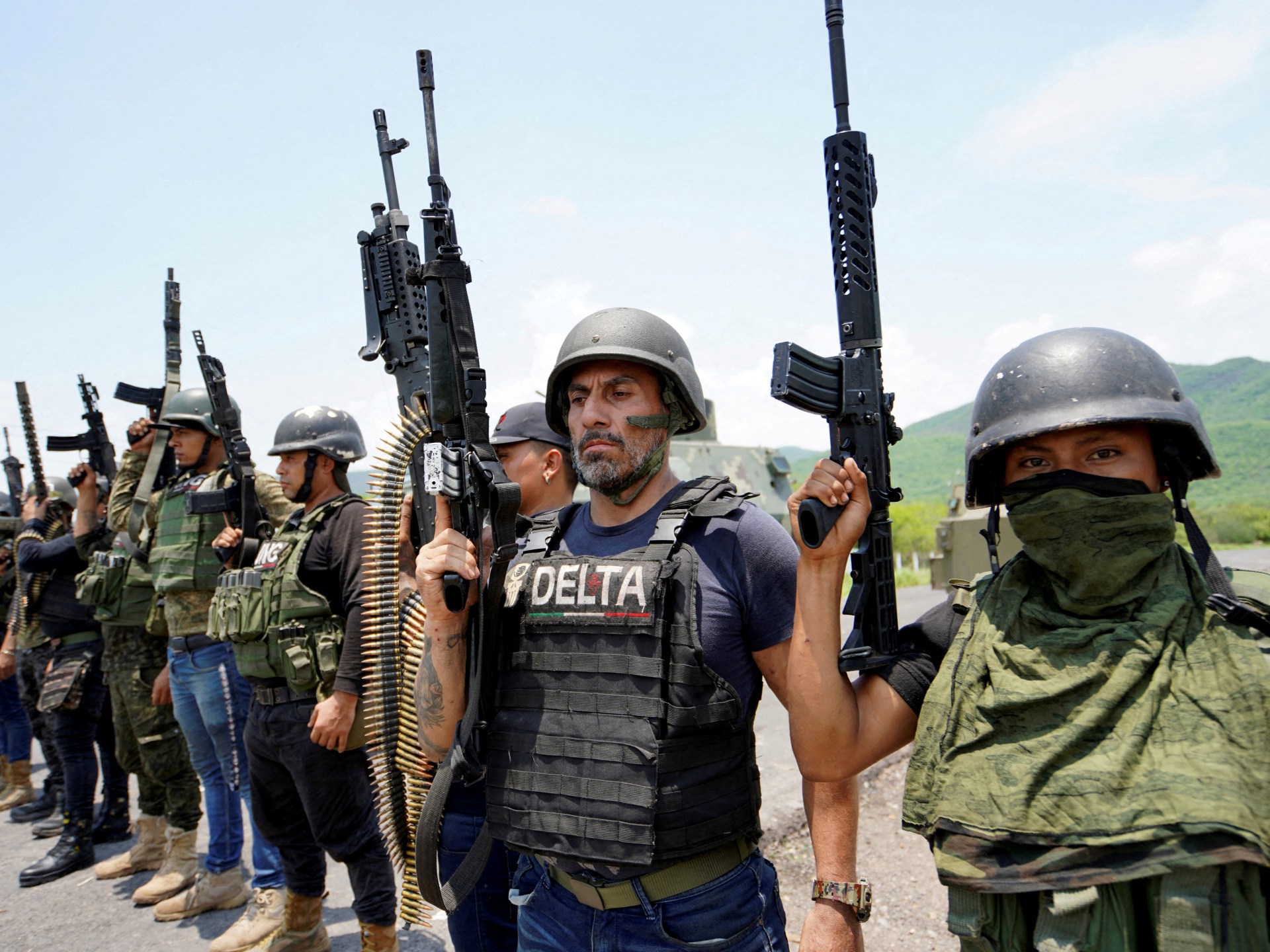
Her government has also launched multiple operations to decapitate cartel leadership over the past year. In February, for instance, the Mexican military killed Nemesio “El Mencho” Oseguera Cervantes, the leader of the Jalisco New Generation Cartel.
“There is a very strong external pressure from the United States, forcing the government to produce results, which may not have a real impact on insecurity,” Leon said. "But they serve to appease the desires of the US."
Still, as with the capture of "El Mayo" Zambada, the death of "El Mencho" sparked a wave of retaliatory violence, as well as cartel infighting.
At least 70 people were killed in the initial outburst. Across the country, more than 250 roadblocks were erected, and violence spread across roughly 20 states.
February's attack on El Mencho was seen by some as a return to a style of direct confrontation with cartels, popularised in 2006.
That was when conservative politician Felipe Calderon was elected to the presidency. Within weeks of taking office, he had deployed 6,500 troops and police officers to his home state of Michoacan to combat organised crime.
At the height of Calderon's "war on drugs", some 96,000 troops were on active duty against cartel violence, drug trafficking and other crimes.
When President Andres Manuel Lopez Obrador took office in 2018, Mexico saw a swing leftwards in its government.
Lopez Obrador initially embraced a "hugs, not bullets" policy in a bid to de-escalate the widespread violence in Mexico.
But over his six-year term, he too intensified the militarisation of Mexico's public security. The military's role expanded to include civilian duties like immigration enforcement, port oversight and infrastructure building.
Still, while military participation in civilian life increased, Lopez Obrador mostly avoided a "direct crackdown on major drug lords", according to Laura Atuesta, an economist who led the drug policy programme at the Center for Research and Teaching in Economics (CIDE).
That appears to have shifted under Sheinbaum, his successor. Atuesta, however, believes that Mexico needs investment in areas outside the military in order to adequately check the cartels.
Criminals have taken power in areas with few government resources, she explained. Without greater education and economic opportunities in those areas, Atuesta argues that populations are left vulnerable to cartel violence and recruitment.
“In that sense, it’s as if we’re forgetting about a large part of Mexico and handing that population over to criminals,” she said.
She added that the "kingpin strategy" also fails to address the market.
Cartels often raise funds through drug trafficking, and Mexico is neighbour to the largest consumer of illicit drugs in the world: the US. One study estimated that the US spent nearly $150bn in 2016 alone on the consumption of illicit drugs.
As long as the market for drugs remains lucrative, criminal operations will continue, Atuesta said.
“We are facing a situation where the illegal market continues to expand and become more lucrative, with numerous criminal groups operating," she said.
"Dismantling or weakening a single criminal group does not yield positive results, and this has happened in Mexico since the drug war strategy was implemented by Felipe Calderon.”
Leon, meanwhile, believes the "kingpin strategy" must be part of a more comprehensive approach that includes strengthening the judicial system and the municipal police with resources and training.
"If we don't have strong municipal police forces, then no matter what we do, neither the National Guard, the Army, nor the Navy will have a real impact," he said. "This is because the origin and the solution to the problem are local."
The violence in Sinaloa has continued to take a heavy toll on civilians, even two years after Zambada's arrest.
Local businesses have shuttered, school classes have been cancelled due to shootouts, and residents have adopted self-imposed curfews. The fighting has also expanded to neighbouring states like Sonora and Durango.
As Sabuesas Guerreras began documenting the rise in disappearances, the organisation also noticed an increase in femicide, the killing of women based on their gender.
The number of femicides in Sinaloa surged from 31 in 2024 to 73 in 2025, a leap of 135 percent.
Sonia Frias, a researcher at the National Autonomous University of Mexico (UNAM), said that criminal organisations frequently use femicides and disappearances to demonstrate control over a particular territory.
She noted that, as criminal networks fragment after the loss of a leader, the new factions that emerge are often more violen
📰 மூல செய்தி (Source): https://www.aljazeera.com/features/longform/2026/4/23/decapitating-cartels-mexico-leans-into-kingpin-strategy-but-at-a-cost?traffic_source=rss


















 உலகம்9 years ago