Connect with us

உலகம்

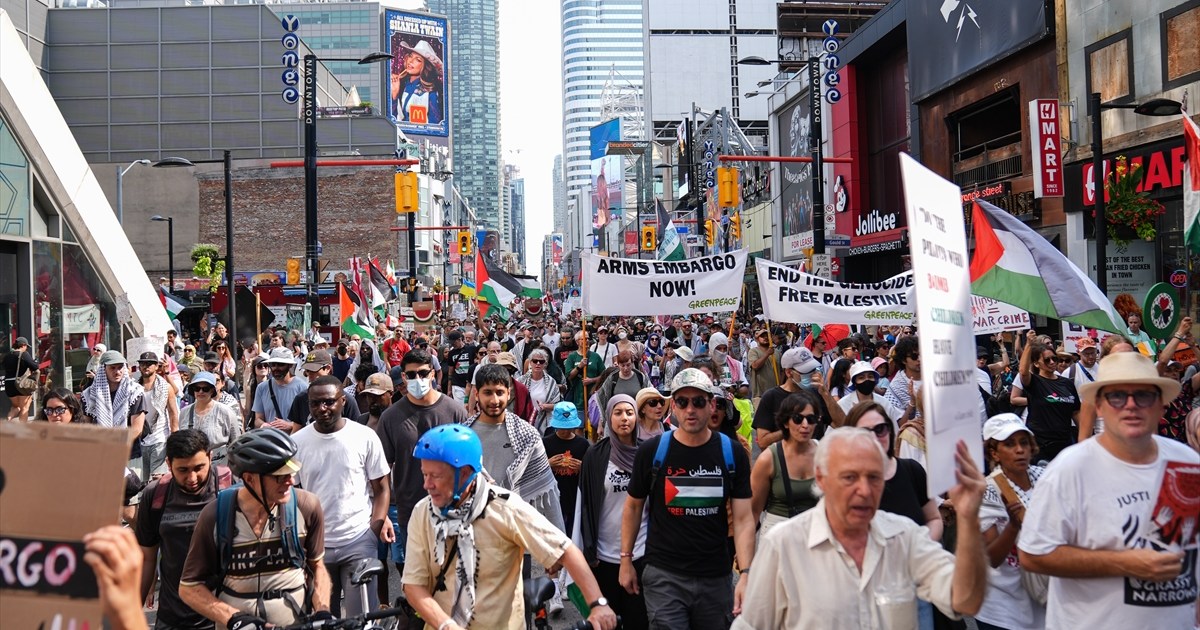
Canada is using its borders to police Palestine solidarity

Published

on

Critics of Israel’s war on Gaza are increasingly facing interrogations, visa revocations and denials of entry.

This past weekend, international scholars and speakers invited to the Muslim Association of Canada’s (MAC) annual convention in Toronto reportedly faced extraordinary immigration scrutiny. MAC said many had their electronic travel authorisations delayed for months or cancelled shortly before departure, while others had visas revoked without notice. Several were reportedly interrogated for hours at Toronto Pearson Airport, denied water and refused a space to pray. MAC described the treatment as “deliberate and coordinated”.

Among those affected was former South African ambassador to the United States Ebrahim Rasool, a veteran of the anti-apartheid struggle who was himself expelled by the Trump administration earlier this year after publicly criticising the MAGA movement. Rasool later told me the Canadian questioning reminded him of apartheid-era interrogations, albeit in a far softer and less openly coercive form. British Muslim commentator Anas Altikriti reportedly spent 11 hours under questioning before ultimately abandoning efforts to enter Canada.

In each case, those targeted had been publicly critical of Israeli policy or involved in Palestine-related advocacy.

These incidents do not stand alone. Earlier this year, French Palestinian member of the European Parliament Rima Hassan was denied entry into Canada ahead of speaking engagements in Montreal because of her outspoken criticism of Israel’s war on Gaza. In November, former United Nations Special Rapporteur Richard Falk and his wife, Hilal Elver, were detained and interrogated for hours at Toronto Pearson Airport before attending the Palestine Tribunal on Canadian Responsibility in Ottawa. Falk later said Canadian officials questioned him extensively about his work on Gaza, his criticism of Israeli policy and his participation in the tribunal. Officials reportedly suggested the couple posed a threat to Canadian national security. Falk later warned that the episode reflected “a climate of governmental insecurity” and an effort “to clamp down on dissident voices”.

At some point, such cases stop looking isolated.

They begin to reveal a political pattern.

When states become insecure about the moral and political consequences of their own alliances, they rarely begin by banning ideas outright. They begin more subtly. They delay visas. They intensify interrogations. They deny entry. They invoke “security concerns” without explanation. They create a climate in which dissent itself becomes suspicious.

That is increasingly what is happening in Canada to critics of Israel and advocates for Palestinian rights.

Canada likes to present itself internationally as a defender of multiculturalism, human rights and liberal democracy. But increasingly, Muslim scholars, Palestine advocates and critics of Israeli policy are encountering a different Canada at its borders: one where political viewpoints appear to trigger heightened scrutiny, where pro-Israel lobbying campaigns seem to shape policy and where criticism of Israel is increasingly treated as adjacent to extremism.

For years, a network of pro-Israel advocacy organisations and lobbying groups has worked aggressively to marginalise Palestine solidarity activism in Canada. Organisations such as HonestReporting Canada, B’nai Brith Canada, the Centre for Israel and Jewish Affairs, the Canadian Antisemitism Education Foundation and various aligned activists and media personalities routinely pressure universities, media outlets, public institutions and governments to cancel speakers, investigate activists and stigmatise criticism of Israel.

In the days leading up to the MAC convention, several of these groups and commentators publicly campaigned against invited speakers, urging venues and authorities to intervene. Similar campaigns preceded the denial of entry to Rima Hassan and the targeting of other Palestine solidarity events across the country.

To be clear, these groups absolutely have the right to advocate for positions they believe in. That is part of democratic life. Governments also have an obligation to prevent genuine hate speech, incitement to violence and legitimate security threats.

But that is precisely why what is happening now is so dangerous.

Because increasingly, the line between legitimate security concerns and ideological policing appears to be collapsing.

The issue is no longer merely whether certain individuals are controversial. The issue is whether state institutions are beginning to absorb and operationalise a political framework in which strong criticism of Israel, solidarity with Palestinians or independent Muslim scholarship become grounds for extraordinary scrutiny.

Across the Western world, governments that present themselves as defenders of liberal democracy are increasingly adopting measures that would once have been condemned as overt political repression. In Germany, Palestine solidarity demonstrations have been banned or heavily restricted. In France, activists and organisations have faced raids and dissolution threats. In the US, universities, lawmakers and lobbying organisations have aggressively targeted students and academics critical of Israel. The weaponisation of immigration law, surveillance powers and institutional pressure against dissenting voices is becoming normalised across much of the West.

Canada is now moving dangerously in the same direction.

The irony is that the state’s response to the MAC convention revealed far more about governmental anxiety than about the convention itself.

I attended. What I encountered was not extremism or radicalisation. It was thousands of ordinary Canadian Muslims, many with young families, attending lectures on spirituality, parenting, mental health, civic engagement, charity and social responsibility. There were political discussions too, naturally. Gaza has become one of the defining moral issues of this generation. But the atmosphere was overwhelmingly reflective, thoughtful and community-oriented.

The online hysteria surrounding the event bore little resemblance to reality.

Ironically, the campaign against the convention appears to have backfired. The gathering was well attended. Several speakers addressed audiences virtually instead. If the objective was to suppress ideas, it only amplified them.

But the deeper damage is not measured by attendance numbers.

It is measured in the growing alienation many Muslims now feel towards institutions that claim to protect equal citizenship while increasingly treating Muslim political expression through a national security lens.

For many Muslims of my generation, this moment feels painfully familiar. In the years after 9/11, Muslim communities across North America experienced surveillance, infiltration, no-fly lists, security certificates, charity investigations and the normalisation of collective suspicion. Entire communities were taught that they belonged conditionally, provided they remained politically quiet and ideologically acceptable.

Canadian Muslims spent decades trying to rebuild trust after those years. Many now fear those same instincts are quietly returning, only this time under the language of combating extremism, protecting social cohesion or fighting anti-Semitism.

Anti-Semitism is real. It is dangerous and must be confronted seriously wherever it appears. But increasingly, accusations of anti-Semitism are also being weaponised to suppress legitimate criticism of Israeli state violence, occupation and apartheid policies. The result is not greater safety for Jews or Palestinians. The result is a shrinking democratic space where criticism of a foreign state increasingly carries professional, institutional and even immigration consequences.

This should alarm everyone, not only Muslims or Palestine advocates.

History repeatedly teaches that extraordinary powers introduced against marginalis

📰 மூல செய்தி (Source): https://www.aljazeera.com/opinions/2026/5/21/canada-is-using-its-borders-to-police-palestine-solidarity?traffic_source=rss

உலகம்

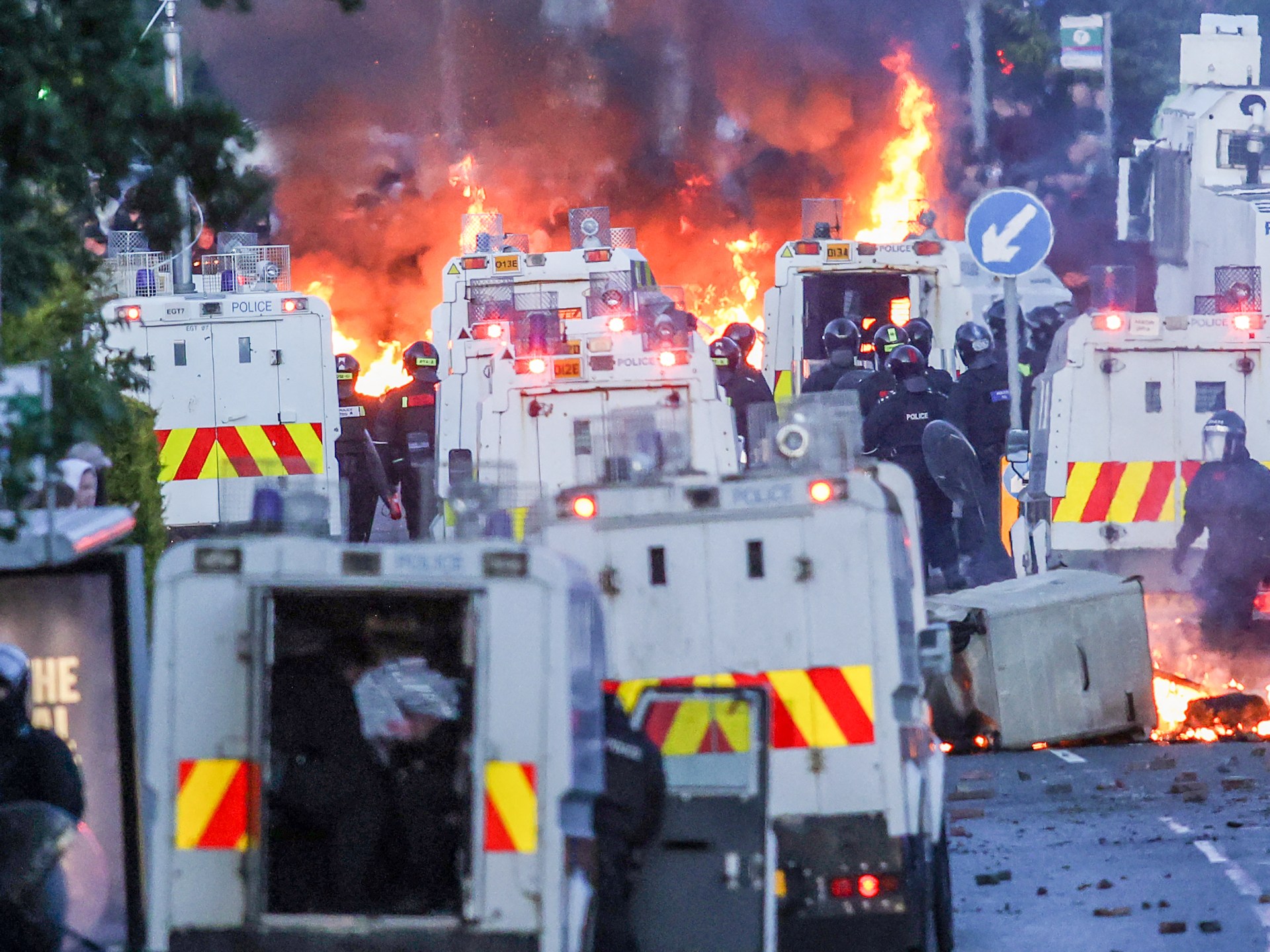
Protesters torch cars, buildings in Belfast after knife attack

Published

on

Unrest comes after a Sudanese man was arrested over a stabbing attack in north Belfast, UK.

Belfast plunged into chaos as vehicles set ablaze following stabbing attack

Anti-immigrant protesters in the city of Belfast in the United Kingdom have torched vehicles and buildings after a Sudanese man was arrested over a knife attack that left one person with serious injuries.

Hundreds of protesters, many of them masked, gathered at several locations across the city on Tuesday, setting fire to a bus and several cars.

A building near the city centre was also set alight, with residents telling the AFP news agency that the protesters started a fire in the bins and went on to throw petrol bombs.

Crowds also gathered in Antrim, about 25km (15 miles) west of Belfast.

Michelle O’Neill, the first minister of Northern Ireland, slammed the protests and urged calm.

“Groups of masked men burning families out of their homes is nothing less than disgusting cowardice,” she wrote on X.

“Racism, intimidation and violence are wrong wherever they occur. There can be no excuse and no justification for these attacks tonight. No one wants to see this on our streets and I again appeal for calm”.

The suspect in the knife attack, which took place in north Belfast late on Monday, was charged late on Tuesday with attempted murder, possession of a bladed weapon in a public place, and making threats to kill.

The 30-year-old man, whose name has not been released, is due to appear in court on Wednesday.

The victim, a man in his 40s, suffered significant injuries to his eyes and slash wounds to his face and back during the attack with a kitchen knife found at the scene, police said.

“I understand that last night’s attempted murder will leave people feeling a range of emotions, from fear to anger,” Northern Ireland’s Assistant Chief Constable Ryan Henderson told ⁠a news conference, as he declared the unrest a “critical incident”.

“I appeal for calm and the safety of all of our communities in ⁠response to this”, he said.

Footage of the knife attack in north Belfast showed several members of the public trying to fight off the ⁠attacker before police arrived, and they were credited by senior officers with saving the man’s life.

UK Prime Minister Keir Starmer called the attack “horrific” and “sickening” on X. “I have absolutely no tolerance for abhorrent scenes of violence like this on our streets,” he said.

His office said that “it is time for calm”, adding: “It’s important that police have the time and space to investigate appropriately.”

The attack, which is ⁠not being treated as terrorism, comes at a time of heightened tensions in the UK following the murder of a student in Southampton who was handcuffed by police as he lay dying from stab wounds after his killer, a Sikh man, had falsely alleged a racist attack.

Although the victim and convicted killer were both British, protesters on Tuesday stood outside a Southampton hotel that had housed asylum seekers, holding signs that read, “Illegal Migration Is Destroying Our Civilisation”.

The attack in Belfast, meanwhile, sparked immediate questions about the suspect’s immigration status, including from some politicians.

Gavin Robinson, the leader of the Democratic Unionist Party, urged authorities to curb “uncontrolled immigration”, while anti-immigration figures, including Reform UK party leader Nigel Farage and Restore Britain leader Rupert Lowe, demanded details about the attacker.

Northern Ireland’s chief constable, Jon Boutcher, told reporters that the suspect was living in the UK on a five-year visa granted in September 2023.

Boutcher said he was believed to have travelled from Sudan to Paris and Dublin before claiming asylum in Belfast.

“There is no trace of this suspect on any of our national security databases, and he was not known to the Police Service of Northern Ireland,” he added.

Northern ‌Ireland’s ‌main political party leaders jointly condemned the knife attack, calling it “horrific” and saying that “there is no place in our society for this kind of brutality”.

They also called for calm, saying that disturbances would only damage their communities.

📰 மூல செய்தி (Source): https://www.aljazeera.com/news/2026/6/10/protesters-torch-cars-buildings-in-belfast-after-knife-attack?traffic_source=rss

Continue Reading

உலகம்

Iran attacks Bahrain, Kuwait, Jordan in retaliation for US strikes

Published

on

Strikes come after US attacked Iranian ports and islands in the Strait of Hormuz over the downing of a helicopter.

Iran’s Islamic Revolutionary Guard Corps (IRGC) has claimed attacks on United States military bases in Bahrain, Kuwait and Jordan in retaliation for US strikes on Iranian ports and islands in the Strait of Hormuz.

In a statement carried by state media on Wednesday, the IRGC said it launched drone attacks on the US Fifth Fleet in Bahrain and the Ali Al Salem airbase in Kuwait, as well as a long-range missile strike on an airbase in Azraq, Jordan.

It said it attacked 21 US targets and destroyed four of them, including an F-35 fighter jet hangar at the base in Jordan.

It also claimed to have shot down a US MQ-9 drone in the skies over the Iranian city of Jam.

The latest flare-up comes after the US military attacked Qeshm Island and ports along the Iranian coast in the Strait of Hormuz after blaming Iran for downing a US Apache helicopter earlier on Tuesday.

The IRGC said the US’s attacks had caused damage to a telecommunications tower in the town of Sirik and destroyed two water tanks there.

It warned that its forces remain fully prepared to deliver a “crushing and decisive” response to any US military actions and that Washington would bear full responsibility for the consequences of further escalation.

There was no immediate comment from the US.

In Jordan, the military said it intercepted and shot down five missiles launched from Iran towards Azraq, adding that the operation “resulted in the fall of shrapnel without any human injuries or material damage”.

The attacks prompted air raid alarms in Bahrain and Kuwait.

The Kuwaiti military said earlier that it was intercepting “hostile aerial targets” in the country’s airspace, without elaborating further.

Trita Parsi, executive vice president of the Quincy Institute for Responsible Statecraft in the US, said Iran’s swift response to Washington’s attacks signalled a new doctrine.

“They believe they have to respond proportionately, but very harshly and swiftly, against any American attack. Because otherwise, a new normal is established, one in which the United States can strike at Iran with more or less impunity,” he said.

The Iranians, he said, were making clear that any attack on them would be responded to, regardless of the size and the scope.

“But at the end of the day, every time these different types of events have occurred, the sense I have gotten from both sides is that their confidence and their trust in the ability of reaching a deal is starting to diminish,” he added.

This new round of strikes came a day after Iran and Israel exchanged fire in their most serious escalation since a ceasefire took effect in April. The war began with US and Israeli strikes on Iran on February 28, and has shaken the global economy and driven up the cost of fuel and food.

Progress towards a peace deal remains slow, complicated further by Israel’s intensifying campaign in Lebanon against the Iranian-backed Hezbollah.

Al Jazeera’s Mohamed Vall, reporting from Tehran, said that despite the latest strikes, neither side wanted a return to full-scale war.

“Whether the Americans are going to absorb this latest retaliation from the Iranians and end their operation or whether there will be new attacks will become clear in the next few hours,” he said.

“But the understanding is that both sides would like to go back to negotiations, even though the Iranians say they don’t trust any American initiative with regards to peace.”

📰 மூல செய்தி (Source): https://www.aljazeera.com/news/2026/6/10/iran-strikes-bahrain-and-jordan-in-retaliation-for-us-attacks-in-hormuz?traffic_source=rss

Continue Reading

உலகம்

Bolivia approves military measures against nationwide protests

Published

on

Bolivia approves military measures against nationwide protests

Bolivian President Rodrigo Paz has authorised military force against protesters amid the country’s worst economic crisis in 40 years, after roadblocks paralysed the nation. At least 10 people have been killed since the unrest began.

📰 மூல செய்தி (Source): https://www.aljazeera.com/video/newsfeed/2026/6/10/bolivia-approves-military-measures-against-nationwide-protests?traffic_source=rss

Continue Reading

Trending

Copyright © 2024 by 7Tamil Media, All rights reserved.