Connect with us

முக்கியச் செய்திகள்

Cake sheds are making bakers £1,000 a week – but the dream might be over

Published

on

Cake sheds are becoming something of a Great British tradition.

You may have noticed one pop up near you. These small, cupboard-like "sheds" are usually jam-packed with home-baked goods that you help yourself to, and for which you are trusted to pay through an honesty box system.

Packed with cookies, brownies, old-school sprinkle cakes or lemon drizzle, they are usually found in front gardens, on driveways or by the roadside.

For some, the sheds are a side-hustle, while for others they're a booming business opportunity. But as the movement grows the sheds are coming under increasing scrutiny from some council officials.

"They are definitely becoming a feature in our landscape and are spreading from the countryside to the urban environment," says Bronya Seifert of Daisy Cake Company. "It's wonderful."

But the sweet trend could be under threat in some parts of the country, as some councils are considering enforcing tighter licensing rules.

Some dedicated cake shedders say if this happens they could be forced to close down.

One cake shed community online said it was getting up to 400 new members on Facebook a week.

"Over the past few months the group has grown exponentially," says Susanne Niess, of That's Cake by Susanne.

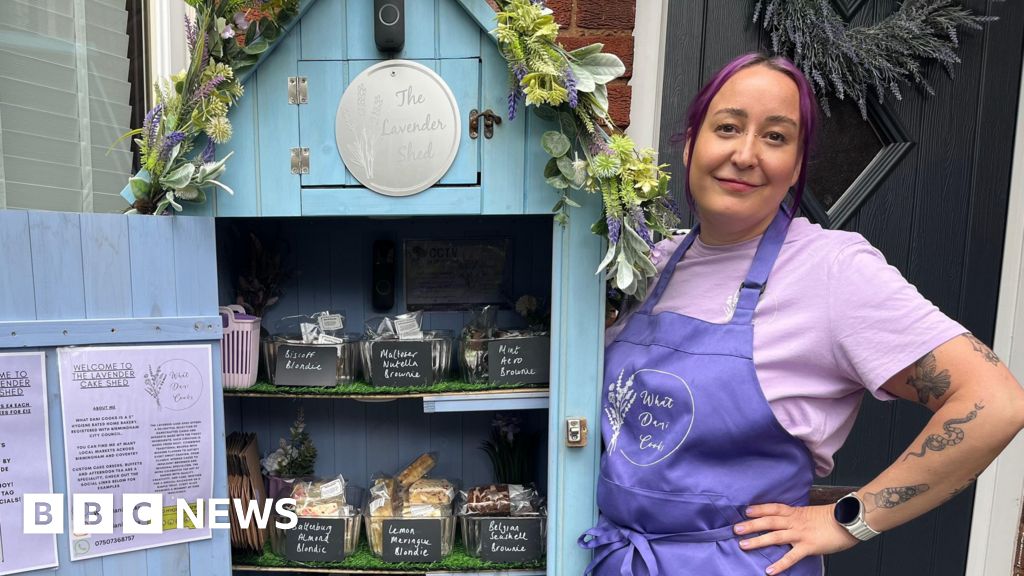
Danielle Edgington set up her cake shed in Kings Heath, Birmingham, eight months ago and it's proved so popular she has quit her job as a catering manager to work on it full time.

Before that she'd been selling her baked goods at markets, having launched a business during the Covid pandemic delivering afternoon teas and birthday cakes. She set up the shed to sell any spares.

"It's taken over my life," said the 41-year-old, who has been a chef for 20 years.

"I'd get up, I'd go to work in the morning and then I'd come home. I'd be baking all evening. So it just became too much.

"I've just not been able to keep up with the demand so I've decided to go full-time."

The Lavender Cake Shed now brings in between £500 to £1,000 a week, with customers flocking from neighbouring towns like Redditch and Solihull to Danielle's quiet suburban road to sample her goods.

Demand is so high, the shed is open seven days a week from 09:00-21:00 BST – and Danielle credits much of the interest to her TikTok account.

"I've got quite a big social media presence. I'll get messages off customers saying 'What have you got in the shed today? Because we are travelling from a bit further out.'

"To see a queue out there is just unbelievable. It's quite humbling really to see."

Mother-of-two Charley Coleman-Pollard opened her cake shed a year ago as an extension to her baking business, which she has been operating for eight years.

The response in her village in Castlethorpe, Milton Keynes, has been huge.

"They think it's amazing. It's their weekly goodies and they are supporting a local business as well," the 28-year-old said.

"I don't like doing the prices too high or too low, all my profit has gone back into the shed. So I've not actually got anything out of it myself."

Her Something Different's Cake Shed is open on Friday and Saturdays, which gives her flexibility with childcare – a common theme with many women running cake sheds.

"A lot of mums are doing it as a full-time job," Charley said. "They're just popping up absolutely everywhere. There's hundreds around the country now."

But red tape is now threatening the future of many bakers' culinary creations as some councils in England are reviewing their street trading policies, and questioning whether cake sheds should require a licence.

Street trading is regulated under the Local Government (Miscellaneous Provisions) Act, which states if you want to sell or offer for sale anything in a street, you must have a street trading licence or street trading consent.

In Nottinghamshire, council officials have even suggested they should receive a slice of any money being made.

Earlier this month, several cake shed owners in the area were told they must fork out more than £1,000 on a street trading licence or face a fine of a similar amount.

Heather Price, of The Retford Bakeshed, was one of eight owners to receive the letter from Bassettlaw District Council.

"A licensing enforcement officer arrived and hand delivered a notice to say I needed a street trading license," Heather said. "I was flabbergasted."

Following a backlash from the community, the local authority pressed pause on the enforcement action while it reviewed its policy.

At a council meeting earlier this week, no decision was reached on how to move forward and further consideration on its street trading policy was requested.

A spokesperson said as a concensus could not be reached on the council's approach, enforcement would continue to be paused and a further report would be prepared.

In the meantime, Heather continues to run her shed in tandem with doing her full-time job.

She has all the necessary paperwork to sell her cakes and gets a buzz from her customers who buy from her once a week.

She said choosing a cake had become something of a weekend ritual for many in her local community.

"We have a little camera inside, you see a little happy dance," Heather said. "They're opening the doors with glee to see what there is this week.

"I've just had lots of support, lots of happy smiles."

She said it would not be viable for her to continue if she was required to get a street trading licence due to the extra costs involved.

"Those extra requirements in themselves are too expensive to make it worthwhile," she said.

"I love baking. I love making things for people. It was a good way of sharing my baking with the community."

Meanwhile, Danielle – who had already registered her business with her local authority and holds a level three food safety and hygiene certificate – is seeking clarification on whether she might be required to have a street trading licence in the future.

"I have contacted Birmingham's council," she said. "I haven't heard back yet.

"The cost can be anything from £1,000 to £3,000, so for some of the smaller sheds, perhaps that wouldn't be viable for them.

"Because mine's quite popular, if it's around £1,000, then I probably would still pay for the street trading licence."

For now, the expiry date on the cake shed community across the country, remains to be seen.

Listen to BBC Radio Nottingham on Sounds and follow BBC Nottingham on Facebook, on X, or on Instagram. Send your story ideas to eastmidsnews@bbc.co.uk or via WhatsApp on 0808 100 2210.

📰 மூல செய்தி (Source): https://www.bbc.com/news/articles/crlpwd2prd0o?at_medium=RSS&at_campaign=rss

முக்கியச் செய்திகள்

Zelensky criticises 'vile' Chornobyl drone strike ahead of London talks

Published

on

UK Prime Minister Sir Keir Starmer will host Volodymyr Zelensky in Downing Street later on Sunday, alongside French President Emmanuel Macron and German Chancellor Friedrich Merz, for talks on European support for Ukraine.

Ahead of the meeting, Kyiv officials said a Russian drone had hit a storage facility for spent nuclear fuel near the Chornobyl nuclear plant in the north of Ukraine.

They said a fire was put out and there were no injuries, with officials adding that radiation levels remained stable. Zelensky labelled it a deliberate and "vile Russian strike".

Separately, at least three people were killed in a Russian strike in a village outside Zaporizhzhia in the south-east of the country, authorities said.

Zaporizhzhia has come under relentless Russian attacks recently, with at least two people killed there on Saturday.

The Russian strike on Chornobyl "partially destroyed" a spent nuclear fuel storage building, according to Ukraine's state-owned nuclear operator, Enerhoatom.

The operator said there were no injuries, and a fire in the building was put out, adding that radiation remained at a normal level.

The body also criticised Moscow for what it called a deliberate threat to nuclear safety, in words echoed by Zelensky.

"Russia deliberately struck this particular nuclear infrastructure facility," Zelensky said in a post on X, describing the building as an "as extremely critical infrastructure facility" and the attack as "vile".

He went on to detail Russian overnight strikes in 13 regions, adding that Moscow had launched 88 missiles, more than 3,250 drones and 1,800 guided bombs over the past week.

On Saturday, Ukraine targeted St Petersburg and the surrounding area as the city hosted the final day of a major economic forum, in a drone attack described as "unprecedented" by Russian authorities.

Days earlier, Kyiv had attacked the outskirts of the same city – some 1,000km (620 miles) from Ukraine – as Russian President Vladimir Putin's flagship forum was getting started, sending a large plume of black smoke over the city's skyline.

In the four years since Moscow's invasion began, Ukraine has developed its defence sector, with Kyiv now able to regularly hit targets within Russia.

The three Western powers represented at Downing Street – the so-called E3 group – are some of Kyiv's strongest allies. The UK and France lead the "coalition of the willing" initiative to provide security guarantees for Ukraine as part of a future potential peace process.

The group had previously convened in London in December, at a time when the US was pushing hard for Moscow and Kyiv to sign up quickly to a plan to end the war in Ukraine.

Since then US efforts to mediate a truce have petered out, and Washington's focus has shifted to the Iran war.

On Friday, Putin rejected a proposal by Zelensky for face-to-face talks on ending the war, saying he did not see any point in meeting the Ukrainian leader.

Zelensky sent an open letter calling for a direct negotiations, writing that it would be "wrong to simply wait" for the conflict to once again become the focus of US attention.

Speaking at the economic forum on Friday, Putin refused the request for a meeting with Zelensky and reiterated his position that a truce would only allow Ukraine to regroup.

He said he would only end the war when Russia's goals had been met.

📰 மூல செய்தி (Source): https://www.bbc.com/news/articles/cr7xr1g3nvvo?at_medium=RSS&at_campaign=rss

Continue Reading

முக்கியச் செய்திகள்

England begin Ashes rebuild with win over New Zealand in first Test

Published

on

Highlights: Atkinson bowls England to 115-run victory over NZ

First Rothesay Test, Lord's (day four of five)

England 140 (Brook 56; Jamieson 5-62) & 226 (Gay 57; N Smith 6-70)

New Zealand 113 (Jamieson 38*; Robinson 5-39,) & 138 (Phillips 44*; Atkinson 5-30)

England won by 115 runs, lead three-match series 1-0

England took less than a session on the fourth day of the first Test against New Zealand to begin their post-Ashes rebuild with a much-needed victory.

In their first Test since their 4-1 defeat in Australia, England exploited the devilishly difficult batting conditions on a poor Lord's pitch to beat the tourists by 115 runs and take a 1-0 lead in the three-match series.

From 55-5 overnight in their chase of 254, New Zealand's disappointing week was complete when they were hustled out for 138, thanks chiefly to Gus Atkinson's 5-30.

After Saturday's third day was almost entirely lost to rain, England required only seven deliveries on an overcast Sunday to resume their wicket-taking -Josh Tongue getting one to skid into the prone pads of Tom Blundell.

With the ball moving up and down, and side to side, Glenn Phillips began an overdue New Zealand counter-attack.

Phillips and Devon Conway added 53 for the seventh wicket, helped by Harry Brook putting down Conway at second slip.

But after England captain Ben Stokes induced a miscue from Conway, the end came quickly.

Nathan Smith edged behind, Kyle Jamieson clipped to mid-wicket and last man Matt Henry was bowled, all by Atkinson, giving the Surrey man yet another place on the Lord's honours board.

The rapid, seam-dominated nature of this match followed a recent trend of matches involving England. Two of the Ashes Tests were done in two days, while this was the first Test in this country without a single delivery of spin bowled by either team since 1988.

The hope is the surface for the second Test at The Oval, beginning on 17 June, produces a more satisfactory contest.

'Comebacks don't get much better' – first Test ratings

England beat Black Caps in bowler's paradise at Lord's

England pick up five wickets before lunch on day four for victory over NZ

The 150th Test at Lord's was a poor spectacle because of the pitch. New Zealand were also uncharacteristically sloppy, missing five chances in the field.

England will not care. After the dismal winter, the retained management structure needed any sort of victory to begin to justify the faith that has been shown in them.

Before this match, Stokes said only the result mattered and now England have the opportunity to win the series at The Oval.

Has much been learned in this match? Seamer Ollie Robinson was outstanding on his return to Test cricket, though his skills were never in doubt – particularly in conditions such as these. His challenge is now to prove his durability.

Debutant opener Emilio Gay looked to have the temperament for Test cricket and his second-innings 57 was the highest individual score of the match. The Durham man will be asked to kick on and make the place his own.

Beyond that, the chaotic nature of this match made it hard to draw conclusions. It was concluded in 166 overs – the third-shortest in history where all 40 wickets have fallen.

England have previously thrived in anarchy – their only win in Australia came in two days of pandemonium in Melbourne. Can they now find the technique, resolve and patience to prevail when a more conventional style of Test cricket is required?

Lord's pitch does not benefit Test format – Stokes

Atkinson bowls Henry to seal England victory

Robinson took two important wickets in the 9.4 overs that were possible on Saturday and it was Tongue who struck in the first full over of Sunday. Pinned to the crease, Blundell did not bother with a review.

Robinson and Tongue might have thought of bowling unchanged until England's job was finished, and may have done had Brook not parried Conway's poke off Tongue. England's first fielding blemish of the match gave Conway a life on 24.

Stokes introduced himself and Atkinson, who troubled Phillips with the ball spitting off a length. Just as New Zealand's momentum was building, Stokes found the breakthrough.

The captain reinforced his leg-side catchers to Conway, on 41. From round the wicket, Stokes targeted the pads of the left-hander, whose leading edge was well caught millimetres off the turf by Jacob Bethell at gully.

In the next over, Nathan Smith tickled Atkinson into the gloves of Jamie Smith – the England wicketkeeper has had an encouraging week after a disappointing Ashes.

Atkinson is another who underwhelmed in Australia, yet he is at home at Lord's. In three Tests on this ground, Atkinson's 26 wickets have come at average of 9.5, including four five-wicket hauls and a 10-wicket haul to go with a century.

Tongue gets an early breakthrough as Blundell goes for four

With England vulnerable following the Ashes, New Zealand appeared to be dangerous opponents, only for the Black Caps to be well below their best.

They were hampered by a back injury to key bowler Henry and severely harmed their cause with the dropped chances in the field- vital in a low-scoring game.

New Zealand were also passive with the bat. With run-scoring so difficult, the best approach looked to be to attack the bowling, yet only Phillips and Jamieson seemed willing to be aggressive.

In the past 12 years, the Black Caps are the sole visiting team to win a Test series in this country – a 1-0 triumph in 2021.

Now, New Zealand have lost seven of their past nine Tests against England, all since Kiwi Brendon McCullum took charge of England.

Bethell takes a good low catch to end Conway's resistance

Get cricket news sent straight to your phone

📰 மூல செய்தி (Source): https://www.bbc.com/sport/cricket/articles/cx2k818rdkgo?at_medium=RSS&at_campaign=rss

Continue Reading

முக்கியச் செய்திகள்

M&S launches new traineeship for 1,000 young people

Published

on

Marks and Spencer is launching a new training scheme for young people trying to get on the career ladder in a bid to tackle the "growing youth unemployment challenge".

Aimed at 16 to 24-year olds, it will create 1,000 training places in the UK and Ireland over the next 18 months.

M&S said the paid scheme was intended to help tackle the rising number of young people not in employment, education or training – so-called "Neets".

The latest official figures show more than a million young people are Neets – the highest level in more than 12 years and equating to roughly one in eight young people.

Last month, a key review warned one in six will be Neet in five years if action is not taken.

The review found job and career opportunities for those hoping to enter employment were "not growing, they're shrinking". Its author, former minister Alan Milburn, warned of a potential "lost generation".

It said there was no one single factor causing the crisis, citing the Covid-19 pandemic, smartphones, health issues and the current jobs market, which has seen a sharp drop in the number of entry-level positions.

High Street retailers and hospitality businesses such as restaurants, cafes and pubs often offer the first experience of work for many.

M&S said its new scheme will provide six months of training, with successful participants then receiving further training to become a store manager.

People do not need a degree to be eligible.

Retail director Thinus Keeve said: "We want more young people to see retail not just as a first job, but as a career with real opportunity, real responsibility and real progression…

"This programme is about opening doors for the next generation and giving talented young people the chance to thrive."

It comes as the government announced a partnership with industry and trade unions examining how artificial intelligence (AI) was affecting entry-level roles.

It will look at how entry-level jobs are changing and give businesses advice on how to redesign roles while maintaining routes into the workforce.

The government said 400,000  students in disadvantaged schools in the UK will get AI and tech training to help them into further education, training and employment.

Last year, Chancellor Rachel Reeves announced that young people who had been out of a job or education for 18 months will be offered a guaranteed paid work placement to help them prepare for a full-time job.

📰 மூல செய்தி (Source): https://www.bbc.com/news/articles/cr7xr3dvxp9o?at_medium=RSS&at_campaign=rss

Continue Reading

Trending

Copyright © 2024 by 7Tamil Media, All rights reserved.